
Hand reconstruction cost begins with the assessed surgical task and the related care it actually requires. Ask for professional, facility, anesthesia and other relevant estimates, then identify any separately specified device or follow-up service. A low device headline can exclude adjustments that another written package includes. This guide provides an original hypothetical worksheet showing how a device package and a per-adjustment arrangement compare under different explicitly stated quantities, without predicting your clinical needs.
No verified national complete hand reconstruction average is supplied here. Trauma, congenital differences and other hand conditions can involve different assessed tasks and care. The dollar figures and adjustment counts below are invented planning inputs, not typical prices, prescribed appointments or a recommendation to choose a device. Follow the treating team’s instructions; a financial package must never decide how your hand should be supported, moved or rehabilitated.
What does hand reconstruction cost include?
The American Society of Plastic Surgeons describes hand surgery as addressing different problems involving hand and finger function, including trauma and congenital abnormalities. The breadth of that scope explains why one operation label cannot establish a complete price. Begin by recording the actual task proposed after assessment, the area involved and the related care already identified. Keep possible future work separate from the current plan so a contingency does not become an assumed mandatory charge.
ASPS cost guidance lists professional, facility, anesthesia, medication, garment and testing categories. It also describes coverage as something to confirm with the insurer, rather than a universal payment promise. The general category list does not establish which items are separately billed in your case. Request the applicable estimates and inclusion statements from the actual billing organizations. A category mentioned in guidance should not be added to a package again if the package already includes it.
Describe the proposed operation in the team’s terms when requesting financial information. An estimate for a limited hand procedure is not automatically an estimate for a more extensive reconstruction or its complete related course. If two proposals have different scopes, label their differences before comparing totals. The worksheet organizes financial assumptions; it cannot determine the clinical appropriateness of one approach or establish equivalent function from a lower price.
Why hand reconstruction cost needs an item and service distinction
If the team specifies a device, ask whether the quoted amount includes the device itself, initial fitting, later adjustments or separately delivered therapy. These are different possible financial components. A physical item and the professional services around it may have different inclusion statements. Obtain the actual terms instead of assuming that every product purchase includes ongoing clinical care, or that every adjustment creates a new device charge.
The MedlinePlus hand-fracture aftercare resource describes splint-related care and directs patients to follow their provider’s instructions. Its scope is hand fractures, not all reconstructions. It supports keeping individual instructions separate from a generic financial comparison; it does not prescribe a device or adjustment schedule for this guide. No wearing duration, movement advice or home modification technique is supplied here. Those details require the treating team’s actual direction.
An adjustment count in the model is an accounting assumption only. A clinician may determine different needs, and a billed service may use a different definition from the word adjustment. Ask what the financial agreement includes and how it describes any separate charge. Do not skip a necessary appointment or try to alter a device yourself because the spreadsheet shows an added amount. Clinical safety and the assessed course remain separate from fee comparison.
Which hand reconstruction cost payment basis applies?
A device cash package is not automatically the basis for an insured claim. If insurance applies, obtain the relevant benefit and responsibility information for the actual specified item and services. A professional surgery approval does not necessarily resolve every separately billed component. Record what has been confirmed, which financial denominator is used and what remains unresolved. Do not subtract an anticipated benefit unless its scope and terms are actually established. For organizing a coverage decision and appeal record, see plastic surgery insurance appeals.
Keep submitted charges, applicable allowances and patient responsibility in separate columns. If a billing organization supplies only one of these, ask what the number represents. An insurer’s arrangement can create a different calculation from a displayed retail amount, and a general statement about reconstructive coverage cannot establish an individual’s final balance. Obtain a dated estimate rather than applying the hypothetical package arithmetic to every payment setting.
For a self-pay comparison, obtain the actual inclusion statement and any adjustment terms in writing. Ask whether the package includes a specified maximum quantity, a defined period or named services only. These boundaries determine what can be compared fairly. A label such as follow-up included does not automatically answer whether it applies to the particular device-related service under discussion, or whether another organization bills it separately.
| Component | Financial detail to record | Keep separate |
|---|---|---|
| Assessed surgery | Actual task, billers and inclusion statement | Possible future reconstruction |
| Specified device | Item and initial fitting boundaries | Professional services not included |
| Adjustments | Actual service definition, rate and package limit | A forecast of clinical appointment needs |
| Therapy | Separately prescribed and estimated services | Device-only adjustment charges |
| Payment basis | Cash terms or confirmed benefit calculation | Submitted amount presented as personal responsibility |
Original hand reconstruction cost worksheet: an adjustment package
Assume an invented device arrangement A costs $250 and includes the initial fitting. Each subsequently indicated adjustment is separately priced at $85 under the hypothetical terms. Arrangement B costs $350 and includes the initial fitting plus up to three named adjustment services during its specified period. For the model only, assume both arrangements cover the same assessed item and the same service definition. That clinical and financial match must be confirmed before comparing actual proposals.
At zero subsequent adjustments, arrangement A costs $250 and B costs $350. At one, A costs $335 and B remains $350. At two, A becomes $420 while B remains $350. At three, A becomes $505 and B remains $350. These quantities are sensitivity inputs, not predictions of the necessary course. The package appears lower only at specified quantities and within its inclusion boundaries; purchasing included capacity does not mean using it is clinically indicated.
| Hypothetical subsequent adjustment quantity | Per-adjustment arrangement A | Package arrangement B |
|---|---|---|
| 0 | $250 | $350 |
| 1 | $335 | $350 |
| 2 | $420 | $350 |
| 3 | $505 | $350 |
| Basis | $250 plus $85 per named adjustment | $350 includes up to three under stated terms |
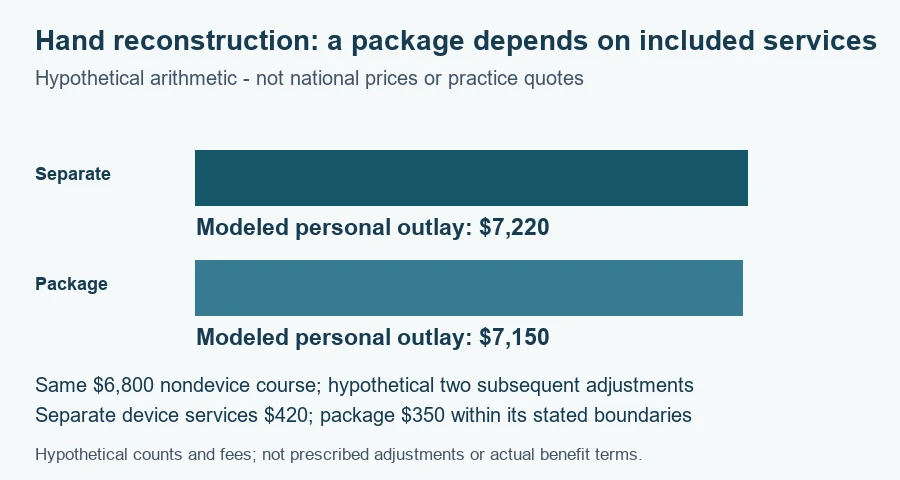
For the original chart, select two adjustments as an explicitly hypothetical scenario. Keep the rest of the course unchanged at $6,800: $4,000 professional, $1,600 facility, $800 anesthesia, $200 specified care and $200 practical travel. Add arrangement A’s $420 to reach $7,220, or B’s $350 to reach $7,150. The $70 difference is a difference in the modeled device-service arrangement, not a lower surgery fee or a better functional outcome.
Both chart bars include the same nondevice course and the same two adjustment services. They are not actual provider quotes, national prices or instructions to select a device. The model assumes no different payer rules, taxes, delivery charges or unlisted services; any relevant actual expense needs its own confirmed row. It also assumes the package services remain within its stated period. Do not extend those assumptions to a real agreement without verification.
Finding a hand reconstruction cost break-even point
Within the specified range, arrangement A is $250 plus $85 multiplied by the adjustment quantity. Arrangement B is $350. The difference between the starting amounts is $100; dividing by $85 produces approximately 1.18 adjustments as a mathematical crossing point. Actual counts in this example are whole services. Therefore A is lower at zero or one, while B is lower at two or three. This is a price-formula result, not an expected appointment count.
Beyond the package’s included quantity, its formula must be updated using the actual additional-service terms. It cannot remain $350 indefinitely simply because the initial package had that amount. If an invented fourth adjustment costs $85 in both arrangements, A would total $590 and B $435 under that additional assumption. If B has a different excess-service rate or period limit, replace the assumption with those terms instead of extrapolating a result.
Do not calculate an expected-value purchase recommendation without credible evidence about the actual clinically indicated course and relevant agreement. The model’s purpose is to show the range in which a fixed and variable fee differ. A financial crossing point does not establish the probability of needing an adjustment, the quality of care or suitability of an item. Request clarification of inclusions rather than making clinical needs fit the formula.
Comparing hand reconstruction cost package boundaries
Ask whether the included services are item adjustments, therapy sessions, routine surgical follow-up or another defined task. Similar everyday words can describe different bills. If one package includes a different service from another, the simple model is not an equivalent comparison. Record the difference, obtain the relevant separate estimate and preserve the clinician’s actual plan. Do not turn a service count into an interchangeable unit merely to make the totals match.
Also confirm any time boundary. A package might identify a period in which named services are included, while separately billed services may have their own terms. Obtain the actual arrangement rather than assuming unlimited follow-up or automatic renewal. A clinically needed service outside a financial package is not automatically unnecessary. Discuss the care requirement with the treating team and the financial basis with the appropriate biller.
Ask what happens if the assessed item or course changes. A newly prescribed item may require a new estimate rather than an adjustment under the original arrangement. A possible future replacement should remain a contingency until it is actually assessed. Record the applicable terms for damage, replacement or unused included services, without assuming a refund, warranty or free replacement. This guide creates no entitlement beyond the actual agreement.
| Question | Useful written answer | Counting error prevented |
|---|---|---|
| What item and fitting are included? | Named scope and initial service | Adding a fitting fee already included |
| What counts as an adjustment? | Defined service and biller | Treating a therapy session as a device adjustment |
| What is the quantity and period limit? | Actual package boundaries | Assuming unlimited included services |
| What happens after the limit? | Confirmed additional rate or new estimate | Holding the original total fixed indefinitely |
| What changes require a new quote? | Assessed-item or scope revisions | Pricing a replacement as a minor adjustment automatically |
Practical expenses in hand reconstruction cost
The chart’s travel amount is a disclosed assumption, not an estimate of every patient’s journeys. An adjustment appointment may coincide with another service or require a separate trip. Obtain the actual appointment arrangements before multiplying a travel amount by a service count. A financial service unit and a journey are different quantities. If arrangements change, update the practical-expense row separately from clinical charges.
Employment and assistance needs also depend on the individual’s circumstances and instructions. Do not use a generic recovery duration to assign missed work or assume paid leave. Obtain actual work arrangements and identify what is confirmed versus possible. If help with daily tasks is needed, record the relevant arrangement and its expense without presenting it as a universal requirement. A useful budget follows the assessed course rather than inventing a standard lifestyle impact.
Keep prescribed items separate from optional retail purchases. A financial comparison should not create a new shopping regimen or suggest an unassessed device as a substitute for specified care. Ask whether an item is required, included, separately estimated or optional. If a suggested product is only optional, preserve that label. Do not hide its cost in mandatory post-operative care or imply that spending more guarantees a better result. For comparing contract obligations and financing costs, see plastic surgery financing.
Reconciling hand reconstruction cost after care
Match each actual service with its estimate, billing organization, applicable payment basis and stated responsibility. Record the item’s initial charge separately from later services so the original purchase is not counted again each time. For a package, track which named services were included under the actual terms without treating unused capacity as care already received. For separate charges, verify that the service definition matches what was billed.
Track deposits as credited payments, not additional clinical expenses. A $200 advance applied to a final $420 device-service responsibility leaves $220 to pay and a $420 total, assuming the account confirms the credit. If a payment applies to a different biller or service, do not move it into this calculation without confirmation. Obtain an account record identifying its application when several organizations or estimates are involved.
For covered components, compare the billing statement with the processed explanation of benefits. For cash components, compare with the actual written inclusion and additional-service terms. If a discrepancy remains, preserve it as an unresolved row and ask the relevant parties for clarification. The spreadsheet documents assumptions and differences; it does not decide contractual liability, clinical necessity or the final outcome of a benefit request.
A useful hand reconstruction cost decision record
A complete comparison names the assessed task, known related care and actual financial denominator. It separates item charges from service charges, identifies package limits and shows how additional quantities affect the total. The original worksheet explains a specific fixed-versus-variable device-service calculation. It does not predict a clinical count, establish current market rates or recommend choosing one item or care arrangement for an individual.
Preserve dated estimates and update them when verified scope, benefit information or practical arrangements change. Keep the treating team’s instructions central, especially where a device or hand movement is involved. The most useful hand reconstruction cost record makes financial uncertainty explicit without converting an invented adjustment count, a general coverage statement or a low headline item price into a fact about your care.
For hand reconstruction cost records, a calendar appointment should not automatically become an adjustment charge. One appointment might contain a named included service and another separately defined service, or a routine review might involve no billed adjustment at all. Record what the actual biller identifies rather than reconstructing a charge count from the calendar. Where a package statement and an invoice use different wording, ask whether they refer to the same service before applying either formula.
Likewise, keep replacement of an item separate from adjustment of the existing item. In the hypothetical model, the $85 applies to a named adjustment under a stated agreement; it says nothing about the cost of a newly prescribed item. If the team assesses a different device, obtain its own inclusion and service terms. A lower adjustment rate cannot be used as a replacement estimate. This distinction preserves the original model’s limited scope while keeping the actual financial questions answerable.
Sources and scope
ASPS hand surgery scope, ASPS hand surgery cost categories and MedlinePlus hand-fracture aftercare were inspected October 12, 2026. MedlinePlus records an actual June 27, 2026 review date; its fracture-specific context is not generalized to every reconstruction. ASPS underlying dates are unspecified. No national complete fee, actual device package, adjustment count, insurance eligibility or individualized clinical clearance was established.
Sources and review scope
Plastic Surgery Editorial Team. Source records checked through October 12, 2026. Review scope: source and editorial checks for general education. No individual clinical assessment is represented.
- ASPS hand reconstruction task scope. American Society of Plastic Surgeons. Publication/update date not stated. Checked 2026-10-12.
- ASPS hand surgery bill categories. American Society of Plastic Surgeons. Publication/update date not stated. Checked 2026-10-12.
- MedlinePlus fracture-specific device instruction boundary. MedlinePlus / National Library of Medicine. Source date: 2026-06-27. Checked 2026-10-12.