
A neck lift is surgery intended to improve visible changes in the neck and jawline. The term can cover a plan addressing loose skin, fullness beneath the chin, neck muscle bands and some lower-face changes. Those are different concerns, so the useful starting point is an examination and a written explanation of which ones the proposed operation addresses. A neck lift does not stop aging, and a shorter incision or a fashionable technique name does not establish that a proposal is the right one for you. ASPS procedure overview
This guide helps you distinguish the operation’s scope from its marketing label, compare evidence with the outcome you want and plan recovery around actual tasks. It does not diagnose a neck feature from a photograph or recommend an operative method. The decisions about tissue treatment, anesthesia and suitability require a qualified clinician’s assessment. Your role is to explain the change you want and understand the limits and tradeoffs of the offered plan.
Separate the concerns before comparing procedures
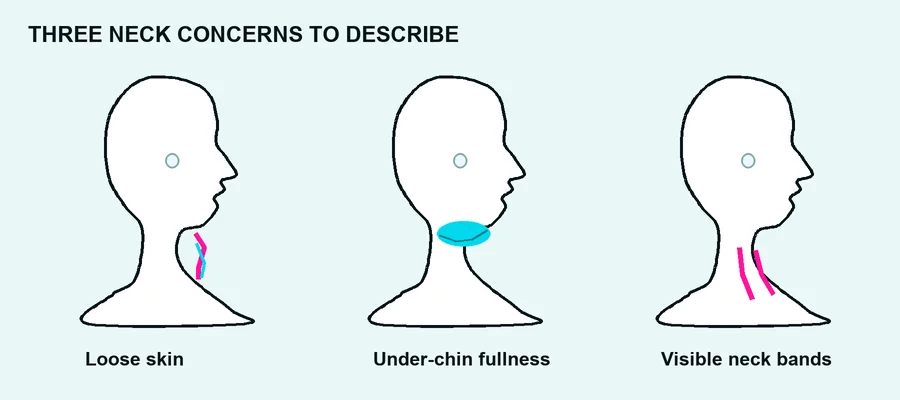
Describe what bothers you without assigning it an anatomical cause. You might notice a loose fold, fullness below the chin, vertical lines or a less distinct jawline. Tell the clinician which feature you see, from which view and whether your concern is present at rest or during movement. A selfie or a mirror description can communicate the concern, but neither tells you which tissue is responsible. Do not choose treatment merely because an advertisement uses the same descriptive word.
ASPS identifies skin relaxation, fatty deposits beneath the chin and muscle banding among neck-lift concerns. Ask the examiner to translate your description into an assessment, then to explain what the proposed treatment is expected to change. If several concerns are present, ask whether each requires a different part of the plan. Write down any feature outside its scope. That makes a recommendation easier to evaluate than a broad promise of a “better profile.”
Keep your priorities ordered. You may be most concerned about loose skin while another person’s decision centers on fullness. A recommendation suited to that person may therefore answer a different question. If you are satisfied with your face but concerned about your neck, say so explicitly. If your concern includes the lower face, ask how that alters the recommendation. The goal is a coherent plan, rather than a collection of separately advertised treatments.
| Feature you notice | Assessment question | Scope question |
|---|---|---|
| Loose neck skin | What contributes to this fold? | Is skin removal or redraping part of the proposal? |
| Fullness beneath the chin | What tissue or other feature explains it? | What improvement is expected, and what will remain? |
| Visible neck bands | How are these assessed at rest and movement? | Does the plan specifically address them? |
| Lower-face or jawline change | How does it relate to the neck concern? | Is lower-face treatment included or separately proposed? |
Neck lift versus a combined face-and-neck plan
ASPS notes that some people seek neck treatment while remaining pleased with the upper face. That does not mean everyone who dislikes the neck needs a full facelift, or that an isolated neck procedure will answer every lower-face concern. Ask the surgeon to describe the intended boundaries on your own photographs. Discuss why a neck-only, lower-face or combined operation is proposed, and which improvement could be limited if you select a narrower scope. ASPS candidate discussion
The word “combined” should lead to a more specific conversation. Identify each procedure, its purpose, the added recovery implications and the associated charges. If an additional eyelid, brow or volume procedure is suggested, ask what it contributes to your stated goal. You can consider a recommendation without treating every optional addition as necessary. Request a version of the plan that makes the essential and optional parts visible separately.
A useful comparison uses the same starting concern for both options. If one proposal includes lower-face work and another addresses only the neck, their photographs, price and recovery descriptions are not direct equivalents. Ask both teams the same scope questions before comparing them. A cheaper quote may cover less; a more extensive proposal may also include changes you do not want. Neither observation by itself settles the clinical decision.
Understand the proposed incisions and tissue treatment
The ASPS procedure explanation describes traditional and limited incision approaches. It notes possible fat sculpting or redistribution, tissue repositioning, platysma treatment, skin redraping and removal, with an additional incision beneath the chin in some plans. A limited incision can offer a narrower scope of correction. Ask where your planned incisions would be, what work each permits and how the surgeon expects the scars to relate to the ear and hairline. ASPS procedure explanation
Do not interpret a “limited” neck lift as automatically safer, sufficient or scar-free. It describes a proposal that needs an explanation of both benefits and limits. Likewise, a more extensive operation is not automatically more appropriate. Ask which feature drives the recommendation and which alternative was considered. If you have had previous face or neck treatment, make sure the clinician knows about it before describing an operation as straightforward.
Terms such as platysmaplasty describe treatment of neck muscle, but they do not supply a complete operative plan. Ask for a plain-language account of the proposed work and why it fits the assessment. Keep that separate from the visible incision pattern. You do not need to learn an operative sequence to provide informed consent; you need to understand the intended change, significant risks and reasonable alternatives. This guide therefore does not provide cutting, suturing or injection instructions.
Why a nonsurgical comparison must name the treatment
The ASPS overview distinguishes surgical lifting from nonsurgical treatments that may address selected features or complement surgery. A broad phrase such as “nonsurgical neck lift” does not tell you whether the proposal concerns skin texture, fat, muscle activity or another target. Ask for the exact treatment and its intended use, rather than assuming the phrase represents a single procedure with a standardized result.
If a medicine or device is offered, ask about its specific indication, evidence, limitations, possible repeat treatments and risks. A claim about one product cannot establish the performance of every treatment sold under the same marketing category. Do not add together promises from several advertisements and assume they reproduce the surgical plan. The relevant comparison is the particular concern addressed by each option, not simply whether one involves an incision.
You can also choose no treatment or delay a decision. Ask what observation or reassessment would be useful if you are unsure. Avoid turning a consultation into a deadline merely because there is a promotional offer. Record why a recommendation is being made now and what would be different if you waited. This keeps your choice focused on your goals and circumstances rather than on an urgency created by a sales message.
Read neck lift evidence by endpoint and follow-up
An original prospective study published in the October 2016 issue of Plastic and Reconstructive Surgery followed 150 consecutive neck-lift patients treated by the same senior surgeon during 2010–2014. The report reviewed 138 cases at three months and 96 at one year. It assessed satisfaction and the return of skin laxity or bands separately. The authors reported declining satisfaction and incomplete maintenance of particular corrections over time. This was one defined technique and practice, not a randomized comparison of every neck-lift approach. Original prospective study
The changing number reviewed matters. An early assessment and a later assessment cannot be treated as though all original patients necessarily supplied both. Nor does satisfaction mean that every specific feature remained unchanged. Ask whether evidence for a proposed technique reports comparable views, how many participants returned and what the researchers called recurrence. A before-and-after image can show a visible change while leaving satisfaction, durability and complications unanswered.
Another original report, with a March 2012 online publication date, described a retrospective group of 25 people undergoing a particular combined neck technique, with or without a concurrent facelift. It assessed photographic measurements at four weeks and satisfaction at a later period. Those different endpoints and timings should remain separate. A short-term measurement from a small mixed-procedure group does not establish a durable advantage over another operation. Original retrospective report
| Study record | What was observed | What it cannot establish |
|---|---|---|
| Prospective, single-surgeon series; 150 treated | 138 reviewed at three months, 96 at one year; satisfaction and recurrence examined separately | A universal personal result or randomized technique superiority |
| Retrospective report; 25 participants | Early photographic measurements and later satisfaction; some concurrent facelifts | An isolated neck-only effect or long-term comparative advantage |
| Your proposed procedure | Requires examination, defined goals and consent | An identical outcome copied from either historical group |
Treat these studies as examples of how to inspect a claim, not as a menu of operations. Request the evidence relevant to the actual recommendation and ask how it differs from your case. An honest answer may be that comparative evidence is limited. That is a reason to retain uncertainty in the discussion rather than replace it with a confident percentage drawn from an unrelated series.
Compare photographs without inventing a success score
Use a simple photographic record when discussing the intended result. Identify the view, posture, expression, lighting and date for any image being used to explain a change. Ask whether the postoperative image was taken early or after later follow-up, and whether other procedures were performed. A neck presented in a different pose may answer a different visual question. Your comparison should make those differences visible rather than overlook them.
For your own planning, annotate a concern on a copy of a photograph in words: “this loose fold” or “this jawline area.” Ask the surgeon which part can reasonably change and which cannot. Do not create an ideal angle or numerical target from a picture without clinical interpretation. A realistic discussion can include residual fullness, asymmetry or limitations. Having these documented before surgery gives the later assessment a shared starting point.
A neck lift photograph record can contain four fields: the feature being discussed, the view that shows it, the treatment performed and the follow-up interval. Keep those fields with the image instead of relying on memory. If a comparison uses a different posture or includes another operation, note that openly. If the date is missing, call it missing rather than assuming that the result is mature or long-lasting. This record is an editorial aid for asking better questions, not a validated scoring tool.
For example, suppose one explanation shows a frontal view of neck bands while another emphasizes a profile view beneath the chin. The two photographs may be discussing different goals. Ask for the same concern to be explained from comparable views before deciding that one neck lift proposal offers more correction. Also ask what the photograph cannot demonstrate: comfort during recovery, an adverse event, sensation or satisfaction beyond the image date. A portfolio can support a discussion, but it is not a complete outcome dataset.
Risks that deserve a specific conversation
ASPS lists anesthesia risks, bleeding, infection, hematoma, prolonged swelling, skin or sensation changes, unfavorable scarring, poor healing and possible revision. It also identifies nerve injury affecting lower-lip movement and serious blood-clot-related complications among potential concerns. Ask which risks are especially relevant to your health and the proposed scope, how the team monitors them and where treatment would occur if a complication develops. A reassuring photograph cannot answer those safety questions. ASPS risk guidance
Make the neck lift scar discussion practical. Ask where scars may be visible with the hairstyles or clothing you normally use, what unfavorable healing could mean and how follow-up would address it. Discuss prior healing problems and previous operations. Avoid interpreting an incision concealed in a natural contour as an absent scar. Also ask what the office considers an unsatisfactory result and what its review and revision policies actually cover.
Consultation and preparation
ASPS describes a consultation that includes goals, health conditions, medicines, supplements, substance use and previous surgery, followed by examination, photographs and discussion of options, outcomes, anesthesia and risks. Prepare a complete list rather than omitting something because it seems unrelated to the neck. Tell the clinician about previous injectables, devices or facial procedures so the assessment can account for your treatment history. ASPS consultation guidance
Preparation can involve medical evaluation and individualized medicine or smoking instructions. Do not stop a prescribed treatment on the basis of a general web page. Obtain the actual instructions from the responsible team and clarify any conflict with your usual care. ASPS advises transport and first-night assistance for outpatient neck-lift surgery. Arrange that support before the operation and discuss any need for a different recovery setting. ASPS preparation guidance
Plan neck lift recovery around actual tasks
ASPS describes possible bandaging and drainage, with instructions about wound care, medicines, head position and follow-up. It specifically warns against applying ice to the neck because of the potential effect on blood flow and skin survival. Follow your treating team’s instructions and resolve uncertainty directly with them rather than applying a familiar remedy from another procedure. Ask who can explain those instructions after discharge and who handles an urgent concern. ASPS recovery guidance
Recovery has practical and appearance-related parts. Ask separately about driving, work, exercise, clothing and events at which you expect to be photographed. An estimate for returning to a quiet desk task is not permission to resume every activity. Write down the clearance conditions for your particular responsibilities. Your support person should know how to contact the team and where the written instructions are kept, especially if you are tired or taking prescribed medication.
ASPS notes that swelling can take weeks to months to settle and incision lines can take up to six months to mature. These are broad educational descriptions rather than your exact calendar. Arrange a later outcome assessment as well as early healing checks. If you have severe or concerning symptoms, seek timely medical care rather than waiting for the planned assessment or deciding from a photograph whether they are normal. ASPS results guidance
Make the price match the neck lift proposal
Ask for an itemized estimate that identifies the exact scope, surgeon’s fee, anesthesia, facility and other expected charges. ASPS distinguishes its headline average from a complete price and notes that most insurance plans do not cover this cosmetic operation or its complications. The current page does not identify the headline figure’s data year, so it is not presented here as a dated benchmark. Verify your own payment responsibility rather than assuming coverage. ASPS cost guidance
| Quote field | Record needed | Why it matters |
|---|---|---|
| Procedure scope | Neck-only and any combined procedures named | Prevents unlike operations being compared as equivalents |
| Charges | Professional, anesthesia, facility and other items | Separates a fee from a total estimate |
| Follow-up | Included visits and contact arrangements | Makes ongoing care responsibility clear |
| Revision | Written policy and possible additional charges | Avoids assuming every later procedure is included |
| Financing | Total repayment and terms if used | Separates clinical choice from a monthly-payment headline |
Before choosing, you should be able to explain which features your plan addresses, what it leaves unchanged, where incisions are expected and how recovery and costs will be managed. Ask for further clarification if the answer is still only a technique name or a promise of youthfulness. A useful neck lift decision includes a realistic assessment of the desired change, the evidence supporting it and the limitations you are prepared to accept.
For related planning, read the facelift guide, recovery planner and consultation questions.
Sources and review scope
Plastic Surgery Editorial Team. Sources checked October 11, 2026. Review scope: source and editorial checks for general education. No individual clinical assessment is represented.
- ASPS neck lift overview. plasticsurgery.org. Publication/update date not stated. Checked 2026-10-11.
- ASPS neck lift candidates. plasticsurgery.org. Publication/update date not stated. Checked 2026-10-11.
- ASPS neck lift procedure. plasticsurgery.org. Publication/update date not stated. Checked 2026-10-11.
- ASPS neck lift safety. plasticsurgery.org. Publication/update date not stated. Checked 2026-10-11.
- ASPS neck lift consultation. plasticsurgery.org. Publication/update date not stated. Checked 2026-10-11.
- ASPS neck lift preparation. plasticsurgery.org. Publication/update date not stated. Checked 2026-10-11.
- ASPS neck lift recovery. plasticsurgery.org. Publication/update date not stated. Checked 2026-10-11.
- ASPS neck lift results. plasticsurgery.org. Publication/update date not stated. Checked 2026-10-11.
- ASPS neck lift cost. plasticsurgery.org. Publication/update date not stated. Checked 2026-10-11.
- Pelle-Ceravolo et al. prospective neck series. pubmed.ncbi.nlm.nih.gov. Source date: 2016-10. Checked 2026-10-11.
- Ezzat et al. retrospective combined-technique report. pubmed.ncbi.nlm.nih.gov. Source date: 2012-03-14. Checked 2026-10-11.