
A Brazilian butt lift, or BBL, transfers a person’s own fat from other body areas to the buttocks to change volume, shape or projection. Despite the name, it is not the same operation as removing loose skin in a buttock lift. The decision involves both the liposuction areas and the fat-transfer area, alongside serious procedure-specific safety concerns. A proposal should identify the intended changes, the safety approach, the responsible surgeon, and the follow-up arrangements before a deposit or travel plan makes the decision harder to reconsider. ASPS procedure distinctions
This guide provides an original proposal record and an evidence-comparison table. They help distinguish a desired contour from an actual operation and distinguish a reported study result from a personal guarantee. It does not provide operative instructions, a universal safe transfer volume, a personal mortality estimate, or a ranked provider list.
Separate volume, surrounding contour and loose skin
Describe the change you want in three parts: the buttocks themselves, the areas from which fat might be removed, and any skin concern. A smaller surrounding contour can change the way a silhouette appears in photographs. Added volume and skin removal are different components. Ask the clinician to explain which component is responsible for each proposed change rather than treating the whole result as “the lift.”
ASPS distinguishes augmentation with fat grafting, augmentation with implants, and a skin-removal buttock lift. Its guidance describes a traditional lift as addressing excess sagging tissue rather than adding volume. A combined proposal therefore needs separate explanations, scars, recovery considerations and costs for its separate components. An implant operation and an injection of liquid silicone are also different interventions; the words “silicone” and “augmentation” alone do not define what is proposed.
The following original goal worksheet is a way to record questions, not to determine eligibility. Write the feature that matters most to you and ask what might remain unchanged. Record whether the clinician recommends a different option or no operation. A realistic limit deserves the same space in your notes as a hoped-for improvement.
| Your concern | Component needing explanation | What the written proposal should identify |
|---|---|---|
| Buttock size or projection | Added volume and feasible shape | Fat-transfer goal and limitations |
| Waist, flank or other surrounding contour | Fat-removal component | Exact liposuction regions and boundaries |
| Loose skin or position | Whether skin removal is required | Separate lift, scars and scope if proposed |
| Unequal sides | Starting appearance and achievable change | Residual asymmetry and assessment method |
| Specific reference-photo silhouette | Whether anatomy and scope are comparable | Which features are feasible and which are not |
A reference photograph should be treated as a communication aid. Ask which view demonstrates the feature you mean and whether another view changes the interpretation. Do not let a posed, edited or unusually lit image become a measurement of what can be achieved. A discussion of feasibility should account for your own starting appearance rather than borrowing another person’s result as the target.
Understand the two-site nature of the operation
The ASPS procedure description identifies fat removal by liposuction, preparation of the harvested material, and transfer to the buttocks. The amount removed is not simply interchangeable with the amount transferred, and neither number alone defines the visible result. Your proposal should distinguish the source areas from the augmentation goal. This guide intentionally leaves technique, anesthetic selection and transfer decisions to the surgical team. ASPS operation components
Ask how the source areas will be assessed and how their contour will be discussed at follow-up. The visible goal may involve a balance between several areas, but each treated area still needs its own explanation. A package described as several “zones” is unclear until the office defines those zones. An operation name should not hide an additional area that changes the proposal or its recovery requirements.
Keep the proposed components in one document. If a later consultation adds another region or a different operation, update the scope instead of appending a price to an old description. This makes it easier to compare proposals that might otherwise look similar. It also helps you identify which questions remain unanswered before giving consent.
Put fat-embolism safety at the center of the discussion
The August 18, 2022 joint statement from ASPS and partner societies describes significant gluteal fat-grafting risk and fatalities from fat embolism. It supports real-time ultrasound to help ensure transfer remains above the gluteal muscle fascia. It also addresses appropriate privileges, surgeon involvement in care, and facility practices that place patient safety ahead of throughput. These are specific safety concerns, not reasons to accept a generic “modern technique” assurance. Joint gluteal fat-grafting safety statement
When checked for this guide, the ASPS current-advisory index continued to list that 2022 statement and the earlier 2018 and 2019 advisories. A statement’s date matters: its discussion of state emergency rules is not a complete description of present laws everywhere. Ask the team to identify the currently applicable standards at the actual location of surgery. This national guide does not present an old state rule as a current nationwide requirement. ASPS current-advisory index
For your proposal record, write down the team’s explanation of the safety approach and who is responsible for each part of care. Ask how the proposed approach relates to the advisory rather than accepting the word “ultrasound” as a complete answer. Technology in a promotional photograph does not document how it will be used for your operation. The purpose of this conversation is an understandable explanation, not an attempt to supervise surgery yourself.
Interpret historical and newer studies without mixing their denominators
The original ASERF task-force report appeared online March 21, 2017, with a July 2017 issue date. It combined an anonymous surgeon survey with other mortality investigations. In the survey, 692 respondents reported 198,857 career cases. That denominator is a reported career experience among respondents, not a contemporary registry of every operation. The report identified serious fat-embolism harm and important uncertainty in estimating its frequency. Its historical estimates should not be presented as a personalized current probability. Original ASERF task-force report
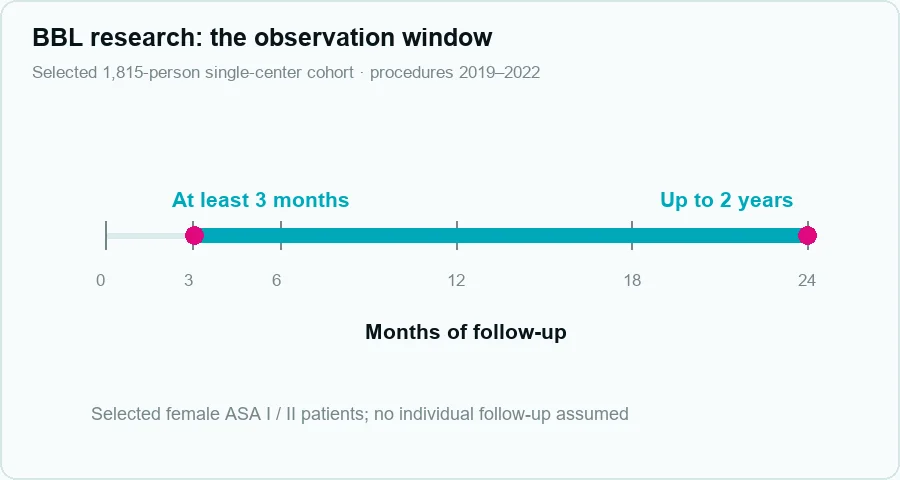
By contrast, a study in the March 15, 2024 issue of Aesthetic Surgery Journal reviewed 1,815 female patients treated at one center between 2019 and 2022 with ultrasound-guided transfer. The abstract describes selected ASA I or II patients and follow-up from at least three months to two years. It reported no macroscopic fat emboli or deaths in that cohort, while also reporting other complications. This is a retrospective single-center record, not a randomized trial or a guarantee that a serious event cannot occur. Original ultrasound-guided cohort
These reports answer different questions. The older investigation helped characterize a serious safety problem across reported experience and other records. The newer cohort describes outcomes under a particular practice approach in selected patients. Dividing, subtracting or comparing their headline figures as though they came from matched groups would create a misleading result. Selection, ascertainment, time period and technique all matter.
| Evidence feature | Historical task-force investigation | Ultrasound-guided cohort | Reading rule |
|---|---|---|---|
| Design | Survey plus other investigations | Retrospective single-center chart review | Do not treat either as a randomized comparison |
| Denominator | Respondents’ reported career cases | Defined treated cohort | Keep case definitions attached to numbers |
| Period | Historical experience reported in 2017 paper | Operations during 2019–2022 | Do not label either a current national rate |
| Population | Survey respondents’ practices | 1,815 selected female patients | Personal applicability needs clinical assessment |
| Observation | Serious fatal/nonfatal fat-embolism reports | No macroscopic fat emboli/deaths reported in cohort | Zero observed events does not prove zero possible risk |
If an office quotes its own “zero complications” record, ask what it counts as a complication, how many cases are included, the follow-up period, and how patients lost to follow-up are handled. A reassuring claim is incomplete when its denominator and observation process are missing. Appearance satisfaction, revision, infection and a rare fatal event are different outcomes; a statement about one should not silently stand in for all the others.
Ask who will provide care and how it can be verified
ASPS recommends asking about plastic-surgery training, board certification, procedure-specific hospital privileges and the facility’s accreditation or licensing. Record the named surgeon and facility, along with the exact credential and privilege being claimed. A title such as “cosmetic specialist” does not answer all those questions. Ask where the relevant information can be independently checked and who can clarify a discrepancy. ASPS credential and facility questions
Keep credentials separate from evidence about this operation and from your own assessment. One favorable field does not automatically answer the others. Likewise, a large photo gallery does not document complication ascertainment, follow-up availability, or the responsibilities of people taking part in care. If a proposal is primarily delivered through sales staff, make sure unresolved clinical questions reach the professional responsible for the treatment.
For surgery away from home, ask how the surgeon will remain involved after you return. The safety statement explicitly includes patients who travel and calls for comprehensive preoperative and postoperative care arrangements. A messaging number alone does not explain who will assess an urgent problem, obtain records, or coordinate treatment. Get those arrangements in writing while you still have the option to change the plan.
Assess health and goals without using an online eligibility formula
The ASPS candidacy guidance emphasizes individualized treatment, health and realistic expectations. It distinguishes the goals of augmentation from the goals of a skin-removal lift. There is no personal eligibility verdict available from this article. Avoid treating a marketing label such as “skinny BBL” or a particular silhouette as proof that an operation fits your health or anatomy. ASPS candidacy guidance
Bring your conditions, drug allergies, previous treatment and surgery history, medications, supplements, alcohol, tobacco and other substance use to the consultation. Include prior injections or procedures in the intended areas, with records when available. Uncertainty should be recorded as uncertainty rather than resolved by a guess about the product or operation. The team needs an accurate history to explain its proposal. ASPS consultation history
Preparation may include testing and coordinated changes to treatment or medicines. Ask the responsible clinicians for specific instructions; do not stop prescribed medication on your own. ASPS also advises arranging transportation and first-night assistance for outpatient surgery. Identify who can provide that help and whether your actual setting permits it before confirming dates. ASPS preparation guidance
Compare complete BBL costs by scope
The ASPS cost page distinguishes a surgeon’s fee from a total that also includes anesthesia, facilities and other expenses. Its current numerical averages do not provide sufficiently explicit data-year and sample details for this guide’s comparison standard, so we omit them. A BBL quote should identify the fat-removal regions and transfer operation, the setting, the related charges and the follow-up policy. An attractive headline number is not a complete budget. ASPS cost inclusions and exclusions
Create one row per quoted component and one column per proposal. Enter only actual written amounts. Add the disclosed charges to calculate a known subtotal, and keep unknown charges in a separate list. If one proposal includes extra liposuction regions, a separate lift or a different period of follow-up, resolve that difference before comparing totals. “All inclusive” needs a written definition.
| Budget component | Information to obtain | Keep separate from |
|---|---|---|
| Surgical scope | Exact regions and procedures | A vague zone count or bundle label |
| Clinical charges | Surgeon, anesthesia, facility and testing | Travel and accommodation |
| Recovery supplies | Prescriptions, garments and any advised equipment | Unrequested commercial add-ons |
| Assistance and follow-up | What the package includes and excludes | An assumption that hotel staff provide care |
| Unexpected care | Financial policy and clinical contact | A promise that complications cannot occur |
For travel, keep lodging, transport, meals and assistance outside the clinical subtotal so neither category hides the other. Confirm refund and rescheduling terms, including what happens if the clinical assessment changes the plan. A financing approval answers a payment question; it does not answer suitability or safety. Preserve the ability to decline rather than allowing a nonrefundable arrangement to decide for you.
Make recovery instructions workable in your real environment
ASPS recovery guidance describes wound care, possible drains, support garments and individualized follow-up. For fat transfer, it also discusses pressure and sitting precautions. Obtain instructions for your own operation rather than treating a general online timetable as clearance. Ask how those instructions translate into sleeping, bathroom use, getting into a vehicle, work, and attending appointments. ASPS recovery and urgent-symptom guidance
Use a task-based plan: identify a necessary activity, the instruction affecting it, the help available, and the person to contact if the plan does not work. A desk job involves more than a date on a calendar when sitting restrictions are part of care. A travel itinerary must also allow for reassessment. Do not assume a pillow, garment or advertised recovery package substitutes for the treating team’s directions.
Keep a copy of the operative and follow-up information accessible to anyone helping you and to healthcare professionals if a problem arises. Write the contact and escalation instructions clearly. For a concerning symptom, clinical assessment takes priority over a planned photograph, a scheduled trip, or a paid additional service. Shortness of breath, chest pain or unusual heartbeats warrants immediate medical attention; do not wait for a routine appearance review.
Judge evolving results and separate them from safety outcomes
ASPS notes that fat-transfer results develop over time, that some transferred fat is reabsorbed, and that subsequent weight change can affect volume. Results are not guaranteed, and another operation may sometimes be considered. An early photograph therefore should not be labeled a stable final outcome. Ask when the team expects to assess different aspects of healing and appearance. ASPS fat-transfer result limitations
Maintain separate records for the source areas, the buttock contour and any health concern. Use comparable photographs for appearance, but give symptoms their own description and date. If a revision is discussed, request the specific problem, proposed operation, added risks and cost policy. A second procedure is another decision, not an automatic final step toward an advertised silhouette.
Carry a usable proposal record into the final decision
Keep a dated version of the proposal, the consent discussion, the quotation and the care plan together. Mark each item as explained, unresolved or changed. This is particularly useful when several conversations happen with different people. An answer about one location or one surgeon should not silently carry over when the booking changes. Confirm that the information still describes the actual operation and setting you are considering.
Use separate headings for appearance, safety, practical recovery and finances. Under appearance, record the particular change and limitation discussed for each region. Under safety, record the clinical explanation and the information still needed. Under practical recovery, record help, appointments and transport arrangements. Under finances, retain the written exclusions as well as the amounts. Keeping these records separate prevents a strong answer in one area from masking an unanswered question elsewhere.
When you reach the decision point, review the unresolved column first. Some uncertainty is inherent in any operation, but an unidentified surgeon, undefined scope or unexplained follow-up arrangement is different from an acknowledged limitation of results. Ask the appropriate person to resolve the information gap. If the proposal changes materially, reconsider the whole decision rather than treating the change as a small administrative update to a booking you have already accepted.
Distinguish fat transfer from unapproved injectable products
FDA states that injectable silicone is not approved for aesthetic body contouring and warns against injectable fillers used to enlarge the buttocks. Its guidance describes serious injury risks. Those warnings should not be confused with the description of transferring your own fat, and the term “nonsurgical BBL” should never substitute for naming an actual material and procedure. FDA unapproved filler and silicone guidance
Before proceeding with any proposal, ensure the operation, source areas, safety explanation, surgeon, setting and care arrangements are clear. Keep unresolved questions visible. A desirable photograph and a complete payment plan do not fill gaps in the clinical proposal. A decision can remain undecided while you obtain the information that matters to you.
For related planning, visit the procedure guide index and the liposuction guide.
Sources and review scope
Plastic Surgery Editorial Team. Source records checked through October 12, 2026. Review scope: source and editorial checks for general education. No individual clinical assessment is represented.
- ASPS buttock enhancement Overview. plasticsurgery.org. Publication/update date not stated. Checked 2026-10-11.
- ASPS buttock enhancement Procedure. plasticsurgery.org. Publication/update date not stated. Checked 2026-10-11.
- ASPS buttock enhancement Safety. plasticsurgery.org. Publication/update date not stated. Checked 2026-10-11.
- ASPS buttock enhancement Cost. plasticsurgery.org. Publication/update date not stated. Checked 2026-10-11.
- ASPS buttock enhancement Recovery. plasticsurgery.org. Publication/update date not stated. Checked 2026-10-11.
- ASPS buttock enhancement Preparation. plasticsurgery.org. Publication/update date not stated. Checked 2026-10-11.
- ASPS buttock enhancement Candidates. plasticsurgery.org. Publication/update date not stated. Checked 2026-10-11.
- ASPS buttock enhancement Results. plasticsurgery.org. Publication/update date not stated. Checked 2026-10-11.
- ASPS buttock enhancement Consultation. plasticsurgery.org. Publication/update date not stated. Checked 2026-10-11.
- ASPS buttock enhancement Questions. plasticsurgery.org. Publication/update date not stated. Checked 2026-10-11.
- Multisociety gluteal fat-grafting safety statement. plasticsurgery.org. Source date: 2022-08-18. Checked 2026-10-11.
- ASPS current advisory index. plasticsurgery.org. Publication/update date not stated. Checked 2026-10-11.
- Mofid et al. ASERF mortality task-force report. pmc.ncbi.nlm.nih.gov. Source date: 2017-03-21. Checked 2026-10-11.
- Vidal-Laureano et al. ultrasound-guided cohort. pubmed.ncbi.nlm.nih.gov. Source date: 2023-12-20. Checked 2026-10-12.
- FDA dermal filler and injectable silicone guidance. fda.gov. Publication/update date not stated. Checked 2026-10-11.