
Tummy tuck vs liposuction is mainly a comparison of surgical scope. Liposuction removes localized fat; a tummy tuck addresses excess abdominal skin and fat and can include repair of weakened or separated abdominal muscles. The right question is which tissue is responsible for the concern you want changed. Neither procedure substitutes for weight loss, and neither promises a perfectly flat abdomen. A combination can be considered when the goals involve both contouring and skin removal, but adding procedures needs its own safety assessment.
This comparison helps you separate those goals, interpret combination-surgery research and compare complete proposals. It cannot determine from a photograph whether you need skin removal, abdominal wall work, fat reduction or evaluation of a different problem. The names on a price menu are too broad to settle that decision. Start with an examination and a clearly described operative plan rather than selecting the procedure with the more appealing recovery headline.
Identify the actual abdominal concern
A request for a flatter stomach can describe several different problems. One person dislikes a localized fatty contour, another dislikes hanging skin, and another describes a persistent bulge whose cause has not been established. These are different starting points. Write the concern in ordinary language, including where it occurs and whether the priority is appearance, clothing fit, skin discomfort or an unexplained symptom. Do not convert that description into a diagnosis at home.
The American Society of Plastic Surgeons describes liposuction as localized fat removal and notes that loose, less elastic skin may not reshape sufficiently afterward. Its tummy tuck guidance describes skin and fat removal with abdominal muscle repair in many cases. These boundaries matter because a procedure can perform its intended task while leaving a different concern unresolved. ASPS liposuction scope; ASPS tummy tuck scope.
Ask the surgeon to distinguish what they observed from what you reported. For example, “I see a bulge” is your observation; “the proposed operation includes abdominal wall repair” is part of their plan. The connection between the two should be explained, not assumed. A proposal that lists several procedures without identifying their separate purposes is difficult to evaluate even when the photographs look impressive.
| Main concern to describe | Liposuction discussion | Tummy tuck discussion | Question that resolves the scope |
|---|---|---|---|
| Localized abdominal or waist fat | Which areas are being treated? | Is skin removal also needed? | What remains if only fat is reduced? |
| Loose or overhanging abdominal skin | How is skin elasticity assessed? | What skin would be removed? | What is the proposed incision and remaining scar? |
| Suspected abdominal wall problem | Do not assume fat removal addresses it | Is repair actually indicated and included? | What diagnosis supports that part of the operation? |
| Several concerns together | Define each contouring area | Define each excision or repair component | Why combine, stage or omit components? |
| Weight-loss goal | Outside its intended purpose | Outside its intended purpose | What nonsurgical assessment belongs first? |
Understand what skin removal changes
Choosing skin removal means evaluating the remaining scar as part of the result. A scar should not be treated as an administrative detail that appears only in the consent form. Ask where the incision is expected to lie relative to your own clothing, whether its proposed extent matches the excess skin being addressed, and how the surgeon explains the uncertainty in its eventual appearance. A promise that a scar will be completely invisible deserves clarification.
ASPS describes a full tummy tuck with a horizontal lower abdominal incision and notes that another incision around the navel may be needed. The amount of excess skin influences incision shape and length. That is a description of a full operation, not proof that every person needs the same incisions or muscle work. ASPS procedure description.
Map the goal before accepting a smaller operation
A smaller named procedure is not automatically a better fit. Ask the surgeon to mark which area it addresses and which area it deliberately leaves alone. “Mini” or “limited” may sound attractive, but the useful comparison is the included treatment area and the expected residual concern. If the explanation is that a larger operation is unnecessary, find out what examination findings support that conclusion rather than assuming the label itself establishes suitability.
Conversely, a large procedure should not be selected merely because it seems more comprehensive. More extensive scope can include a change you do not actually want. Compare the proposed operation with your original priorities and ask what benefit is expected from each component. This is especially helpful when one consultation recommends fat reduction and another recommends excision: the difference may be their assessment of the skin, their interpretation of your goal or the scope you discussed.
Separate stretch marks from contour and skin excess
Stretch marks, a fatty contour and excess skin are separate endpoints. Do not combine them into a single promise that the abdomen will look “smooth.” ASPS states that a tummy tuck does not generally correct stretch marks, although marks in the skin actually removed may be eliminated or improved. Ask which marks lie in the anticipated excision area and which would remain. A statement about the removal of particular skin should not become a guarantee about every mark.
For a proposed liposuction operation, ask specifically what is expected of the remaining skin. A photograph of a slimmer waist does not establish that the procedure improved stretch marks or loose skin. Keep the original concern visible in the conversation: if the feature you most want changed is outside the procedure’s expected scope, a technically successful operation may still disappoint you. The assessment should acknowledge that possibility before you commit to treatment.
You can make this discussion more precise without measuring yourself for surgery. Annotate a private photograph with the areas you wish to discuss, then let the clinician explain the relevant anatomy and treatment limits. Avoid copying an online patient’s markings or incision pattern. The annotation is a way to communicate a concern, not a surgical design, and it should never substitute for an examination or informed consent.
Combined procedure decisions
Treat combination surgery as a third proposal
Tummy tuck vs liposuction does not always end with choosing one alone. ASPS notes that liposuction can be performed with a tummy tuck. If both are proposed, request a third, explicit description of the combined operation rather than adding the two marketing summaries together. Specify abdominal excision, any abdominal wall repair, every liposuction area and the planned setting. Otherwise, two quotes called “tummy tuck with lipo” may refer to materially different treatment.
The useful questions concern necessity and alternatives: What does adding the contouring component achieve? What would the result leave untreated without it? Why is one operation being proposed instead of staged treatment? What would make the surgeon change that recommendation after assessment? These questions do not presume that combination surgery is wrong or right; they make the rationale available for scrutiny before financial commitments become difficult to reverse.
Ask whether any proposed additional body or breast procedure is essential to your abdominal goal or simply another elective request. An abdominal operation plus limited contouring is not automatically equivalent to an abdominal operation with several other procedures. The plan needs to identify the full scope in one place. If components change later, request an updated explanation of safety, logistics, costs and consent rather than relying on the original conversation.
Read the combination-surgery study’s actual endpoint
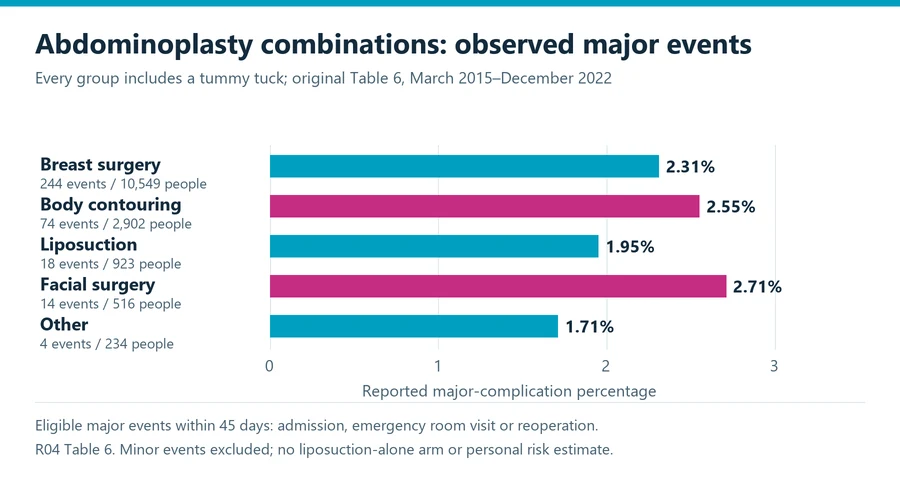
A 2024 original database study used records from March 2015 through December 2022. Its definition of a major complication required an event within 45 days leading to hospital admission, an emergency room visit or reoperation. Table 6 reported 18 events among 923 people receiving abdominoplasty with liposuction, or 1.95%. The other plotted groups also received abdominoplasty. There is no liposuction-alone arm in this chart. Original study, Methods and Table 6.
| Abdominoplasty plus the listed procedure | People in Table 6 | Major complications reported | Reported percentage |
|---|---|---|---|
| Breast surgery | 10,549 | 244 | 2.31% |
| Other body contouring | 2,902 | 74 | 2.55% |
| Liposuction | 923 | 18 | 1.95% |
| Facial surgery | 516 | 14 | 2.71% |
| Other procedures | 234 | 4 | 1.71% |
The study’s adjusted analysis did not identify significant added major-complication risk for combined procedures compared with abdominoplasty alone. Its database excluded minor complications managed in the clinic, and participation selected particular surgeons, facilities and patients. The paper disclosed an author’s ownership interest in the company owning the database trademark. These qualifications belong beside the numerical finding, not hidden after a reassuring headline.
The practical lesson is to ask what a safety number actually counts. The absence of an eligible major claim is not the same as an uncomplicated recovery, an acceptable scar or satisfaction with contour. Different operations also serve different patients and purposes, so the smallest bar does not identify the best choice for you. A study can inform a safety discussion without supplying a personal probability or proving that all combination plans are interchangeable.
Risk and recovery
Compare consent topics rather than counting incision sites
Both choices involve surgery. A plan with smaller visible entry sites should still explain anesthesia, bleeding, infection, altered sensation and contour concerns. For abdominoplasty, ASPS also lists wound-healing problems, unfavorable scarring, fluid collections and blood-clot or cardiopulmonary complications. Liposuction guidance includes contour irregularities and injury risks as well as general surgical risks. The lists describe possible events, not procedure-specific personal frequencies. ASPS tummy tuck risks; ASPS liposuction risks.
Make the consent conversation specific to what is being offered. If a technology name appears in the liposuction proposal, ask what it adds to the operative plan and how the associated risks are explained. If abdominal wall repair is included, ask how that component changes your aftercare instructions. Do not use an online list to decide which risk matters least; ask the operating team how your health, scope and proposed setting shape their recommendations.
Separate an unwanted aesthetic result from an urgent medical event. The appropriate response pathways differ. Before surgery, obtain written instructions identifying whom to call, how to reach the team outside office hours and what symptoms require emergency assessment. A photograph upload portal should not be the only plan for urgent concerns. This guide does not provide a substitute symptom checklist or a do-it-yourself treatment protocol.
Compare recovery by tasks, not one return-to-work date
ASPS recovery guidance for both procedures discusses dressings, possible drainage care, compression or support, medicines and individual instructions. The exact arrangements need to come from the team treating you. Liposuction’s general recovery timetable makes return to work dependent on the job and describes gradual changes in activity and swelling. It is not clearance for a particular person or for a combined abdominal operation. ASPS tummy tuck recovery; ASPS liposuction recovery.
A useful comparison starts with the actual demands of your life. Describe prolonged standing, lifting, commuting, driving, exercise and care of dependents separately. “Office work” can still involve stairs, a long journey or physical duties. Ask which tasks require explicit clearance and which can be modified. A friend returning quickly after a different operation does not settle your own arrangements, particularly if your proposal includes excision, repair and several contouring areas.
Distinguish comfort, clearance and visible result
Feeling more comfortable, receiving permission to resume a task and being ready to judge the contour are different milestones. Record them separately instead of treating one encouraging early change as proof that recovery is finished. Ask when the team plans to assess the result and what they expect you to report between visits. This makes it easier to distinguish routine follow-up questions from concerns that need prompt contact.
Plan who will help, how instructions will be stored and how follow-up will be attended before making a deposit. For travel, ask the treating team to explain the plan for local follow-up and unexpected care. Do not assume that a low initial quote includes accommodation, an extended stay or additional clinical assessments. Those arrangements are part of the practical comparison even though they are not measures of surgical effectiveness.
Scope and results
Normalize the quote to the actual operative scope
Compare written totals only after identifying the components. A liposuction quote for one abdominal area is not equivalent to a multi-area contouring proposal, and a surgeon fee for abdominoplasty is not the complete bill. Ask for separate entries for the operation, anesthesia, facility, any additional procedures and follow-up arrangements. Include the date and location of the quote so an older price is not silently treated as a current local offer.
When comparing a combined operation with staged treatment, do not assume either is financially preferable. Request both complete proposals and record what each includes. If no staged quote is available, mark that total unknown rather than estimating a discount or doubling one component. A financial illustration should state its assumptions clearly; it should not masquerade as a national average or a prediction of what your surgeon will charge.
| Quote field | What to record | Why it changes the comparison |
|---|---|---|
| Operative scope | Excision, repair and each contouring area | Prevents comparing different operations |
| Fee basis | Surgeon fee or complete quoted total | Avoids missing anesthesia and facility charges |
| Combined or staged | Included components and separate proposals | Makes assumptions visible |
| Follow-up and additional care | Included visits, exclusions and written policy | Clarifies future financial responsibility |
| Nonmedical arrangements | Assistance, travel and time away from work | Completes the planning budget without inventing prices |
Get the policy for unplanned treatment and elective revision in writing. These are different situations, and neither should be inferred from a phrase such as “follow-up included.” Ask who determines whether a concern is eligible for an adjustment and which costs remain payable. The purpose is to understand the agreement, not to assume you will need another operation or that all dissatisfaction can be corrected by one.
Decide how you will assess the abdominal result
Agree on the main result you will discuss at follow-up before choosing an operation. “Smaller,” “tighter” and “flatter” are not identical descriptions. If your priority is removal of a skin fold, record that explicitly. If it is contour at the waist, identify the relevant area. If it is a suspected structural problem, the assessment must connect that concern to a diagnosis rather than relying on appearance alone. This prevents an attractive change in one feature from hiding an unresolved priority in another.
Do not turn a single photograph, scale weight or clothing size into a universal success measure. Each answers a different question, and each may be influenced by factors outside the operation. Ask which observations the treating team uses when evaluating the particular goal and when those observations become useful. Keep any comparison consistent enough to interpret: the same requested view and context is more informative than choosing whichever image looks most flattering.
If the final result does not match your expectation, bring the original goal and operative description to the discussion. Ask whether the concern was within the agreed scope, whether assessment is still premature or whether another evaluation is appropriate. That conversation should address the specific finding and available choices rather than jumping straight to another procedure. Clarifying an endpoint beforehand gives both you and the clinical team a more useful reference than a broad promise of transformation.
Timing and sources
Check timing and expectations before committing
ASPS advises discussing future substantial weight loss or pregnancy when considering a tummy tuck because these changes can diminish its outcome. This is a planning consideration, not a promise that one calendar date makes surgery appropriate. Explain your real plans and ask how the recommendation would change if those plans occur sooner or later than expected. Weight stability and readiness should be evaluated clinically rather than reduced to a rule taken from a comment thread.
Use photographs carefully during this discussion. Ask whether the example operation matches the scope proposed for you, how long after surgery it was photographed, and whether other procedures contributed to the appearance. Lighting, posture and clothing coverage should not become substitutes for a description of the actual operation. A gallery can help you communicate preferences, but it cannot establish your eligibility, your likely scar or your individual result.
Finally, write down what you would consider an acceptable trade-off. You might prioritize removal of excess skin while accepting a visible scar, or prioritize limited contouring while accepting remaining skin looseness. Those are preferences to discuss, not medical indications. A good tummy tuck vs liposuction decision connects an examined concern to a defined operation, acknowledges what remains untreated and includes a realistic care and financial plan. Choosing no operation or revisiting the decision later also deserves a clear place in that conversation.
For related planning, see the procedure guide library, questions to ask a plastic surgeon and how plastic surgery costs are described.
Sources and review scope
Plastic Surgery Editorial Team. Source records checked through October 12, 2026. Review scope: source and editorial checks for general education. No individual clinical assessment is represented.
- ASPS tummy tuck overview. plasticsurgery.org. Publication/update date not stated. Checked 2026-10-12.
- ASPS liposuction overview. plasticsurgery.org. Publication/update date not stated. Checked 2026-10-12.
- ASPS tummy tuck procedure steps. plasticsurgery.org. Publication/update date not stated. Checked 2026-10-12.
- Complications and Risks Associated With the Different Types of Abdominoplasties: An Analysis of 55,956 Patients. academic.oup.com. Source date: 2024-03-18. Checked 2026-10-12.
- ASPS tummy tuck risks and safety. plasticsurgery.org. Publication/update date not stated. Checked 2026-10-12.
- ASPS liposuction risks and safety. plasticsurgery.org. Publication/update date not stated. Checked 2026-10-12.
- ASPS tummy tuck recovery. plasticsurgery.org. Publication/update date not stated. Checked 2026-10-12.
- ASPS liposuction recovery. plasticsurgery.org. Publication/update date not stated. Checked 2026-10-12.