
Dermal fillers are injectable medical-device implants used for particular volume or contour corrections. They are not one interchangeable product, and an approval for one product and site does not automatically apply to another. The practical decision starts with the exact material and product, the feature you want changed, the proposed indication and the follow-up plan. A dermal fillers appointment still involves medical risks, including uncommon complications that can require urgent care. ASPS treatment overview
This guide provides a product-and-indication record, an evidence-endpoint comparison and a quote worksheet. It does not recommend an injection site, teach an injection technique, prescribe a volume, or supply a home remedy for a complication. Its purpose is to help you understand the actual treatment proposed rather than buying an area label or a number of syringes without that explanation.
Match the feature to the purpose of dermal fillers
Describe one feature you would like to change and the conditions in which you notice it. A concern about fullness, a crease, facial proportion and loose tissue can lead to different discussions. Do not assume that every concern can be solved by adding material. Ask what the proposed treatment can address, what may remain and what alternatives the clinician considers appropriate after assessment.
ASPS discusses fillers as volume and contour treatments and distinguishes them from surgical rejuvenation when a lift is needed. Keep that distinction in your own goal record. A service described as a “liquid facelift” does not identify the material, the intended change or its limits. Ask the clinician to translate the phrase into specific features and components before comparing it with a surgical proposal.
Write down both a desired change and a boundary you care about. You might want one feature to appear different while retaining another aspect of your appearance. These preferences do not establish what is technically feasible, but they give the professional something more specific than “make me younger.” For dermal fillers planning, a reference image can help communicate a feature without becoming a promised result or an automatic request for more material.
Identify the material and full product name for dermal fillers
FDA consumer guidance lists absorbable materials including hyaluronic acid, calcium hydroxylapatite and poly-L-lactic acid, and describes a nonabsorbable PMMA-bead product containing bovine collagen. These are different materials, not interchangeable names for a generic injection. The same material category can also include multiple named formulations and approvals. Record the complete proposed product and request its current patient information. FDA filler-material guidance
ASPS describes several filler categories with different properties and purposes. Its broad procedure page is useful for terminology, but a list of possible uses is not a substitute for a specific FDA indication. Keep the material name, exact product, proposed site and stated purpose together. If a proposal lists only “HA filler,” ask which formulation will actually be used and why that formulation fits the intended goal. ASPS filler categories
This original record helps prevent a material name from becoming an approval or outcome claim. Fill it from the written proposal and the clinician’s explanation. Leave unknown fields visible rather than filling them with another product’s brochure. A change in the product should prompt a new explanation of the plan, not merely a change to the invoice.
| Product-record field | Information needed | Avoid substituting |
|---|---|---|
| Exact named product | Complete formulation name | A material class alone |
| Material and relevant components | Patient-label information | An assumption based on a brand family |
| Proposed site and purpose | Specific intended correction | A broad facial-rejuvenation label |
| Approval and clinical rationale | Current indication and any other proposed use | Another product’s approval |
| Assessment timing | When the intended effect will be reviewed | Immediate appearance as a final verdict |
| Follow-up and unexpected effects | Who assesses concerns and how | A sales contact without a care pathway |
Read dermal fillers approval as a specific product record
For example, FDA’s March 26, 2020 Restylane Kysse approval record describes lip augmentation and correction of upper perioral wrinkles in people over age 21. That record does not turn every product with a related brand name into the same lip treatment. It illustrates why you should check the exact product, age scope and indication rather than the brand family alone. FDA Kysse approval record
A separate January 29, 2021 approval expanded Restylane Defyne’s use to the chin region to improve chin-profile appearance in people over age 21. FDA describes that as an expansion from previously approved nasolabial-fold use. The example demonstrates how a supplement can change an indication over time. It is not a recommendation to choose either named product. FDA Defyne approval scope
Ask the treating professional to show how the actual proposal matches current product information. If they propose another use, ask them to identify that clearly and explain the supporting evidence, alternatives and uncertainty. An area appearing in advertisements does not resolve the indication question. Neither does a product having an approval somewhere else on the face.
Keep improvement measures separate in dermal fillers studies
A randomized, evaluator-blinded multicenter study published in the April 1, 2021 issue of Dermatologic Surgery compared a hyaluronic-acid lip product with a control. Treatment was randomized two to one, with an optional touch-up at week four and observation across 48 weeks. Its primary question was noninferiority for a defined lip-fullness measure at week eight after the last injection. That is a specific comparison, not proof that the product is superior for every person or facial area. Original randomized lip-fullness study
FDA separately explains how aesthetic-device evaluations can include clinician-reported scales and patient-reported outcomes. A clinical rating, personal satisfaction, local tolerability diary and serious-event assessment are different kinds of information. Keep the outcome and timepoint attached to the result. A claim that people were satisfied does not supply the same information as a blinded rating or establish that a rare complication cannot occur. FDA outcome-assessment explanation
| Evidence question | What to identify | What not to infer |
|---|---|---|
| Product and indication | Exact formulation and studied feature | A class-wide result |
| Comparison | Another product, no treatment or a different design | Superiority from a noninferiority finding |
| Outcome | Defined clinical rating, satisfaction or safety measure | One measure answers every question |
| Timepoint | Time after initial or last treatment | A touch-up study describes one injection only |
| Study population | Eligibility and exclusions | Personal suitability from an average |
| Commercial context | Funding and author relationships | That a branded result is independent by default |
The lip-study record includes manufacturer-employed authors. Commercial relationships should be read alongside design and results, without treating them either as a guarantee or an automatic reason to discard findings. Ask which evidence supports the actual proposal, including whether it involves the same product and purpose. Do not combine several reports of the same study as if they were independent groups of patients.
Ask what temporary, longer-lasting and removable actually mean
ASPS describes duration as varying with the filler and the person. “Temporary” does not specify an identical time to disappearance for every site or treatment. Ask the clinician to explain the intended observation period, what change might lead to reassessment and whether maintenance is an option rather than an obligation. Avoid turning a product’s broad duration claim into your own automatic calendar of purchases. ASPS duration context
FDA warns that reducing or removing filler may require additional procedures and can be difficult or impossible for some materials. This is why “reversible” needs a careful explanation. Ask what the team means for the exact product and concern, what the limitations are and how a problem would be evaluated. A possibility of removal does not mean that every adverse effect can be undone or that an unwanted result can be corrected instantly. FDA filler risks and removal limitations
Keep three questions separate: how long the intended appearance may last, whether material can be reduced, and whether a complication can be treated successfully. They are not equivalent promises. This guide deliberately gives no dissolving dose, massage instruction or rescue algorithm. Any assessment or corrective treatment belongs with the responsible healthcare professionals.
Recognize urgent symptoms before the appointment
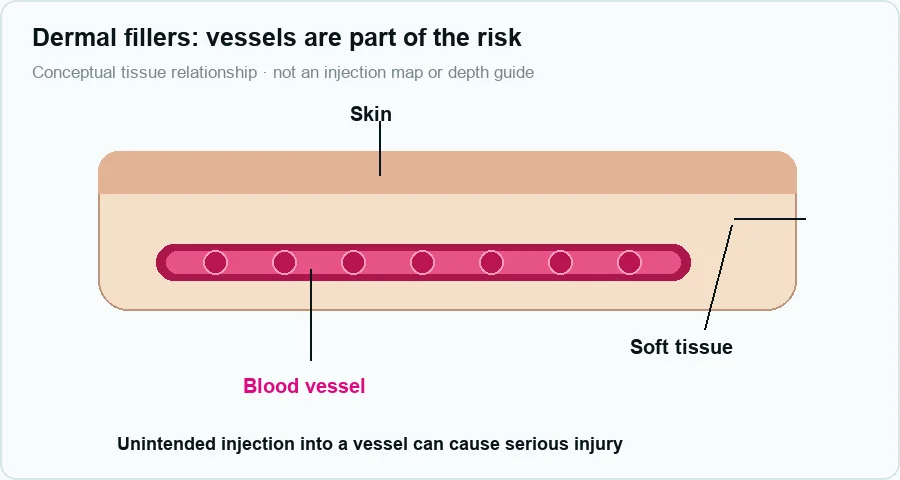
Filler can unintentionally enter a blood vessel, with serious consequences including tissue injury, blindness or stroke. FDA advises immediate medical attention for unusual pain, vision changes, white, gray or blue skin near the injection site, or stroke signs during or shortly after the procedure. Do not wait for a routine appearance review to report those symptoms. A brief cosmetic appointment does not make urgent symptoms less urgent.
ASPS also lists potential bruising, swelling, asymmetry, lumps, infection and under- or overcorrection, alongside vascular harm. Ask how the office distinguishes an expected local reaction from a problem needing assessment and how to obtain help after hours. Avoid assuming that every lump or color change has the same cause. A photograph sent to a sales contact is not an adequate substitute for urgent care when concerning symptoms are present. ASPS risks and urgent-care discussion
Get the name of the administering professional and the care contact before treatment. Ask where you should go if an urgent problem occurs and what information another healthcare professional will need. Have the product and appointment record available, but do not let searching for a receipt delay medical attention. Recordkeeping supports care; it does not precede it in an emergency.
Bring an accurate history to a dermal fillers consultation
ASPS consultation guidance includes medical conditions, allergies, medications and supplements, prior fillers, botulinum toxin, lasers and facial surgery. Bring dates, named products and areas when you know them. For prior treatment with an unknown product, state that it is unknown and request records where possible. Guessing a material from an old appointment’s marketing name can make the history misleading. ASPS consultation record
Ask the clinician which history changes the proposed plan and why. Product ingredients and warnings matter at the specific-product level. Do not hide a past problem because it resolved or occurred at another office. Equally, do not infer your own contraindication from a general list; give the information to the professional who can assess it.
Include planned treatment elsewhere and upcoming events in the discussion. Do not stop prescribed medicines on your own to reduce the chance of bruising. Ask the responsible clinician for coordinated directions. If a broad package includes several areas or different products, obtain an explanation for each component rather than assuming the same assessment applies to all of them.
Compare dermal fillers quotes with defined volumes and care
ASPS notes that charges vary with product, procedure, professional expertise, time and location. Its current average figures lack sufficiently explicit year and sample details for this guide’s comparison standard, so they are omitted. Obtain the office’s actual written dermal fillers estimate. A syringe count, product volume and treatment fee are separate fields until the office defines how they relate. ASPS cost context
For a syringe-based estimate, record the exact product and the volume represented by the quoted syringe, along with the proposed quantity and any separate charge. For a treatment package, record its included sites, products, assessment and follow-up. Do not compare “one syringe” from different proposals as if the formulation and volume necessarily match. A unit price is only useful after the billable unit is defined.
| Financial field | Record from the actual estimate | Keep clinically separate |
|---|---|---|
| Product and volume | Named formulation and billable amount | Appropriate treatment amount |
| Base charge | Written syringe, volume or package fee | Expected appearance |
| Additional care | Consultation and other disclosed charges | A promise that no care will be needed |
| Follow-up | Timing, included assessment and policy | An automatic additional injection |
| Correction or removal | Assessment and financial policy if needed | Guaranteed reversibility |
| Future treatment | Separate optional planning scenario | A universal repeat schedule |
Calculate the known subtotal by adding only disclosed charges. Keep unknowns in a separate column. If two written estimates describe comparable scope, their ratio can show the financial difference; it cannot show which product is medically appropriate. A cheaper amount may reflect different volume, formulation or care. Resolve those differences before treating the totals as equivalent offers.
Ask what happens if the clinician recommends less treatment than originally estimated, postpones part of a package or advises against additional treatment at follow-up. Keep financial terms separate from clinical permission. An included “touch-up” should not be an obligation to inject more material when the clinician considers it unnecessary or inappropriate.
Plan dermal fillers follow-up and later assessment separately
ASPS describes an appointment involving assessment, site preparation, treatment and evaluation. Ask what the team intends to assess immediately and what requires later follow-up. This guide does not reproduce a treatment map or instruct you to choose injection points. The clinical proposal should explain the intended change without turning your consent conversation into a technical tutorial. ASPS appointment components
ASPS recovery guidance notes that initial appearance may include swelling, bruising, numbness or palpable areas, and that recovery varies by person and product. Get your own instructions for activity, skin care and when to contact the team. Do not classify every symptom as normal because swelling appears on a general recovery list. The urgent-symptom guidance takes priority when a concerning feature appears. ASPS recovery context
At an agreed appearance assessment, compare similar lighting, expression, angle and camera distance. Keep the product, date and any additional treatment attached to the photographs. An immediate post-treatment image is different evidence from a later result. A photograph after several appointments should not be interpreted as proof of what a single appointment will achieve.
Set an appearance goal that has a stopping point
Before treatment, describe how you and the clinician will judge the specific feature you want changed. This is different from asking how many syringes you can buy. A product quantity is an input to the plan; it is not a definition of satisfaction. Ask what appearance assessment they recommend and which aspects of the concern may remain even if the intended treatment effect occurs.
Keep the original goal at the follow-up. If it changes, record the new concern as a new decision rather than quietly replacing the first objective. A request for a different lip shape, a newly noticed facial feature or a broader rejuvenation goal may need a different explanation. Do not assume that a favorable response to one treatment supplies evidence for every additional area.
Ask what findings would lead the clinician to recommend waiting, reassessment, another option or no further treatment. An appropriate stopping point should be explainable without relying on the amount purchased or a package deadline. This is not a clinical threshold supplied by the article; it is a question about how the professional will assess the plan.
At the decision point, review three records together: the intended feature change, the product-specific information and the completed treatment history. Keep cost and convenience visible, but do not let them rewrite the purpose of care. A clearer next step may be a discussion rather than another injection, even when a promotion makes additional treatment seem easy to arrange.
Check the completed product record before a future decision
Request the completed dermal fillers treatment details rather than retaining only the quotation. Keep the exact products, dates, sites and documented quantities together. Mark any change from the original plan. This helps a later professional understand what actually happened instead of relying on a package name or an uncertain memory of a brand.
Organize follow-up concerns into appearance, local healing and health symptoms. Record when each concern began and obtain appropriate care. Timing is relevant information, but does not establish causation by itself. If another treatment is proposed, ask which concern it addresses and why; do not assume that more material is the answer to every disappointment.
FDA cautions against direct-to-consumer fillers and unapproved needle-free injection devices. It also warns against injectable fillers for body enlargement, including breasts or buttocks. An attractive label such as “needle-free” or “nonsurgical enhancement” does not define an approved product and use. Seek a clear professional explanation rather than purchasing an injectable product to administer yourself.
A complete dermal fillers decision identifies the goal, exact product and indication, alternatives, expected limitations, care responsibilities and full quote. You can decline or postpone while these remain unclear. The ability to buy additional treatment is separate from whether it is the appropriate next step.
For related planning, see the procedure index, Botox guide and facelift guide.
Sources and review scope
Plastic Surgery Editorial Team. Source records checked through October 11, 2026. Review scope: source and editorial checks for general education. No individual clinical assessment is represented.
- ASPS dermal fillers overview. plasticsurgery.org. Publication/update date not stated. Checked 2026-10-11.
- ASPS dermal fillers types. plasticsurgery.org. Publication/update date not stated. Checked 2026-10-11.
- ASPS dermal fillers results. plasticsurgery.org. Publication/update date not stated. Checked 2026-10-11.
- ASPS dermal fillers safety. plasticsurgery.org. Publication/update date not stated. Checked 2026-10-11.
- ASPS dermal fillers consultation. plasticsurgery.org. Publication/update date not stated. Checked 2026-10-11.
- ASPS dermal fillers cost. plasticsurgery.org. Publication/update date not stated. Checked 2026-10-11.
- ASPS dermal fillers procedure. plasticsurgery.org. Publication/update date not stated. Checked 2026-10-11.
- ASPS dermal fillers recovery. plasticsurgery.org. Publication/update date not stated. Checked 2026-10-11.
- FDA filler consumer guidance. fda.gov. Publication/update date not stated. Checked 2026-10-11.
- FDA dermal filler safety guidance. fda.gov. Publication/update date not stated. Checked 2026-10-11.
- FDA Kysse PMA supplement. accessdata.fda.gov. Source date: 2020-03-26. Checked 2026-10-11.
- FDA Defyne indication expansion. fda.gov. Source date: 2021-01-29. Checked 2026-10-11.
- Weiss et al. randomized lip filler study. pubmed.ncbi.nlm.nih.gov. Source date: 2021-04-01. Checked 2026-10-11.
- FDA aesthetic-device outcome measures. fda.gov. Publication/update date not stated. Checked 2026-10-11.