
Upper blepharoplasty is surgery to address excess tissue of the upper eyelids, often including skin that creates hooding or obscures the natural contour. It can serve an appearance goal or, in selected patients, a functional goal. The first decision is whether the concern comes from excess eyelid skin, the eyebrow’s position, a low eyelid margin, or a combination. Removing skin does not automatically correct every cause of a drooping appearance. ASPS eyelid surgery overview
The brow, upper-lid skin and eyelid edge need separate assessment. A useful plan identifies the structure being treated, how the eye will be protected and which result is realistic. This guide explains those distinctions, the limits of dry-eye research and how functional documentation differs from a cosmetic request. It does not provide a home test for eligibility or a personal operation recommendation.
Three structures can contribute to a hooded appearance
Upper-eyelid skin can form a fold that hangs over the lid. The eyebrow can also descend and affect the apparent amount of skin above the eye. Separately, ptosis describes a drooping upper eyelid margin. ASPS points out that upper-lid drooping may reflect the brow or a stretched eyelid muscle and that ptosis needs a different treatment. These possibilities can coexist, so a photograph alone should not determine which operation is appropriate. ASPS anatomical assessment guidance
This distinction changes what counts as a successful result. If your main concern is a skin fold, ask what part of that fold the proposed operation addresses. If the margin itself is low, ask whether the plan includes assessment for ptosis. If the brow contributes, ask how its position has been considered. A proposal should not leave you expecting one procedure to perform the job of another merely because all three concerns are described as hooded eyes.
| Structure to clarify | Concern it can contribute to | What to ask about the plan |
|---|---|---|
| Upper-eyelid skin | Overhanging fold or altered contour | Which tissue is being addressed and what remains |
| Eyebrow | Brow descent affecting the upper-eye region | Whether the brow contributes to the appearance or functional complaint |
| Upper-lid margin | A low-riding eyelid edge, termed ptosis | Whether a separate ptosis assessment or treatment is needed |
| Eye surface and closure | Comfort and eye protection | How existing symptoms influence suitability and follow-up |
The table organizes discussion; it is not a diagnostic score. Avoid pulling or taping the skin yourself to select an operation. Clinical assessment may evaluate structures together, but the explanation should still make their different roles understandable. Being able to describe the proposed scope is more valuable than choosing a treatment from an image that resembles your concern.
Upper blepharoplasty and ptosis repair are different operations
ASOPRS describes ptosis as a low-riding upper lid that can affect one or both eyes and may obstruct the upper visual field. Its treatment addresses the eyelid’s elevation mechanism; the exact approach depends on the assessment. That is different from a discussion focused on excess skin. It also means that a drooping lid should not automatically be attributed to normal aging without evaluation. ASOPRS ptosis explanation
When more than one operation is proposed, ask which component addresses which finding. Upper blepharoplasty might be discussed alongside a ptosis procedure or brow treatment, but the name of the skin operation alone does not establish the complete scope. Ask whether the intended improvement is in the fold, lid position, field of vision, symmetry or several of these. The distinction helps prevent dissatisfaction caused by an expectation the proposed procedure was never designed to meet.
A useful consent conversation should also describe what may remain different between the two eyes. Perfect symmetry is not a realistic guarantee. If your starting eyelid positions differ, ask how the clinician distinguishes existing asymmetry from the change being sought. A surgeon can explain an individualized plan without promising a millimeter target or inviting you to diagnose your own eyelid mechanics.
The operation involves more than a hidden incision
ASPS describes upper-eyelid access through the natural crease, allowing removal or repositioning of fat, muscle tightening and removal of excess skin as appropriate. This explains broad procedural scope, not a requirement that every patient needs every component. A natural crease is a planned location for an incision; it does not mean the procedure has no scar or healing burden. ASPS procedure description
Ask whether the proposal is primarily skin treatment and whether muscle or fat will also be addressed. The answer should include why those choices fit the examination. More tissue removal is not automatically a better result, and a technique name does not explain how eye closure and contour will be preserved. Avoid treating a short description of the incision as the full operation.
If upper and lower eyelid surgery are combined, keep their goals separate. A change in the upper fold does not show what will happen to an under-eye bag, and a lower-lid contour plan does not define upper-lid function. Request a component-by-component explanation so the recovery instructions, price and follow-up correspond to the actual operation rather than the broad phrase eyelid surgery.
Eye-surface assessment belongs before the aesthetic decision
ASOPRS explains that dry eye, thyroid eye disease or eyelid laxity may need attention before blepharoplasty. Mention irritation, existing eye treatment and previous procedures even if you are seeking surgery for appearance. Eye comfort should not become a detail discussed only after the date is booked. It can influence the sequence and scope of care. ASOPRS eyelid and brow guidance
ASPS consultation guidance also asks about eye problems, medical conditions, current medicines and previous surgeries. Bring a complete history and ask what additional assessment is appropriate for you. A reassuring external photograph does not establish that the eye surface is healthy, and a general eligibility list is not medical clearance. ASPS consultation scope
Keep symptoms and appearance goals in different parts of your notes. For example, record the cosmetic feature you want changed separately from discomfort or difficulty with usual visual tasks. This lets the clinician address each concern without assuming that a cosmetic improvement will necessarily resolve symptoms. It also provides a clearer starting point for comparing what has changed at follow-up.
Dry-eye studies do not support a universal promise
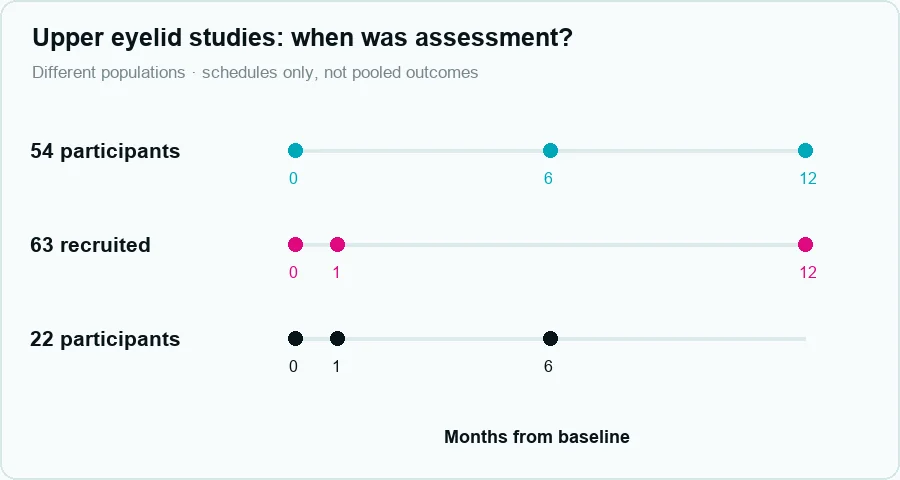
A double-blind randomized trial enrolled 54 healthy patients and compared upper blepharoplasty with and without removal of a strip of orbicularis muscle. It assessed tear measures and symptoms before surgery and at six and twelve months. The paper appeared online in October 2021 and in the August 2022 issue. Most outcomes did not differ significantly between techniques, while symptom scores improved over time in that selected group. This is not proof that surgery treats dry eye in every patient. Original 54-patient randomized study
A second randomized study recruited 63 patients without prior dry-eye syndrome or other severe conditions. Published online in June 2023, it assessed symptoms and several objective measures before surgery, at one month and at one year. It reported subjective improvement in both technique groups without significant differences in objective assessments. Its eligibility criteria matter when applying the findings to someone who already has an eye-surface disorder. Original 63-patient randomized study
Different populations and observation times can produce different findings
A smaller single-surgeon study published in March 2024 followed 22 patients, assessing one eye per person before surgery and at one and six months. It reported worsening in some symptom and eye-surface measures after skin and muscle-strip removal. This was not a randomized comparison of two techniques. The finding deserves attention, but it should not be combined with the two randomized trials into a simple universal verdict. Original 22-patient ocular-surface study
The useful question is how closely a study resembles your starting situation and proposed procedure. A healthy trial population is not interchangeable with a patient who already needs eye-surface treatment. A one-month observation is also not the same as a twelve-month assessment. Subjective comfort and an objective tear measurement can describe different aspects of the result. Ask which findings are most relevant to the risks the surgeon identified during your examination.
| Research feature | Why it matters | What to avoid concluding |
|---|---|---|
| Baseline eye health | Some trials excluded prior dry-eye disease | Findings automatically apply to established disease |
| Procedure components | Skin-only and skin-plus-muscle comparisons differ from a single series | Every upper-lid operation is the same |
| Follow-up timing | Studies observed different postoperative intervals | Early and later measurements are interchangeable |
| Outcome type | Symptoms and tear measurements answer different questions | A change in one proves all aspects improved |
The supporting graphic should show the actual study assessment schedules rather than invented changes in tear scores. Three timelines can mark baseline and the reported follow-up visits. This makes an important evidence distinction visible without manufacturing an effect size or pretending that the studies establish a personal complication probability.
Functional goals require documentation, not a cosmetic label
If your concern involves vision or everyday tasks, describe the actual difficulty. A functional assessment may investigate how the eyelid or brow affects the visual field and whether the proposed procedure addresses that finding. It is a separate question from whether you would prefer a different appearance. A cosmetic goal and a functional complaint can coexist, but one does not establish the other.
A Medicare local coverage determination, L34528, has a revision effective January 1, 2026. It distinguishes functional complaints and documented examination or visual-field findings from cosmetic surgery. It is a contractor-specific policy, not a universal coverage rule or proof that your operation will be paid for. The applicable policy and documentation must be checked for your plan and situation. Current CMS local coverage policy example
Ask the clinical and billing teams to clarify which part of a proposed operation is being evaluated as functional and which part is cosmetic. A favorable clinical recommendation is not the same as an insurer’s decision. Obtain the relevant requirements and cost responsibilities before surgery rather than relying on a general statement that hooded eyes are covered. No diagnosis code, test threshold or coverage guarantee is supplied here for self-qualification.
Describe functional difficulty in everyday terms
If function is the reason for seeking evaluation, record the tasks that are difficult and when the problem occurs. Reading, looking ahead and completing a prolonged visual task are different situations. Explain whether the concern is constant or variable and whether one side seems different. These notes do not establish the diagnosis, but they give the clinician a clearer question than a general wish for eyes to look more open.
Ask how the proposed assessment connects to the task you described. A photograph documents appearance; a visual-field test investigates a different aspect of function; a symptom questionnaire records your experience. None should be presented as answering every question about eye health. If the clinician recommends more than one assessment, ask what each is intended to clarify.
Keep your own goal separate from an insurer’s documentation requirement. A coverage threshold is an administrative criterion in an applicable policy, not a universal definition of the operation you need. The best clinical sequence may also include addressing an eye condition before deciding about skin surgery. This distinction helps preserve an informed treatment decision when financial coverage and medical evaluation are proceeding together.
Risks include eye protection as well as appearance
ASPS identifies risks such as bleeding, infection, scarring, dryness, difficulty closing the eyes, changes in eyelid position, revision and visual complications, including a very rare possibility of blindness. These are categories for informed discussion, not a personal probability. A crease incision or muscle-preserving description does not establish that every risk has been eliminated. ASPS risk categories
Ask which problems the surgeon considers most relevant to your eye history and complete operation. Separate residual hooding or asymmetry from issues involving closure and comfort. Those concerns may have different explanations and follow-up needs. A consent form is more useful when you can explain how to obtain help for a concerning change, rather than only recognize a list of possible complications.
Arrange an explicit contact plan for postoperative concerns, including outside ordinary hours. New or worsening visual symptoms should receive prompt clinical assessment; do not use a recovery photograph or internet calendar to decide they are normal. Discuss the warning signs and escalation instructions with the team before the operation, when there is time to clarify them.
Recovery has several milestones
ASPS describes early healing that can include swelling, bruising, irritation, dry eyes and discomfort, along with individualized eye-care and follow-up instructions. Your regimen should reflect the procedure actually performed. A friend who had a different eyelid operation is not a source of medication or compress instructions for your care. ASPS recovery guidance
The same society gives a broad estimate that most eyelid-surgery patients are presentable in public in ten to fourteen days, while final healing may take months. Public appearance is not clearance for driving, lenses, exercise or occupational tasks. Ask about the activities you actually need to resume and what findings determine readiness. ASPS healing and result scope
| Milestone | Ask for individualized advice about | Keep separate from |
|---|---|---|
| Immediate discharge | Transport, assistance and eye-care instructions | Independent activity readiness |
| Return to tasks | Vision demands, work and usual activities | A public-appearance estimate |
| Early review | Closure, comfort, wounds and prescribed care | Final aesthetic judgment |
| Later assessment | Residual contour or symmetry concerns | A guarantee that aging stops |
Preparation can include medical evaluation, smoking cessation and clinician-led medication adjustments. Coordinate any changes with the surgical team and the clinician who prescribed treatment. A generic instruction to avoid a medication is not permission to stop it yourself. Make sure written preparation and recovery advice includes any ptosis, brow or lower-lid procedure performed alongside upper blepharoplasty. ASPS preparation guidance
Evaluate results with consistent photographs and stated goals
Before comparing images, identify which feature you are judging. More visible upper-lid contour, a changed lid margin and a changed brow are different observations. Ask which procedures were performed and when the photograph was taken. An image from a combined operation cannot isolate the contribution of the skin procedure, and an early result does not document all later outcomes.
Look for consistent lighting, head position and expression. A raised brow or a different gaze can make the upper-eye region harder to compare. These checks do not prove that an image is misleading; they identify information needed to interpret it. A photograph also cannot document eye comfort or replace functional testing. Keep those outcomes in the written follow-up discussion.
An editorial portrait used to illustrate this topic is not a surgical result. A structure diagram explains anatomy, and a study timeline explains observation. Neither should be presented as a patient’s experience. The useful comparison remains your defined starting concern against the stated scope of the operation, not an undocumentable promise to match an attractive example.
Compare scope before comparing price
ASPS distinguishes a surgical fee from the total that includes anesthesia, facilities and related expenses. No dated national upper blepharoplasty total is supplied here because the displayed fee’s data year was not verified. Request an estimate for your actual operation, including any combined procedure and follow-up arrangements. ASPS cost scope
Compare upper-lid skin surgery with the same scope elsewhere. A quote including ptosis repair, brow treatment or lower eyelids is not directly comparable with an upper-skin-only fee. Clarify any insurer decision, patient responsibility and later-care terms separately. The lowest number is not a complete comparison until the proposed treatment is understandable.
Before deciding, summarize the plan in a few sentences: which structure is responsible, what is being treated, which eye-health issues matter and how results will be assessed. If those answers remain unclear, more photographs or a simpler procedure name will not resolve the uncertainty. A useful decision connects the expected benefit with its limits and the care required to pursue it.
For related planning, read the main eyelid surgery guide, complete-cost explanation and procedure guide index.
Sources and review scope
Plastic Surgery Editorial Team. Source records checked through October 11, 2026. Review scope: source and editorial checks for general education. No individual clinical assessment is represented.
- ASPS eyelid surgery overview. plasticsurgery.org. Publication/update date not stated. Checked 2026-10-11.
- ASPS brow versus skin versus ptosis. plasticsurgery.org. Publication/update date not stated. Checked 2026-10-11.
- ASOPRS ptosis distinction. asoprs.org. Publication/update date not stated. Checked 2026-10-11.
- ASPS crease access and tissue scope. plasticsurgery.org. Publication/update date not stated. Checked 2026-10-11.
- ASOPRS eye health before blepharoplasty. asoprs.org. Publication/update date not stated. Checked 2026-10-11.
- ASPS eye history and assessment. plasticsurgery.org. Publication/update date not stated. Checked 2026-10-11.
- Original54-person randomized upper-lid tear study. pubmed.ncbi.nlm.nih.gov. Source date: 2021-10-06. Checked 2026-10-11.
- Original63-person randomized dry-eye study. pubmed.ncbi.nlm.nih.gov. Source date: 2023-06-24. Checked 2026-10-11.
- Original22-person single-surgeon ocular-surface study. pubmed.ncbi.nlm.nih.gov. Source date: 2024-03-22. Checked 2026-10-11.
- CMS local coverage example L34528 current revision. cms.gov. Source date: 2026-01-01. Checked 2026-10-11.
- ASPS risks. plasticsurgery.org. Publication/update date not stated. Checked 2026-10-11.
- ASPS recovery care. plasticsurgery.org. Publication/update date not stated. Checked 2026-10-11.
- ASPS healing milestones. plasticsurgery.org. Publication/update date not stated. Checked 2026-10-11.
- ASPS preparation. plasticsurgery.org. Publication/update date not stated. Checked 2026-10-11.
- ASPS surgical fee versus total. plasticsurgery.org. Publication/update date not stated. Checked 2026-10-11.