
RF microneedling uses small electrodes to deliver radiofrequency energy and produce local heating in tissue. It differs from microneedling without an energy source. Before considering treatment, establish the exact device, intended concern and treatment region, then discuss the risks that apply to that proposal. FDA’s October 2025 communication identifies reports of burns, scarring, fat loss, disfigurement and nerve damage, sometimes requiring medical or surgical intervention. A “rejuvenation” description should not replace that discussion. FDA RF microneedling safety communication
The central decision is whether a defined treatment has useful evidence for the concern you want changed, with risks and recovery you accept. A familiar device nickname, impressive photograph or short appointment is not enough to establish that match. This guide separates device scope, scar and wrinkle research, treatment burden and financial assumptions. It does not recommend needle depth, energy settings or a personal treatment schedule.
RF microneedling is different from ordinary needling
Both terms refer to procedures involving small needles, but the RF component adds a source of energy. FDA explains that RF devices work differently and have different risks. Do not treat a general description of microneedling as evidence for every energy-delivering device or every proposed use. Ask which procedure is actually being offered and whether its written information describes the energy component clearly. FDA explanation of microneedling technologies
Ask whether the patient information and authorization summary refer to the same model the practice intends to use. Retain the model name with the date of the information reviewed.
Keep three fields separate in your notes: the device, the treatment concern and any additional product or procedure. This prevents an answer about one field from standing in for another. A clinician could use the same device for different concerns, or propose another intervention alongside it. Neither a shared device name nor a shared appointment makes the evidence for those tasks interchangeable.
Ask the clinician to explain the treatment without relying only on mechanism language. Statements about heating or a biological response can describe why a procedure might be studied; they cannot tell you how much visible change to expect. Request evidence about the outcome that matters to you. If you want a change in acne-scar texture, a study measuring another feature should not be presented as a direct answer to that goal.
Check the device and RF microneedling indication together
FDA’s RF safety communication describes Class II devices cleared through the 510(k) pathway and points readers to device summaries containing authorization dates and intended uses. Ask for the specific device name and its patient information. A broad statement that a treatment is “FDA cleared” should be followed by an explanation of which device and use that statement describes. Clearance does not erase the need to discuss adverse effects.
The useful record is the exact model, proposed body region, stated treatment goal and source of the intended-use information. If the practice changes the device between consultation and treatment, ask whether the explanation and consent information also need updating. Treat that as a substantive change to clarify, rather than assuming every RF device has identical evidence or patient instructions.
| Treatment record | Ask for this detail | Comparison error to avoid |
|---|---|---|
| Device | Exact model and patient information | Comparing a category name with a specific device |
| Concern | Scar texture, wrinkles or another defined task | Treating every “rejuvenation” claim as the same outcome |
| Region | Actual proposed treatment area | Extending one region’s evidence to the whole body |
| Added product | What is being used and why | Assuming device clearance covers a combined treatment |
| Course | Visits, reassessment and conditions for changing the plan | Treating one appointment as the studied course |
What does the RF microneedling safety warning establish?
FDA’s October 15, 2025 communication says its evaluation is ongoing and advises treatment by a licensed provider trained and experienced with the devices. It specifically says RF microneedling should not be used at home. These statements belong in a present-day decision, including when an older study or brochure uses reassuring language. The warning does not provide a numerical personal-risk estimate or a complete ranking of device safety.
Do not convert a report of injury into either a universal prediction or a claim that it can safely be ignored. The meaningful question is what the practice does to assess suitability, explain risks, monitor problems and arrange care. Ask how it handles a concern after treatment and whether the person providing follow-up has the information needed to identify the actual procedure and device.
Keep the safety discussion distinct from the benefit discussion. Evidence that a treatment improved a measured score in a selected study does not establish that serious injuries cannot occur outside that sample. A small study may offer useful information about a particular outcome while being unable to quantify uncommon complications. Neither type of evidence should be substituted for the other merely because one is more reassuring.
RF microneedling research: scars are not one universal endpoint
Paired treatment areas are not independent people
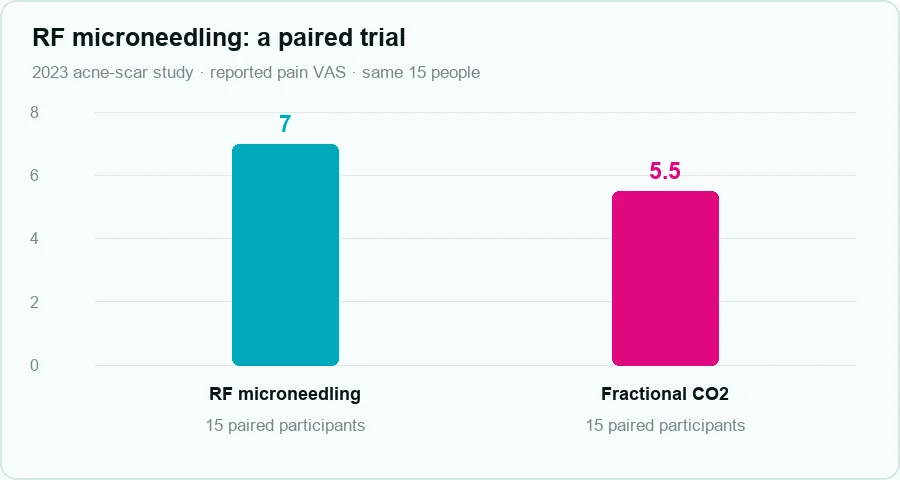
A randomized 2023 study compared fractional CO2 laser with microneedle radiofrequency in fifteen participants with moderate to severe acne scars. Similar test areas within each participant were assigned different treatments. After one treatment, the reported median texture improvement at three months was one point for each approach on the study’s 0–10 evaluation scale. That is a defined paired comparison, not proof of complete scar removal. Original randomized acne-scar study, first online March 19, 2023
The participants supplied paired observations: thirty treated areas did not mean thirty independent people. This matters when reading a chart or a headline about sample size. The individual comparisons help control for some differences between people, but do not transform a small study into a large population study. Ask whether a quoted sample count refers to people, facial halves, test areas or treatment sessions.
The same original abstract reports a higher treatment pain score for radiofrequency than laser, while some early skin reactions were more intense after laser. The reported pain values were 7.0 and 5.5 on a visual analogue scale. Benefit, discomfort and recovery are therefore separate dimensions. A shorter-looking recovery photograph would not establish that a treatment is less painful or better in every respect.
The study’s texture result also does not answer every question about wrinkles, pores or facial shape. Its participants, concern, single-treatment design and follow-up define the scope of the finding. If your proposed course or goal differs, ask the clinician to explain how relevant the study is, rather than importing the result simply because both proposals use radiofrequency energy.
What combination RF microneedling evidence can tell you
A separate twenty-person randomized split-face study compared nonablative fractional laser alone with an alternating laser and RF microneedling course. Ninety days after the final treatment, both facial halves improved, but the study found no statistically significant difference between approaches in its measured scar score or percentage improvement. This is a particular comparison of two courses, rather than a demonstration that adding RF always improves a laser result. Original alternating-treatment study, first online October 26, 2023
Keep the comparator visible. “Improved from baseline” describes change within a treated group; “better than the alternative” requires the between-treatment comparison. Both sides can improve without demonstrating that the more complex course offers an advantage. A combined package should have its own rationale, including any additional burden, instead of relying on the fact that each component has been studied somewhere.
An absence of a statistically significant difference is also not a guarantee that two procedures are equivalent in all circumstances. Sample size, variability, measurements and study design affect what can be detected. Ask what uncertainty remains and whether an asserted advantage is supported by the actual endpoint. This is especially useful when a package costs more or combines multiple sources of tissue effects.
| Evidence statement | Check the underlying comparison | Do not infer |
|---|---|---|
| Improvement from baseline | Which scale, region and assessment time? | That the treatment beat another option |
| Split-face study | How many people and paired areas? | That each area is an independent participant |
| No significant difference | Sample and design limits | Universal equivalence |
| Better recovery outcome | Which reaction and duration? | Less pain or better overall benefit |
| Combination treatment | The actual added component and comparator | That more procedures always produce more improvement |
Wrinkle and RF microneedling claims need their own evidence
An original prospective randomized split-face study examined microneedle radiofrequency and a nonablative fractional laser for facial photoaging in Asian patients. Its existence does not make scar-trial outcomes interchangeable with wrinkle outcomes. Ask which measured features and assessment times support the claim being made in your consultation. A device name should not become a shortcut around that distinction. Original facial-photoaging comparison
The photoaging abstract reports mean downtime of 6.96 days for RF treatment and 4.56 days for its laser comparator in fifteen participants. Those means are not deadlines for your own recovery. They also illustrate why a general claim that RF always has less downtime than any laser is too broad: the comparator and study context matter. This laser was nonablative, whereas the separate acne-scar trial compared an ablative fractional CO2 treatment. Changing the comparator changes the question being answered.
If a comparison table groups all lasers together, ask for the actual laser and endpoint to be identified before using the table. Do the same when all RF devices are grouped together. A table can be neatly designed and still conceal differences that make its apparent ranking unhelpful. The shared category is a starting point for research, not a substitute for the specific intervention used in the study or planned in your appointment.
Before evaluating a percentage, write down what the percentage represents. A scale-score change, the proportion meeting a response threshold and a satisfaction rating describe different observations. A claim of “collagen improvement” needs its own measurement and scope; it should not be illustrated by an unrelated photograph of a tighter-looking face. Separating those outcomes helps you identify what is genuinely relevant to your goal.
For photographs, ask whether posture, expression, lighting and follow-up date are comparable. Those questions improve the usefulness of the record, but they do not turn a photograph into a controlled study. If several interventions occurred between the images, request that information. A combined-treatment example cannot independently show which component produced the visible difference.
Skin history and RF microneedling suitability
FDA’s broader microneedling guidance describes suitability concerns involving bleeding, immune or skin conditions, medications and other circumstances. It also notes pigment-change risks and that some authorized devices were not studied in darker skin types. Bring your actual history rather than declaring yourself suitable based on an advertising claim about all skin tones. Ask what evidence exists for the device and proposed use in circumstances like yours. FDA device guidance and suitability considerations
Describe previous reactions, current skin concerns and earlier procedures even when they seem unrelated to the treatment package. Identify products and medicines you currently use, including those supplied by another clinician. Do not stop a prescription or change an established treatment yourself to meet an appointment schedule. The clinician should explain whether further information, another plan or deferral is needed.
The assessment should leave room for a goal that the proposed procedure does not address well. Men and women may seek changes in scar texture or wrinkles without wanting an altered facial shape. State what you want preserved as well as what you want improved. A consultation is more useful when the proposed outcome is specific enough to compare with that preference.
Products added to RF microneedling need separate scrutiny
FDA states that microneedling devices are not approved to deliver cosmetics, topical medicines, vitamins, drugs or blood products into skin. Do not assume an added serum, PRP or another product has been reviewed as part of the device’s authorized use. Ask what evidence supports the actual combination and whether the clinician is distinguishing it from the device-only evidence.
A study of a combination should identify the added intervention and comparator clearly. If both groups received RF treatment, the difference between them may concern the added product rather than RF versus no RF. Conversely, a result for a combined course does not establish the effect of the device alone. Record the proposed components separately so any later explanation of benefit, risk or cost uses the same plan.
RF microneedling recovery and the follow-up record
FDA’s consumer guidance describes skin reactions and advises asking about aftercare because skin may be more sensitive to sun exposure and skincare products. Obtain instructions for your actual procedure rather than copying a routine from ordinary needling or a different energy device. Ask when and how your normal products can be resumed, and who will answer if you develop a concerning reaction.
Also ask whether a new cartridge is used at every session and how reusable parts are handled. FDA says cartridge reuse is unsafe even if it is cleaned. A course consisting of several visits still needs a fresh cartridge for each session; being the same patient does not make reuse consistent with the agency’s guidance. Keep that question separate from general claims that the room or device is clean.
Prepare a dated record of symptoms and changes without attempting to diagnose them yourself. Ask which concerns require prompt assessment and what to do when the practice is closed. If you experience problems or are worried after treatment, FDA advises seeking licensed medical care. A portal photograph or message should not replace the practice’s instructions for an urgent situation.
Ask when the clinician intends to assess the result, separately from when visible reactions may improve. A later outcome assessment may use a different clock from the first visit or last visit. Keeping those dates distinct prevents early swelling, a temporary appearance or an incomplete course from being described as the final response. Record any additional treatment performed before the assessment.
Comparing RF microneedling cost fairly
This guide does not establish a dated national device-specific price range. Compare written estimates for the same treatment region, device, proposed course and included assessments. A per-session price is not a complete-course price, and the word “package” does not tell you whether consultation, numbing products, aftercare items or later assessments are included. Ask for those components explicitly rather than inferring them from the headline.
| Financial item | Clarify before comparing | Keep this distinction |
|---|---|---|
| Initial assessment | Separate fee or included service | Assessment versus treatment |
| Device and region | Actual planned treatment scope | Similar names versus comparable procedures |
| Course | How further sessions are decided and charged | Per-visit quote versus possible commitment |
| Added intervention | Separate purpose and charge | Device evidence versus combination package |
| Follow-up and changes | Included assessments and cancellation terms | Monitoring versus additional treatment |
If an estimate assumes several visits, ask what happens if the plan changes after reassessment or if you choose not to continue. Prepayment should not substitute for a new clinical discussion when the treatment circumstances change. Consider the practical time and support burden as well as the fee, without assuming that a low first-session price is the least costly usable plan.
A useful RF microneedling decision
Leave with the exact device and proposed use, the concern it is intended to address, the research outcome relevant to that concern, acknowledged uncertainties and a current safety discussion. The record should also explain follow-up, changing the course and financial scope. A mechanism, a clearance statement and a favorable image answer different questions; none replaces a complete benefit-and-risk assessment.
For related planning, see the procedure guide hub, clinician selection guide and cost planning guide.
Sources and review scope
Plastic Surgery Editorial Team. Source records checked through October 11, 2026. Review scope: source and editorial checks for general education. No individual clinical assessment is represented.
- FDA RF microneedling safety communication. fda.gov. Source date: 2025-10-15. Checked 2026-10-11.
- FDA consumer microneedling guidance. fda.gov. Publication/update date not stated. Checked 2026-10-11.
- Original randomized single-treatment split-area scar trial. pubmed.ncbi.nlm.nih.gov. Source date: 2023-03-19. Checked 2026-10-11.
- Original alternating laser/RF trial. pubmed.ncbi.nlm.nih.gov. Source date: 2023-10-26. Checked 2026-10-11.
- Original photoaging split-face trial. pubmed.ncbi.nlm.nih.gov. Source date: 2022-01-27. Checked 2026-10-11.
- FDA device/use/suitability guidance. fda.gov. Source date: 2025-10-15. Checked 2026-10-11.