
Laser skin resurfacing uses light-based treatment to address selected wrinkles, scars and other skin concerns. There is no single resurfacing procedure: the device, treatment pattern, intended tissue effect, area and course all matter. Two useful distinctions are whether treatment is ablative or nonablative and whether it is fractional or nonfractional. Fractional does not automatically mean nonablative, painless or free of visible recovery. The decision should begin with the diagnosed concern and the proposed treatment, rather than selecting a brand or the strongest-sounding laser. ASPS resurfacing overview ASPS laser classification learning objectives
For a reader comparing offers, the most useful record contains indication, device, pattern, area and course. It should also distinguish the expected cosmetic change from the recovery burden and the remaining uncertainty. This guide explains those fields, how to read actual comparative studies and how to evaluate complete proposals without turning device settings into self-treatment instructions.
Two classification questions, not one ladder of intensity
ASPS’s professional educational catalog distinguishes ablative versus nonablative treatment from fractional versus nonfractional treatment. Its patient procedure guidance describes CO2 and erbium resurfacing that removes superficial skin tissue. These sources concern different levels of explanation; the catalog establishes the classification axes, while the patient guidance describes particular resurfacing approaches. ASPS procedure guidance
Fractional photothermolysis was introduced in an original 2004 study as an array of microscopic treatment zones. The pattern is the key concept here, rather than treating every part of the field identically. That early prototype research does not supply universal modern device settings, recovery times or outcome percentages. Original fractional photothermolysis study
For a consultation, ask the clinician to identify each classification separately. If the proposal says fractional CO2, what does each term describe? If it names a nonablative fractional device, what concern is it intended to treat and why? You do not need to choose the settings yourself. You need an explanation that makes the operation or treatment identifiable enough to compare with another offer and with the relevant research.
Do not arrange different labels on a simple stronger-to-weaker scale. A procedure can change in wavelength, pattern, area or number of sessions, and a study can compare more than one of those features at once. The most informative comparison names the exact intervention. A broad claim that “fractional is better” leaves both the comparator and the outcome unclear.
| Treatment identity field | What to request | Why the name alone is insufficient |
|---|---|---|
| Indication | Diagnosed concern and proposed endpoint | Scar, pigment and wrinkle goals are different |
| Device | Exact laser or technology | A brand may encompass different treatments |
| Tissue effect and pattern | Ablative/nonablative and fractional/nonfractional | These are separate classification questions |
| Area and course | Region, sessions and reassessment | One treatment is not equivalent to a course |
Match the endpoint to the skin concern
ASPS lists wrinkles, scars and blemishes among resurfacing concerns. Its broader skin-rejuvenation guidance distinguishes texture, pigmentation and other skin features and describes several different treatment categories. ASPS skin-rejuvenation categories A proposal should therefore identify which feature is expected to change. Improvement in one feature should not be used as proof that every concern has been addressed.
For an acne-scar concern, ask how the scars are being assessed and what result measure will be used. For a pigment concern, establish the diagnosis rather than treating all dark patches as the same problem. For wrinkles, distinguish skin texture from a goal involving facial contour or loose tissue. A laser device cannot be evaluated fairly without knowing which question it is supposed to answer.
Write your priority in ordinary language before looking at treatment packages. If two concerns matter, rank them and ask whether one treatment addresses both or whether separate decisions are needed. This prevents an attractive combined-treatment image from setting expectations for a single component. It also helps you recognize when the proposed intervention is outside the scope of the result you want most.
Do not treat resurfacing as a substitute for assessing an unexplained or changing skin lesion. The clinician must determine whether cosmetic treatment is appropriate. A consultation that identifies a different diagnosis or recommends deferral has supplied useful information even if no laser is scheduled. The purpose of the assessment is to clarify the skin problem and the available options, not to fit every concern to the same machine.
Comparative research shows tradeoffs, not a universal winner
An original eight-person randomized split-face acne-scar study compared one session of nonablative fractional erbium-glass treatment with ablative fractional CO2 treatment. It assessed improvement at three months and reported longer mean crusting and redness on the CO2-treated side. The small population and specific devices limit wider conclusions. Original single-session split-face comparison It illustrates why an outcome discussion should include recovery rather than only a cosmetic score.
A separate original randomized split-scar study enrolled 100 people with traumatic or surgical scars and compared nonablative and ablative fractional treatment over a course. Patient reports and blinded observer assessment did not produce one simple story of superiority. Its scar population is different from an acne-scar population. Original traumatic and surgical scar comparison Combining the studies into a single “laser success rate” would discard the distinctions that make them interpretable.
When reading either paper, look at the treated condition, number of sessions, comparator and timing. A single-session study cannot automatically answer the question posed by a multi-session package. An acne-scar result does not establish treatment of every wrinkle or pigment condition. Likewise, a patient satisfaction measure and an observer’s scar score are different outcomes. Both can be relevant, but they should keep their names.
A current trial separates scar change from recovery
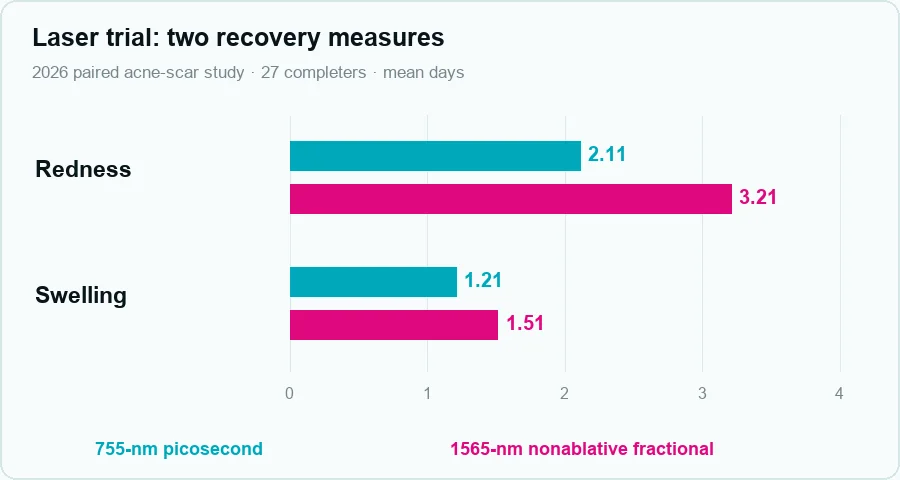
A September 2, 2026 split-face study analyzed 27 completers after comparing a 755-nm picosecond treatment with a 1565-nm nonablative fractional treatment. It found no statistically significant difference in its scar-score comparison, while reported mean redness duration was 2.11 versus 3.21 days and swelling duration 1.21 versus 1.51 days. The final assessment was three months after the treatment course. Four enrolled participants did not complete follow-up; analysis included completers only. Original 2026 comparison: methods and results
Those recovery values can support a clearly labeled chart of what happened in that trial. They cannot become your return-to-work date or a universal comparison of every device in either category. The absence of a statistically significant scar-score difference also does not prove that all treatments are identical. It describes what this study detected under its conditions, with its sample and follow-up.
Skin characteristics and treatment history matter
ASPS candidacy guidance emphasizes evaluation of whether resurfacing is appropriate for the individual and the concern. ASPS candidacy considerations Ask how the clinician assesses your skin, previous treatments and history of pigment or healing problems. A device advertised for many skin types still requires an explanation of the particular treatment being proposed.
Describe previous reactions precisely: the procedure or product, the area, what changed and how it was managed. Bring the names of medicines and active skincare products rather than describing all of them as routine skincare. Ask whether that history changes the plan or creates a reason for further assessment. Do not start a preparation regimen or stop a prescription from a study protocol or another person’s account.
Check how closely a study population resembles the proposed indication. A trial involving selected people and a particular scar type cannot establish a personalized risk estimate for every complexion. Ask what evidence is relevant and where the clinician must rely on individual assessment. An honest explanation can include uncertainty; a claim of universal suitability without a defined treatment gives you less information.
Nonablative and fractional do not mean no adverse effects
ASPS recovery guidance identifies infection, cold-sore reactivation, pigment changes, prolonged redness and scarring among resurfacing complications. ASPS complications and recovery guidance These are categories for a clinical discussion, not probabilities that this guide can personalize. Ask which concerns apply to your proposed treatment and how the team plans to assess and manage them.
Read the actual adverse-event observations rather than treating a classification as a safety guarantee. A trial comparing nonablative technologies may still record visible skin reactions. A study with no observed event cannot prove that the event is impossible outside that sample. Likewise, a shorter mean duration of one reaction does not establish that every other reaction is less frequent or less important.
Request written instructions that distinguish anticipated healing changes from concerns needing assessment. The contact route and access to examination should be clear before treatment, especially if you are traveling. A generic website description is not a substitute for instructions tied to the actual procedure. If a concerning change occurs, use the treating team’s assessment route rather than applying a second treatment to try to correct it yourself.
Preparation and aftercare belong to the actual treatment
ASPS procedure guidance discusses individualized skin preparation, pain management and protective care after treatment. ASPS preparation and procedure context The details depend on what is being done. A guide can help you ask about these responsibilities, but it cannot choose an anesthetic, prescribe preventive medicine or specify device settings for you.
Ask what care you will need to perform, how long it is expected to continue and what practical arrangements support it. Consider your actual workday and home environment. Outdoor exposure, travel, exercise and a public-facing job create different planning questions. Discuss them with the clinician rather than treating a recovery photograph as permission to resume every activity.
Separate healing, visible redness and final response assessment. A person may feel well while still having visible changes; a skin surface may look improved before the agreed outcome assessment. The calendar should identify the relevant decision at each review. This avoids turning a short period of discomfort into a claim that the entire treatment and recovery are complete.
| Planning milestone | Question to resolve | What it does not authorize |
|---|---|---|
| Preparation | Which written instructions apply to this treatment? | An independently chosen medicine or product change |
| Early healing | What care and contact arrangements are needed? | Automatic clearance from a photograph |
| Visible recovery | What changes may affect work or social plans? | A guaranteed date derived from a study mean |
| Outcome review | Which original concern and measure are evaluated? | A universal durability claim |
Compare the complete course, including reassessment
ASPS cost guidance separates ablative and nonablative categories and notes that fees vary with scope and other factors. ASPS cost categories A category average is not a verified total for your proposed device, area and course. This guide does not insert an undated national amount into a current personal budget or imply that a more expensive device provides better results.
Request a dated estimate stating the treatment area, sessions, accompanying care and follow-up. Ask when the clinician will reassess before another session. A course should have an explained purpose rather than merely bundle several appointments. If more than one technology is included, identify what each contributes and whether the evidence concerns that combination or only one component.
Compare practical costs separately from medical charges: travel, time away from work and any required support. A lower session price can still describe a different total commitment if the number of sessions or included care differs. Do not convert a quoted per-session price into a final total without confirming the planned scope and the policy if treatment changes after reassessment.
Ask about additional-care and cancellation terms in writing. If healing concerns or an unclear response lead the clinician to pause a course, understand how prepaid sessions are handled. Financial terms should be clear without making the decision about suitability dependent on using every purchased appointment. An unused session is not a lost cosmetic benefit if the plan no longer supports it.
| Offer field | Information to compare | Common misleading shortcut |
|---|---|---|
| Exact intervention | Device, effect and pattern | Comparing brand names alone |
| Scope | Area and sessions | Treating one session and a course as equal |
| Expected endpoint | Measure and timing | Calling every favorable photo success |
| Included care | Preparation, follow-up and policies | Treating the session charge as the complete commitment |
Make photographs and charts answer a specific question
If photographs are used, seek comparable lighting, angle and presentation and identify the timing. Ask whether another procedure, skincare regimen or makeup contributed to the shown appearance. An example can help illustrate a result while remaining unable to isolate a single treatment. The record should preserve that distinction rather than invite you to assume every visible difference came from one laser session.
For a chart, identify the unit before reading the bars. Mean days of redness describe a recovery observation; a scar score describes a different endpoint. Neither is a percentage of patients cured. A chart of one small study should retain the number analyzed, the treatment course and the assessment timing. Those details are part of the result, not optional fine print.
Also ask which observations are missing. If the final follow-up is measured in months, it cannot directly establish outcomes many years later. If the analysis excludes people who missed follow-up, keep that exclusion visible. A new device or recent publication may add useful evidence, but recency does not remove the need to inspect its design and limitations.
Improvement and comparison answer different questions
When a study reports improvement from baseline, its first question is whether the measured condition changed after treatment. A head-to-head comparison asks a second question: did the change differ between the treatments? Both sides of a split-face study can improve while the study detects no significant difference between them. A headline that mentions only improvement cannot establish which treatment should be preferred.
Keep the comparison tied to its stated endpoint. If the question concerns the duration of redness, a scar-score result does not answer it. If the priority is scar appearance, shorter redness alone cannot demonstrate a larger cosmetic change. A reader may reasonably value both, but the final decision requires weighing separate observations rather than collapsing them into a single ranking.
The same caution applies when an offer promises a percentage improvement. Ask whether that percentage represents change in a measured score, a category assigned by an evaluator or a proportion of participants who reached a threshold. Those numbers have different meanings. A score reduction is not automatically the proportion of scars removed, and an evaluator’s category is not a count of people whose skin became normal.
Request the assessment point and what was included in the measurement. If several treatments contributed, the number describes that course under its conditions. If no numerical effect relevant to your proposed treatment has been verified, leave the estimate uncertain rather than importing a figure from a different device or indication. Clear uncertainty is more useful than a precise-looking percentage with the wrong denominator.
Choose a plan that remains clear after the brand name is removed
A strong laser skin resurfacing proposal identifies the skin concern, exact intervention, expected endpoint and practical course. It explains the potential adverse effects and the arrangements for care and reassessment. You should be able to compare those fields with another proposal without relying on a slogan about strength, speed or rejuvenation.
Decide whether the expected change is valuable enough for you given the recovery burden, cost and uncertainty. A smaller treatment, a different approach or deferring an elective procedure can all be reasonable outcomes of that discussion. The important point is that the choice follows a diagnosed concern and an understandable plan, rather than a device label that promises to address every aspect of the skin.
For related context, see the facelift guide for a separate surgical contour decision, complete cost planning and procedure library.
Sources and review scope
Plastic Surgery Editorial Team. Source records checked through October 12, 2026. Review scope: source and editorial checks for general education. No individual clinical assessment is represented.
- ASPS resurfacing scope. plasticsurgery.org. Publication/update date not stated. Checked 2026-10-12.
- ASPS classification learningobjectives. ednet.plasticsurgery.org. Publication/update date not stated. Checked 2026-10-12.
- ASPS ablativeprocedurecontext. plasticsurgery.org. Publication/update date not stated. Checked 2026-10-12.
- Originalfractionalconceptprototype study. onlinelibrary.wiley.com. Source date: 2004-06-18. Checked 2026-10-12.
- ASPS distinctskinconcerns. plasticsurgery.org. Publication/update date not stated. Checked 2026-10-12.
- Original8-personsplitfacecomparison. pubmed.ncbi.nlm.nih.gov. Source date: 2009-12-17. Checked 2026-10-12.
- Original100-personsplit-scarstudy. pubmed.ncbi.nlm.nih.gov. Source date: 2020-06. Checked 2026-10-12.
- Original2026picosecondversusnonablativefractionaltrial. pmc.ncbi.nlm.nih.gov. Source date: 2026-09-02. Checked 2026-10-12.
- ASPS candidacy. plasticsurgery.org. Publication/update date not stated. Checked 2026-10-12.
- ASPS recoveryandcomplications. plasticsurgery.org. Publication/update date not stated. Checked 2026-10-12.
- ASPS costcategories. plasticsurgery.org. Publication/update date not stated. Checked 2026-10-12.