
Buccal fat removal reduces tissue from the buccal fat pad to change cheek contour. It can suit a selected concern about cheek fullness, but it is not a general solution for every round face, jawline concern or sign of facial aging. The first question is whether the feature you want changed actually corresponds to this tissue target. The second is whether you accept a tissue-removal decision whose longer-term appearance cannot be predicted from a short follow-up photograph.
Start with an examination, a precise description of the proposed change and a discussion of what will remain unchanged. A celebrity comparison cannot supply those answers. This guide uses original studies to distinguish candidate assessment, volume measurements and combined facelift outcomes. Its planning records help you compare the treatment scope, follow-up evidence and financial commitments without turning a group average into a surgical target for your own face.
What buccal fat removal changes
ASPS describes the operation as removal of the cheek’s buccal fat pad, with the goal of reducing fullness around the cheek hollows. It notes that a naturally thin or narrow face may be a poor setting for the procedure because the result can look more gaunt with age. ASPS procedure overview. That guidance supports careful selection, not a formula predicting exactly how your face will look decades later.
Describe the feature in your own words before naming a solution. Is it lower-cheek fullness, an indistinct jawline, an asymmetry or an overall impression that the face is too round? Ask the surgeon to identify which anatomical component explains the concern and whether changing the buccal fat pad addresses it. A photograph may help communicate what you notice, but it should not substitute for the assessment that links a feature to an operation.
Also ask what the plan does not address. An explanation limited to the desired hollow can leave the rest of the facial goal unclear. If the proposal includes another treatment, record its target separately. You should be able to explain why each component is present without assuming that a more extensive package always produces a more suitable result. Keeping the scope visible makes it easier to evaluate an offer and to decline an unnecessary addition.
Buccal fat removal candidacy should be specific to your face and your goal
The ASPS candidate guidance emphasizes an individualized decision, stable weight, physical health, realistic expectations and nonsmoking. It also advises choosing the procedure for yourself rather than another person’s preferences or an idealized image. ASPS candidate guidance. These general considerations are the beginning of an assessment; they do not establish that anyone meeting a brief checklist has the relevant tissue or will benefit.
A cross-sectional study published online January 22, 2022 examined 66 people reporting cheek fullness. Two surgeons classified 49 as suitable and 17 as unsuitable, then clinical and ultrasound measures were analyzed in relation to that judgment. The authors emphasized combinations of findings rather than isolated measures. This research studies assessment criteria; it does not prospectively prove decades of satisfactory appearance or provide a home eligibility test. Original clinical and ultrasound assessment study.
Ask how the clinician’s assessment applies to your face, not whether your selfie resembles a study illustration. If imaging is proposed, ask what question it is intended to answer and how the result changes the decision. Imaging may provide useful information in a particular assessment, but citing one study does not establish that every person requires the same investigation. Do not extract a cutoff from a paper and treat it as permission to operate.
| Concern you notice | Assessment question | Decision information to retain |
|---|---|---|
| Lower-cheek fullness | Does the buccal fat pad explain the feature? | Target area, expected change and remaining fullness |
| Jawline definition | Which structure determines the concern? | Whether the proposed operation actually addresses it |
| Unequal appearance | What explains the difference between sides? | Existing asymmetry, proposed scope and residual uncertainty |
| Fear of future hollowing | What is known about this plan over time? | Actual follow-up evidence and limits, not a simulated forecast |
Tissue volume is an outcome measure, not a beauty target
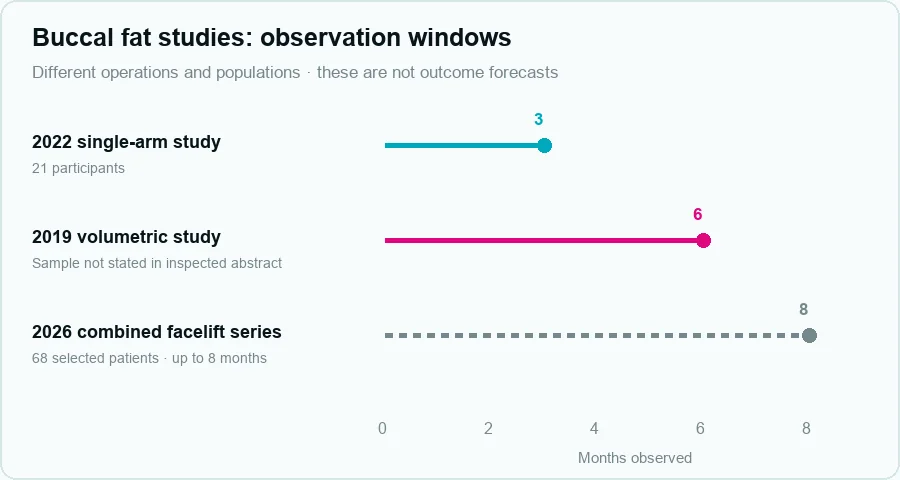
An original volumetric study in the May 16, 2019 journal issue assessed selected patients with ultrasound before surgery and at six months. It reported average pad volumes and the average volume excised, and cautioned about retaining midface volume. Those averages describe its selected group and protocol. They should not become a fixed amount to remove from someone else’s face. Original ultrasound volume study.
Volume and satisfaction answer different questions. A measured decrease establishes a physical change in the assessed tissue; it does not establish that the amount is aesthetically preferable for every individual. Ask how the proposed extent of reduction relates to your goal and tissue-preservation priorities. A plan can be specific without promising an exact future appearance. Avoid deciding that a larger tissue quantity automatically represents greater value or a better result.
Record how the surgeon describes the planned extent and what uncertainty remains. The important discussion is the balance between intended contour change and preserving an appropriate appearance for your individual face. Do not ask an online calculator to choose a removal amount. A group average, an operative record and a personal aesthetic goal are three different kinds of information, even when they all include the word volume.
Studies of appearance and satisfaction need their context
A single-arm clinical trial enrolled 21 people undergoing partial buccal fat removal and assessed pain, mouth opening, facial measurements, oral-health quality of life and facial satisfaction through three months. It reported improvements in some measured outcomes. With no untreated or alternative-treatment group and a short assessment window, it cannot isolate every influence on satisfaction or establish late-life appearance. Original single-arm outcome study.
A July 7, 2026 retrospective report included 68 patients aged 45–64 who underwent buccal fat management during a deep-plane facelift with one surgeon. Follow-up extended up to eight months. The paper reported contour improvements and described complications. These are combined-operation observations, not results of isolated cheek-fat excision in younger adults. Its reported absence of excessive hollowing during that window cannot settle what happens over decades. 2026 combined-facelift case series.
The difference between these populations is central to interpreting the evidence. A study involving a facelift, partial excision and possible suspension examines a different treatment package from a standalone removal offer. If a consultation uses its photographs or conclusions, ask which part of the study matches the proposed operation. Do not assume that sharing one anatomical term makes the procedures interchangeable or allows the entire outcome to be attributed to the fat-pad component.
| Original research | What was examined | Limit on applying it to a decision |
|---|---|---|
| Assessment study, online 2022 | 66 people; clinical judgment and ultrasound criteria | Candidate classification is not proof of later outcome |
| Volumetric study, 2019 issue | Selected patients; ultrasound before and at six months | Group volumes do not choose your removal amount |
| Single-arm trial | 21 patients; measurements and questionnaires through three months | No control group or decades-long forecast |
| Combined facelift series, 2026 | 68 patients aged 45–64; up to eight months | Different operation and population; no isolated effect or long-term guarantee |
Do not let a result lose its follow-up period
Eight months of observation cannot prove that an appearance remains unchanged for decades. A paper’s favorable wording must be read alongside its actual follow-up. Ask for the assessed time window, the number returning for assessment and whether any additional procedures occurred. If those details are absent from a promotional summary, request the source before treating the headline as a reason to undergo buccal fat removal.
Also distinguish no event observed from no possibility of an event. Small or selected samples cannot reliably describe every uncommon harm, and an early photograph cannot rule out a later concern. These limits do not erase an observed improvement. They make the confidence and duration of the claim proportionate to what was actually measured. You can consider a potential benefit while acknowledging that important longer-term questions remain unanswered.
Buccal fat removal and uncertainty about future appearance
The operation removes tissue; it should not be presented as a trial that can simply be switched off. Ask what the team means when discussing reversibility and what evidence supports any proposed way of addressing later dissatisfaction. A different treatment intended to add volume is not the same as restoring the original anatomy. The decision should include that distinction before surgery rather than after an unwanted result.
Avoid both categorical promises that the operation will age you and categorical assurances that it cannot. The more defensible discussion identifies your current anatomy, the proposed scope and the actual duration of relevant observations. Ask how uncertainty affects the clinician’s recommendation and whether doing less, postponing or choosing no operation is reasonable. A digital simulation may communicate a goal, but it cannot establish the biological course of your future face.
Write down which appearance changes you would dislike as well as those you want. For example, if retaining cheek fullness matters to you, make that priority explicit rather than only requesting definition. Ask how the clinician balances competing goals. This is especially useful when the desired look comes from a photograph that also reflects lighting, expression or other procedures. A precise discussion can reveal that the underlying goal differs from the procedure name you first researched.
Buccal fat removal risk discussion should include function as well as contour
The ASPS safety list includes asymmetry, infection, persistent pain, altered sensation, salivary-duct injury and facial-nerve injury that can cause temporary or permanent muscle weakness. It also includes suboptimal or minimal aesthetic change and possible revision. ASPS risks and safety. A small or hidden incision does not make those concerns irrelevant. Ask how they apply to your proposed operation and how a suspected complication is assessed.
Keep functional and aesthetic questions separate. Difficulty with a symptom or a possible nerve-related concern should not be reduced to whether the photograph looks satisfactory. Ask who provides assessment after hours, where you would be seen and how care is coordinated if you live elsewhere. A revision policy is not a substitute for a clinical response plan. You should understand the contact pathway before the appointment is scheduled.
At the buccal fat removal consultation, discuss medical conditions, allergies, medicines, supplements, tobacco use and previous procedures. The ASPS consultation guidance includes evaluation of health and risk factors, options, expected outcomes and anesthesia. ASPS consultation topics. Provide names and dates for earlier facial treatments when possible, especially if another operation is being proposed simultaneously. Do not change prescribed medicine without guidance from the responsible clinician.
Buccal fat removal recovery has several different milestones
Ask for written care instructions for the inside-mouth surgical site, food and drink, prescribed medicines or rinses, activity and follow-up. ASPS notes that an initial liquid diet and specific mouth rinses may be instructed; these are matters for your surgeon’s actual plan, not a universal protocol to copy. ASPS recovery guidance. Clarify what to do if you cannot follow the diet or have a concern rather than improvising a substitute.
Separate ability to return to routine tasks from the timing of the contour assessment. Speaking at work, commuting, eating comfortably and being ready for an important photograph are different planning questions. Describe those duties before choosing a date. If you are traveling for care, identify where follow-up will occur and who can assess a problem after you return home. A short trip should not make access to postoperative care an afterthought.
The ASPS results page states that swelling can initially obscure the outcome and that final appearance may take several months to become visible. It also advises immediate medical attention for shortness of breath, chest pain or unusual heartbeats after surgery. ASPS results and escalation guidance. Follow your clinician’s specific instructions and seek assessment of a concern; do not use online images to decide that a suspected complication is merely routine swelling.
Compare costs only after comparing operation scope
A buccal fat removal quote should name whether the procedure is isolated or combined, which anesthesia is proposed, where it occurs and which visits are included. The ASPS cost guidance lists surgeon, anesthesia, facility and related charges; its displayed average excludes several components of the complete price. ASPS cost categories. Check your actual policy for any coverage question rather than assuming that the operation’s name establishes a benefit.
This guide supplies no market average or invented total. Obtain a complete written estimate and ask what charges are conditional. If one offer includes a facelift or another procedure, compare the component scopes before comparing the total prices. A larger combined quote is not simply an expensive version of the same standalone service. Likewise, a lower surgeon fee may omit costs included in another estimate.
| Quote component | What to record | Comparison question |
|---|---|---|
| Operation scope | Standalone removal or named combined procedures | Are the same anatomical goals being addressed? |
| Anesthesia and setting | Proposed approach and facility charges | Does the estimate include the actual planned care? |
| Follow-up | Visits, travel needs and complication-assessment terms | What care remains available after leaving? |
| Further treatment | Revision, cancellation and refund terms | What is conditional rather than included? |
A decision record that remains useful afterward
Before buccal fat removal, retain a short record of the target feature, the clinician’s explanation, the proposed scope and the uncertainties you discussed. If photographs are taken, ask for consistent views and retain unfiltered originals where available. Different angles and lighting can make a contour comparison misleading. The purpose is to document the agreed goal and assessment, not to create a home measure that chooses surgery or judges a complication.
At follow-up, ask separately about healing, function, contour and satisfaction. These questions need not have identical answers. If the clinician proposes another treatment, request its rationale and how it relates to the original goal. Keep any added procedure in the record rather than attributing a later appearance to the first operation alone. This helps preserve an honest account of what changed and what remains unresolved.
If you are unhappy with the result, seek an assessment before accepting a correction package. Bring the original scope and available records, and describe the specific concern rather than selecting a new treatment from promotional photographs. Clarify clinical options, uncertainty and costs independently. A new proposal deserves the same level of explanation as the first one; an offer to revise does not itself prove that another operation is appropriate.
Read the image as carefully as the caption
When evaluating a buccal fat removal photograph, ask what procedure or combination produced the image and when it was taken. A caption that identifies the operation but omits a simultaneous facelift leaves an important part of the explanation missing. The same applies to an image taken before the scheduled final assessment. Ask whether the photograph represents the outcome being discussed, the early recovery period or a selected promotional example.
Check whether the facial expression, viewing angle and lighting are comparable. A more dramatic shadow is not a measurement of tissue removal. You can use an image to communicate an aesthetic preference without treating it as evidence that your anatomy is similar or that surgery will reproduce it. A clinician should explain which features of the example are relevant, which are not and which cannot be assessed from the photograph.
For a published study, keep the image’s role distinct from its measured endpoint. A six-month ultrasound assessment describes a tissue-volume observation; a satisfaction questionnaire describes a participant’s response. A clinical photograph illustrates an appearance at a particular visit. None alone supplies every answer about safety, function, preferences and long-term change. This separation makes the consultation more precise and prevents a compelling visual from doing more evidentiary work than it can support.
For related planning, see the facelift guide, cost-planning guide and recovery-planning guide.
Sources and review scope
Plastic Surgery Editorial Team. Sources checked October 11, 2026. Review scope: source and editorial checks for general education. No individual clinical assessment is represented.
- ASPS buccal fat removal overview. plasticsurgery.org. Publication/update date not stated. Checked 2026-10-11.
- ASPS buccal candidates. plasticsurgery.org. Publication/update date not stated. Checked 2026-10-11.
- Cardona-Gomez et al clinical and ultrasonographic assessment. pubmed.ncbi.nlm.nih.gov. Source date: 2022-01-22. Checked 2026-10-11.
- Sezgin et al volumetric considerations. pubmed.ncbi.nlm.nih.gov. Source date: 2019-05-16. Checked 2026-10-11.
- Pimentel et al single-arm trial. pubmed.ncbi.nlm.nih.gov. Source date: 2022-09-24. Checked 2026-10-11.
- Samargandi and ElAbd combined deep-plane facelift series. pubmed.ncbi.nlm.nih.gov. Source date: 2026-07-07. Checked 2026-10-11.
- ASPS buccal risks. plasticsurgery.org. Publication/update date not stated. Checked 2026-10-11.
- ASPS buccal consultation. plasticsurgery.org. Publication/update date not stated. Checked 2026-10-11.
- ASPS buccal recovery. plasticsurgery.org. Publication/update date not stated. Checked 2026-10-11.
- ASPS buccal results. plasticsurgery.org. Publication/update date not stated. Checked 2026-10-11.
- ASPS buccal cost. plasticsurgery.org. Publication/update date not stated. Checked 2026-10-11.