
A hair transplant moves existing hair-bearing tissue from a donor area to an area of thinning or loss. It redistributes a limited resource; it does not create an unlimited supply of new hair. The central decision is whether your diagnosis, available donor hair and long-term goals support a surgical plan. A useful proposal explains both the area receiving hair and the appearance of the area supplying it. It also accounts for hair that may continue to thin around the transplant. ASPS hair-restoration overview
This guide gives you a donor-and-recipient planning record, a technique comparison and a quote worksheet that keeps grafts separate from hairs. These are discussion tools, not a self-assessment of donor capacity or a validated outcome calculator. No clinician can be selected from a graft price alone, and no photograph supplies a personal survival-rate guarantee.
Establish the diagnosis before selecting a hair transplant package
Describe where loss began, how it has changed and what treatments you have already used. Bring photographs with dates when they help document the pattern. Do not assume that every kind of hair loss calls for the same operation or that an online pattern chart establishes your diagnosis. The first clinical explanation should identify what is being assessed and why transplantation is, or is not, a relevant option.
ASPS describes healthy hair growth in donor areas as a candidacy consideration and notes that color, texture and curl can affect the cosmetic result. It emphasizes that existing hair is the source material and that there are limits to achievable change. A large requested graft count is therefore not evidence of eligibility. Ask the clinician to explain the donor assessment, the proposed priorities and the limits before discussing a maximum package. ASPS candidacy and donor limitations
Write the appearance goal in everyday terms: a particular frontal feature, a thinning region that bothers you, or a concern about visible scalp in certain conditions. Then ask what the proposed treatment could change and what may remain. A request to restore an earlier photograph may contain several different goals. Separating them helps the clinician explain whether the proposed distribution of hair matches the feature you care about most.
Plan three areas in a hair transplant, not just a new hairline
Keep three parts of the plan visible: donor hair, transplanted hair and remaining native hair. The donor assessment concerns the material available and the appearance left behind. The recipient assessment concerns placement and the intended visual effect. The remaining native hair concerns how the overall appearance might change if loss continues. A hair transplant proposal focused on only the recipient area leaves two important parts of the decision unexplained.
ISHRS patient guidance describes androgenetic hair loss as progressive and variable and explains that later procedures may be considered for further loss, density preferences or revision. It warns that available donor hair can become a limiting factor over a series of treatments. That is a reason to request a long-term plan rather than interpreting “permanent transplant” as a promise that the entire surrounding hairstyle will remain unchanged. ISHRS follow-up and ongoing-loss guidance
Use the original worksheet below to keep those components separate. Ask the clinician to complete the assessment fields; your own observations belong in the goal column. If a later plan adds a recipient region, revisit the donor explanation instead of assuming the first estimate remains sufficient. Decisions about additional procedures should be considered individually rather than treated as automatic installments.
| Plan component | Your observation or priority | Clinical explanation needed | Follow-up record |
|---|---|---|---|
| Donor area | Preferred hairstyle and visible-area concerns | Available resource and harvest limitations | Healing, scars and remaining appearance |
| Recipient area | Feature or region you want changed | Proposed distribution and achievable effect | Comparable views and agreed assessment timing |
| Native hair | Changes documented over time | Diagnosis and ongoing-loss management discussion | New changes distinct from transplant growth |
| Future treatment | What you would consider or decline | How future choices affect today’s plan | Reasons for reassessment rather than an automatic booking |
Ask how the plan might still look if you later decline another procedure. This is an important planning scenario, not a prediction that you will need one. A design should be discussed in relation to plausible future change and your preferences. Keep financial willingness and clinical donor capacity as separate issues: the ability to pay for another session does not create more source hair.
Understand FUE and strip harvesting without a marketing shortcut
ISHRS distinguishes follicular unit excision, or FUE, from linear strip harvesting. FUE removes individual follicular units through small excisions; strip harvesting removes a strip of hair-bearing tissue that is divided into grafts. FUE avoids the same linear donor wound but is still surgery and can leave small round scars. Strip harvesting leaves a linear scar. Neither description establishes a universal best option for every person. ISHRS surgical-treatment definitions
Ask about the harvest method and the placement method separately. A name focused on the implantation instrument does not necessarily explain how donor tissue is obtained. Likewise, a name focused on shaving does not fully describe the operation. Write the actual components in the proposal, including whether a device assists one step. Avoid comparing one complete operation with another proposal’s single named instrument.
| Comparison topic | FUE discussion | Strip-harvesting discussion | Avoid assuming |
|---|---|---|---|
| Donor harvest | Individual unit excisions | Strip removal and graft preparation | A marketing name describes every step |
| Donor scar pattern | Small round scars can occur | Linear scar | Either method is scar-free |
| Hairstyle preference | How scars and harvesting might appear | How a linear scar might be covered | A photograph predicts your own healing |
| Recipient work | Distribution and placement still need explanation | Distribution and placement still need explanation | Harvest method alone determines a natural appearance |
| Evidence claim | Identify the measured endpoint | Identify the measured endpoint | One favorable metric proves universal superiority |
ISHRS notes that some branded FUE terms are not recognized terminology. Ask which part of the procedure actually differs, which evidence supports that difference and what outcome it is intended to improve. A new name is not a substitute for an explanation. At the same time, an established name does not establish that the operator, selection or plan is appropriate for you.
WATCH THE EXPLANATION
FUE & FUT and Maximizing the Hair Graft Harvest
A society-hosted explanation of FUE and strip harvesting. Use it alongside the donor-area, graft-count and technique questions in this guide. The video presents general education; it does not establish your suitability or a guaranteed result.
Source: International Society of Hair Restoration Surgery video library. The YouTube player loads when you select play.
Clarify what “unshaven” means in each area
ISHRS guidance separates donor-site shaving, recipient-site shaving and implantation implications. A person may hear “unshaven” and assume that the entire scalp and every harvested hair remain unchanged in length. The actual proposal may involve a partial shave, a limited concealed area, or a different recipient-area plan. Ask for a plain description for each site rather than one overall label. ISHRS shaving terminology
Your practical question is how the stated plan fits your hairstyle, work and preference about visibility. Record what will be shaved, what may be visible immediately afterward and what aftercare is required. An image from another person may show a different hair length or harvest extent. The decision about concealment should be based on your actual plan rather than a promotional photograph labeled “no downtime.”
Keep this preference separate from the goal of preserving donor appearance. A plan that avoids an obvious haircut still needs an explanation of harvesting and its limits. If an unshaven option changes the proposal or charge, identify the change explicitly. Convenience is one dimension of a choice; it should not silently replace the clinical discussion.
Keep graft counts, hair counts and outcomes distinct
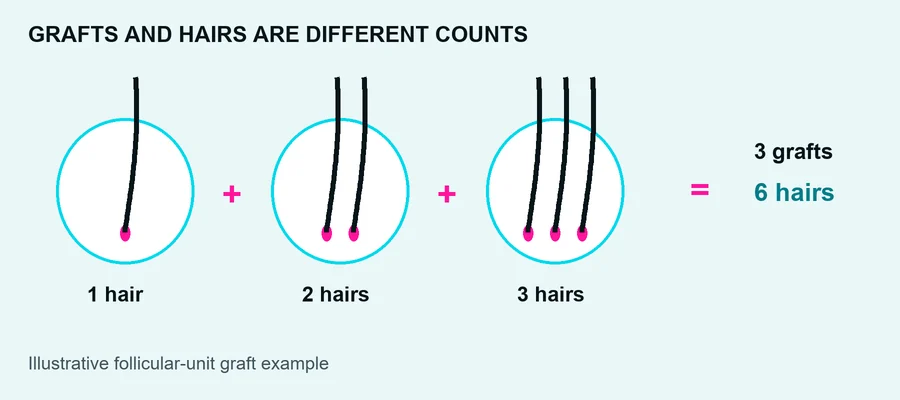
A follicular unit is a naturally occurring hair grouping, so a count of grafts is not automatically the same as a count of individual hairs. ISHRS terminology helps distinguish the unit from the visible hair it carries. Ask whether an estimate describes grafts, follicles, hairs, or an expected visible result. Those quantities should not be used interchangeably when comparing proposals. ISHRS terminology glossary
A June 2016 bilateral controlled study involving 24 patients compared robotic graft selection with random follicular-unit harvesting. The abstract reported different hairs-per-graft and hairs-per-harvest-attempt values between the approaches. This illustrates why the denominator matters. It evaluates a defined harvesting capability, not a guarantee of final cosmetic density, graft survival or satisfaction for every robotic procedure. Original robotic graft-selection study
The original quote worksheet below makes the accounting distinction explicit. Enter only the office’s actual written quantities and amounts. Keep any estimated hair count labeled as an estimate, along with its basis. A “maximum graft” hair transplant package also needs a description of how the clinically appropriate scope will be selected and how the bill changes if the final scope differs.
| Quote field | What to record | What the field cannot prove |
|---|---|---|
| Billable unit | Exact definition of graft or other unit | Final appearance |
| Proposed quantity | Clinician’s estimate and uncertainty | Unlimited donor capacity |
| Unit price or package fee | Actual written amount | Suitability or operator skill |
| Included care | Assessment, procedure, supplies and follow-up scope | That later care is unnecessary |
| Additional charges | Defined exclusions and conditions | That a low headline includes every expense |
| Later sessions | Separate hypothetical budget if discussed | A prescribed lifelong schedule |
For a unit-based hair transplant quote, multiply the written price by the proposed number of the defined billable units and add disclosed charges. For a package, use the package amount plus its disclosed exclusions. Compare like scopes first. Do not divide a package by an advertised maximum count and call that a personal per-graft price if the count remains uncertain or includes different care. The fut hair transplant guide explains that procedure and its consultation questions separately.
You can also express two actual estimates as a ratio. If the complete second estimate is 1.20 times the complete first estimate for genuinely comparable scope, it is twenty percent higher by arithmetic. That tells you the financial difference, not the medical value. No market price or clinical quantity is invented by this comparison; the inputs come from your own written proposals.
Read hair transplant satisfaction evidence by its actual scope
A multicenter retrospective study published online July 15, 2025 and in the February 1, 2026 issue of Plastic and Reconstructive Surgery examined frontal hairline correction. It included 736 eligible people from 780 initially considered, across four institutions, with procedures performed from June 2021 to July 2023. It analyzed factors associated with satisfaction, including hair characteristics and financial context. These are observations about a selected procedure and population, not a random comparison proving that transplantation will improve every person’s wellbeing. Original multicenter hairline-satisfaction study
When someone cites a success rate, identify the outcome before recording the percentage. Is it surviving grafts, hair count, donor healing, photograph ratings or a questionnaire response? Ask who assessed it, at what time and how missing follow-up was handled. A satisfaction outcome does not automatically establish a technical survival figure, and a high count does not automatically mean the recipient area looks the way you hoped.
Build a simple evidence record with the population, procedure, comparison, measure and observation period. Keep an office’s claims separate from a paper’s findings. If they rely on the same paper, ask how the study resembles your proposal. A number stripped of its design can look more useful than it is; the surrounding definitions determine what it actually answers.
Know who is responsible for the hair transplant
The ISHRS scalp-surgery position statement, revised July 13, 2024, treats incisions and relevant harvesting or recipient-site work as surgical procedures and emphasizes trained, licensed professionals. It recognizes that permitted delegation differs by jurisdiction and licensed professional scope under appropriate supervision. This is a professional position statement, not a complete legal opinion for every destination. Ask who performs each major step and how responsibility and supervision work at the actual location. ISHRS qualifications position statement
Get the responsible professional’s name before making hair transplant travel arrangements. A clinic brand, device brand or sales contact is not the same information. If the proposal changes to a different operator, obtain the new explanation and reconsider it. The person answering a payment question should not be the only route to questions about diagnosis, donor assessment or complications.
ASPS consultation guidance stresses individualization and cautions against treating one technique as capable of doing everything. Ask why the proposed option fits your assessment and what alternatives were considered. That question does not require you to demand an unfamiliar procedure; it asks the clinician to explain their reasoning in terms you can use. ASPS consultation guidance
Plan hair transplant healing and later growth as different stages
ASPS preparation guidance calls for specific instructions about eating, drinking, smoking and medications, together with practical transportation arrangements. Obtain those instructions for your actual procedure. Do not stop a prescribed medicine or add a supplement based on a generic checklist. Describe any planned travel, headwear requirement or work activity so the team can address the real constraint. ASPS preparation guidance
ASPS recovery guidance distinguishes initial healing, return to activities and the temporary shedding that can precede regrowth. The timing depends on the operation and individual instructions. Ask when and how to wash, when the donor and recipient areas will be assessed, what symptoms should prompt contact and when particular activities can resume. This article does not turn a general timetable into permission to exercise or ignore a symptom. ASPS recovery and follow-up guidance For a separate discussion of recovery tasks and questions after that procedure, see hair transplant recovery.
Arrange your hair transplant outcome record around the agreed assessments rather than taking an immediate photograph as a final verdict. Record the donor area as well as the recipient area. Use the same lighting, hair length where feasible, angle and styling for comparisons. Product use, wet hair and different camera conditions should be noted when they materially affect what the picture shows.
Check that the proposal and completed record describe the same work
Save the dated proposal before treatment and request a record of the work actually performed afterward. Keep the harvest method, recipient regions, documented graft count and follow-up instructions together. If the proposal included an estimated hair count, ask how it was estimated and whether the completed record reports the same quantity or a different one. A change from “hairs” to “grafts” in a summary is not a harmless wording change when you are trying to understand the scope.
Mark which items were estimated and which were actually recorded. Distinguish a clinician’s proposed number from an advertising maximum and from a completed count. Keep the source of each hair transplant quantity clear rather than combining them into one impressive total. If an invoice is based on units, check its definition against the record. Resolve an apparent difference with the office; do not infer a missing treatment or a superior outcome from the arithmetic alone.
For photographs, request the date and the procedure context. Ask whether they show the recipient area only, include a later session or involve additional treatment. A photograph after multiple procedures is different evidence from a result after one. This does not make either image unhelpful, but it changes what it can illustrate about the proposal you are considering.
At follow-up, compare your own concerns with the original plan: which feature was meant to change, which limitation was explained and which aspect is still evolving? Keep that discussion separate from the bill and from a new proposal. A clear record supports a focused clinical reassessment and helps prevent a later sales conversation from rewriting the original goal.
Discuss risks and preserve the option to reassess
ASPS describes possible infection, bleeding and failure of some grafts to grow, alongside procedure-dependent scarring concerns. It also notes that continuing loss around transplanted areas can create a patchy appearance. Ask which risks apply to the proposed operation, how they are monitored and who will assess a problem. A favorable gallery cannot replace that discussion. ASPS risks and continuing-loss limitations
If the result is disappointing, separate the concern into appearance, growth, donor healing or new native-hair loss. Share dated observations with the team and request an explanation before considering another purchase. A revision proposal should identify the problem being addressed, available donor material, added risks and charges. More grafts should not become the automatic answer to every dissatisfaction.
A complete hair transplant decision includes diagnosis, donor limits, recipient priorities, the continuing-loss discussion, the actual responsible professionals and usable follow-up. Keep unknowns visible. You can postpone or decline while resolving them, even if a package offers an attractive deadline or maximum count.
For related procedure planning, visit the procedure guide index.
Sources and review scope
Plastic Surgery Editorial Team. Source records checked through October 11, 2026. Review scope: source and editorial checks for general education. No individual clinical assessment is represented.
- ASPS hair transplant overview. plasticsurgery.org. Publication/update date not stated. Checked 2026-10-11.
- ASPS hair transplant candidates. plasticsurgery.org. Publication/update date not stated. Checked 2026-10-11.
- ASPS hair transplant consultation. plasticsurgery.org. Publication/update date not stated. Checked 2026-10-11.
- ASPS hair transplant preparation. plasticsurgery.org. Publication/update date not stated. Checked 2026-10-11.
- ASPS hair transplant recovery. plasticsurgery.org. Publication/update date not stated. Checked 2026-10-11.
- ASPS hair transplant safety. plasticsurgery.org. Publication/update date not stated. Checked 2026-10-11.
- ISHRS surgical treatment definitions. ishrs.org. Publication/update date not stated. Checked 2026-10-11.
- ISHRS follow-up and progressive loss. ishrs.org. Source date: 2024-08-25. Checked 2026-10-11.
- ISHRS shaving terminology. ishrs.org. Source date: 2026-05-21. Checked 2026-10-11.
- ISHRS hair restoration glossary. ishrs.org. Publication/update date not stated. Checked 2026-10-11.
- Bernstein and Wolfeld graft-selection controlled study. pubmed.ncbi.nlm.nih.gov. Source date: 2016-06. Checked 2026-10-11.
- Fu et al. multicenter hairline satisfaction study. pubmed.ncbi.nlm.nih.gov. Source date: 2025-07-15. Checked 2026-10-11.
- ISHRS scalp-surgery qualification statement. fightthefight.ishrs.org. Source date: 2024-07-13. Checked 2026-10-11.