
A FUT hair transplant uses a strip of hair-bearing scalp to obtain follicular-unit grafts for a thinning or bald recipient area. The donor wound leaves a linear scar, while the transplanted grafts are placed in a separate area. The decision therefore involves two results: the appearance and healing of the donor scalp, and the eventual coverage of the recipient scalp. Neither result can be judged from the number of grafts alone.
ISHRS describes strip harvesting and follicular-unit excision, or FUE, as different ways of obtaining donor grafts. Strip tissue is divided into small grafts with microscopic assistance; FUE obtains units through individual excisions. Both involve surgery and scarring. FUT is not automatically obsolete, and FUE is not automatically scarless. The useful question is which donor strategy fits your hair loss, scalp and preferences. ISHRS surgical treatment overview
Understand what the FUT label describes
FUT is commonly used to mean the strip harvest approach. The ISHRS task-force guidance also uses terms such as strip FUT, linear strip excision and follicular-unit strip surgery. Ask the practice to describe the actual donor method in plain language. A name on a package should not leave you unsure whether a strip or individual units will be removed.
The November 1, 2024 ISHRS task-force document discusses scalp elasticity, donor thinning, acceptance of a linear scar and planning for future hair loss. These are assessment considerations, not a do-it-yourself guide to choosing strip dimensions. A proposal should explain why strip harvesting is suitable for your scalp rather than treating it as a way to obtain an unlimited graft count. ISHRS FUT task-force guidance
Keep donor harvesting separate from recipient design. The harvest method does not specify the hairline shape, the distribution of grafts or the area to prioritize. Ask how the grafts obtained will be used and which goal may remain only partly addressed. This matters when a large session is advertised: the session’s size is not a description of a natural-looking plan or a guarantee of sufficient density everywhere.
Begin with the cause and pattern of hair loss
ASPS describes assessing hair growth, hair loss, family history, previous transplantation, health and expectations. The diagnosis and pattern matter before choosing a harvest method. Explain whether the change is gradual, recent, patchy or associated with symptoms, and describe any treatments already tried. Do not assume that every visible thin area has the same cause or that surgery is the first decision to make. ASPS assessment and planning
Ask which parts of the hair loss are established and which remain uncertain. A plan may need to account for continuing thinning rather than assuming the current pattern will stay unchanged. Explain your priorities: a more defined frontal outline, better coverage in one region or a smaller visible scalp area. A clear priority allows the discussion to address a limited donor supply without implying that every region can receive its original density.
Bring photographs that show your own progression, when available, with approximate dates. They can support the history without serving as a diagnosis or a prediction. Distinguish your former hairstyle from the hair density you expect to regain. Restoring a youthful hairline exactly may be a different request from improving the appearance of current thinning, and those requests should not be silently treated as identical.
Ask about alternatives and any role for ongoing hair-loss management. The decision to use FUT should follow an assessment, not exclude other approaches merely because the practice offers one method. If a treatment is recommended before or alongside transplantation, ask what it is intended to do and how progress will be evaluated. This guide does not supply a medication or dosing plan.
Assess the donor area as a resource with limits
The donor assessment should address the distribution of hair, scalp characteristics and earlier procedures. The ISHRS task-force guidance warns that generalized donor thinning can make a person unsuitable for FUT or transplantation more broadly. A dense-looking photograph alone does not establish a stable donor supply. Ask how the team assessed the area and how uncertainty about future loss affects the plan.
Scalp elasticity matters to the strip decision. Ask the clinician to explain what was found during examination and how that affects the proposed harvest. Do not interpret the ability to move the scalp with your fingers as proof that a particular strip width is appropriate. The relevant assessment concerns your tissues and the operation, not a universal number shared online.
If you have had an earlier transplant, make sure the team assesses the remaining donor area and scars rather than counting only the new recipient need. A previous operation changes the planning context. Ask whether a future strip procedure is realistically possible, what limitations remain and whether another method is being considered. The objective is an honest plan for available donor tissue, not a promise that repeated sessions can always provide more hair.
Discuss the hairstyle you actually intend to wear over time. You may currently keep the back long but want the option of a very short cut later. That preference matters to accepting a linear scar. Consider how you would feel if the scar were more visible than expected, and ask how the team communicates the range of possible appearances without promising invisibility.
| Planning issue | FUT discussion | FUE discussion |
|---|---|---|
| Donor scar pattern | A linear scar in the strip area | Small excision scars distributed through the harvested area |
| Hairstyle preference | Visibility of the line with shorter hair | Visibility of scars or thinning as harvesting increases |
| Scalp assessment | Elasticity, prior scars and suitable strip region | Suitable donor units and remaining distribution |
| Future procedures | Whether another harvest is feasible | Remaining supply and prior excision effects |
| Recipient goal | Placement and coverage require their own plan | Placement and coverage also require their own plan |
A linear scar is a real tradeoff
ISHRS’s patient explanation of scar patterns describes the linear scar of strip surgery and the small scars of FUE. Their visibility depends on healing and how hair is worn. The distinction is the distribution of scars, not surgery versus no surgery. Avoid choosing either method on an assurance that nobody will ever be able to see evidence of the harvest. ISHRS scar-pattern explanation
Ask to discuss donor photographs separately from recipient photographs. A successful-looking frontal view cannot show the back of the scalp. If examples are presented, clarify the hairstyle, lighting and time since surgery, and whether the example is relevant to your circumstances. Photographs can communicate a possible appearance; they do not establish the rate of widened scars or predict your individual healing.
An original single-center study examined donor scars in 30 men after FUT, with assessment after at least three months. It found an association between wider harvested strips and wider scars. This retrospective observation does not establish one universally safe strip width or prove that a closure method guarantees an invisible scar. The study’s small, selected population should remain attached to any claim based on it. Original donor-scar study
Ask what the team would do if the donor scar became a concern. Scar assessment, another harvest and a possible camouflage approach are different decisions; none should be assumed to erase every trace. If an earlier scar is present, have its condition and the proposed treatment described before a new procedure is planned. A statement that the old scar can be incorporated into a later operation still needs an individual assessment.
Grafts and hairs are different counts
A follicular unit is a naturally occurring hair grouping. A transplanted graft can contain more than one hair. A quoted number of grafts should therefore not be silently substituted for the same number of hairs, nor should a hair count be advertised as though it were a graft count. Ask which unit the estimate uses and how the final record will describe it.
A harvested hair count is not a grown-hair result. Distinguish the preoperative estimate, the units actually obtained, the grafts actually placed and the later recipient assessment. Each is a different stage. A practice may count the material obtained accurately while still needing time and follow-up to assess growth. Conversely, a promising photograph does not prove that the original quote’s count was measured as stated.
Ask whether the plan includes the expected distribution of single-hair and multiple-hair units. That distribution can matter to how the clinician designs the recipient area. You do not need to choose a graft mix yourself; you need to understand why the proposal cannot be reduced to one large number. If the final yield differs from the estimate, ask how the actual material was allocated and which planned areas were addressed.
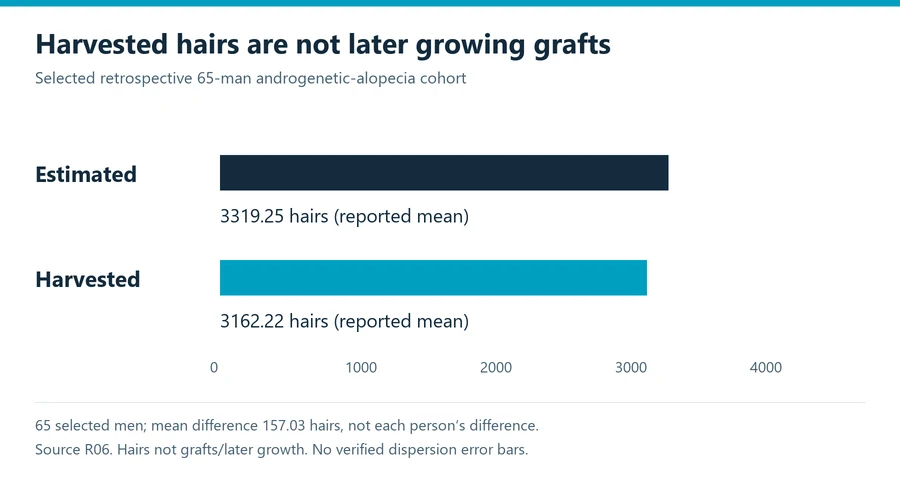
An original retrospective study of 65 men with androgenetic alopecia compared estimated and actually harvested hairs in FUT procedures. It reported a mean estimate of 3,319.25 hairs and mean harvested count of 3,162.22. These are hair counts, not follicular-unit counts, and they concern harvest measurement rather than later growth. The paper appeared online on August 6, 2018, with a June 2019 journal issue. Original estimated-versus-harvested study
| Measurement in the 65-patient study | Reported mean hairs | What the number measures |
|---|---|---|
| Preoperative estimate | 3,319.25 | Estimated hair yield from the planned donor harvest |
| Actual harvested count | 3,162.22 | Hairs obtained in that study’s procedures |
| Difference between means | 157.03 | Calculated as 3,319.25 minus 3,162.22; not a growth-failure count |
Do not turn an average difference into a personal guarantee
The calculated difference does not mean that every patient received exactly that many fewer hairs than estimated. It also does not establish deliberate miscounting, a complication rate or the percentage of grafts that survived. An estimate and a measured harvest are different quantities. Use the distinction to ask how a quote handles uncertainty, not to claim that every FUT procedure has the same shortfall.
For any study or quotation, keep the count definition attached to the number. Ask whether the material describes units, individual hairs, an estimated density or a count at a later recipient assessment. If a survival percentage is offered, ask what was counted, when it was counted and how losses to follow-up were handled. A study title that includes graft survival is not enough to answer those questions.
Read FUT-versus-FUE claims in context
The donor-method comparison should address your priorities, not require a universal winner. FUT and FUE differ in how tissue is obtained and how donor scars are distributed. Recipient design, graft handling, assessment and the patient’s hair characteristics also matter. A claim about one part of the process should not be used to guarantee every other part.
Ask whether comparative evidence concerns graft harvest, later visible growth, donor appearance or patient satisfaction. Those endpoints should not be exchanged. A small split-scalp observation, for example, cannot establish every person’s long-term donor appearance. A study measuring material obtained during surgery cannot answer how a hairline looks after later hair loss. The relevant question is whether the measured endpoint addresses the claim being made to you.
Consider how the groups were selected. People offered different donor methods may differ in scalp characteristics, prior surgery or preferences. Without an appropriate comparison design, a result difference should not automatically be attributed to the method. Ask the clinician to explain the evidence and its limits rather than treating an impressive percentage as a complete explanation of suitability.
Avoid claims that either approach guarantees permanent full density everywhere or unlimited additional harvesting. Ask for the planned recipient priorities and the reserve available for possible future needs. If a combination of methods is proposed, request the reason and the scar implications of each. Combining techniques should be an explained plan rather than a label that conceals the limitations of the donor area.
Clarify shaving and immediate appearance
ISHRS distinguishes shaving decisions in the donor and recipient areas. Strip FUT can involve hair within the strip being cut or left long, while surrounding hair may help conceal the closed wound. The recipient area has its own preparation decision. An unshaven label should therefore not be interpreted as a promise that no hair anywhere is shortened or that surgery will be immediately undetectable. ISHRS shaving terminology
Ask which areas will be prepared and what you should expect to see afterward. This helps plan work, travel and personal commitments without confusing early concealment with a healed result. If keeping hair long is a priority, explain that before the procedure is booked. The preparation plan should be specific enough that a package name does not create a surprise on the day of surgery.
Recovery involves both donor and recipient care
ASPS explains that recovery depends on the length, complexity and type of hair restoration procedure. It calls for follow-up to assess healing and notes that shedding of transplanted hair can precede regrowth. Those general points do not provide one personal calendar for a FUT hair transplant. Obtain the treating team’s instructions for your donor closure, recipient area, washing, activity and follow-up. ASPS recovery and follow-up
Ask which observations belong to early wound healing and which belong to a later growth assessment. An early shed hair is not automatically evidence that a follicular unit has failed, but a new concerning change should not be dismissed from a generic internet timeline. Confirm whom to contact and how the team wants symptoms documented. Do not combine washing, medication or wound-care recipes from different operations.
Explain your work tasks, exercise and headwear needs individually. Ask about activities that place pressure or friction near the treated areas and about any scheduled removal or review of closure material. A statement that you can return to work may not address a helmet, heavy physical duties or travel without access to the team. Plan support around the actual instructions rather than a marketing estimate of downtime.
ASPS notes that infection, graft failure and continuing hair loss can affect outcomes. Surgery does not freeze the rest of the scalp at its present appearance. Ask how future thinning would affect the transplanted area’s relationship to neighboring hair and how the plan accounts for that possibility. A growth result and a long-term appearance plan are related but different endpoints. ASPS safety and continuing hair loss
Compare quotes with the same units and scope
A price per graft cannot be compared fairly with a price per hair without understanding the definitions. Ask whether the quote is an estimate, a fixed session fee or a charge based on an actual count. Record which medical assessment, facility costs, medicines and follow-up are included, and what happens if the final harvest differs from the estimate. Do not assume a larger package delivers a better plan.
| Quote or record | Clarification to obtain | Misinterpretation to avoid |
|---|---|---|
| Proposed session size | Grafts, hairs or another unit? | Treating all counts as interchangeable |
| Expected yield | Estimate and possible variation | Promising the exact mean from a study |
| Final procedure record | Obtained and placed grafts, with count definitions | Treating harvest as a later growth measurement |
| Included care | Assessment, operation and follow-up scope | Comparing an isolated fee with a complete package |
| Future work | Conditions for further assessment or surgery | Assuming every later procedure is free or feasible |
If the estimate changes after donor assessment, ask why and have the recipient priorities updated. A reduced count may require reconsidering which area matters most rather than spreading the plan without discussion. Similarly, if more grafts are proposed, ask how that affects donor planning and future reserve. The goal is a transparent decision, not achieving the largest number in an advertisement.
Before choosing a FUT hair transplant, make sure you understand the donor method, the linear scar tradeoff, the units in the estimate, the recipient priorities and the follow-up responsibilities. A useful plan explains how the present operation fits future hair loss and acknowledges the limits of prediction. You should not have to infer these details from a technique name or a before-and-after photograph.
For related planning, see procedure guides, questions to ask a surgeon and comparing surgery costs.
Sources and review scope
Plastic Surgery Editorial Team. Source records checked through October 12, 2026. Review scope: source and editorial checks for general education. No individual clinical assessment is represented.
- ISHRS donor methods and follicular units. ishrs.org. Publication/update date not stated. Checked 2026-10-12.
- ISHRS FUT task-force guidance. ishrs.org. Source date: 2024-11-01. Checked 2026-10-12.
- ASPS individualized hair-loss assessment. plasticsurgery.org. Publication/update date not stated. Checked 2026-10-12.
- ISHRS donor scar patterns. ishrs.org. Publication/update date not stated. Checked 2026-10-12.
- Original donor scar observational study. jcasonline.com. Source date: 2013-10/2013-12. Checked 2026-10-12.
- Original estimated versus harvested FUT study. pubmed.ncbi.nlm.nih.gov. Source date: 2018-08-06. Checked 2026-10-12.
- ISHRS shaving terminology. ishrs.org. Source date: 2024-06-26. Checked 2026-10-12.
- ASPS recovery and shedding distinctions. plasticsurgery.org. Publication/update date not stated. Checked 2026-10-12.
- ASPS hair transplant risks and future thinning. plasticsurgery.org. Publication/update date not stated. Checked 2026-10-12.