
Capsulectomy removes some or all of the scar-tissue capsule around a breast implant. It is a different decision from removing the implant itself. The appropriate extent depends on the clinical problem, examination, device history and surgical tradeoffs. More tissue removal is not automatically more beneficial, and the term en bloc should not be used as a general promise of a more complete detoxification. Ask what tissue the proposal removes, why it is being removed and what benefit remains uncertain.
The Breast Surgery Collaborative Community’s 2024 consensus distinguishes partial, total, total intact and en bloc capsulectomy. It reserves en bloc removal, including a margin of uninvolved tissue, for suspected or established implant-associated cancer after appropriate workup. This distinction is useful when comparing proposals that use the same phrase to mean different operations. BSCC capsule terminology consensus
Separate the implant from the capsule in your decision
An implant and its surrounding capsule are different structures. The FDA describes implant removal alone as one option and removal of some or all surrounding capsule as another. The latter can involve more dissection and different risks. Ask the clinician to explain whether the concern relates to the device, the surrounding tissue, another breast finding or several issues together. FDA implant removal and risk information
Write down the question you are trying to resolve. You may be considering treatment for a diagnosed local problem, asking about removal because you no longer want implants, seeking assessment of systemic symptoms, or responding to a new breast change. Those situations do not automatically lead to the same operation. A proposal should make its reasoning visible rather than beginning with the largest available removal package.
Keep three choices separate: whether to remove the implant, whether to remove capsule tissue, and whether to add replacement or reshaping. You can ask about each independently. If a plan includes all three, ask what each component contributes and what changes if you decline an optional component. This helps prevent an appearance preference from being presented as a medical necessity or a capsule procedure from being described as a guaranteed symptom treatment.
If the two breasts have different findings, ask whether the same scope is recommended on both sides and why. Symmetry in a diagram does not establish that the clinical situation is identical. The consent should describe the intended work clearly enough that you understand any important side-to-side difference.
Four terms describe different extents of removal
| Term | Tissue-removal meaning | Clarification to request |
|---|---|---|
| Partial capsulectomy | Some capsule is removed and some remains | Which area is intended to remain, and why? |
| Total capsulectomy | The entire capsule is removed, potentially in pieces | Is intact removal necessary for the clinical purpose? |
| Total intact capsulectomy | The complete capsule is removed as one unit | What benefit is expected from retaining it as one unit? |
| En bloc capsulectomy | Capsule and a margin of uninvolved tissue are removed for the specified cancer context | What diagnosis or suspicion supports the oncologic plan? |
These definitions follow the BSCC consensus. They do not describe a hierarchy in which the last row is automatically best. Ask the clinician to use the precise term in your written proposal. If an advertisement says en bloc but means intact-total removal without a surrounding margin, the terminology should be corrected before it becomes part of consent.
A photograph of an intact specimen cannot by itself answer why that extent was necessary or establish a systemic health benefit. Nor does a specimen picture show every surgical tradeoff or your eventual appearance. Evaluate the plan by its indication, expected benefit, risks and assessment process rather than by how impressive the removed tissue looks in a promotional image.
A new breast change needs assessment before package selection
FDA guidance describes persistent swelling, a mass or pain as symptoms that can warrant evaluation for BIA-ALCL. It explains that assessment may include examination, imaging and testing of fluid or tissue, and that a confirmed diagnosis can change the operation needed. Do not replace that diagnostic process with a general-purpose removal booking. FDA BIA-ALCL questions and answers
Bring the device card, prior operative reports and any imaging or pathology already performed. Record when the change started, whether it is progressing and which side is affected. If you do not know the implant model or surface, mark that information unknown and ask how records can be obtained. Guessing from a photograph or implantation year is not a substitute for identifying the device.
Ask who is coordinating the evaluation and how results will reach the operating team. If testing is pending, clarify whether it needs to be completed before a final surgical plan. You should understand how the diagnosis informs the treatment rather than treating every test as paperwork that can be skipped to accelerate scheduling.
Do not assume that every new symptom means cancer, or that an absence of a visible external change rules out a problem. The next useful step is appropriate assessment. A website can explain why the distinction matters, but it cannot interpret your examination or test results.
Systemic symptoms deserve a separate record and evaluation
The FDA discusses patient-reported systemic symptoms often called breast implant illness, including fatigue, cognitive concerns and joint pain. It states that the symptoms and their causes remain poorly understood and that some patients report improvement after removal. That uncertainty should be explained without dismissing the symptoms or promising that surgery will resolve them.
Prepare a dated account of what you experience, when it began, what investigations have occurred and what treatment has helped or not helped. Include the effect on everyday life. Keep symptom descriptions distinct from a conclusion that a particular capsule finding caused them. This gives your healthcare team a more useful record than a list copied from an online community.
Ask how other possible explanations will be assessed and who remains responsible for ongoing care. A plan for implant removal does not mean that every unrelated health concern should be set aside. Equally, an inconclusive test does not mean your experience should be ignored. The discussion should identify what is known, what remains uncertain and how symptoms will be followed afterward.
Choose a practical assessment plan before treatment. Which symptoms matter most to you, how will they be recorded, and when will reassessment occur? A broad statement that you hope to feel better is understandable, but a more specific record helps you and the team evaluate change without reconstructing the baseline from memory.
What prospective symptom research actually showed
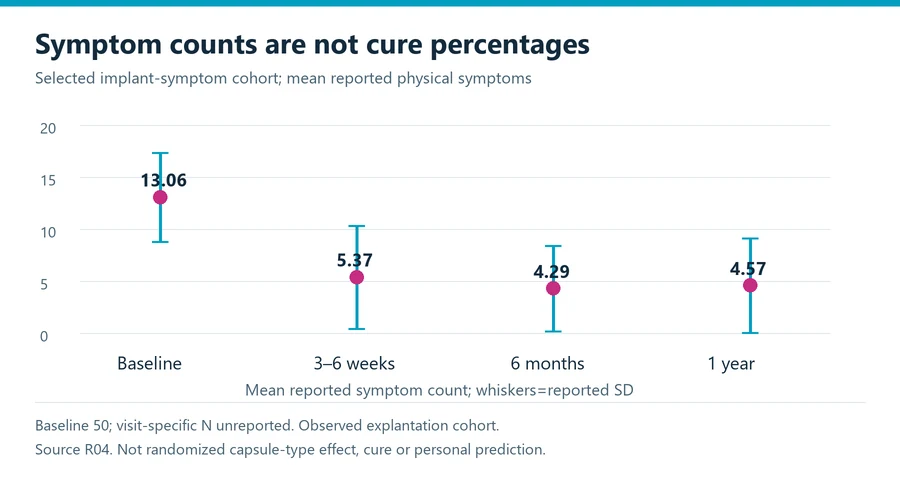
The ASERF study enrolled 150 participants across three equal cohorts. Its 2023 follow-up paper reported the symptomatic group’s mean symptom count as 13.06 before surgery, 5.37 at three to six weeks, 4.29 at six months and 4.57 at one year. Improvement did not significantly differ by capsulectomy type. These are group means after treatment, not proof of a specific capsule-removal mechanism or a guarantee of complete symptom resolution. The study was funded by ASERF, and authors disclosed relevant industry relationships. Original ASERF one-year follow-up
The earlier report also found similar symptom improvement across intact-total, total and partial removal. Capsule extent was not randomly assigned. An absence of a statistically significant difference is not proof that all approaches are equivalent for every diagnosis. Original ASERF capsulectomy-type report
| Claim you may encounter | Evidence question to ask | Conclusion that should remain separate |
|---|---|---|
| Symptoms improved after treatment | What was measured, in whom and when? | Which treatment component caused the improvement |
| A group mean decreased | How much variation and incomplete follow-up remained? | Whether every individual became symptom free |
| Types had no significant difference | Was allocation randomized and was equivalence tested? | That every extent is interchangeable for every diagnosis |
| A specimen looked abnormal | What examination or pathology supports the interpretation? | That its appearance explains systemic symptoms |
Improvement, causation and complete resolution are different endpoints
A lower mean symptom count is not the same as every patient being cured. A person can improve substantially while still needing further evaluation or care. A study can observe a change after an operation without isolating the contribution of every component. Keep those distinctions attached to a claim before using it to choose an extent of surgery.
Ask what an outcome chart actually plots. A mean number of symptoms is different from the percentage of people with any improvement, the percentage with no symptoms and a validated quality-of-life score. Those measures cannot be exchanged just because each can be drawn as a descending line. A clear chart should name its measure and preserve the original assessment time points.
Be cautious about a personal prediction built from a selected study. The relevant population, treatment choices and follow-up may differ from your circumstances. Evidence can inform the consent discussion while leaving uncertainty about your own result. A useful explanation acknowledges that limit instead of converting an observational finding into a promise.
Ask why the proposed extent fits the clinical problem
For a local concern, ask the clinician to name the diagnosis or finding and connect it to the intended capsule work. For a preference-driven removal, ask which options are reasonable and what tradeoffs distinguish them. For systemic symptoms, ask what benefit is supported and what remains unknown. The explanation should use the same precise terminology as the written consent.
Ask whether the proposed extent could change during surgery and what circumstances would lead to that change. If tissue cannot be removed safely as planned, how would the team proceed within the agreed consent? Clarify what will be documented afterward. You should understand the boundaries of authorization without having to learn dissection techniques or direct technical choices yourself.
Do not let an online slogan replace that discussion. Statements that a capsule must never remain, that an intact specimen proves detoxification or that a larger operation always gives better health outcomes need evidence specific to the claim. Ask for the source and its scope. The strength of the explanation matters more than how emphatically the promise is delivered.
If opinions differ, compare their diagnoses and assumptions. One team may be addressing a local finding while another is discussing a preference or an appearance goal. Until the underlying question is aligned, a vote on terminology may not resolve the disagreement. A second opinion can help clarify the reasoning without obligating you to another procedure.
Appearance choices should have their own consent and evidence
Implant removal, capsule removal, replacement and a breast lift are distinct components. Ask what appearance is expected after the clinically proposed removal and what an added procedure is intended to change. If replacement is suggested, its device-related long-term responsibilities need a separate discussion. If a lift is suggested, clarify its scars and limits independently.
ASPS implant-removal result guidance notes that appearance depends on factors such as tissue condition and the size of the removed implants. Ask how the clinician applies those considerations to your examination. Do not rely on another patient’s photograph as a prediction of your shape after removal. ASPS removal results
If appearance is not your main reason for treatment, say so. You may prefer to assess the result before deciding on optional reshaping. Ask whether a staged appearance decision is reasonable and what it would involve. Keep optional refinements clearly identified so that they do not become indistinguishable from the care needed for the original concern.
Pathology and follow-up need a named process
Ask what tissue or fluid will be examined, why, and how the result will be communicated. Who reviews the report with you? What happens if a finding requires additional assessment? A photograph of removed tissue is not a substitute for a pathology report or the clinician’s interpretation. Request a copy of relevant reports for your own medical record.
Keep the operation report as well as the pathology result. The former documents what was performed; the latter answers the questions posed to the laboratory. They are different records. If some tissue remains, ask how that is described and whether it affects future assessment. A clear postoperative explanation can prevent later uncertainty about what a marketing phrase meant.
The BSCC’s June 2024 announcement explains that it is unknown whether capsulectomy prevents future implant-associated cancer and that standard monitoring should continue, particularly after textured implants. Capsule removal should not be sold as eliminating every future risk. Ask what follow-up applies to your actual history and findings. ASPS announcement of the BSCC consensus
Recovery depends on the full operation
ASPS implant-removal recovery guidance describes dressings, possible temporary drains and individualized instructions for wound care, medication and follow-up. Ask what applies when capsule work or additional reshaping is included. A removal-only recovery account is not automatically a schedule for a more extensive combined proposal. ASPS removal recovery
Discuss your daily tasks, including driving, lifting, childcare and work duties. Ask who will clear activities and what determines when restrictions change. Arrange practical assistance around the instructions you receive rather than assuming that an advertised recovery interval applies to every activity. If traveling, clarify where in-person follow-up will occur after you return home.
ASPS lists removal risks including bleeding, infection, fluid accumulation, poor healing, altered sensation, scars, persistent pain and possible further surgery. Ask how your medical history and the proposed extent affect the relevant risks. A larger extent of removal should have a reasoned benefit-risk discussion rather than an assurance that completeness removes all danger. ASPS removal risks
ASPS preparation guidance includes assessment, medication review and arrangements for transport and initial support. Coordinate prescribed-medication changes with the responsible clinicians. Obtain the team’s warning signs and routine and urgent contact instructions before surgery. Do not wait for a routine photo review when urgent medical attention is needed. ASPS removal preparation
Compare quotes by tissue scope and complete care
The ASPS removal cost page excludes anesthesia, facility and related expenses from its broad average. That is not a verified total for your planned capsulectomy. Ask for an itemized quote that distinguishes device removal, capsule work, any added reshaping, laboratory services and follow-up. ASPS removal cost scope
| Quote component | Clarification needed | Error to avoid |
|---|---|---|
| Device and capsule work | Exact extent on each side and intended reason | Comparing different scopes as the same operation |
| Additional shaping or replacement | Required versus optional components | Treating an appearance addition as automatically necessary |
| Facility and anesthesia | Included services and separate billing | Assuming a surgeon fee is the total |
| Testing and follow-up | Included reports, visits and possible referrals | Assuming every later assessment is prepaid |
| Further care policy | Written terms and remaining charges | Reading a revision policy as a health-outcome guarantee |
Ask about possible insurance coverage for the specific diagnosis and services, and obtain the actual payer determination where needed. Do not assume that symptoms, a recall history or a preferred removal term guarantee payment for every component. Keep the clinical recommendation and the financial authorization in separate parts of your record.
Keep the decision record separate from promotional proof
If you request a specimen photograph, ask what it can usefully document and how it will be stored. You can value that record without treating it as a laboratory result. Keep the image with its actual date and explanation rather than labeling it proof that every symptom source was removed. If an office proposes public sharing, decide separately whether you want your medical material used in that way. Agreement to treatment and agreement to promotional use are different choices. Your written operative and assessment records should remain available regardless of whether you choose to share an image.
Leave with precise terms and a follow-up plan
The ASPS consultation guidance includes goals, previous treatment, medical history and device-related information. Bring the records you have and identify missing information honestly. Ask the team to explain the indication, tissue extent, important uncertainties and expected postoperative assessment in plain language. ASPS removal consultation
Before committing, check that the consent, quote and clinical explanation describe the same plan. You should know which decisions are medical, which reflect your preferences and which remain unresolved. That record is more useful than an intact-specimen promise or an unlabeled symptom-improvement percentage.
For related guidance, see the breast augmentation guide, the breast lift guide and complete cost planning.
Sources and review scope
Plastic Surgery Editorial Team. Source records checked through October 12, 2026. Review scope: source and editorial checks for general education. No individual clinical assessment is represented.
- BSCC capsuleterminologyconsensus. plasticsurgery.org. Publication/update date not stated. Checked 2026-10-12.
- FDA implant removal and risks. fda.gov. Source date: 2023-12-14. Checked 2026-10-12.
- FDA BIAALCL assessment. fda.gov. Publication/update date not stated. Checked 2026-10-12.
- Original ASERF part4 one-year report. pmc.ncbi.nlm.nih.gov. Source date: 2023-04-12. Checked 2026-10-12.
- Original ASERF part1 capsuleextent study. pubmed.ncbi.nlm.nih.gov. Source date: 2022-06-20. Checked 2026-10-12.
- ASPS BSCC announcement. plasticsurgery.org. Source date: 2024-06-12. Checked 2026-10-12.
- ASPS Removal results. plasticsurgery.org. Publication/update date not stated. Checked 2026-10-12.
- ASPS Removal recovery. plasticsurgery.org. Publication/update date not stated. Checked 2026-10-12.
- ASPS Removal safety. plasticsurgery.org. Publication/update date not stated. Checked 2026-10-12.
- ASPS Removal preparation. plasticsurgery.org. Publication/update date not stated. Checked 2026-10-12.
- ASPS Removal cost. plasticsurgery.org. Publication/update date not stated. Checked 2026-10-12.
- ASPS Removal consultation. plasticsurgery.org. Publication/update date not stated. Checked 2026-10-12.