
A deep plane facelift is a facelift approach that works beneath the superficial musculoaponeurotic system, or SMAS, to reposition connected facial tissues. The name describes a surgical approach, not a guaranteed result. Whether it suits you depends on your facial and neck findings, your goals, your health and the specific operation proposed. A useful decision compares the actual treatment plan and its evidence rather than assuming that a technique label proves greater longevity, a shorter recovery or a more natural appearance. ASPS facelift anatomy and technique education
Ask what is being repositioned, which concerns remain untreated and how the result will be assessed. Those answers are more informative than a promise to look a fixed number of years younger. This guide separates related technique names, explains what original studies can establish and provides a practical way to compare operations, recovery plans and complete quotes.
What the technique name tells you
The SMAS is a tissue layer involved in facial support. Facelift approaches differ in how they address it: a plan may fold and secure it, remove a portion, or mobilize a tissue flap. The platysma is relevant to the neck. These terms describe different components and approaches within facial rejuvenation; they do not identify a single standard operation shared by everyone using a similar marketing name. The ASPS professional education article describes several SMAS techniques and their anatomical context. It is not a patient-specific recommendation.
For a patient, the useful translation is that skin and deeper tissue handling are separate questions. A proposal should explain the intended region of correction and how the neck is involved, without expecting you to select an operative entry point or judge a surgeon’s technical steps. The distinction matters when two quotes both say facelift but include different regions or additional procedures. A broad label can conceal important differences in scope.
The ASPS general procedure description explains that facelift surgery may involve deeper tissue repositioning and skin redraping, with an additional incision under the chin when the neck needs treatment. Other approaches have different incision patterns and scope. Ask for the plan in ordinary language: face, neck, or both; which incision areas; and which other treatments are included. A named technique alone does not answer these questions. ASPS facelift procedure overview
Start with the concern, then evaluate the operation
A facelift addresses selected signs of aging in the face and neck. It does not stop aging or replace every other facial treatment. A concern about the lower facial contour is different from a concern about eyelid skin, surface texture or facial volume. Some people have several concerns, but combining them into a single word such as rejuvenation can make it difficult to know what the proposed operation is expected to accomplish. ASPS facelift scope
Write down the changes you notice without diagnosing their cause. For example, describe the region that bothers you and whether your priority is a contour change, less apparent laxity or an improvement in another feature. Then have the surgeon explain which finding corresponds to that concern. This creates a clearer connection between your goal, the intervention and the result being discussed.
It also helps identify a mismatch before consent. If a plan focuses on facial tissue repositioning while your strongest concern is surface texture, ask what improvement is reasonably expected from that component alone. If additional treatment is recommended, distinguish its intended benefit, risks and price. An appealing combined result does not establish that every visible change came from the facelift component.
| Concern to describe | Clarification needed | What the technique label cannot settle |
|---|---|---|
| Lower-face contour or jowling | Which facial tissues and region are being addressed? | The amount or durability of your improvement |
| Neck appearance | Is a neck procedure included, and what is its scope? | Whether every neck concern is covered |
| Facial fullness or hollow areas | Is a separate volume treatment proposed? | Whether a photograph shows a facelift-only result |
| Eyelids or skin texture | Is another procedure needed for this separate goal? | Whether deeper lifting changes that feature |
Deep plane versus SMAS is an incomplete comparison
Calling an operation SMAS rather than deep plane can suggest a simple opposition, but it leaves out substantial variation within the SMAS category. Plication, for example, is a particular approach rather than a synonym for every facelift that treats that tissue layer. Comparisons are useful only when the alternatives are defined clearly enough to understand what was actually done.
Ask whether a comparison concerns deep plane versus SMAS plication, two variants of deep plane surgery, or a combined face-and-neck plan versus a more limited operation. Those are different questions. A study answering one cannot automatically answer the others. A result that favors one approach in a particular selected group also does not identify the most appropriate approach for a person who has not been assessed.
The strongest practical comparison includes the proposed anatomical target, the surgeon’s experience with that specific operation, the additional procedures and the evidence used to explain likely outcomes. If the explanation consists mainly of a label, request enough detail to understand the plan. You do not need an operative manual; you do need a clear account of what you are consenting to.
What original comparative research actually found
A historical study published in the January–February 2004 issue compared photographs from 20 deep plane and 20 SMAS plication patients. Four surgeons rated the images while masked to the technique. Its short-term findings did not establish deep plane superiority. Importantly, randomized photographic review does not mean patients were randomly assigned to an operation. The study is informative about its selected photographs and ratings, not a universal rule about every patient’s outcome. Original 2004 photographic comparison
A more recent prospective cohort, first published online July 1, 2026, enrolled 166 primary facelift patients treated by one surgeon: 45 received deep plane surgery and 121 received SMAS plication. The abstract reported no statistically significant differences in the assessed early outcomes, with median follow-up of three months. Unequal groups, short follow-up and the absence of validated outcome instruments limit the conclusion. This was a cohort comparison, not proof that the operations are interchangeable for all patients or equally durable over many years. Original 2026 prospective cohort
These studies are a reason to question sweeping superiority claims, not a reason to dismiss either technique. Their measurements, patients and periods of observation differ. A reader should also distinguish an absence of a statistically significant difference from proof that no meaningful difference could exist. The study may not answer the question you care about most, especially if that question concerns long-term durability or a different surgical combination.
Photographs, movement and satisfaction answer different questions
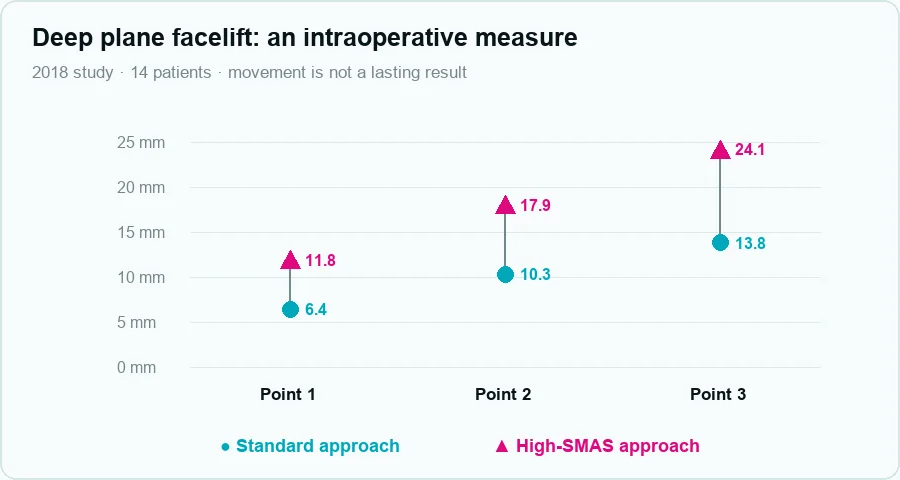
A 2018 study evaluated tissue movement during surgery in 14 patients. It compared standard and high-SMAS entry approaches within deep plane surgery. Reported mean vertical movement at three measurement points was 6.4, 10.3 and 13.8 millimeters with the standard approach, versus 11.8, 17.9 and 24.1 with the high-SMAS approach. Those are intraoperative tissue measurements. They are not a prediction of how far your face will move, how long a result will last or which approach has lower complication risk. Original 2018 tissue-movement study
The useful lesson is methodological: a larger measured movement during an operation is a different endpoint from a patient’s later appearance or satisfaction. A diagram of this study should identify its small population and operative timepoint. It should not turn those measurements into an ideal facial displacement or use them as a scale for a personal surgical target.
| Evidence type | What was observed | What remains unanswered |
|---|---|---|
| 2004 photographic comparison | Masked ratings of selected short-term images; 40 patients | Universal technique superiority or long-term durability |
| 2018 movement measurement | Intraoperative tissue movement; 14 patients | Personal cosmetic benefit or complication probability |
| 2026 prospective cohort | Early clinical outcomes; 166 patients; median three months | Many-year durability or every surgeon and patient population |
Reading before-and-after photographs carefully
Photographs can make a proposed goal easier to understand, but they need context. Ask when the after image was taken, whether the person had additional procedures and whether the example represents a similar starting concern. A photograph immediately after an operation and one taken after a longer period of healing answer different questions. Neither supplies a personal guarantee.
Separate the facial regions as you look at an example. A change around the eyes might reflect an eyelid procedure, while a change in surface appearance might reflect another treatment or photographic conditions. If the example includes multiple interventions, it can illustrate a combined plan but cannot isolate the facelift’s contribution. Request this distinction rather than treating the entire image as proof of one branded approach.
Consistency also helps interpretation. Notice whether the expression, angle, framing and lighting make comparison straightforward. If a feature seems different because the head is positioned differently, ask for a clearer explanation rather than trying to estimate a precise change from the image. You are evaluating whether the example communicates the intended result honestly, not measuring surgical effectiveness with a photograph.
Your own priorities may differ from those of the photographed person. A useful discussion includes what you want to preserve as well as what you hope to change. Describe recognizable features and the degree of change you would find acceptable. Terms such as natural are too broad unless you explain what they mean to you.
Assessment and preparation are part of the plan
ASPS describes suitable candidates generally as healthy people without conditions that impair healing, nonsmokers and people with realistic expectations. This does not provide an age cutoff or a remote eligibility test. A personal assessment must consider health, anatomy, previous procedures and the proposed scope. The technique name cannot override a concern about whether surgery is appropriate. ASPS candidate guidance
Bring an accurate history of facial procedures and medical conditions, along with medicines and supplements. Explain your priorities and ask which findings make the proposed plan suitable or unsuitable. ASPS consultation guidance includes discussing health, previous surgery, medicines, expectations and possible outcomes. An evaluation should also allow you to discuss alternatives and the option of waiting. ASPS consultation guidance
Preparation may include medical evaluation, smoking cessation and clinician-directed medication adjustments. Do not stop a prescribed treatment because a general surgical checklist mentions it. Ask which instructions apply to you, who coordinates them and when they should occur. If you receive instructions from more than one clinician, resolve any conflict before the operation rather than improvising a compromise. ASPS preparation guidance
Risks deserve specific discussion
Facelift risks include bleeding, infection, healing problems, altered sensation, scarring and facial nerve injury with weakness. Anesthesia and serious medical complications also belong in the consent discussion. A statement that a method is natural or advanced does not remove these risks. Ask which complications the proposed plan could produce and how the team recognizes and manages them. ASPS risks and safety
It is useful to distinguish an unwanted appearance from a medical complication without minimizing either. An asymmetry or scar concern may require a different response from bleeding or an acute symptom. Before surgery, obtain written contact instructions that explain how to reach the team, when urgent assessment is needed and where to seek emergency care. This guide cannot substitute for those individualized instructions.
When a percentage is quoted, ask what it measures. A series might count temporary symptoms, permanent injury, any complication or only events requiring another operation. Its denominator may be patients or procedures, and its follow-up may be short. Those differences make percentages unsuitable for casual comparisons unless their definitions are clear. A number without its endpoint and observation period can create more confidence than the evidence supports.
Recovery has several milestones
The early recovery plan may include dressings, drains, wound care, medicines and follow-up. ASPS advises obtaining specific instructions about care, concerning symptoms and subsequent visits. Ask who will help you initially and whether additional procedures change your care requirements. A calendar should reflect the complete operation rather than a recovery estimate borrowed from a simpler procedure. ASPS recovery guidance
Being comfortable appearing in public, returning to a particular job, resuming exertion and evaluating a mature result are separate milestones. ASPS gives general facelift guidance that public appearance may be possible around 10 to 14 days, while tissues can take two to three months to feel more normal. Those general descriptions are not deep-plane-specific trial results or personal clearance for driving, exercise or work. Your own instructions take precedence. ASPS results and healing guidance
Consider the demands of your actual work rather than asking only how many days off most people take. Public-facing work, physical tasks, travel and the ability to attend follow-up create different constraints. Tell the surgeon what you need to do and ask which milestone governs each activity. Leave room for a slower recovery rather than arranging an important appearance around an unqualified best-case estimate.
Define how your result will be evaluated
Before choosing an operation, agree on the questions that later follow-up should answer. A contour concern might be discussed using consistent photographs and your assessment of the change, while a scar concern needs its own examination. Ask when the team expects to evaluate each issue and which early findings should be monitored rather than judged as a final result. This makes follow-up more informative than a single statement that healing looks normal.
Document the starting priorities in a short, plain-language record. Include the region you want addressed, the changes you would find acceptable and any features you hope to preserve. The record is a communication aid, not a contract guaranteeing an appearance. If your priorities change during planning, discuss that change explicitly so the final consent reflects the current goal rather than an earlier conversation.
Also ask how an unsatisfactory result would be reviewed. Clarify who assesses it, which information is collected and how the team distinguishes healing from a persistent concern. Understanding the process in advance can reduce uncertainty without promising that further treatment will be needed or that any particular revision would be appropriate.
Compare complete costs and follow-up responsibilities
A surgeon’s fee is not necessarily the total cost. ASPS explains that its displayed average fee excludes anesthesia, operating-room facilities and other related expenses. The guidance page does not establish a verified current total for your proposed deep plane operation, so this guide does not supply an invented price range. Obtain a dated, itemized quote for the actual plan. ASPS cost scope
| Quote component | Detail to request | Why it affects comparison |
|---|---|---|
| Face and neck operation | Exact included regions and additional procedures | Similar names may cover different plans |
| Anesthesia and facility | Separate fees or confirmed inclusion | Surgeon fee alone may understate the total |
| Routine follow-up | Visits, dressings and other expected care | Follow-up arrangements affect practical planning |
| Unexpected care or revision | What is included, excluded or separately charged | An attractive initial quote may omit later costs |
Keep financial terms distinct from the clinical recommendation. If financing is offered, compare the total repayment and terms independently of whether the operation suits your goals. Ask how costs change if the plan changes after assessment, and whether quoted prices have an expiration date. Travel, time away from work and local accommodation also deserve a separate personal budget.
The decision is ready for further consideration when you can describe the intended change, the operation’s scope, meaningful alternatives, the evidence limits, the risks and the follow-up responsibilities in your own words. If you cannot yet connect those elements, seek clarification. A deep plane facelift can be a reasonable topic to explore without treating its name as proof that it is the right choice for every face.
For related context, see the main facelift guide, eyelid surgery guide, plastic surgery cost planning and surgeon selection directory.
Sources and review scope
Plastic Surgery Editorial Team. Source records checked through October 11, 2026. Review scope: source and editorial checks for general education. No individual clinical assessment is represented.
- ASPS anatomy and technique education. plasticsurgery.org. Source date: 2020-10-01. Checked 2026-10-11.
- ASPS procedure scope. plasticsurgery.org. Publication/update date not stated. Checked 2026-10-11.
- ASPS facelift overview. plasticsurgery.org. Publication/update date not stated. Checked 2026-10-11.
- Original masked photographic comparison. pubmed.ncbi.nlm.nih.gov. Source date: 2004-01. Checked 2026-10-11.
- Original prospective deep plane versus SMAS plication cohort. pubmed.ncbi.nlm.nih.gov. Source date: 2026-07-01. Checked 2026-10-11.
- Original intraoperative tissue-movement study. pubmed.ncbi.nlm.nih.gov. Source date: 2018-12-04. Checked 2026-10-11.
- ASPS candidates. plasticsurgery.org. Publication/update date not stated. Checked 2026-10-11.
- ASPS assessment history. plasticsurgery.org. Publication/update date not stated. Checked 2026-10-11.
- ASPS preparation. plasticsurgery.org. Publication/update date not stated. Checked 2026-10-11.
- ASPS risks. plasticsurgery.org. Publication/update date not stated. Checked 2026-10-11.
- ASPS recovery. plasticsurgery.org. Publication/update date not stated. Checked 2026-10-11.
- ASPS healing/results. plasticsurgery.org. Publication/update date not stated. Checked 2026-10-11.
- ASPS fee scope. plasticsurgery.org. Publication/update date not stated. Checked 2026-10-11.