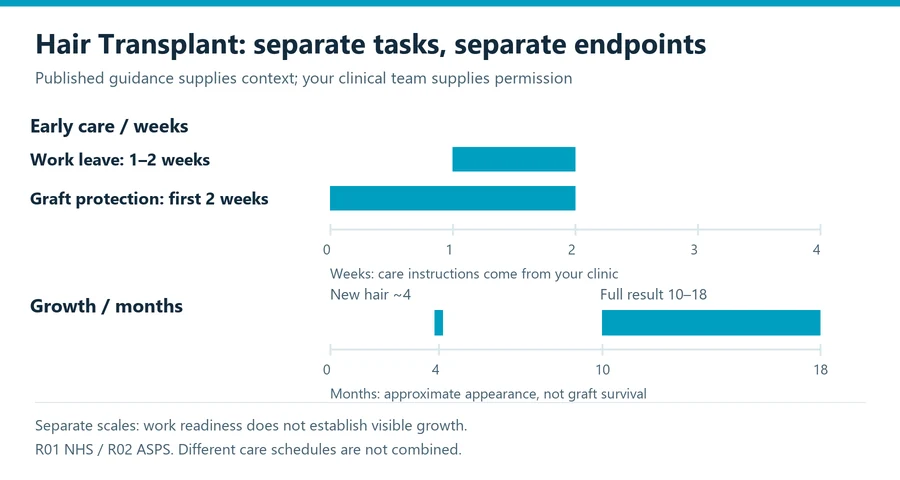
Hair transplant recovery has two different clocks: early scalp care and much slower visible hair growth. The NHS describes one to two weeks away from work, special care during the first two weeks while grafts are not secure, and possible exercise reduction during the first month. New hair commonly begins to appear around four months, with full results taking ten to eighteen months. Those broad estimates are not your washing instructions or an individual growth forecast. NHS hair transplant guidance
This guide concerns surgical transplantation to the scalp, rather than a medication course, a hair system or treatment of a different body region. It helps organize questions about recipient grafts, the donor area, work, headwear and follow-up. It does not recommend a graft count, guarantee density or decide whether you are a suitable candidate. If your procedure includes another treatment, ask which instructions apply to each part before combining their schedules.
What should a hair transplant recovery plan identify?
Start by asking the clinic to record the technique and the areas treated. Follicular unit extraction and strip surgery have different donor-site arrangements; knowing which you had helps clarify your care instructions. Ask which area contains transplanted grafts, which is the donor area, and whether a dressing or closure needs clinician follow-up. You do not need to diagnose the appearance of either site yourself, but you need to know whom to contact about a concern.
Obtain your own written plan for washing, touching the scalp, prescribed medicines and follow-up. Hair transplant recovery advice online often gives exact day numbers for a routine without describing the operation behind it. This article deliberately does not reproduce a home washing method or removal instructions. Ask the team to demonstrate anything you are expected to do and explain what to do if you cannot carry it out comfortably or are uncertain about the instructions.
List the everyday items that could involve the scalp: work headwear, a uniform cap, a helmet, hair products, bedding, showers and your usual commute. The point is to ask about their use, not assume they must all be prohibited. Show the team the relevant item or describe it accurately. An accessory marketed as postoperative does not establish suitability for your particular graft or donor-site plan.
The support you need should reflect your anesthesia, operation and discharge arrangements. Ask whether someone must accompany you and what practical help is recommended. Arrange transportation to follow-up separately from a hoped-for driving date. If you live far from the clinic, clarify who will assess a concern locally and how records can be shared. A remote check-in and an in-person examination should not be assumed interchangeable for every problem.
Which hair transplant recovery milestones belong on different calendars?
Keep early care, task permissions and growth expectations on separate lines. A work-leave interval does not mark full graft maturation or visible results. Similarly, a growth milestone cannot tell you when you may resume exercise. The companion diagram uses weeks for the early period and months for later appearance. It avoids compressing an eighteen-month horizon onto a two-week recovery scale, where very different questions would become difficult to distinguish.
| Hair transplant recovery question | General source context | Individual decision still required |
|---|---|---|
| How much work leave should be discussed? | NHS: one to two weeks; ASPS notes some light activity may be possible after several days | Actual operation, job demands, headwear and appearance preferences |
| What needs extra care early on? | NHS: graft protection during the first two weeks | The clinic’s touching, washing and protection instructions |
| How should exercise be scheduled? | NHS: exercise may be reduced in the first month; ASPS discusses avoiding vigorous activity for at least three weeks | The sport, intensity and donor-site restrictions |
| When does visible growth become relevant? | NHS: new hair around four months; full results ten to eighteen months | Individual course and the team’s assessment |
These sources do not offer identical daily care schedules. ASPS and NHS differ in their examples of washing and closure review. That is a concrete reason to follow your treating team’s instructions rather than assemble a routine by selecting the earliest date from each page. ASPS hair restoration recovery Neither overview examines your scalp or identifies the exact care your clinic has prescribed.
For hair transplant recovery scheduling, label an appointment as an appointment. A booked review may result in continued restrictions, a modified instruction or a request for another assessment. It does not guarantee permission to resume every activity. This distinction helps when an employer or family member asks for a fixed endpoint: explain which task you are planning and when you expect an answer, without presenting an anticipated review as a promised clearance.
The growth calendar should also remain flexible. Early photographs, a shedding episode and the number of calendar days since surgery cannot independently establish your final outcome. Ask the clinic which changes it expects you to report and when it plans to assess growth. No percentage of graft survival, rate of complication or guaranteed number of hairs is provided by this organizer. It is a way to keep follow-up questions from being confused with cosmetic expectations.
How should recipient and donor care be kept distinct?
Ask for instructions that name each area. A statement such as keep the scalp protected may leave uncertainty about where a dressing is located or what should be handled by staff. Have the team clarify the recipient area, donor area and any closure. If the written instructions use a technical term you do not understand, ask for an explanation in ordinary words before discharge. Do not rely on a diagram from a different procedure to fill the gap.
Clarify the clinic’s washing instructions rather than borrowing a recipe
For hair transplant recovery at home, confirm the first permitted wash, the method the team wants you to use, approved products and what to do if there is a problem. Ask whether someone should help you. This resource does not prescribe water pressure, massage, shampoo ingredients or scab removal. A gentle-sounding product or technique is not automatically appropriate, and an internet routine should not override a clear instruction from the clinician responsible for your grafts.
If a dressing, stitch or other closure needs review, write down who will handle it and where. Do not turn a general published timeframe into permission to remove something yourself. An appointment may need arranging outside the original clinic, especially when travel is involved. Resolve that arrangement in advance so the responsibility is clear. A vague instruction to have it checked later is less useful than a named service and confirmed next step.
Keep medicines in the plan your prescriber supplied. Ask whom to contact if you cannot obtain a prescription, have trouble using it or think it is causing a problem. This guide does not recommend adding a hair-growth medicine, supplement or topical treatment after surgery. Transplant aftercare and a longer-term plan for hair loss are different discussions, even if the clinic addresses both during the same appointment.
When you contact the team about a change, identify the area and describe the problem rather than trying to name a diagnosis. Say when it began, whether it is getting worse and what instructions you have followed. If the clinic asks for a photograph, use its approved private method. A photo can support communication, but it should not be assumed sufficient for every clinical assessment or used to postpone care the team recommends.
How can work and headwear be planned?
Work planning for hair transplant recovery should include the physical environment. Describe required hats or helmets, heat, dust, strenuous tasks and time spent outdoors. A remote office role and a construction role do not ask the same things of the scalp. Ask the team which duties fit the current restrictions and whether a change of duties needs consideration. No universal return date can account for all those conditions.
Headwear questions deserve specificity. Ask about the exact hat, helmet or uniform item, when it may be used and whether any adjustment is needed. Do not assume that a loose cap or a protective helmet can be worn merely because it is useful at work. Conversely, do not invent a blanket ban from another person’s account. The useful decision combines the job’s requirements with the clinician’s advice for the actual treatment sites.
Appearance preferences are a separate planning issue. You may want flexibility around in-person meetings or photographs even when a task is medically permitted. Tell the team which concern is affecting your schedule and ask what general expectations are reasonable. A personal preference to avoid public attention is legitimate, but it should not be described as a clinical restriction unless your team actually gives one. This helps you communicate accurately with an employer.
For a commute or follow-up visit, ask about driving readiness in your circumstances. Consider anesthesia, medicines, comfort and the ability to perform driving tasks; confirm advice with the treating team and any relevant insurer requirements. Being able to attend a video meeting does not establish readiness to drive. Make a passenger or alternative transport arrangement for a planned appointment if permission remains unresolved.
For hair transplant recovery leave, arrange an option if the expected return needs to change. An adjustable meeting or staged workload may be easier to manage than a fixed full-day commitment. This is an administrative suggestion, not a medical recommendation for a specific schedule. Ask your workplace what documentation it requires and whether temporary adjustments are possible. This article does not determine employment entitlements or certify fitness for work.
What should be asked about exercise, grooming and future treatments?
Describe your usual sport, not just whether you exercise. A contact sport, strenuous resistance session and a routine that requires a helmet involve different questions. Ask which activities are restricted and how the next decision will be made. Do not use the earliest general timeline as a test date on which you try the activity yourself. Permission should address the real demands and the care of both recipient and donor areas.
For grooming, ask about appointments and products you normally use: haircuts, coloring, styling and scalp treatments. Put them on the question list before booking. This guide does not provide a date for coloring or cutting because the directly inspected source guidance does not establish a universal permission for those services. Explain the proposed service to your clinic and obtain advice that considers your actual healing and treatment plan.
Avoid making a series of cosmetic bookings contingent on the assumption that the scalp will be ready by a particular day. If an appointment requires contact, heat or products near a treated area, identify that dependency. A salon can explain what its service involves, but it cannot independently replace the transplant team’s postoperative instructions. Give both parties accurate information rather than asking one to guess the other’s procedure.
The longer-term hair plan belongs in follow-up rather than being improvised during early recovery. Ask when growth will be reviewed, whether ongoing hair loss elsewhere needs a separate discussion and what evidence the team will use to assess the result. No single image should be treated as a complete evaluation. Standardized private photographs may be useful if the clinic requests them, but a public progress diary is not necessary to obtain care.
How should shedding and symptoms be interpreted?
The NHS notes that transplanted hair often sheds after a few weeks before new hair grows, while ASPS also describes temporary postoperative shedding. That general explanation does not let this guide identify the cause of every change in your scalp. NHS growth and recovery stages Ask your clinic how it distinguishes expected changes from concerns that need examination, and when it wants you to make contact.
Severe pain or unexpected symptoms after a transplant should be reported to the clinic, rather than attributed automatically to shedding. This follows the NHS postoperative contact advice. Describe the symptom, its location and its course. Do not assume that a published early-care window establishes that any discomfort within it is harmless. An ordinary follow-up appointment should not be the reason to delay attention to a new concerning problem.
For emergency symptoms such as new breathing difficulty, chest pain or fainting, obtain immediate emergency help; in the United States, call 911. CDC identifies those as possible clot warning symptoms, while new limb swelling, pain, warmth or discoloration needs prompt assessment. CDC warning symptoms This is general emergency guidance, not a transplant-specific clot probability or a diagnosis of the cause.
Do not attempt to solve a worsening scalp concern by adding an unapproved lotion, removing material from the area or changing prescribed medicine. Use the contact instructions and seek appropriate urgent care if the team is unavailable and assessment cannot wait. A request to report the problem to the clinic and a need for urgent medical evaluation can both be relevant; routine documentation must not obstruct the urgent response.
How can follow-up keep care and growth expectations separate?
For hair transplant recovery coordinated across clinicians, identify which team is coordinating the postoperative plan. Ask them to resolve an apparent conflict before you change a routine. Keep the current written version and its date so a helper does not follow an older message. For a review elsewhere, confirm how the relevant record will reach that clinician. These are communication arrangements, not evidence that a particular washing or exercise schedule is preferable.
Bring two short lists: current care questions and longer-term growth questions. The first includes what you may now do, what remains restricted and any symptoms requiring review. The second concerns when results can be assessed and what changes elsewhere in the scalp may need discussion. This organization makes hair transplant recovery more understandable without treating work readiness as a promise of cosmetic success.
At each review, record the next action and the person responsible. If an instruction changes, make sure your helper or outside clinician has the current version. If a task remains unanswered, keep it pending rather than filling the blank with a number from the internet. A clear, current plan can accommodate an additional visit or a revised schedule without suggesting that recovery has a universal finish line.
The practical outcome is a care calendar that protects the distinction between early postoperative tasks and later appearance assessment. Hair transplant recovery is easier to plan when those endpoints stay visible, the clinic’s instructions remain authoritative and concerns have a reliable contact route. A chart can organize your questions; it cannot predict a personal result or certify that a graft is secure.
For related procedure context, read hair transplantation and the plastic surgery recovery guide.
Sources and review scope
Plastic Surgery Editorial Team. Source records checked through October 12, 2026. Review scope: source and editorial checks for general education. No individual clinical assessment is represented.
- NHS hair transplantation. nhs.uk. Source date: 2023-09-29. Checked 2026-10-12.
- ASPS hair restoration recovery. plasticsurgery.org. Publication/update date not stated. Checked 2026-10-12.
- CDC: About venous thromboembolism. cdc.gov. Source date: 2025-03-05. Checked 2026-10-12.