
Plastic surgery insurance appeals should address the actual decision, the reason stated and the process belonging to your health plan. Start with the written notice rather than a general request to cover plastic surgery. Identify the service, plan provision, review stage and applicable deadline. This guide offers an original denial-to-document worksheet; it does not promise coverage, write a legal claim for you or decide whether a procedure is medically necessary. The does insurance cover gynecomastia surgery guide explains that procedure and its consultation questions separately.
An authorization denial before treatment and a claim denial after treatment are different events. A rejected benefit request, an incomplete submission and a billing correction also may call for different actions. Ask the plan to identify what it decided before choosing a response. Calling every problem an appeal can make it harder to locate the relevant instructions and the person responsible for the next step.
Read the decision before building the packet
HealthCare.gov explains that health-plan decisions can be challenged through internal appeal and, where applicable, independent external review. The notice should explain the denial and how to dispute it. This general guidance concerns health-plan review; it is not a single appeal process for every insurance program or a determination that all cosmetic services must be covered. 1
For plastic surgery insurance appeals, make a one-page summary of the actual notice. Record the recipient, service or claim identifier, decision date, date received, stated reason, cited provision and named response route. Copy the relevant language accurately. If the notice refers to another document you do not have, list that as a missing item instead of guessing which version of a policy was applied.
Read the entire reason, not just the word cosmetic. The decision may cite an excluded benefit, an unmet clinical criterion, a network issue or absent information. A useful response needs to distinguish those possibilities. A detailed clinical letter may address one question while leaving an exclusion or an administrative discrepancy untouched. Ask what issue is actually being reviewed before requesting new paperwork.
Identify the plan and the governing process
Plastic surgery insurance appeals depend on the plan involved. A workplace plan, an individual plan and a public insurance program can use different procedures. Ask the administrator which framework applies and locate the actual plan documents. This guide does not apply the HealthCare.gov process as if it were the Medicare or Medicaid process, nor does it assume that an insurer’s brand identifies every governing rule.
DOL’s health-benefits claims guide describes the ERISA framework generally used by private-sector employment health plans, with exceptions for government and most religious-body plans. It points members to the Summary Plan Description and claims procedure. If you are unsure whether that framework applies, ask the plan administrator rather than applying its deadlines to an unrelated plan. 4
Keep the plan-year and document version visible. A policy example from another insurer or a prior year may help explain terminology, but it is not the provision governing your notice. Request the relevant current material and save it with the decision. If a change in coverage or employment occurred, record that fact so the reviewer can distinguish the proposed treatment date from an earlier eligibility period.
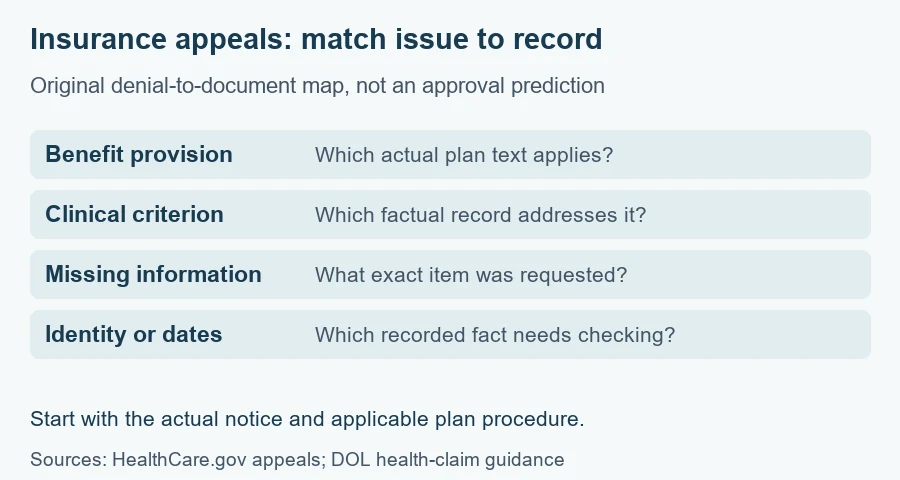
A denial-to-document map for plastic surgery insurance appeals
The original map in this guide links four broad issues to the questions and records that may clarify them: benefit provision, clinical criterion, missing information and administrative identity. These are organizational categories, not a prediction of approval. More than one issue can appear in a notice, and the actual plan wording remains the starting point.
For a benefit question, identify the cited provision and ask how it applies to the requested service. For a clinical criterion, identify the actual requirement and the existing clinical material relevant to it. For missing information, identify the exact requested item. For an administrative issue, identify the claim, person, service, date or network fact in dispute. Do not manufacture evidence to fill a worksheet cell.
The map is designed to prevent volume from replacing relevance. Twenty extra photographs may not answer a missing enrollment fact. A repeated emotional explanation may not identify the benefit provision being disputed. Conversely, a factual correction may matter when a notice describes a service that was not requested. Build the response around the discrepancy you can document rather than the largest packet you can assemble.
| Stated issue | Clarifying record | Question for the responsible party |
|---|---|---|
| Benefit provision | Actual plan text and notice | Which provision and service are being evaluated? |
| Clinical criterion | Relevant factual clinical record | Which criterion is unresolved? |
| Missing information | Specific request and submission record | What item is needed and where should it go? |
| Administrative identity | Actual claim, dates and enrollment details | Which recorded fact needs checking? |
Preserve the distinction between medical purpose and coverage
Plastic surgery insurance appeals can involve reconstructive care, functional concerns or a proposed appearance-related service. The clinician can explain actual findings and treatment purpose. The plan applies its benefit and review rules. A meaningful clinical concern does not automatically prove that every requested component is covered, and a denial does not itself erase the clinical concern. For separating reconstruction-benefit questions from a personal coverage decision, see breast reconstruction insurance coverage.
If a combined proposal includes different components, ask for an accurate description of each. Do not relabel an elective addition or invent symptoms to make the package fit a policy. A useful record separates genuine services and findings so the plan can review the actual request. Any billing or coding clarification should come through the responsible practice’s factual process.
Avoid building an appeal around another patient’s approval. Different policies, dates, indications and services can produce different outcomes. That story may suggest a question about which provision was used, but it does not establish your entitlement. Use the actual notice and your own accurate materials instead of treating a forum anecdote as evidence that the plan made the same decision in the same circumstances.
Internal review uses the actual instructions
HealthCare.gov’s internal-appeal page describes submitting the required forms or a request with identifying information and relevant additional material. It gives a 180-day filing period from receipt of a denial within its described health-plan framework. Your notice and applicable process need to be checked; do not copy that number into every program, every later appeal level or every other type of dispute. 2
For plastic surgery insurance appeals, create a deadline record containing the triggering notice, the date you received it, the stated period and the source of the instruction. If the start date or route is unclear, ask promptly for clarification. A phone discussion about the claim is not automatically the formal submission required by the process. Preserve a copy of the actual request and confirmation.
If the practice assists, confirm exactly what it is submitting and whether authorization to act for you is required. A clinical letter, a provider billing inquiry and a member appeal are not interchangeable documents. Ask who is monitoring the response and how you will receive copies. This avoids an assumption that someone else filed the appeal when they only sent supplemental information.
Build a readable evidence index
Use a short cover index with document identifiers, dates and purpose. The original notice, relevant plan provision, service description, accurate clinical material, earlier submission and correspondence should be easy to locate. Avoid sending unrelated medical history merely because it is available. Ask the responsible reviewer or professional about appropriate secure submission and relevant material.
For plastic surgery insurance appeals, organize the index around the actual reason. If the notice says a requested document was not received, identify the document and prior submission confirmation. If it describes the wrong service, identify the accurate request. If it cites a clinical requirement, identify the factual material addressing that requirement. Keep your explanation tied to the record rather than adding unsupported conclusions about what an insurer must do.
Give each version a clear date. A later clinician clarification should remain distinguishable from the original record, and an amended estimate should remain distinguishable from the earlier proposal. Do not silently change the source document or remove inconvenient facts. The goal is an accurate review of the actual request, not a reconstructed story that appears more favorable than the events support.
| Packet item | Record its role | Avoid this confusion |
|---|---|---|
| Denial notice | Decision and instructions being addressed | An unrelated earlier estimate |
| Plan provision | Applicable benefit or procedure text | Another insurer’s example policy |
| Clinical material | Actual findings and requested scope | Unsupported symptoms or invented necessity |
| Submission confirmation | What was sent, where and when | A general phone conversation |
Review stages need separate status records
DOL’s ERISA guide says participants have at least 180 days for an initial denied-claim appeal under its framework and can request relevant claim documents free of charge. It also explains that a plan may have more than one internal level and that the later level does not necessarily receive another full 180 days. Use the actual notice and procedure for the stage you are in. 4
For plastic surgery insurance appeals, record each stage separately: initial decision, internal request, additional-information response, internal determination and any further route identified. Keep the document that opens each stage linked to its instructions. This makes it less likely that a date from the first appeal will be carried into a later step where a different instruction applies.
If the status is unclear, ask whether the plan is awaiting information, reviewing a submitted appeal or issuing a final internal determination. Those are different positions in the process. A statement that the matter is being looked at does not identify the formal stage. Request the actual response and keep your own record of what was submitted and received.
External review is a distinct pathway
HealthCare.gov describes external review for specified categories, including medical-judgment and experimental-treatment denials and certain coverage cancellations. Its page describes a four-month request period in that framework and directs readers to the final notice for the organization handling review. This is not a promise that every benefit exclusion qualifies for external review or that an independent reviewer will decide in your favor. 3
In plastic surgery insurance appeals, locate the external-review instructions in the actual final decision and confirm applicability to the denial. Do not assume that submitting the same packet to a different address creates a valid external request. Identify the required form, route, authorizations and deadline through the applicable process. State and federal arrangements can differ, so preserve the instructions belonging to your case.
The external-review packet should still address the actual disputed issue with accurate records. An independent process does not make a stronger claim out of unsupported material. Keep the internal decisions and relevant submissions together so the reviewer can understand the history. If the process or eligibility remains uncertain, seek help from the responsible regulator, consumer-assistance service or qualified legal adviser rather than inventing a route.
Urgency is a clinical and procedural question
A hoped-for operation date or an expiring quote is not the same as clinical urgency under a plan’s expedited-review rules. HealthCare.gov describes faster review where the standard process would seriously jeopardize life or the ability to regain function. Ask the treating clinician and responsible plan about the actual clinical circumstances and applicable process. Do not describe an elective scheduling preference as a medical emergency. 2
For plastic surgery insurance appeals, record whether the request is pre-service or post-service and whether an expedited process has actually been requested. Keep the clinician’s factual explanation separate from your preferred appointment date. This guide does not calculate an urgent-review deadline for every plan or provide a substitute for necessary medical care while administrative decisions are pending.
If a medical concern develops, contact the appropriate clinical service rather than waiting for an appeal packet to be completed. The insurance process concerns payment or benefits; the treating team addresses care. Keep financial and clinical contacts distinct in your records so a person helping with paperwork knows which question belongs to which pathway. For recording expense-eligibility questions and supporting documents, see plastic surgery FSA and HSA.
An original appeal-status worksheet
The following plastic surgery insurance appeals worksheet records actions rather than approval odds. It can be used alongside the plan’s required forms, but it does not replace them. Use actual dates and instructions; leave a cell unresolved when the information is not known. A visible gap is more useful than a confident estimate of when the next decision should arrive.
| Stage | Actual evidence to retain | Status question |
|---|---|---|
| Decision identified | Notice and applicable provision | What exactly was denied? |
| Request prepared | Relevant packet and required authorization | Does it address the stated reason? |
| Request submitted | Copy and confirmed route | Was the formal request received? |
| Response reviewed | Determination and next instructions | What remains available or unresolved? |
If several services or claims are involved, use separate identifiers and show how they relate. Approval of one component does not necessarily resolve another, and a denial of one claim should not be generalized to every possible service. Link a response to the actual claim it concerns. This is particularly useful when facility, surgeon and other charges generate different correspondence.
Check the calendar units in plastic surgery insurance appeals
When recording instructions, preserve whether a period is stated in days, business days or months and what event starts it. Do not convert four months into a presumed fixed number of days or use a submission date when the instruction refers to receipt of a decision. The worksheet should quote the actual instruction in your private record and link it to the notice.
If two documents appear to give different deadlines, retain both and ask the responsible process contact to clarify promptly. A general explanatory webpage and a case-specific notice may describe different stages or frameworks. Do not choose the longer number simply because it gives more time, and do not assume that an informal conversation extends a formal deadline. Get appropriate help with the applicable process rather than guessing from a calendar calculator.
Planning while the outcome is unresolved
Do not treat pending plastic surgery insurance appeals as approved payment in your budget. Record the disputed amount and any relevant billing correspondence separately from the clinical proposal. Ask the responsible practice and plan about the actual status through their processes. This guide does not determine whether a balance is owed, instruct you to ignore a bill or promise that an appeal pauses every payment obligation.
If the treatment plan changes, ask how the new facts affect the existing request. A different service or date may require a different submission rather than a revision to an old narrative. Keep the earlier decision visible so that the change can be explained. Never revise the clinical history solely to make the appeal resemble an earlier covered example.
A complete working record ends with a precise statement of status: what decision is being reviewed, what accurate material was submitted, what response arrived and which instructions remain to follow. That is the useful result of this planning method. The quality of the record supports a clearer review without guaranteeing a particular coverage outcome.
Sources and their limits
The primary government pages below were inspected October 12, 2026. The inspected pages do not show a publication or revision date, so the inspection date is not presented as a policy enactment date. HealthCare.gov’s general framework and DOL’s ERISA scope remain separate. This guide does not replace a plan notice, government-program procedure or individual legal advice.
| Source | What it supports | Important boundary |
|---|---|---|
| R01: HealthCare.gov appeal overview | Internal and independent review distinction | Not one process for all insurance programs |
| R02: HealthCare.gov internal appeals | Request, record and expedited-review framework | Actual applicable notice and stage still matter |
| R03: HealthCare.gov external review | Specified denial categories and review route | Not universal eligibility or an approval guarantee |
| R04: DOL filing a health-benefits claim | Private-employment ERISA claim and review process | Government and most religious-body exceptions noted |
Sources and review scope
Plastic Surgery Editorial Team. Source records checked through October 12, 2026. Review scope: source and editorial checks for general education. No individual clinical assessment is represented.
- HealthCare.gov health-plan appeal overview. healthcare.gov. Publication/update date not stated. Checked 2026-10-12.
- HealthCare.gov internal appeals. healthcare.gov. Publication/update date not stated. Checked 2026-10-12.
- HealthCare.gov external review. healthcare.gov. Publication/update date not stated. Checked 2026-10-12.
- DOL filing a health-benefits claim. dol.gov. Publication/update date not stated. Checked 2026-10-12.