
Plastic surgery financing creates a payment obligation that needs its own review alongside the surgical quote. Compare the amount borrowed, the contract terms, the total repayment and the schedule you can actually meet. A low advertised monthly payment does not show the complete cost or establish that a procedure is appropriate for you. This guide provides a contract-reading and arithmetic worksheet, not a lender recommendation or individual borrowing advice.
Start with the complete quote before evaluating credit. Identify which services are included, what remains uncertain, when charges are due and whose invoice each charge appears on. Then make a second record for the financing offer. The medical practice, financing company and person receiving care can have different roles; a friendly explanation at the consultation does not replace the agreement you will be responsible for following.
What are you actually financing?
A plastic surgery financing offer may apply to one practice’s charge rather than the entire episode of care. Ask which surgeon, facility, anesthesia, testing or other charges are included in the amount presented for borrowing. Record any remaining payment dates separately. Do not combine a quoted loan amount with an unrelated national surgeon-fee average and call the result your complete treatment budget.
Use the final written estimate as a reference document. If the clinical plan is still changing, mark the borrowing figure as provisional. It is easier to evaluate a payment schedule when you know what it buys and what may still need a separate payment. A credit limit larger than the estimate does not mean the additional amount is a required medical expense or a sensible reserve.
For an original quote-to-credit worksheet, give each charge an identifier, payee, due date, current amount and financing status. A charge marked outside this offer belongs in the cash-flow review even if it is part of the same operation. The worksheet should also preserve uncertainty: an estimated charge is different from a posted balance, and a possible later service is different from a scheduled payment.
Identify the product and creditor
CFPB guidance distinguishes medical credit cards from medical installment plans. A credit-card company can pay the practice while you repay that company. Installment products may have a fixed number of payments, while card terms can operate differently. Ask for the actual product, creditor and account agreement rather than assuming that an office payment arrangement and a third-party credit product are the same. 1
For plastic surgery financing, write down who receives each payment and who answers account questions. The surgical office can explain the medical invoice, but the creditor’s agreement governs the credit account. If an outside company is involved, locate its actual statements and contact process. Avoid sharing sensitive personal details through a link or message simply because it uses the practice’s name; verify the channel through the actual documents.
Ask which steps are an application, which are a credit inquiry and which create an obligation. A conversation about affordability, an estimate and an application are different events. Read the requested authorization before submitting it. This guide does not predict credit approval, the effect on your score or the rate you might receive, because those depend on the actual product and individual circumstances.
| Record | What to identify | What it does not establish |
|---|---|---|
| Treatment estimate | Services, payees and due dates | Approved financing terms |
| Credit offer | Product, creditor and conditions | Medical suitability or coverage |
| Account agreement | Repayment rules and actual obligation | A guarantee that every quoted service occurs |
Interest-free language needs careful reading
The CFPB explains that a deferred-interest offer can charge interest dating back to the original purchase if the balance is not paid within the promotional conditions. Minimum payments may not eliminate the balance by that deadline. A deferred-interest period can also end on a different date from the normal payment due date. These are reasons to read the conditions rather than treating the phrase no interest as a complete explanation. 2
Plastic surgery financing advertisements can emphasize a promotion while giving less attention to what happens when it ends. Ask the creditor to identify the exact promotion type, qualifying purchase, end date, required payments and consequences if a condition is missed. A true introductory zero-percent APR structure and a deferred-interest structure should not be assumed identical. Preserve the actual language rather than shortening both to free financing in your notes.
Do not estimate retroactive interest by multiplying the remaining balance by an advertised rate unless that matches the contract’s calculation. Interest can depend on balances over time and other terms. If you want a scenario calculation, request the creditor’s explanation using the actual purchase and payment schedule. The original worksheet below deliberately shows principal arithmetic only, so it cannot be mistaken for a contractual payoff or interest calculation.
An illustrative payment comparison
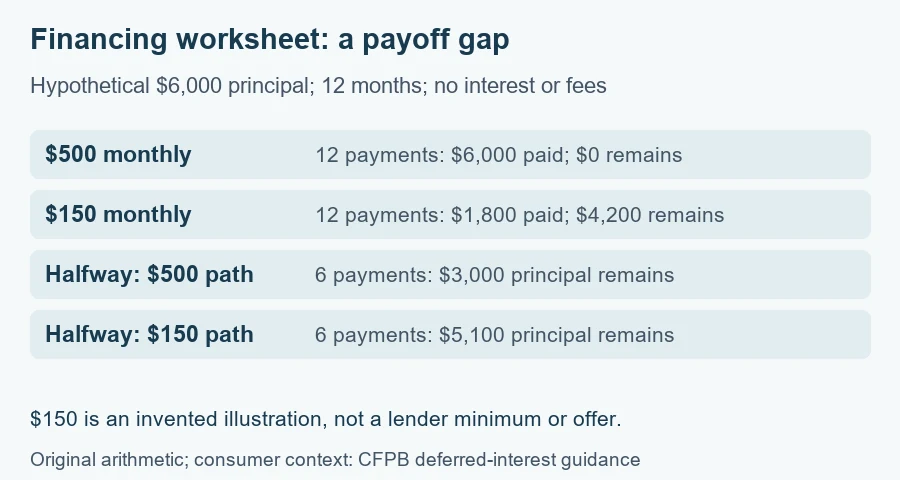
Consider a hypothetical $6,000 purchase with a 12-month payoff target and no additional charges or interest in this arithmetic illustration. Dividing $6,000 by 12 gives $500 per month. Paying a hypothetical $150 each month for 12 months totals $1,800, leaving $4,200 of principal. The $150 amount is invented for the illustration; it is not a lender’s minimum, a national price or an offer available to any reader.
The plastic surgery financing graphic compares those two deliberately simplified paths. At six months, twelve planned $500 payments would be halfway through the original principal, with $3,000 remaining. Six $150 payments total $900, with $5,100 remaining. These figures expose the difference between a chosen payoff target and a smaller monthly payment; they do not calculate interest, fees, allocation effects or what any contract requires.
| Hypothetical path | Principal paid after 12 months | Principal remaining |
|---|---|---|
| $500 monthly for 12 months | $6,000 | $0 |
| $150 monthly for 12 months | $1,800 | $4,200 |
| Scope of both examples | Original $6,000 principal only | No interest, fees or extra purchases calculated |
Before using similar arithmetic with a real offer, identify whether every payment will be applied to the balance you are targeting. If an account has multiple purchases or balances, ask the creditor how payments are allocated. Keep the promotional balance separate in your record. A total account payment and a reduction in one specific promotional balance are not necessarily interchangeable figures.
Compare total repayment and actual cash flow
For plastic surgery financing, compare more than the monthly amount. Record the borrowed principal, any stated fees, rate terms, number of payments, total repayment shown in the agreement and any conditions that can change the result. A longer schedule may reduce a payment while changing the amount or duration of the obligation. Use the actual documents rather than an assumed national rate or a generic online calculator setting.
Then place the proposed payments on your ordinary calendar with existing bills. A payment that looks manageable in an isolated spreadsheet can be harder to meet during unpaid leave or a month with several other obligations. This is a planning exercise, not a recommended debt-to-income threshold. Keep uncertain income marked uncertain rather than treating a hoped-for bonus, overtime shift or reimbursement as guaranteed money.
Make two separate lists: obligations already due and costs that may arise. Include relevant treatment-related expenses only when you have a reason to expect them, and label estimates honestly. Avoid adding a random complication reserve and presenting it as a medical forecast. Ask the practice what its actual policies cover and use your own verified circumstances when assessing how much flexibility the budget has.
Charges, deposits and cancellation
A plastic surgery financing contract and a practice’s cancellation or refund policy answer different questions. Ask when the provider charge is submitted, what a deposit represents and what happens if the treatment plan changes. Obtain the actual policy before relying on a verbal summary. Do not assume that a postponed procedure automatically pauses a creditor’s required payments or that a practice refund immediately closes the account.
If a cancellation or refund occurs, track the provider transaction and creditor balance separately. Record the amount, date, recipient and any stated processing time. Keep making account decisions through the actual creditor’s process while asking how the adjustment is reflected. This guide does not decide a refund right or advise ignoring a statement; it explains why both sides of the transaction need to be reconciled.
When the procedure changes before the charge is made, ask for an updated quote and an updated financing explanation. A smaller medical plan should not remain attached to an unexplained larger borrowing amount. A larger plan may require new terms rather than the original assumptions. Save both versions with clear dates so that the change is understandable instead of overwriting the earlier figure.
Separate account terms from clinical judgment
Plastic surgery financing approval is not medical clearance. A creditor evaluates an application under its own process; a treating clinician evaluates the proposed care. Neither a large credit limit nor an approaching promotional deadline establishes that surgery should happen sooner. Keep the financial discussion from becoming a substitute for informed clinical questions about alternatives, suitability and the actual treatment plan.
Ask whether the consultation team can provide the written quote without requiring an immediate financing decision. Use the documents to compare options at your own pace. An office may describe a product it offers, but that description should not be treated as an independent assessment of your entire financial situation. This guide does not rank lenders or claim that one payment method is best for every patient.
Clinical choices may also change what you are budgeting for. If the team recommends a different treatment or no treatment, return to the actual quote and account status. Record whether any service has already occurred and whether a charge has already been submitted. The fact that an application was approved does not mean you must preserve the originally imagined operation in your planning record.
Insurance, account reimbursement and financing
Plastic surgery financing is a way of paying an obligation, not a determination that insurance covers the procedure or that an FSA/HSA expense qualifies. Keep any coverage or account question in a separate review with the responsible insurer or administrator. Do not subtract a possible reimbursement from the repayment schedule as if it were already received.
The CFPB’s medical-financing materials discuss the broader medical-debt market and potential consumer costs. Its May 4, 2023 report is historical context, not a current rate sheet for cosmetic surgery. This guide does not carry older report rates into a supposed latest national financing price. It also does not assume that financial-assistance programs for eligible hospital care apply to every private cosmetic practice. 3
If you are comparing payment methods while a reimbursement question remains unresolved, label the amount and timing as conditional. Ask what happens to the budget if that payment never arrives or arrives later than hoped. That sensitivity check helps distinguish a feasible schedule from one that depends on an unanswered third-party decision. It is not an instruction to take a loan or to proceed with treatment.
A contract-reading record for plastic surgery financing
Use a single page to record the agreement version, purchase amount, product name, creditor, promotion type, deadline and payment instructions. Add a section for unanswered questions and the actual response. A representative’s answer is easier to assess when it names the balance or purchase involved rather than describing the company’s products generally. Preserve written materials that explain the answer.
| Question | Information to record | Follow-up if unclear |
|---|---|---|
| What balance is financed? | Actual charge and included payees | Request the updated quote and account amount |
| What ends a promotion? | Exact deadline and contract conditions | Ask the creditor for the applicable explanation |
| Where do payments go? | Allocation and statement process | Confirm the balance being reduced |
| What changes after a refund? | Provider adjustment and account readback | Reconcile both records through their processes |
If several people participate in the financial discussion, identify the borrower and any other contractual role from the actual documents. A relative who helps organize records is not necessarily the person responsible for repayment. Do not infer a co-borrower, guarantor or authorized-user role from casual conversation. Ask the creditor to explain the proposed role before anyone signs or provides personal information.
Recalculate when the target date changes
The illustrative plastic surgery financing worksheet can also be used to expose a calendar change. With the same invented $6,000 principal and no interest or fees, ten equal payments would require $600 each instead of the $500 shown for twelve payments. That arithmetic is not a creditor’s schedule. It shows why dividing by an advertised number of months can be misleading when the actual charge and deadline leave fewer payment opportunities.
Write the expected payment dates rather than just the month count. Then ask whether the creditor’s deadlines and payment-crediting process fit those dates. A plan described during an early consultation may begin at a later purchase date, or its contractual deadline may differ from the date you pictured. Confirm the actual structure instead of choosing whichever interpretation makes the payment look smaller.
If the recalculated amount is uncomfortable, leave that finding visible. Do not extend the imaginary repayment period beyond the promotion and continue calling the result the promotional payoff amount. Ask about the real post-promotion terms and evaluate the actual obligation. An unresolved schedule is a reason to obtain more information, not evidence that a longer hypothetical spreadsheet solves the contract. For separating revision-policy terms from clinical decisions, see plastic surgery revision policy.
Reading the first statement
After a real account is opened, compare the first statement with the agreement and the posted purchase. Check the charge amount, promotion information, due date and payment instructions. If something is different, identify the discrepancy precisely and contact the responsible party through a verified channel. Keep the issue open in your record until the actual account information is understood.
For plastic surgery financing, a useful monthly record includes the payment made, the date it was credited, the relevant balance and any new charge or adjustment. Comparing that record with the intended principal path can reveal a mismatch early. Do not assume a payment reduced the balance by the same amount when the account includes interest, fees or another allocation; use the actual statement figures.
A final planning decision should rest on an understandable quote, an understandable obligation and a schedule you have evaluated against your own circumstances. If a material term remains unclear, name it and seek clarification before treating the offer as settled. The worksheet’s purpose is to make those missing facts visible, not to turn borrowing approval into a recommendation for surgery.
Sources and their limits
These CFPB pages were inspected October 12, 2026. The medical-product guide was modified May 8, 2023; the deferred-interest page was reviewed January 22, 2024 and modified February 2, 2024. The report was published May 4, 2023. Their consumer explanations are used within that scope, without presenting historical market figures as current lender offers.
| Source | What it supports | Important boundary |
|---|---|---|
| R01: CFPB medical credit cards and payment plans | Product and creditor distinctions | Actual contract and individual terms still control |
| R02: CFPB deferred-interest explanation | Promotion conditions, deadlines and payment limits | Worksheet does not calculate contractual interest |
| R03: CFPB medical-financing report, May 4, 2023 | Historical consumer-product context | No historical APR is presented as a current offer |
Sources and review scope
Plastic Surgery Editorial Team. Source records checked through October 12, 2026. Review scope: source and editorial checks for general education. No individual clinical assessment is represented.
- CFPB medical credit cards and payment plans. consumerfinance.gov. Source date: 2023-05-08. Checked 2026-10-12.
- CFPB deferred-interest explanation. consumerfinance.gov. Source date: 2024-02-02. Checked 2026-10-12.
- CFPB Medical Credit Cards and Financing Plans report. consumerfinance.gov. Source date: 2023-05-04. Checked 2026-10-12.