
A plastic surgery revision policy describes a practice’s stated conditions for considering further work and any financial terms that apply. It does not determine that a revision is medically appropriate, guarantee a particular result or promise that the entire operation will be free. Ask for the actual written policy and a clinical assessment of the concern. Keep a possible professional-fee waiver separate from facility, anesthesia, devices, evaluation and other expenses that the proposed course may involve.
The word “revision” can refer to different situations: an assessed complication, a change in cosmetic goals, a planned stage or a concern about the earlier result. Those situations should not be assumed to have the same clinical or financial implications. Ask the treating clinician what the current finding means and what options are appropriate. Separately, ask the responsible office which policy provision addresses the actual proposal. A policy cannot diagnose the concern or create eligibility simply because someone is dissatisfied.
What does the plastic surgery revision policy actually cover?
Start with the policy’s scope and definitions. Identify whether it describes an assessment process, a possible adjustment to a charge, a time-related condition or a different arrangement. Ask what the terms mean in the actual circumstances instead of assuming that a familiar phrase has a standard industry meaning. This guide does not invent a national revision guarantee, standard free-surgery period or contractual obligation for an unnamed practice.
Keep the original operation, current concern and proposed response in separate fields. An assessment may lead to further observation, another evaluation, an alternative approach or a revision discussion; this guide does not choose among them. The financial policy can be examined only alongside the actual proposal. A statement about possible revision fees does not establish that the clinician recommends another operation or that a particular technique will address the concern.
The ASPS consultation questionnaire includes questions about how complications are handled and options if the cosmetic outcome is unsatisfactory. The undated document encourages asking the relevant questions; it does not supply a standard revision policy or a promise of payment. Use it to request an explanation of the clinical process and actual terms rather than treating a question on the checklist as an entitlement to a particular remedy.
| Plastic surgery revision policy topic | Question about the actual document | Keep separate from this assumption |
|---|---|---|
| Scope | Which concern and proposed service does the policy address? | Every dissatisfaction receives the same response |
| Assessment | Who evaluates the current concern? | A fee provision establishes clinical suitability |
| Financial benefit | Which specific charge may be adjusted? | A professional-fee waiver pays every bill |
| Conditions | What actual requirements or limits apply? | A headline describes the full agreement |
| Process | Who supplies a decision and estimate? | A discussion means a revision is approved or booked |
Read a plastic surgery revision policy by cost component
Ask which billing parties and services would be involved in the actual proposal. A surgeon’s professional charge is different from the facility’s charge, anesthesia, any device or material and relevant evaluation. Do not infer that one office can waive every other organization’s bill. The estimate should identify its inclusions, exclusions and provisional amounts. This guide supplies no national revision price and assumes no policy at a named clinic.
The original worksheet lists the components and a status for each: included, separately estimated, conditionally adjusted or unresolved. These labels organize the response; they are not an instruction that every practice use the same billing structure. If a component is not part of the proposal, mark that explicitly rather than inventing a charge. If an amount is unknown, leave it unknown until the relevant billing party supplies the information.
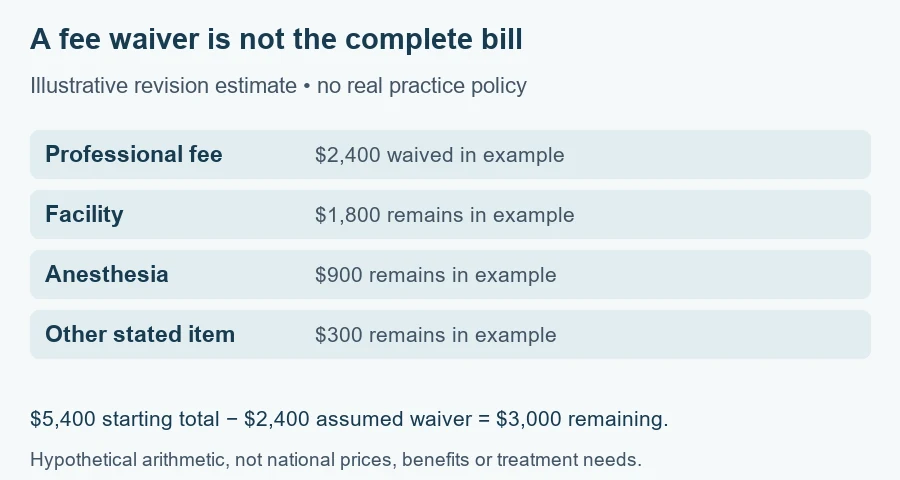
An invented example illustrates the distinction. Suppose a hypothetical proposal contains $2,400 in professional charges, $1,800 for the facility, $900 for anesthesia and $300 for another stated item: $5,400 altogether. If the example’s assumed policy waives only the $2,400 professional charge, the remaining stated charges are $3,000. That is arithmetic under fictional inputs, not a typical revision cost, a real practice benefit or an assurance that the other components are medically needed.
The example’s waived amount is about 44.44 percent of its $5,400 starting total, not one hundred percent. That percentage is a property of the invented worksheet, not a national fee-waiver rate or predicted saving. If the proposed scope changes, the relevant figures and policy questions may change too. Keep the complete estimate and actual written decision together instead of advertising a percentage saving based on a single component.
Plastic surgery revision policy and timing are different decisions
Ask the clinician how the current finding should be assessed and whether further information or observation is relevant. Ask the office separately about any time-related financial provision. Do not use a stated administrative period to decide that healing is complete or that another operation should happen before a deadline. This guide gives no universal interval for revision, because the appropriate clinical timing requires assessment of the individual course and proposed work.
If the financial document refers to a period, identify what event starts it and what action must occur within it. A requirement to request an assessment could mean something different from a condition referring to an operation date. Ask for the actual interpretation rather than supplying one yourself. Preserve the wording and the office’s response. A calendar entry should reflect the stated condition without being mislabeled as a clinical recommendation.
When the clinician’s advice and the administrative wording seem difficult to reconcile, ask both responsible parties to explain how the actual arrangement handles the situation. Do not assume that delaying for clinical reasons guarantees a financial extension or that a financial limit justifies disregarding medical advice. The relevant response should identify the specific provision and proposal. Appropriate clinical assessment and informed consent remain separate from a possible financial accommodation.
Track the plastic surgery revision policy decision stage
A general policy explanation, an assessment appointment, a proposed revision and a written financial decision are different stages. Record the actual status so a possible option is not mistaken for an accepted course. A friendly conversation about further work does not establish that every condition is satisfied, that the procedure is scheduled or that all charges have been waived. Ask which questions remain and who can confirm the next step.
Keep the same distinction when an estimate includes a provisional adjustment. Ask whether the amount is a confirmed decision or depends on another assessment, document or approval described by the office. Do not remove the charge from your planning record merely because an adjustment is being discussed. A budget can show the amount and its status separately, preserving the difference between a possible reduction and an actual obligation confirmed in writing.
| Plastic surgery revision policy status | Evidence to retain | What remains to clarify |
|---|---|---|
| General terms identified | Actual policy and edition | Does it apply to this proposal? |
| Concern assessed | Clinician’s explanation and recommendation | What options and limits were discussed? |
| Financial request considered | Question and responsible office | Which decision is still pending? |
| Written adjustment confirmed | Charge, conditions and actual response | Which other costs remain? |
| Booking or payment made | Current estimate and receipts | Does the record match the agreed course? |
Compare the clinical explanation, not just the policy headline
If the clinician recommends a revision, ask what it aims to address, what it may not change and what alternatives are relevant. If no revision is recommended, ask the reasons and what follow-up or information is appropriate. This guide does not decide whether either recommendation is correct. A policy statement cannot replace the clinical explanation, and another operation is not automatically the right response to every concern about appearance.
If another opinion is obtained, keep its question, records and proposed scope clear. It may address a different concern or use additional information. Do not assume that a different recommendation triggers the original practice’s financial terms or proves a breach of agreement. Ask the responsible parties to address the actual findings and policy question separately. The purpose is an accurate comparison, not a clinician ranking based on willingness to offer further work. For preparing the questions and records for another opinion, see plastic surgery second opinion.
Avoid combining pieces of separate plans without the clinicians’ agreement. A proposed technique, timing discussion and postoperative course should be understood as parts of the actual care plan. A financial policy may affect planning, but it does not authorize the patient to select a regimen from several sources. Ask how ongoing-care responsibilities and relevant information will be coordinated if the proposed treatment relationship changes.
Plastic surgery revision policy exclusions and unresolved wording
Read the conditions and exclusions with the same attention as the promised benefit. Ask whether the wording addresses the assessed concern, an elective change in goals, a service supplied by another organization or another specifically described circumstance. This guide does not presume what the policy excludes. Copy the actual passage and question, then request an explanation connected to the proposal rather than relying on broad labels such as “touch-up” or “guarantee.”
If the response is unclear, identify the missing element. It might be the service covered, the relevant time condition, the financial component or the person who makes the decision. A targeted clarification can reveal whether the issue is an incomplete explanation rather than a disagreement. Preserve the original document and later correspondence so the sequence remains understandable. Do not rewrite an earlier conversation as an unconditional promise if the actual wording was uncertain or conditional.
If a proposed adjustment requires signing another document, read that document’s actual terms and obtain appropriate advice about implications you do not understand. This guide does not recommend accepting a release, abandoning a claim or challenging a contract. A document-reading worksheet can organize the relevant facts but cannot resolve an individual legal dispute or determine the effect of an agreement without the actual circumstances and applicable law.
Keep refund requests and credit-card disputes distinct
A disagreement about a revision policy is not automatically a credit-card billing error. The CFPB’s billing-error guidance, reviewed April 15 and modified May 3, 2024, distinguishes the billing-error process from possible different procedures for defective goods or services. It describes a written notice within sixty calendar days after the charge appears on the statement to preserve billing-error rights. These facts do not establish that clinical dissatisfaction meets that category or guarantee a returned payment.
If a financial dispute exists, explain the actual transaction and issue accurately to the relevant organization. Keep the agreement, receipt, clinical proposal and financial response distinguishable. The card issuer’s process is not a clinical assessment, and a merchant’s revision discussion is not the same as a processed refund. This guide gives no personalized instruction to stop paying, initiate a particular legal claim or characterize a service as undelivered solely because the result was not preferred.
The CFPB refund guidance, reviewed May 15 and modified September 6, 2024, distinguishes contacting the seller, card disputes and conditional rights about unpaid amounts. It also notes that other payment methods can have different rights. Ask for the appropriate process under the actual agreement and payment arrangement. A general consumer resource does not create a universal revision refund or decide a treatment-quality dispute. For recording deposit and cancellation terms, see plastic surgery deposits and refunds.
Preserve a plastic surgery revision policy change history
Keep the original policy, current assessment, proposal and financial response together. If the proposal changes, record what changed and which earlier answer needs confirmation. A waiver attached to one proposed scope should not be carried into a broader operation or another billing arrangement without an actual explanation. Similarly, an earlier estimate should not be presented as the current complete amount after new services have been proposed.
| Plastic surgery revision policy change entry | Record the actual information | Avoid this bookkeeping error |
|---|---|---|
| Original proposed scope | Services and estimate originally discussed | Treating it as the final operation regardless of changes |
| Revised scope | Clinician’s actual new proposal | Assuming every earlier adjustment still applies |
| Confirmed fee adjustment | Specific component and conditions | Calling a partial waiver a free operation |
| Actual payment or credit | Receipt and transaction purpose | Counting the same amount twice |
| Unresolved expense | Identified billing party and question | Replacing an unknown with zero |
Ask how the plastic surgery revision policy handles a changed proposal
Suppose the initial discussion concerns one limited adjustment, while a later assessment proposes a broader course with a different facility arrangement. This invented scenario shows why an earlier financial explanation needs to be connected to its scope. Ask whether the adjustment was attached to the first proposal, whether it is confirmed for the new proposal and which other charges have changed. Do not treat a verbal reference to “revision” as a permanent financial commitment covering every future operation.
The same check is useful when another billing party’s estimate is provisional. If the professional charge is confirmed but the facility amount remains unknown, the complete total remains incomplete. Recording a zero would make the worksheet look resolved while concealing the missing estimate. Keep the known figure, identify the party that supplies the unknown one and ask what conditions could alter it. This supports an honest planning record without inventing an expense allowance.
Separate a benefit’s size from the time at which it affects payment. An adjustment might appear on an estimate or a billing credit might be processed later; the actual response should explain which. Do not presume that an unconfirmed reduction eliminates an amount due at an earlier stage. The transaction record can show what has been paid and the adjustment status without providing loan advice or recommending how to finance a remaining expense.
Keep your own notes distinct from the clinical and financial documents
Write down the question, actual response and point that remains unclear. If your note summarizes a conversation, label it as your understanding rather than presenting it as a signed policy or clinical order. Ask for clarification when the difference is consequential. This matters when a phrase such as “we will review it” is later remembered as “the operation is approved.” Accurate status language prevents an uncertain discussion from becoming a supposed commitment.
Share the relevant record through the agreed channel when another office needs it, avoiding broader disclosure of sensitive clinical information than necessary. Keep earlier versions so changes are traceable. The goal is to make the actual proposal and decision understandable to the responsible parties, not build a public accusation or an outcome guarantee from incomplete correspondence.
A useful consultation outcome
Leave with an explanation of the current clinical concern, the relevant options and the actual policy questions still outstanding. Ask for a complete estimate if a course is proposed and a written explanation of any financial adjustment. Identify who answers each unresolved clinical or administrative question. A clear record may still contain uncertainty, but it should distinguish an uncertain clinical outcome from an unconfirmed financial benefit and a pending appointment from a booked service.
A plastic surgery revision policy is useful when its scope, conditions and financial components are understood alongside the clinical assessment. Preserve the actual terms, avoid equating a professional-fee waiver with complete payment, and keep any revision decision subject to appropriate assessment and consent. The original worksheet supports a clearer discussion without promising a remedy, judging a clinician, inventing a practice policy or guaranteeing that a further operation will provide the result you want.
Sources and review scope
Plastic Surgery Editorial Team. Source records checked through October 12, 2026. Review scope: source and editorial checks for general education. No individual clinical assessment is represented.
- ASPS: Consultation questions. plasticsurgery.org. Publication/update date not stated. Checked 2026-10-12.
- CFPB: Disputing a credit card charge. consumerfinance.gov. Source date: 2024-05-03. Checked 2026-10-12.
- CFPB: Refunds for credit card purchases. consumerfinance.gov. Source date: 2024-09-06. Checked 2026-10-12.