
A plastic surgery second opinion is another clinician’s assessment of a defined question, such as whether a proposed operation fits your goals, how a finding should be evaluated or which alternatives deserve discussion. It is most useful when the clinician has accurate records and understands what you want clarified. Another consultation does not guarantee agreement, a better outcome, a refund or that a previous recommendation was wrong.
Begin by writing the question in ordinary language. “I want to understand why this operation is proposed” is different from “I have a new postoperative concern.” The first concerns a decision; the second may require timely clinical assessment. Do not use a routine opinion appointment or a records request as a reason to delay advice about a new concern. Ask the treating team how your actual circumstances should be assessed and which information another clinician will need.
What is the plastic surgery second opinion meant to answer?
Choose the main question before assembling a large file. It might concern suitability, the scope of a proposed operation, alternatives, the meaning of an assessed finding or the purpose of a possible revision. A focused question helps the receiving office explain whether its consultation can address the issue and what records it needs. It does not require deciding the answer in advance or selecting the opinion that most closely matches your preferred outcome.
Keep your goals separate from the existing recommendation. A goal describes what matters to you; a recommendation describes a proposed clinical response. If the two seem misaligned, that is a useful subject for discussion. For example, ask what the proposal is expected to change, what it cannot address and why the clinician considers its tradeoffs appropriate. This guide does not recommend a technique or assume that a less extensive procedure is safer or sufficient.
The AMA’s patient-rights ethics opinion includes opportunities to ask questions, obtain records, seek another opinion and discuss appropriate alternatives, including forgoing treatment. This is professional ethical guidance, not a determination of your legal rights in a dispute or a promise that a particular clinician must accept your consultation. It supports a respectful discussion of questions and uncertainty rather than treating another assessment as an accusation.
A plastic surgery second opinion question-to-record matrix
Different questions call for different information. Ask the receiving office what it needs before sending sensitive records. An operative report may clarify what was done, while the written proposal identifies what is now being considered. Images or test reports may be relevant when the question concerns an assessed finding. Do not assume that an attractive gallery photograph or a short marketing description gives another clinician the information needed to evaluate your situation.
| Plastic surgery second opinion question | Record to ask the receiving office about | What the record cannot establish alone |
|---|---|---|
| Why is this operation proposed? | Actual clinical assessment and written proposal | Whether the procedure is suitable without assessment |
| What was done previously? | Operative report and relevant device information | Current findings or a new treatment plan |
| What does this finding mean? | Relevant examination, imaging or test information | A diagnosis made by this worksheet |
| Which alternatives fit my goals? | Goals, proposed scope and clinician’s reasons | An automatic ranking of techniques |
| What is the purpose of a revision? | Earlier procedure and current assessed concern | Who caused the concern or whether revision is needed |
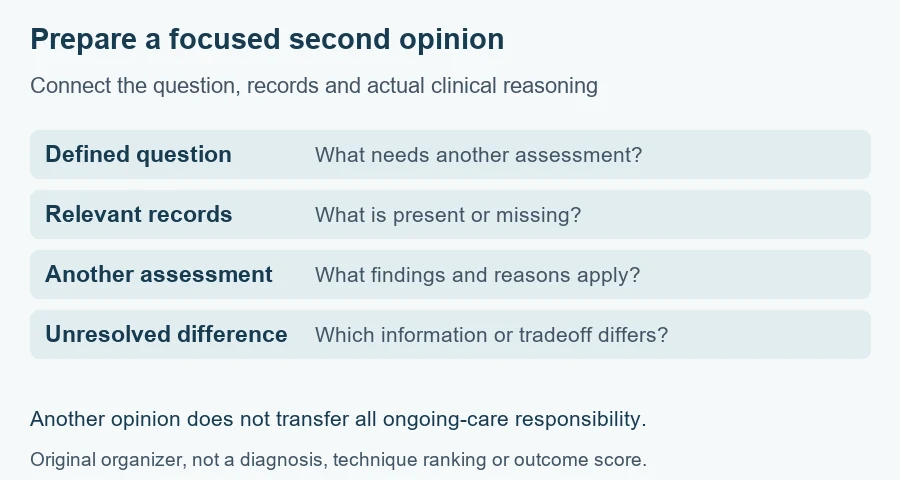
The visual organizes four layers: your question, relevant records, another assessment and unresolved differences. These layers are not a score for a surgeon or an algorithm that chooses a treatment. The worksheet is complete when it makes the question and missing information clear, even if the clinical answer remains uncertain. A specific unanswered question can be more useful than a large folder whose documents have not been connected to the consultation purpose.
Obtain your own records without guessing the transfer rules
The HHS medical-records guidance, reviewed May 30, 2025, describes access to medical and billing records held by entities covered by the HIPAA Privacy Rule, with exceptions. It distinguishes obtaining your own records from sending information to another organization. Ask the record-holding office about its actual request process and the receiving office about its preferred secure delivery method. Do not assume that a portal screenshot includes the complete relevant record.
Make the request specific enough to identify the material. Record the relevant procedure or visit dates and the type of document requested, using the information you actually have. Ask whether an operative report, device information, test report or imaging file is held by a different organization. A surgeon’s office, facility and imaging service may have different records. This is an organizational question, not a claim that every office must create a new summary on demand.
HHS’s January 28, 2020 notice about the Ciox court order explains important limits affecting third-party directives and associated fees, while stating that access to your own records remains in effect. Therefore, do not assume that sending records to another clinician follows every rule applicable to receiving your own copy. Ask which process is being used and what fees or permissions are actually described; this guide does not decide a fee dispute.
Confirm the records for your plastic surgery second opinion
Before the appointment, ask whether the relevant records arrived and whether anything is missing. A successful upload notification does not necessarily mean the clinician has reviewed the material, that every file is readable or that images are available in the needed format. Keep a small receipt log with the document name, sending organization, recipient and confirmed status. This avoids repeating an entire transfer when one specific report is the missing item.
If records are unavailable, tell the receiving office what you know and what you cannot verify. Do not reconstruct an operative report from memory or describe an implant model as certain when you have only a remembered brand. The clinician can explain how that gap affects the consultation. A transparent missing-record status is more informative than a confident but inaccurate history, particularly when a proposed revision depends on what was previously done.
Ask whether patient photographs are requested and how to provide them appropriately. Use the office’s instructions and secure channel rather than publishing sensitive images to obtain an informal online verdict. A remote image review may have limits that differ from an examination or assessment with relevant records. Confirm the actual scope of the appointment; the word “consultation” alone does not establish that a diagnosis or complete treatment plan can be provided.
Compare a plastic surgery second opinion on the same question
When recommendations differ, first check whether the clinicians addressed the same goal, records and assessed findings. One may be explaining a possible option, while another is recommending a course after a different examination or additional information. Those statements cannot be treated as opposing answers without their context. Ask each clinician to explain the reasons, expected limitations and alternatives relevant to the actual proposal rather than choosing by a technique name or a promised degree of improvement.
Distinguish a factual difference from a preference-sensitive tradeoff. A clinician may interpret a finding differently, or two clinicians may agree about the finding but weigh the proposed benefits and burdens differently. Your record should capture that distinction in their actual words or an accurate summary confirmed when needed. Do not convert an unclear explanation into a conclusion that one person is incompetent, deceptive or necessarily correct.
| Plastic surgery second opinion comparison | Record each clinician’s actual answer | Question when answers appear different |
|---|---|---|
| Main problem or goal addressed | Specific assessed finding and patient goal | Are both addressing the same concern? |
| Proposed scope | What would be changed and what would remain | Is one proposal broader than the other? |
| Reasons for the recommendation | Relevant findings, alternatives and limitations | Which reasoning differs? |
| Additional information needed | Actual requested records or assessment | Could a missing item explain uncertainty? |
| Unresolved decision | Remaining question and next discussion | What would help clarify the tradeoff? |
Plastic surgery second opinion fees and proposed scope
A plastic surgery second opinion may produce a different proposed scope and therefore a different estimate. Compare the actual work before comparing the amount. A lower quote may cover fewer services or a different course, while a higher figure does not prove better clinical judgment. Ask for the proposed services, billing parties and financial terms in writing. This guide does not invent a national price for another consultation or recommend borrowing to obtain one. For checking the exact specialty-board credential, see plastic surgeon board certification.
Ask the receiving office what the appointment costs and what it includes before relying on a general statement that a consultation is available. If insurance may be relevant, ask the actual plan and office how the proposed visit is processed. A routine cosmetic discussion, a medical assessment of a finding and a plan-required opinion can involve different questions. Do not assume that a second opinion is automatically free, covered or credited against a later operation.
Keep cancellation, deposit and revision terms distinct from the clinical recommendation. Another assessment does not automatically cancel an existing financial commitment or create a refund. Ask the responsible office to explain the actual agreement if your plans change. A decision to obtain more information and the financial consequences of changing a booking are separate matters; neither should be inferred from a general ethics statement about patient choices.
What if the opinion concerns a possible complication?
Tell the receiving office that the question concerns a current postoperative finding rather than a routine future procedure choice. Ask the treating team for advice about evaluation and timing. This guide does not provide a symptom-based triage rule or tell you how to manage a complication at home. A records request, online comparison or appointment wait should not replace the clinical contact and assessment appropriate to your circumstances.
Clarify who remains responsible for ongoing care while another assessment is being arranged. Obtaining an opinion does not automatically transfer all clinical responsibility or establish a new follow-up relationship. Ask both offices how information and care will be coordinated, especially if a new plan is proposed. A clear contact arrangement matters independently of whether the clinicians agree about the next operation. Do not assume a new consultation creates access to every service at that practice.
When the proposed course changes, ask how the relevant records and instructions will be updated. Preserve the earlier advice so the sequence remains understandable. Avoid combining parts of separate plans yourself—for example, choosing one clinician’s procedure proposal and another’s aftercare instructions without their agreement. The clinicians need to know what course is actually being followed before they can explain the appropriate assessment and follow-up.
Prepare a concise plastic surgery second opinion summary
Write a short factual summary containing your main question, relevant procedure dates, records available, records missing and the existing proposal. Add the goals or limitations that matter to your decision. Label uncertainty directly. A summary is an index to the actual history, not a replacement for the records or an argument designed to secure a particular recommendation. The receiving clinician can tell you what additional detail is needed.
| Plastic surgery second opinion summary field | Appropriate entry | Avoid this substitution |
|---|---|---|
| Main question | The issue you want clarified | A conclusion that must be endorsed |
| Previous procedure | Actual date and available report | A guessed technique or device |
| Current proposal | Written scope and clinician’s reasons | A marketing phrase without clinical context |
| Missing information | Explicitly unconfirmed record or finding | A confident reconstruction from memory |
| Next responsibility | Agreed contact and follow-up question | Assuming a consultation transfers all care |
Bring the summary and let the clinician’s assessment determine the discussion rather than treating the table as a diagnostic checklist. If an answer is unclear, ask for an explanation in familiar language and repeat your understanding so it can be corrected. You can ask what remains uncertain, what further information would change the recommendation and what options include no intervention. These are decision questions, not a demand that every uncertainty be removed. For organizing options, unanswered questions and the consent discussion, see plastic surgery informed consent.
Trace a disagreement back to its information
Suppose an original proposal discusses a contour change, while another consultation focuses on a structural finding described in a newly obtained report. The difference may concern the information available rather than a direct contradiction about the same question. This invented example is a reasoning aid, not a case report or diagnosis. Ask which finding each clinician considered, which goals were discussed and whether the additional record changes the scope of the recommendation. Keep the answers beside their dates. For checking the actual licensing-board record, see plastic surgeon disciplinary history.
A plastic surgery second opinion comparison becomes clearer when each statement is attached to its conditions. “This could be considered if the assessment supports it” differs from “this is recommended after the assessment.” A patient summary that removes the condition can create an apparent conflict. Ask the clinician to clarify the statement rather than deciding its meaning from a remembered phrase. The same care applies to estimates: an amount associated with one proposed scope cannot establish the cost of a different course.
If you discover a factual error in your summary, correct your index and notify the relevant office through its usual channel. If you think the underlying medical record itself is inaccurate, ask the record-holding organization how to request an amendment rather than editing its document. Keep your own clarification labeled separately from the original record. This preserves the difference between what the clinical file says and what you believe needs correction, allowing another clinician to understand the uncertainty honestly.
Before making a decision, identify which parts of the discussion you can explain clearly and which remain unresolved. You might understand the goal but not the proposed scope, or understand the technique name but not why it is suitable for your findings. Ask the next question about that specific gap. A useful comparison does not need a single overall winner; it needs enough accurate reasoning to support a decision about your actual proposal and preferences.
After the plastic surgery second opinion appointment
Record the actual recommendation, its reasoning and any additional steps discussed. Separate a suggested possibility from a scheduled plan and a conditional statement from a firm conclusion. If the opinion creates new questions for the original clinician, send the relevant issue through the agreed channel and request clarification. Do not circulate sensitive records or another clinician’s comments more broadly than necessary to coordinate care and answer your question.
Ask whether the receiving clinician supplies a consultation summary and how it can be shared with the appropriate treating team. If your own notes are the only summary available, label them as your understanding and ask for clarification when a consequential detail is uncertain. An accurate account is more useful than a polished description that conceals uncertainty.
If the two discussions leave you uncertain, identify the specific unresolved point rather than collecting opinions indefinitely without a consistent question. Another visit may be useful when it addresses missing information or a different relevant expertise, but the number of consultations does not establish correctness. Consider whether the remaining issue concerns the clinical findings, proposed scope, personal goals, cost or willingness to accept a tradeoff; each calls for a different discussion.
A plastic surgery second opinion should leave you better able to understand the decision and the evidence behind it. Its value is not measured by whether it validates the first recommendation or promises a preferred result. Preserve accurate records, ask a focused question, compare the reasons and confirm ongoing-care responsibilities. That method supports an informed conversation while leaving diagnosis, suitability, technique and treatment timing to the clinicians assessing your circumstances.
Sources and review scope
Plastic Surgery Editorial Team. Source records checked through October 12, 2026. Review scope: source and editorial checks for general education. No individual clinical assessment is represented.
- AMA ethics opinion 1.1.3: Patient rights. code-medical-ethics.ama-assn.org. Publication/update date not stated. Checked 2026-10-12.
- HHS: Your medical records. hhs.gov. Source date: 2025-05-30. Checked 2026-10-12.
- HHS notice: Right of access court order. hhs.gov. Source date: 2020-01-28. Checked 2026-10-12.