
Plastic surgeon board certification is a specialty credential that must be checked with the actual certifying board. It is different from a state medical license, society membership, hospital privileges and a marketing description. Confirm the physician’s identity, the named specialty and the current status; a familiar logo or the words board certified alone do not answer every question. This guide explains a verification method without certifying any individual physician, recommending a provider or promising a surgical outcome.
What does plastic surgeon board certification establish?
The American Board of Plastic Surgery describes certification as a voluntary credential involving approved specialty training and examination beyond minimum medical-licensure requirements. It also describes ongoing learning and practice-improvement responsibilities. That is a meaningful credential, but its meaning should remain specific. It does not independently establish that a particular person is the best choice for your procedure, has particular hospital privileges or can guarantee a result. Those are separate questions requiring their own evidence and clinical discussion.
Start by recording the exact board and specialty claimed. A broad phrase on a website may not tell you whether the certification concerns plastic surgery or another specialty. Do not infer the specialty from the clinic’s name or the procedures it advertises. The board’s own explanation can clarify what its credential involves, while its verification service addresses the current status of the named physician. Keep the general credential requirements separate from a person’s actual record so that reading an educational page does not become an unsupported claim that someone has been verified.
Read the ABPS explanation of certification.
How is certification different from a medical license?
The ABPS public FAQ distinguishes licensure, which is required to practice medicine, from voluntary specialty certification. A license question belongs with the applicable state medical board; a certification question belongs with the named specialty board. One search result cannot be treated as proof of both. An active license does not identify every specialty credential, and a specialty-board listing should not replace a current state-license check.
For plastic surgeon board certification, build separate entries for these records. Record the source, physician identity, specialty or jurisdiction, status wording and date checked. If one entry remains unresolved, leave it unresolved instead of inferring it from the other. A state-license restriction may also require reading the actual order or additional information, rather than interpreting a broad status label alone. This guide does not decide whether a physician may perform a particular procedure under every state’s law. It supplies a way to organize the questions accurately so that a legal or credentialing conclusion is not invented from a partial search.
Read the ABPS distinctions between licensure, certification and membership.
Which name should you search?
Use the physician’s actual professional name, including details that help distinguish people with similar names. Ask the practice for clarification if a public marketing name differs from the name used in official records. City and state can help narrow a search, but location alone does not prove identity. A physician may have moved, have more than one practice location or appear under a name variation. Those possibilities are reasons to clarify the record, not reasons to assume any result with a familiar surname is the right person.
Plastic surgeon board certification checks should preserve the identity match explicitly. Write down which information matched and which did not. If the service returns several possibilities, do not select the most favorable one merely because it looks plausible. If no result appears, check the entered information and ask the board or practice how to resolve the discrepancy. This is an original record method, not evidence that an actual physician was searched for this article. No names, license numbers or certification results are presented here as verified profiles. The same care is needed when a directory or review service seems to supply an easy shortcut.
How do you use the ABPS verification page?
The ABPS verification page provides name and location search fields and identifies the board as the primary source for its surgeon records. Use the actual search service rather than a copied screenshot when you need current information. Record the displayed result faithfully, including any relevant status or participation wording. A screenshot of an old result may be useful history, but it does not prove that the status remains the same when a new procedure is being planned.
For plastic surgeon board certification, the useful record contains the source and check date as well as the outcome. Do not convert an educational link into a verified badge for a person who has not actually been matched and checked. If the result includes a note directing attention to another authority, follow that route for the appropriate information instead of ignoring it. The ABPS page explains a separate route for state-license concerns. This article inspected the verification method, not an individual search result, and does not certify that any provider currently meets the board’s requirements. For checking the actual licensing-board record, see plastic surgeon disciplinary history.
Use the official ABPS verification method.
What belongs in the credential worksheet?
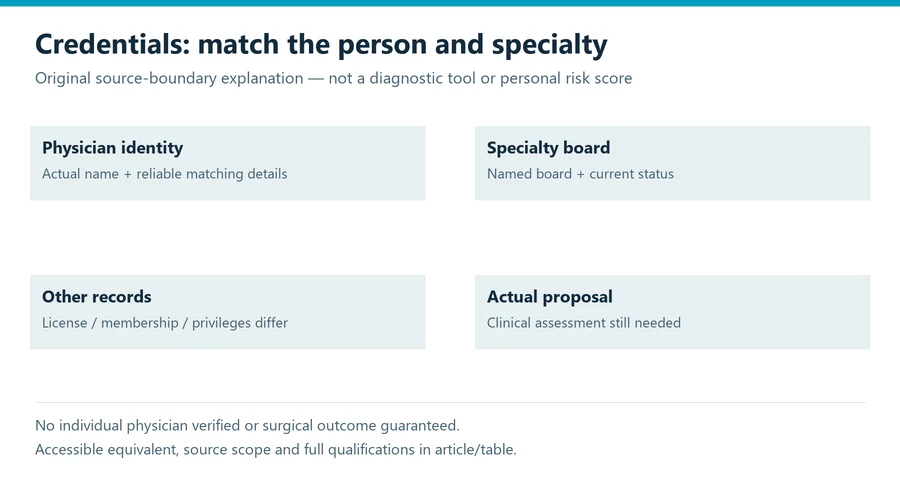
| Record | What to capture | What remains separate |
|---|---|---|
| Physician identity | Actual name and matching details | A similar name is not a confirmed match |
| Specialty certification | Named board, specialty and current status | State licensure and procedure experience |
| State license | Jurisdiction, status and relevant public information | Specialty-board credential |
| Procedure assessment | Actual proposal and relevant training questions | No credential guarantees your outcome |
This worksheet separates plastic surgeon board certification from related records rather than adding them into a provider score. The source and date belong beside each entry, and unknown information should remain visibly unknown. You can print or save the table and add factual notes from your actual searches. Do not enter a favorable conclusion simply because an advertisement appears professional or because one authority’s record is complete.
The original diagram is an explanation of that distinction. It is not a verified provider directory, a credentialing certificate or a clinical recommendation. A completed worksheet may identify questions that need further clarification; it does not approve someone to perform an operation on you. Keep the actual records available so that another reviewer or clinician can understand how each entry was established. That is more useful than a row of untraceable check marks that does not identify the board, jurisdiction, person or date behind them.
What if the physician is certified in another specialty?
The ABPS FAQ acknowledges that training in other specialties can include relevant procedures, such as head-and-neck, eye-area or skin work. It suggests discussing how the physician’s training prepares them for the proposed procedure. Therefore, another specialty credential should not be relabeled as ABPS certification, and its existence should not be treated as proof that the physician has no relevant training. The exact specialty and actual proposal matter.
For plastic surgeon board certification, write the other board’s full name and the specialty as actually stated. Then ask the physician to explain procedure-specific training, experience and responsibilities. If the answer depends on a fellowship or additional qualification, ask how that claim can be verified rather than assuming every term has the same meaning as specialty-board certification. This page does not make an individual competence judgment or rank specialties for every procedure. Its purpose is accurate interpretation: preserve the credential that exists, avoid inventing a credential that does not, and seek relevant explanations for the care being considered.
Is society membership the same thing?
The ABPS distinguishes a certification board from a professional membership society. Membership requirements belong to the particular society and should be checked with it when the claim matters. A society logo, award badge or academy name should not automatically be translated into specialty-board certification. Equally, a board listing does not establish membership in every professional organization. These are different records with different purposes.
Plastic surgeon board certification discussions become clearer when a practice identifies each claim precisely. Ask what the logo or initials represent and which body maintains the relevant record. Keep the answer separate from claims about results, popularity or customer satisfaction. If a membership claim is unresolved, record the uncertainty rather than allowing it to fill a gap in the certification entry. This is not a criticism of professional membership; it is a distinction that prevents a reader from attributing the wrong meaning to it. No society membership or award recipient is independently verified in this article.
Do older certificate dates prove current status?
The ABPS explains that certificates issued since 1995 have time limits and that continuing certification has additional requirements. Historical certificates are not all identical, and the presence of an old date on a biography should be interpreted through the current official record. Do not assume a certificate has expired solely because a long time has passed, or assume it is current solely because an old certificate is displayed. The actual board can resolve the relevant status.
For plastic surgeon board certification, retain both the historical information and the current check date when they are useful. A record showing when certification began answers a different question from a record describing current status or participation. If the meaning of the displayed wording is unclear, request the board’s explanation rather than improvise a label such as permanently verified. This article does not create an automatic renewal calendar for a named physician. It helps prevent old documents, current listings and educational descriptions from being collapsed into one claim without regard to what each actually establishes.
Does certification replace a procedure-specific consultation?
No credential can decide whether a proposed operation is appropriate for your individual situation. The consultation needs the actual goals, medical history, findings, procedure scope and alternatives. A board credential is one relevant part of understanding a clinician’s qualifications, but it does not replace that assessment. It also does not independently verify the facility, anesthesia arrangement, postoperative care or financial policy for the proposal you receive. For checking the named facility and accreditation record, see plastic surgery facility accreditation.
Plastic surgeon board certification should therefore support a better conversation rather than close it prematurely. Ask how the clinician’s relevant preparation fits the procedure, who will perform each part and what happens if another clinician becomes involved. If the proposal changes, revisit the related questions instead of assuming one credential settled every future version. Keep the credential worksheet alongside the procedure record, with clear separation between verified facts and the clinical judgments still needed. The site’s procedure guides provide broader operation context, while personal suitability and the specific care arrangements require an actual professional assessment.
What does a missing or ambiguous result mean?
A failed search is an unresolved result, not automatic proof of fraud, incompetence or absence of every credential. Check identity, spelling and the board being searched. Ask the practice for the exact claim and the relevant authority for clarification. Conversely, a plausible-looking result should not be declared a match while important identifying details conflict. The goal is accuracy, not the quickest reassuring or alarming conclusion.
For plastic surgeon board certification, preserve the search method and limitation. Record whether the problem was no match, multiple matches, an unclear status or inability to access a service. Those are different situations and may need different follow-up. A temporary technical problem does not justify inventing a verified status, and an unresolved match does not justify publishing an accusation. If the information remains material to your decision, you can pause elective scheduling while clarification or another opinion is sought. This worksheet does not diagnose the reason for a missing entry or promise that every discrepancy will have a simple administrative explanation. For evaluating what a photographic comparison can establish, see plastic surgeon before and after photos.
How does a hypothetical two-name problem work?
Keep both possibilities unresolved until identity is established
Imagine that a search returns two people with the same surname in different locations. Neither is established as the physician you intend to see merely because one has a favorable status. Record the identifying information available, ask the practice for clarification and confirm the relevant match through the official source. This is a hypothetical paperwork example, not an account of an actual provider researched for this guide.
For plastic surgeon board certification, the example demonstrates why a result and an identity match are separate steps. A clinic’s branding may not be the official physician name, and a location may have changed. Those possibilities should be clarified, not used as permission to select a preferred result. Keep any subsequent explanation dated and separate from the original search observation. Once identity is established, record the actual status without extending it to unverified license history, privileges or outcome promises. A careful record makes a later recheck easier and reduces reliance on an uncertain remembered conversation.
What if the official service is temporarily unavailable?
Record the access problem and the date rather than substitute a search-engine excerpt as a completed current verification. Ask the board how the relevant status can be confirmed. The practice may provide identifying details or a document, but label that material by its actual source. A copy of an older certificate and a current board observation answer different questions. Do not silently merge them to fill an unresolved entry.
For plastic surgeon board certification, a practical record can include three columns: information supplied, official observation and remaining clarification. This is an original organization method, not a claim that a particular board offers a guaranteed alternative turnaround. Identify which question is material to your decision and whether elective scheduling should wait for it. Keep a temporary access failure separate from a physician’s credential status. The inability to obtain information does not prove the credential exists or does not exist. When the official answer arrives, preserve its exact meaning and date rather than rewrite the earlier failed search as if it had succeeded. That dated sequence makes later review understandable without inventing verification work.
When should you recheck the information?
A dated credential record can change, and an old search should not be presented as permanently current. Before a new operation or a changed clinician arrangement, confirm that the relevant information still applies. This is an original planning recommendation rather than a universal legal recheck interval. The source pages were inspected on October 12, 2026; where no publication or revision date was displayed, no new review date is invented from copyright or retrieval.
Use plastic surgeon board certification information for the question it actually answers. Match the person, name the specialty board, record the current displayed status and keep other qualifications and clinical decisions separate. No provider profile, certification badge or individual license result was established by this article. A clear worksheet can reveal what is known, what needs clarification and where to obtain it. It cannot promise a safe operation or replace informed clinical assessment, but it can make the credential discussion more accurate and useful before you decide about the actual proposed care.
Sources and review scope
Plastic Surgery Editorial Team. Source records checked through October 12, 2026. Review scope: source and editorial checks for general education. No individual clinical assessment is represented.
- ABPS public credential FAQs. abplasticsurgery.org. Publication/update date not stated. Checked 2026-10-12.
- ABPS primary-source verification page. abplasticsurgery.org. Publication/update date not stated. Checked 2026-10-12.
- ABPS what certification means. abplasticsurgery.org. Publication/update date not stated. Checked 2026-10-12.