
Plastic surgeon disciplinary history should be checked through the relevant state medical board and interpreted using the actual public record. Match the physician’s identity, separate current license status from historical actions, and read the scope of any order. A review-site allegation, malpractice settlement and medical-board action are different things. This guide explains a record method without investigating, clearing, accusing or ranking an individual provider. Absence of a result in one search is not a universal clean-record guarantee.
What does plastic surgeon disciplinary history include?
The Federation of State Medical Boards explains that state boards regulate medical practice and can impose actions ranging from administrative measures and education requirements to restrictions, suspension or revocation. The actual record matters more than a broad headline saying disciplined. A reader needs to know the authority, action, date, stated basis and current effect. Those details cannot be inferred from a star rating or an unexplained directory badge.
Start with the question you are trying to answer. You may need to establish whether a physician holds a current license in the jurisdiction where treatment is proposed, understand a historical public order, or clarify a claim heard elsewhere. Those are related but different tasks. Record them separately so that a result about one is not silently treated as proof of the others. The method here does not decide whether an individual is competent, whether an allegation is true or whether an operation is suitable for you. It helps preserve the distinction between an official observation and an interpretation requiring further information.
Read the FSMB explanation of board actions and malpractice distinctions.
Which state or jurisdiction should you check?
Identify where the proposed medical care will occur and which authority maintains the relevant license record. A practice address, consultation office and surgical facility may not all describe the same location. Ask the practice to clarify the actual physician and treatment site before assuming a familiar business address supplies the applicable jurisdiction. If a physician has worked or holds licenses elsewhere, additional public records may be relevant, but one state’s search should not be described as a universal nationwide investigation.
For plastic surgeon disciplinary history, write the jurisdiction beside every result. A dated observation about a license in one state answers that particular question; it should not be extended to all other licenses without checking. The FSMB consumer guide describes state profiles and the consolidated DocInfo service as information routes. Use the official authority’s current instructions when you need details or the underlying order. This article inspected those methods, not a named physician’s licensing history. It contains no license number or provider status that has been independently verified for publication.
Read the FSMB consumer record guide.
How do you match the correct physician?
Use the actual professional name and any reliable identifiers available through the practice or official record. Similar names are a reason for care, not permission to choose the result that looks most favorable. A location, middle initial or name variation may help resolve a match, but each detail should be interpreted honestly. If important information conflicts, retain that uncertainty and ask the relevant authority how to clarify it.
Plastic surgeon disciplinary history checks should record the identity match before interpreting the status. Write down what matched, what differed and how any discrepancy was resolved. A business name or advertising nickname may not be the physician’s official name. A photograph on a review page does not substitute for record matching. This is an original verification worksheet method rather than a claim that a named person was examined here. Avoid publishing a conclusion about someone based on an ambiguous result, and avoid treating a record belonging to another person as reassurance about the clinician you intend to see. Accuracy matters in both directions.
What does the state-board record actually show?
The FSMB describes variation in public physician-profile information. Some profiles provide more detail than others, including links to actual orders or other public information. Read the authority’s explanations of its fields and terms instead of assuming every portal uses an identical structure. A summary may be a useful starting point, but it is not automatically a substitute for the document explaining the action and its scope.
For plastic surgeon disciplinary history, capture the wording faithfully. Distinguish the displayed license status, any listed action and the date checked. If a document is unavailable, record that limitation rather than paraphrase a headline as though the entire order was read. If an action appears to have been modified, identify the later record before concluding what remains in force. The purpose is a traceable account of the available information, not a consumer score assembled from snippets. This guide cannot interpret a particular state’s order for you or establish a legal conclusion about what a named physician may currently do.
What belongs in the public-record worksheet?
| Entry | Record the actual evidence | Avoid inferring |
|---|---|---|
| Identity | Name and reliable matching details | Same surname means same person |
| Current license | Jurisdiction, status and check date | Every jurisdiction has been checked |
| Public action | Authority, order, date and scope | Every action has the same significance |
| Unresolved information | Missing document or unclear wording | Unknown means cleared or guilty |
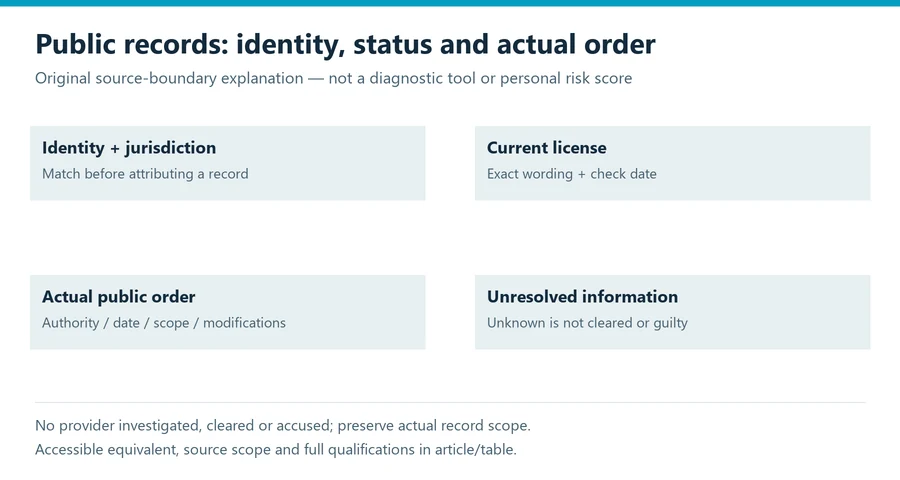
This worksheet keeps plastic surgeon disciplinary history distinct from a popularity ranking. An entry needs a source and date, and a conclusion needs the evidence that actually supports it. You can save or print the table and add notes from an official search. Leave unavailable information visibly unresolved. A row with a check mark but no identity, jurisdiction or source cannot establish what was verified.
The original diagram explains those record categories. It is not a legal determination, a disciplinary certificate or an endorsement of any physician. Completing it does not establish that an operation is safe or appropriate for you. It may instead show which questions remain important before a decision. Keep the original documents where possible and distinguish your questions from the authority’s actual statements so that a later discussion is based on the record rather than an uncertain remembered summary.
Is a current license the same as no previous action?
A current status and a historical record answer different questions. The relevant authority’s own wording and any actual orders determine what can be said. Do not erase history merely because a current label seems favorable, and do not assume an old headline describes a current restriction without checking subsequent information. The fact that time has passed does not by itself establish how a board matter was resolved. For checking the exact specialty-board credential, see plastic surgeon board certification.
For plastic surgeon disciplinary history, keep a small timeline when there are multiple documents. Record the date, issuing authority, document type and what it explicitly says. Then identify any open question about the present effect. This is an organizational suggestion, not legal analysis or a method for predicting future conduct. If a condition or restriction is unclear, ask the board or an appropriate professional for clarification. A practice’s explanation can be recorded as an explanation, while the official documents remain separate evidence. Neither should be silently substituted for the other when you describe what has actually been checked.
How is malpractice different from board discipline?
The FSMB distinguishes malpractice claims or settlements from board actions and explains that a settlement does not necessarily determine fault. A report of a claim is therefore not automatically proof of a medical-board violation, and a board action should not be rewritten as a civil judgment when it is not one. Different processes and records can concern related events while answering different questions. For assessing the limits of online-review evidence, see plastic surgery online reviews.
Plastic surgeon disciplinary history research should preserve those distinctions in the worksheet. Label the actual type of information rather than combine every unfavorable item into a single total. If you encounter a news report about a matter, locate the official record relevant to the conclusion you are trying to understand when available. Do not present an allegation as a final finding or assume a settlement establishes incompetence. This page supplies no individual malpractice analysis or probability of a future complication. Its contribution is careful record labeling so that an important concern can be discussed accurately without exaggerated or unsupported conclusions.
What if a public search finds no action?
A search observation has a scope: the authority, identity, date and information actually inspected. State that scope rather than write an absolute claim that no action has ever occurred anywhere. A missing match, unavailable document or technical failure also differs from a matched record with no action displayed. Those distinctions should remain visible. Do not turn lack of access into a favorable verification simply to complete a worksheet.
For plastic surgeon disciplinary history, record the search method and ask the authority how to resolve a material uncertainty. Check whether the entered name and jurisdiction are correct and whether the portal explains its disclosure limits. The FSMB guide describes public information routes, but it does not make a particular consumer search exhaustive. You may choose to pause elective scheduling while an important question is clarified. That planning choice does not itself establish wrongdoing. The aim is an accurate understanding of the available official information, including what was not obtained, rather than a badge promising complete absence of past concerns.
How does a state-specific example help?
The Medical Board of California provides an official license-verification route. It can illustrate where a person seeking California physician information would begin. It is not the portal for every state, and its available fields or instructions should not be presumed identical elsewhere. Use the appropriate authority for the jurisdiction that actually applies to the planned care rather than copy another state’s terminology into your record.
Plastic surgeon disciplinary history questions benefit from this specificity. Write California only when that is the record being checked, and identify another state explicitly when using another authority. This article inspected the California verification page as a method example; it did not submit a physician name or establish a license status. A method example can teach how to locate the official route without pretending to have investigated a person. If the process redirects to a separate official licensing system, follow the authority’s instructions and retain the actual source used for the final observation rather than assume the educational landing page itself is a verification result.
Read the California board’s verification instructions.
How should you discuss an unresolved concern?
Prepare a concise question tied to the actual record. Ask what the document means for the proposed care, what clarification is available and whether another authority or professional should interpret it. Avoid substituting an accusation for a question when the identity or finding is unresolved. Equally, do not dismiss a material restriction because a sales representative describes it as old or administrative without the supporting record.
For plastic surgeon disciplinary history, preserve the answer with its source and date. A clinician’s statement, an official order and your own interpretation are different entries. You can seek another clinical opinion about the proposal while separately clarifying credential or license questions. This resource does not determine how much weight a particular matter should carry in your individual decision. It helps ensure that the decision is not based on a mistaken identity, an incomplete headline or an invented clean-record claim. The site’s procedure guides provide operation context; provider records and personal suitability still require their own appropriate assessment. For evaluating what a photographic comparison can establish, see plastic surgeon before and after photos.
What does a hypothetical record discrepancy illustrate?
Distinguish an unresolved match from an established action
Imagine finding an order attached to a similar name, while the location and other identifying details do not clearly match the physician you intend to see. Record the discrepancy, seek clarification and avoid attributing the order prematurely. This is a hypothetical organization example, not an actual physician investigation, accusation or exoneration. It illustrates why a document’s existence and its relevance to the correct person are separate steps.
For plastic surgeon disciplinary history, the reverse problem also matters: do not select a different same-name physician with a favorable result as reassurance about the intended clinician. The worksheet should keep both uncertainty and the route to resolution visible. If identity is established later, record how it was established and then interpret the actual document within its scope. Keep that later observation separate from the earlier ambiguous search. A traceable record is more useful than changing an uncertain entry to a categorical conclusion without evidence explaining the change.
How can you keep a public summary and an order separate?
An official summary can help locate a matter while the underlying order supplies the detail available for interpretation. Save the summary and the document as distinct records, with their dates and source. If a link is missing or inaccessible, ask the authority how the public information can be obtained. Do not create an order description from an unrelated article or presume a missing document has no significance.
For plastic surgeon disciplinary history, an original record organizer can identify the exact question each item answers: identity, current status, historical action or later modification. Then list what remains unknown. A file title alone may not identify the full effect of an order, and the date of the web page may differ from the date of the action. Keep both when available. This method does not interpret a particular order or promise that every board discloses the same material. It helps a reader avoid treating a brief status label as a complete historical account, or treating an old document as the entire current record when another official entry may clarify what followed.
When should the record be revisited?
Public records and current status can change. Before a new procedure or changed clinician arrangement, consider whether the information relevant to your decision needs a current check. This is an original planning suggestion, not a universal legal recheck interval. The cited official pages were inspected October 12, 2026; where no clear issue or update date was displayed, retrieval or copyright is not represented as a new clinical or legal review.
Use plastic surgeon disciplinary history information to understand the actual official record, not to create a provider ranking or predict a personal outcome. Match identity, identify jurisdiction, preserve status and order wording, and keep historical actions, allegations and malpractice information distinct. No individual physician was verified, cleared or investigated by this article. A useful worksheet reveals what is known, what remains unresolved and where clarification belongs. That approach supports a more accurate decision without pretending that a single search proves universal absence of concerns or that every public action has identical meaning.
Sources and review scope
Plastic Surgery Editorial Team. Source records checked through October 12, 2026. Review scope: source and editorial checks for general education. No individual clinical assessment is represented.
- FSMB consumer records guide. fsmb.org. Publication/update date not stated. Checked 2026-10-12.
- FSMB discipline and malpractice distinctions. fsmb.org. Publication/update date not stated. Checked 2026-10-12.
- Medical Board of California license verification. mbc.ca.gov. Publication/update date not stated. Checked 2026-10-12.