
Plastic surgery online reviews can raise useful questions about a patient’s reported experience, but they do not establish a surgeon’s credentials, a complication rate or your likely result. Check the source, the experience described, its timing and any disclosed connection. Then separate what the review says from what requires other evidence. This guide offers an original review-to-question worksheet, without ranking providers, verifying individual reviewers or promising a reliable fake-review detector.
Begin with the decision you are trying to make. You might be asking about communication, the billing process, follow-up arrangements or the limits of a treatment proposal. Those are different questions. A short positive comment about a friendly receptionist does not answer a clinical-outcome question, while a long recovery story may leave the appointment process unclear. Classify the claim before deciding how much weight it can carry.
What experience is actually described?
For plastic surgery online reviews, identify whether the writer describes a consultation, treatment, recovery, a billing interaction or another event. A review posted after an initial visit can provide an account of that visit without describing an operation that never occurred. Do not promote it in your own notes from consultation experience to surgical-outcome evidence merely because the practice performs surgery.
Look for the limits stated by the writer. A person may explain that they are early in recovery or have not yet had follow-up. Preserve those limits rather than reducing the review to satisfied or dissatisfied. An account of a particular moment does not establish what happened later. The date posted and the interval from treatment, if stated, are separate pieces of context.
Your working note can say reported appointment experience, reported recovery experience or event unclear. These are descriptions of the review, not verification that the event occurred. If the question matters to your decision, bring it to the actual practice as a factual process question. Avoid contacting a reviewer to seek intimate medical details or asking them to evaluate your candidacy.
Consider the source and platform
The FTC’s October 2022 consumer guidance recommends considering the reviewer and the platform, looking at varied sources and checking recency. It warns that suspicious-looking details do not reliably prove whether a review is real or fake. It also notes that fabricated negative reviews can harm competitors. These are consumer cautions, not a diagnostic test for an individual surgeon’s profile. 1 For evaluating what a photographic comparison can establish, see plastic surgeon before and after photos.
When reading plastic surgery online reviews, distinguish a platform’s public policy from your assumptions about its verification. A badge may have a defined meaning that is narrower than proof of the complete medical story. Read the actual explanation if available. Do not treat an account photograph, a verified label or an impressive writing style as independent confirmation of clinical facts.
Also identify who controls the display. A practice-selected testimonial and a platform’s review collection can serve different purposes. A shared screenshot may omit the date, surrounding conversation or disclosure visible in the original setting. Record the source you actually viewed and whether the full context is available rather than assigning all versions the same evidentiary weight.
Disclosed connections change the question
The FTC announced its consumer reviews and testimonials rule on August 14, 2024. The announcement describes prohibited practices including certain fabricated reviews, incentives conditioned on a particular sentiment, specified undisclosed insider connections, misleading company-controlled review sites and certain review suppression. This guide summarizes that agency context without deciding whether a particular practice or post violates the rule. 2
For plastic surgery online reviews, read any stated connection and ask what it means for the claim. A relationship, incentive or promotional arrangement does not become invisible because a story is detailed. Conversely, you cannot infer an undisclosed connection simply from enthusiasm. Record a connection as disclosed, not observed or unclear; do not convert unclear into an accusation.
If a review becomes part of an advertisement, distinguish that use from the original place it was posted. Selection and presentation can change how readers encounter the account. Ask what the displayed statement is intended to support and whether necessary context remains visible. This guide does not endorse a testimonial or republish a patient’s review as evidence of a provider’s performance.
| Information type | What to record | What it cannot establish alone |
|---|---|---|
| Reported experience | Event and scope actually described | Independent verification of every medical fact |
| Display source | Platform, practice page or repost | Complete selection and verification history |
| Disclosed connection | Exact connection if stated | An undisclosed relationship inferred from tone |
| Clinical claim | Specific claimed result or risk | Your candidacy or a practice-wide outcome rate |
Ratings lack a clinical denominator
Plastic surgery online reviews are a selected set of accounts, not a census of treated patients. The number of reviews does not tell you the total number of operations, who chose to post, how long follow-up lasted or what outcome definition was used. Do not divide complaints by review count and call the result a complication rate. The denominator is not a documented clinical cohort.
A numerical illustration makes the distinction clear without representing any real practice. Imagine a display containing 20 reviews, with four mentioning a problem. Four divided by 20 is 20% of those hypothetical reviews mentioning a problem. It is not a 20% complication probability for patients. The example supplies no patient denominator, verified diagnosis, outcome definition or complete follow-up, so a clinical-risk calculation would be unsupported.
The same limitation applies to an average star rating. It describes the ratings included under that platform’s method, not a measured medical endpoint. A high average can coexist with missing information about long-term outcomes; a low rating can concern a nonclinical experience. Read the actual topic of the comments and seek suitable evidence for a medical-risk question rather than treating stars as a clinical score.
An original review-to-question map
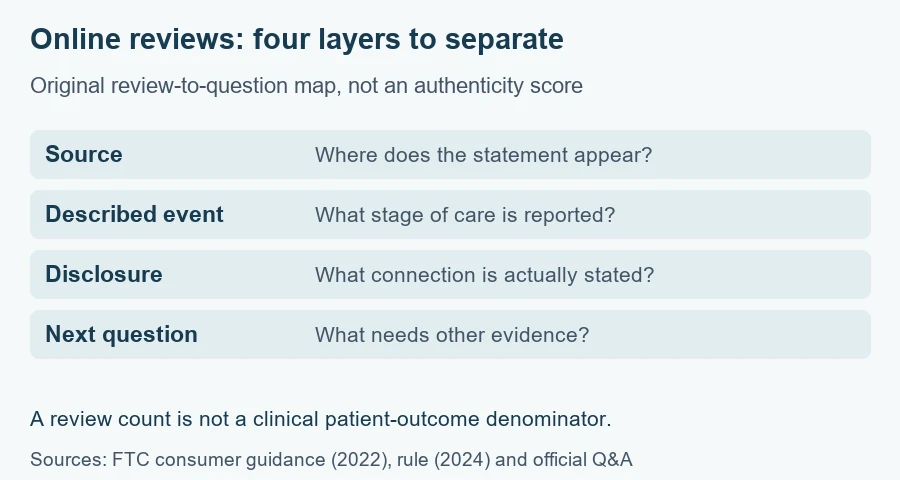
This guide’s original worksheet separates four layers: source, described event, disclosure and next question. It is a way to organize uncertainty, not a trustworthiness score. For each layer, record the observable fact and the limitation. A review can provide a useful question even when you cannot verify its complete story. The worksheet helps keep that usefulness within its actual scope.
For example, a comment about difficulty reaching the practice can prompt a question about the current follow-up contact process. It does not establish that every patient encounters that difficulty. A comment about an unexpected charge can prompt a request for the current written quote and billing policy. It does not determine whether the original charge was lawful or whether your own bill would be the same.
Use the map with plastic surgery online reviews before collecting a large folder of screenshots. More saved posts do not automatically produce better evidence. A concise record of a recurring topic and a precise question is often more useful during a consultation than a pile of comments with different procedures, dates and circumstances. Keep any copied personal information to the minimum needed for your own inquiry.
| Review layer | Observable fact | Next question |
|---|---|---|
| Source | Where the statement appears | What does the platform say its label or display means? |
| Event | Consultation, treatment or later contact described | Which actual practice process would answer this topic? |
| Disclosure | Connection stated or not observed | Is relevant context visible in the original display? |
| Claim limit | What remains unverified | Which independent evidence is needed? |
Patterns are questions, not verdicts
If several plastic surgery online reviews mention a similar topic, record the topic and the dates. Ask the practice about the current process relevant to it. Similar comments can justify a closer factual inquiry without proving the same experience happened to every patient. Do not translate repetition into a verified prevalence estimate or a definitive finding of misconduct.
Check whether the comments concern the same service, location or period before grouping them. A discussion of a different procedure may involve a different care pathway. A former scheduling process may not describe the current one. A repost can make one account appear in several places. Those are reasons to clarify the grouping rather than count every appearance as an independent patient report.
Keep the explanation neutral in your notes. Write several comments mention follow-up contact, then ask how follow-up contact currently works. That preserves the question without claiming that a specific clinician ignored patients. The practice’s answer should be evaluated on its actual content and relevant documents, not solely on whether it agrees with the tone of the reviews.
Be cautious about bursts and unusual detail
The FTC consumer guidance suggests noticing sudden clusters of reviews and examining a reviewer’s broader activity, while warning that appearance alone cannot reliably identify fabrication. A new account, brief comment or burst is a context clue, not conclusive proof. A plausible account can also be false, and an awkwardly written account can be genuine. Do not advertise a certainty the evidence does not support. 1
For plastic surgery online reviews, avoid assigning a fake label through a checklist of writing habits. Repeated phrases, polished prose or a lack of technical detail can have multiple explanations. Your practical response is to preserve uncertainty, consult varied sources and ask specific questions. This guide provides no automated authenticity score and does not inspect or classify named reviewers.
Likewise, a detailed account with photographs still needs context. Detail can help identify the claim being made, but it does not independently establish every diagnosis, treatment event or timepoint. Treat outcome photographs as a separate evidence question, with their own comparability and context limits. A compelling narrative should not remove the need for an individualized clinical consultation.
Read responses without treating them as adjudication
A public response from a practice can explain a policy or offer a contact route, but the exchange may not reveal the complete facts. Patient privacy and the limits of a public discussion matter. A brief response does not prove that no further action occurred, and a confident denial does not independently resolve the underlying account. Keep both statements within the information actually available.
Use plastic surgery online reviews to identify a process you can ask about directly. If the topic is after-hours communication, request the actual contact instructions. If it concerns dissatisfaction, ask how the practice discusses assessment and possible further care. If it concerns fees, request the written scope and relevant policy. These are different questions, and one friendly reply cannot answer all of them.
Do not invite the practice to disclose another patient’s private medical record to settle your curiosity. Ask about your own proposed care and the general process you would use. That approach can produce useful information without turning a public disagreement into an attempted clinical investigation by an outsider. For checking the actual licensing-board record, see plastic surgeon disciplinary history.
Rules do not make every posted account reliable
The FTC’s official rule questions and answers state that the consumer reviews rule took effect October 21, 2024. The staff guidance distinguishes the rule’s provisions and notes that the guidance is not definitive, comprehensive or a safe harbor. This guide does not turn the rule’s existence into a claim that every platform has verified every post or that every troubling review is legally actionable. 3
For plastic surgery online reviews, the relevant consumer task remains the same: identify the statement, its source and the evidence needed for the decision. A general legal prohibition can address misconduct without guaranteeing that misconduct never occurs. Do not assume a rating is trustworthy merely because deceptive practices are prohibited, and do not assume a suspected problem has been proved by the rule’s wording.
If you believe a review-related issue warrants reporting, use the appropriate platform or official consumer process and provide accurate information. This guide does not assess an individual legal claim, contact a provider or file a report for you. Keep suspicions distinct from verified facts and avoid publishing another person’s private medical details in an attempt to validate a story.
Keep clinical verification separate
Plastic surgery online reviews cannot replace verification of relevant credentials, facility arrangements or the treating team’s plan for your actual circumstances. Those questions require their own reliable records and conversations. This guide deliberately does not rank providers or infer qualification from the number of favorable comments. A positive report of bedside manner and an appropriate professional credential are different evidence types. For checking the exact specialty-board credential, see plastic surgeon board certification.
Ask the clinician about the proposed treatment, alternatives, risks and limitations using your own assessment. A reviewer who liked the same procedure name may have had a different anatomy, indication, technique or combination of care. Do not use the story as a treatment recommendation or a guarantee of the outcome you want. Keep the clinical decision with the appropriate consultation.
Your final notes should distinguish reported experience, observable platform context, unanswered process question and independently verified information. That division prevents a useful account from becoming an unsupported conclusion about medical performance. It also makes the consultation more efficient because you can explain exactly what you want clarified.
A practical reading record
Use a dated record for plastic surgery online reviews you consider important, preserving enough context to locate the original statement. Identify the topic and stage of care rather than copying an entire personal narrative. Mark what is uncertain. If a post changes or disappears, do not infer why without evidence; record only the actual change you observed.
| Record entry | Write the observable fact | Keep unresolved |
|---|---|---|
| Date and source | When and where viewed | Whether it represents all submitted reviews |
| Event described | Actual stage mentioned | Any unreported later course |
| Question raised | Specific process or evidence question | Whether the account generalizes to your care |
| Follow-up answer | Actual response and document | Any remaining clinical or factual uncertainty |
The result should be a short list of useful questions, not an unverified ranking. A review can help you notice an issue worth discussing while remaining a limited account. Combining that question with appropriate records and an individualized consultation is more informative than converting the review into a clinical probability or certainty about a provider.
Revisit the question after a consultation
After discussing a topic raised by plastic surgery online reviews, update your record with the actual explanation and any document provided. Keep the earlier question visible. A clear response may explain the process you would use without verifying or disproving someone else’s experience. Those are different outcomes, and your notes should say which one occurred.
If the answer remains vague, identify the missing detail rather than returning to the star rating for reassurance. You might still need the actual follow-up contact route, the written scope of a quote or an explanation of how the practice handles an assessment of dissatisfaction. Request the relevant information through the ordinary consultation process. A useful next step is tied to the unresolved question, not to the emotional tone of the review.
This final update turns the reading record into a consultation aid while preserving the review’s limits. It does not create a verified testimonial or a clinical score.
Sources and their limits
The FTC sources below were inspected October 12, 2026. The consumer article displays October 2022; the final-rule announcement is dated August 14, 2024; the official Q&A states the rule’s October 21, 2024 effective date but has no separate displayed publication date in the inspected text. No actual provider reviews, names or testimonials are reproduced. The hypothetical 20-review arithmetic is an original illustration, not a dataset.
| Source | What it supports | Important boundary |
|---|---|---|
| R01: FTC evaluating online reviews, October 2022 | Source, recency and authenticity cautions | Clues do not prove a particular review is false |
| R02: FTC final-rule announcement, August 14, 2024 | Stated prohibited review practices | No legal finding about a named provider or post |
| R03: FTC rule questions and answers | Official staff explanation and October 21, 2024 effective date | Not comprehensive individual legal advice or guaranteed authenticity |
Sources and review scope
Plastic Surgery Editorial Team. Source records checked through October 12, 2026. Review scope: source and editorial checks for general education. No individual clinical assessment is represented.
- FTC how to evaluate online reviews. consumer.ftc.gov. Source date: 2022-10. Checked 2026-10-12.
- FTC final-rule announcement on reviews and testimonials. ftc.gov. Source date: 2024-08-14. Checked 2026-10-12.
- FTC consumer reviews and testimonials rule Q&A. ftc.gov. Publication/update date not stated. Checked 2026-10-12.