
Hand reconstruction is a family of assessed procedures intended to address a specific problem affecting the hand or fingers. The useful starting point is the task that needs improvement and the structure involved, not a generic promise of a restored hand. Ask the treating team what diagnosis it has established, which tissue or function the proposed procedure addresses, and how rehabilitation and later assessment fit the plan. This guide provides a structure-to-task consultation worksheet and explains why evidence from one hand condition cannot be applied to every reconstruction.
An acute hand injury needs appropriate timely clinical assessment; this planning guide does not provide first aid, authorize a delay or diagnose a new problem. No universal operation, exercise program or return-to-work date is supplied. An established condition, previous injury or congenital difference can raise different questions. Individual suitability, the proposed technique and instructions must come from the team that has examined the actual hand.
What should hand reconstruction be intended to change?
Describe a task that matters to you, such as handling a fastening, using a work tool or holding an everyday object. These are examples for discussion, not diagnostic tests. Explain what happens when you attempt the task and what you want evaluated. Keep your experience separate from an assumed explanation: difficulty using an object does not by itself establish whether the cause involves a tendon, nerve, joint, scar or another structure.
The American Society of Plastic Surgeons describes hand surgery as addressing certain problems affecting strength, function and flexibility, including trauma and congenital abnormalities. Its overview also discusses distinct conditions such as carpal tunnel syndrome and Dupuytren’s contracture. These examples show that the broad label covers different diagnoses. They do not mean that the same reconstructive operation or recovery plan applies to every person with reduced hand function.
Ask the clinician to translate the diagnosis into the task under discussion. Which part of the proposed treatment is expected to address that problem, and which limitation might remain? A technical repair, a measured movement and the ability to complete an activity are related questions, but they are not identical endpoints. Recording them separately makes later discussions of improvement more precise.
An original hand reconstruction structure-to-task worksheet
Organize the consultation around three fields: the activity you want evaluated, the assessed structural problem and the proposed way to assess progress. Leave the structural field blank until the clinician explains the findings. A self-diagnosed anatomical label can narrow the conversation prematurely. Your description of the activity is useful evidence about your concern even when the diagnosis is still being established.
Also identify whether the dominant hand, both hands or particular fingers are involved in the assessed task. That detail can help describe your practical needs, but it does not automatically determine treatment. Avoid turning one difficult activity into a claim that every function is impaired. A useful record can describe both what is difficult and what remains possible, leaving clinical interpretation to the examination.
| Consultation field | Information to record | Boundary |
|---|---|---|
| Activity | A specific everyday or work task | Not a self-administered diagnostic test |
| Assessed structure | The clinician’s explanation of the problem | Not inferred from a symptom alone |
| Intended change | The function or tissue problem the proposal addresses | Not a guarantee of a normal hand |
| Progress measure | The team’s chosen movement, activity or other assessment | One endpoint does not establish every benefit |
| Practical context | Hand involved and relevant responsibilities | Does not independently establish suitability |
How different hand reconstruction procedures address different tasks
ASPS procedure guidance gives examples including tendon repair after trauma, surgery to relieve median-nerve compression in carpal tunnel syndrome and reconstruction for certain congenital finger differences. It also describes possible use of grafts, local tissue rearrangement, microsurgery and therapy in selected plans. These are procedure categories with different targets. Their presence in one educational overview does not establish that you need several of them or that their outcomes are interchangeable.
Ask what the proposed technique does in plain language. Does it address tissue coverage, a specific injured structure or a different assessed problem? Which part of the hand is involved, and is another tissue site part of the plan? A technique name alone does not establish the whole scope. The explanation should connect the method to the examined problem rather than simply list available operations.
If more than one technique is proposed, ask why the combination is being considered and which goals each part addresses. Keep proposed stages distinct from possibilities that may be discussed later. An operation that addresses one structural problem may leave another question for reassessment. This does not mean the first operation failed; it means the intended scope needs to be understood before judging it against a larger goal.
When microsurgery is part of hand reconstruction
ASPS describes microsurgery as intricate repair using specialized equipment, with applications including vessel and nerve repair, replantation and free tissue transfer. It emphasizes individualized reconstructive problems and the role of other coverage options. The term identifies a method used for particular tasks, not a universal requirement for hand surgery or proof that a more complex procedure is better for everyone.
If microsurgery is discussed, ask which structure or tissue-transfer problem makes it relevant. Clarify what the proposed repair is intended to accomplish and how the team will evaluate that result. A technical endpoint such as tissue survival should not be silently substituted for every activity goal you described. Request an explanation of the relationship between the technical operation and the functional outcome that matters to you.
Avoid using the presence of a microscope, graft or specialized device as an independent quality score. The consultation needs an assessed rationale and a discussion of alternatives and uncertainty. A method may be appropriate for one problem and unnecessary for another. General descriptions can improve the questions you ask, but they cannot select a technique without examination and the relevant clinical history.
Evidence example: postburn hand reconstruction
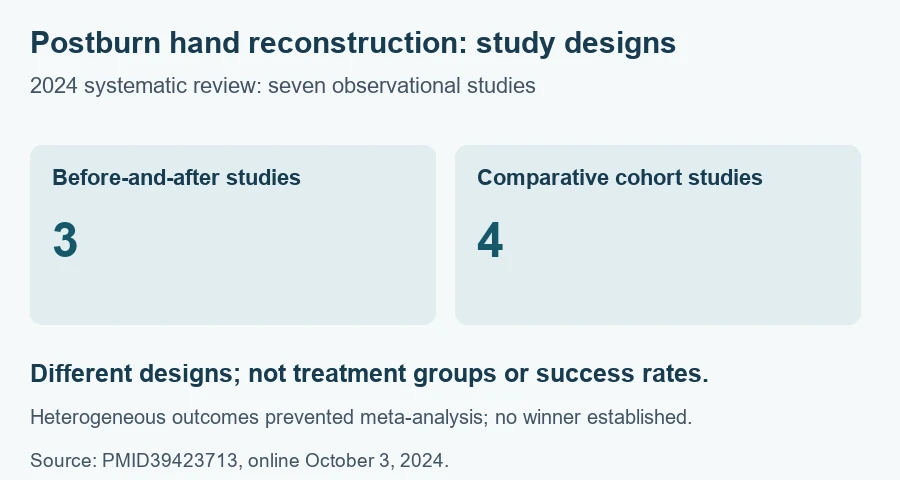
A systematic review published online October 3, 2024 examined reconstruction for postburn hand contractures. It included seven observational studies involving 1,310 patients: three before-and-after studies and four comparative cohorts. The authors reported substantial bias and incompatible outcome measures, preventing a meta-analysis. They did not establish that one reconstruction technique was superior. The original graphic shows the study-design counts, not treatment success or personal risk.
This evidence concerns postburn hand contractures. It does not establish the outcome of tendon repair, nerve decompression or congenital reconstruction. It also does not prove that all options are equivalent. A review that cannot establish a comparative winner leaves uncertainty; it does not fill that gap with a tie. Ask whether the evidence cited for your proposed procedure matches the actual diagnosis, task, technique and outcome.
| Evidence field | Actual review information | Interpretation boundary |
|---|---|---|
| Anatomical and clinical scope | Postburn hand contractures | Not all hand diagnoses |
| Included studies | Seven observational studies | Not seven treatment options |
| Before-and-after designs | Three studies | Change over time alone does not prove a causal comparison |
| Comparative cohorts | Four studies | Observational groups can differ in relevant ways |
| Reported patients | 1,310 across the included studies | Not a personal prognosis or technique-specific probability |
| Synthesis limit | No meta-analysis because outcomes differed | No universal technique winner established |
How to ask about hand reconstruction evidence
When an outcome number is offered, ask what was measured and who was included. A movement measurement, scar assessment, reported activity or technical event can answer different questions. Ask whether the study examined the same type of problem and whether combined procedures affected interpretation. If the source reports an operation group rather than a diagnosis-specific group, that distinction should remain visible.
Ask how follow-up relates to the result. The period during which patients entered a study is not the same as the time each patient was observed. A statement that a study lasted several years does not establish long-term follow-up for everyone. Also ask what proportion was assessed at the reported endpoint and which information is missing. These questions help distinguish a well-defined outcome from a broadly reassuring headline.
The purpose is not to demand certainty that the literature cannot provide. It is to understand what evidence supports the proposal and where individualized judgment remains necessary. A clear discussion can explain why a technique is considered suitable despite limited comparative research. It should not claim that a small or selected series proves an inevitable result for a person with a different problem.
Rehabilitation and instructions belong in the hand reconstruction plan
Discuss who will provide individualized rehabilitation instructions and how those instructions are coordinated with the proposed procedure. A hand therapist’s role, a device service and a surgical follow-up appointment are different parts of care. Ask which are included in the assessed plan and which decisions depend on reassessment. Do not assume that a generic exercise list from another condition is appropriate after your own reconstruction.
ASPS recovery guidance discusses individualized care instructions and the possibility of therapy to help restore function. It does not establish one timetable for every hand procedure. Ask which activities are restricted, how those restrictions will be reviewed and whom to contact if the instructions are unclear. Record the team’s own conditions for progression rather than treating the passage of a certain number of days as automatic permission.
Explain practical demands such as typing, handling tools, driving or caregiving to the team. These activities can involve different tasks and should not be merged into a single return-to-normal date. Request advice about the particular activity and the actual operation. Completing a wound review or attending one therapy session does not independently establish readiness for all work or household responsibilities.
Devices and splints within hand reconstruction
If a device is part of the plan, ask its purpose, who fits it, which instructions apply and how adjustments are arranged. A device item, initial fitting, later adjustment and therapy session can be distinct services. Do not infer the clinically needed quantity from a price package or assume that purchasing a device replaces individualized assessment. The separate hand reconstruction cost guide explains those financial units without prescribing adjustments.
MedlinePlus hand-fracture aftercare, reviewed June 27, 2026, provides an example of condition-specific splint instructions tied to the treating clinician’s advice. Its scope is hand fracture care, not every reconstruction. That distinction is why this guide does not borrow its duration or activity instructions as a universal postoperative schedule. Obtain the actual instructions for your diagnosis and operation rather than applying a familiar device rule from another condition.
Keep fit or use questions within the appropriate clinical service. This guide does not instruct you to alter, remove or substitute a prescribed device. Ask how to reach the team about a concern and whether an appointment is required. If financial or access problems affect obtaining prescribed care, tell the relevant service so those problems can be addressed instead of silently changing the plan.
An original hand reconstruction plan-comparison matrix
Compare assessed proposals using a common task and a clearly stated scope. The matrix below does not rank techniques or select surgery. It helps identify information that one proposal supplies and another leaves uncertain. A procedure described as simpler may address a narrower problem, while a larger proposal may include a different tissue task. The comparison should preserve those differences rather than compare names alone. For assigning help, availability and backup tasks, see plastic surgery caregiver planning.
| Planning question | Actual answer to obtain | Avoid assuming |
|---|---|---|
| Diagnosis and target | Examined problem and proposed structural response | Every symptom has the same explanation |
| Intended endpoint | Function, coverage or another defined measure | Technical success equals every activity goal |
| Additional tissue site | Whether another site is involved and how it is cared for | Only the hand requires planning |
| Rehabilitation coordination | Who gives and revises individualized instructions | A generic calendar supplies clearance |
| Device scope | Item, fitting, adjustment and therapy distinctions | A package determines clinical quantity |
| Future possibilities | Known planned work versus unresolved contingencies | Every discussed procedure is inevitable |
Keep the answers dated and preserve the original descriptions. If the plan changes, ask which goals, restrictions and practical arrangements change with it. A record from an earlier consultation should not be reused as though it covered a new diagnosis or technique. Someone helping with your care should be able to identify the current plan without guessing which of several different instruction sheets applies.
Risks, changing symptoms and the contact plan
Ask the team which risks apply to the actual operation and which concerns need prompt assessment. Request instructions for contacting the service during and outside its ordinary hours. This guide does not provide a complete complication checklist or tell someone to wait for a scheduled appointment when a new problem is concerning. An acute injury or a worrying change requires appropriate clinical advice rather than interpretation through a planning table. For organizing the actual discharge document and contact instructions, see plastic surgery discharge instructions.
Also discuss how an unmet functional goal would be reassessed. A difference between your expectation and the intended endpoint should be clarified before treatment where possible. Afterward, the team can explain which observations are relevant and whether the plan needs review. Do not label every remaining limitation as a technical failure, and do not assume that another operation will be necessary simply because it was discussed as a possibility.
For any financial comparison, establish the assessed scope first. Obtain written estimates for the actual participating organizations and identify what is included. Keep practical help, transport and work arrangements separate from a professional fee. Coverage and pricing questions require the actual plan and agreement; the broad label reconstructive does not establish a benefit determination or a complete national price.
Preparing records for a hand reconstruction consultation
Ask which previous clinical records would help explain your problem. Earlier operative reports, assessments or instructions may clarify what has already been treated and what remains. If a record is unavailable, state that gap rather than replacing it with a guessed technique name. Your own account of the activity can still help the consultation, provided it is distinguished from a documented diagnosis or measured outcome.
Describe previous changes in the same task you want evaluated now. For example, report what became easier, what remained difficult and what you have not tried because of existing instructions. Do not perform an unapproved movement test to complete a worksheet. The team should decide how function is assessed safely and which measurements are useful for the actual condition.
If photographs are relevant, keep their dates and context. They can support discussion of appearance but do not independently establish nerve function, tendon integrity or readiness for an activity. Differently positioned images are also not a standardized outcome assessment. The useful consultation record combines your concern, the clinical findings and a proposed method of assessment rather than treating a photograph as the entire diagnosis.
Hand reconstruction planning is most useful when it leaves a clear account of the assessed problem, intended task, proposed structural response and remaining uncertainty. Evidence can inform that account without promising a perfect hand or a universal technique winner. Keep individualized instructions and contact information with the current plan so the practical decisions follow the actual care team rather than a generic online calendar.
Sources and evidence boundaries
Sources were inspected October 12, 2026. ASPS educational pages are undated. The postburn hand review was published online October 3, 2024, with a December 2024 issue; its evidence remains specific to that condition. MedlinePlus hand-fracture aftercare was reviewed June 27, 2026 and is not a universal reconstruction schedule. No clinician or human review is represented.
ASPS hand-surgery diagnoses and functional scope
ASPS procedure categories and structural tasks
ASPS individualized hand recovery and therapy
ASPS individualized microsurgery applications
Postburn hand review: designs and comparative uncertainty
MedlinePlus fracture-specific device instructions
Sources and review scope
Plastic Surgery Editorial Team. Source records checked through October 12, 2026. Review scope: source and editorial checks for general education. No individual clinical assessment is represented.
- ASPS hand-surgery diagnoses and functional scope. plasticsurgery.org. Publication/update date not stated. Checked 2026-10-12.
- ASPS procedure categories and structural tasks. plasticsurgery.org. Publication/update date not stated. Checked 2026-10-12.
- ASPS individualized hand recovery and therapy. plasticsurgery.org. Publication/update date not stated. Checked 2026-10-12.
- ASPS individualized microsurgery applications. plasticsurgery.org. Publication/update date not stated. Checked 2026-10-12.
- Postburn hand review: designs and comparative uncertainty. pubmed.ncbi.nlm.nih.gov. Source date: 2024-10-03. Checked 2026-10-12.
- MedlinePlus fracture-specific device instructions. medlineplus.gov. Source date: 2026-06-27. Checked 2026-10-12.