
Plastic surgery caregiver planning starts with the treating team’s actual instructions and the help they say you need. Identify the relevant tasks, who is willing and able to perform them, when that person is available and what happens if the arrangement changes. A friend offering to help is not the same as a confirmed care plan. This worksheet organizes the discussion; it does not establish medical readiness, teach a care technique or prescribe how many hours of supervision you require.
Bring the draft roster to the clinical team before relying on it. Ask which tasks or support arrangements matter for your proposed course, what instruction a helper needs and how your actual circumstances affect the plan. Do not infer the answer from the procedure name, another patient’s recovery or an invented staffing total. The most useful outcome is a clear connection between a clinician-confirmed task, a named responsibility and a realistic arrangement for carrying it out.
Download the caregiver roster (printable PDF). Complete it privately and bring unresolved care questions to your treating team.
Start plastic surgery caregiver planning with the actual care requirements
Ask the team what assistance it expects after the actual operation and how those expectations will be explained before discharge. Tasks can involve practical logistics, understanding the written plan or help the clinicians specifically identify. This article does not create a standard task list that everyone must follow. Record the team’s actual instructions and the source document so your roster can be updated when the clinical proposal changes. For organizing the actual discharge document and contact instructions, see plastic surgery discharge instructions.
The MedlinePlus after-surgery overview suggests asking the surgeon about supplies, equipment, help at home and activity restrictions. It does not supply a procedure-specific helper schedule. Use those topics to ask what applies to your course, then record the answer. A general educational list cannot tell you that one person is sufficient, that support is optional or that you may resume a particular task on a certain day.
Distinguish an activity you usually perform from an activity the clinical team says you can perform during the relevant stage. If a household routine involves lifting, driving or another task you are unsure about, describe the actual demand and ask for guidance. Avoid converting a vague restriction into an improvised rule. The roster should show the confirmed instruction or unresolved question, leaving clinical decisions with the treating team rather than a planning spreadsheet.
A plastic surgery caregiver planning task roster
For each clinician-confirmed need, write the task in plain language, identify the person responsible and record the relevant availability. Add the instruction or demonstration needed, the backup arrangement and the confirmation status. This is more precise than listing a friend’s name under “help.” Someone may be able to bring a meal but unavailable to attend a teaching session; another may be willing to drive but unable to perform a task the team needs demonstrated.
| Plastic surgery caregiver planning field | What to enter from the actual arrangement | Question if unclear |
|---|---|---|
| Task | Clinician-confirmed need or practical responsibility | Does this apply to the current plan? |
| Primary helper | Person who has actually agreed to this role | Can they do the task and be present when needed? |
| Instruction | Relevant written direction or team teaching | Is explanation or demonstration still required? |
| Availability | Confirmed time and limits | Does it cover the actual need? |
| Backup | Agreed alternative or explicit gap | What happens if the primary helper is unavailable? |
The printable worksheet follows these same fields. Leave a row marked “unresolved” rather than inventing an answer to make the table look complete. A roster with visible gaps can guide a useful conversation with the team and helpers. A full-looking roster with guessed tasks or unconfirmed availability cannot establish that the actual needs are met. The worksheet is a record of arrangements, not a clinical sign-off.
Plastic surgery caregiver planning: willingness, ability and availability
A helper can be willing but unavailable at a particular time, available but not taught a required task, or capable of one role but not another. Record those differences respectfully. Ask about practical limits such as work hours, transport, other dependents and whether the person can participate in the relevant explanation. Do not assume that a close relationship guarantees the capacity to provide every kind of assistance or that accepting help transfers responsibility for clinical decisions. For arranging dependent-care tasks and backup coverage, see plastic surgery childcare planning.
Make the request specific enough for the person to answer. Rather than asking whether they can “help after surgery,” explain the role identified by the clinical team and the arrangement you need confirmed. If a required task has not yet been explained, say so. The helper can then identify what they need to understand before agreeing. This is coordination, not an instruction that an untrained person should carry out a clinical task based on an online description.
If someone cannot meet the requested role, record the gap and discuss options with the appropriate people. Avoid pressuring a helper to promise more than they can provide. A realistic limitation is useful information for planning; an unsupported reassurance may conceal a problem until the arrangement is needed. This guide does not endorse a paid service or claim that hiring any particular type of help automatically satisfies the clinical team’s requirements.
Plastic surgery caregiver planning and shared responsibilities
The National Institute on Aging’s caregiver worksheets, reviewed April 11, 2023, organize caregiving responsibilities and needs and suggest dividing tasks among family and friends. Their broader caregiving context is not a plastic surgery recovery protocol. The useful planning method is to make responsibilities visible rather than presume one person can handle everything. This article’s roster is original and does not reproduce the agency’s worksheet or apply its older-adult context as a clinical rule.
When tasks are shared, specify the handoff. The person helping with one appointment may not be the person receiving the next set of instructions. Ask how the relevant information will be communicated with your permission and through appropriate channels. Keep the current written plan available to the agreed helpers who need it. Do not circulate sensitive clinical details to a large group when a narrower practical message can coordinate a meal or transport task.
Assign one point of coordination when that is useful for the actual arrangement, without making that person responsible for medical decisions. Their role can be maintaining the roster, confirming appointments or recording unresolved practical questions. The patient and treating team still need clear clinical contact arrangements. A shared calendar cannot diagnose a problem, determine whether a restriction should change or substitute for advice from the people responsible for the care plan.
An illustrative schedule gap in plastic surgery caregiver planning
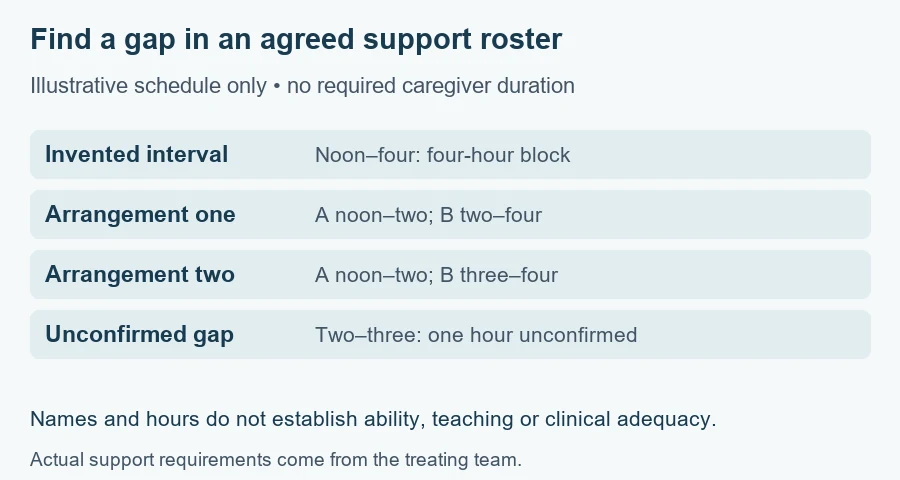
Consider a fictional practical arrangement for one four-hour afternoon block, from noon to four. Helper A agrees to be present from noon until two, and helper B confirms two until four. The planned blocks cover the four-hour period without a gap. This is arithmetic for an invented availability example, not a recommendation that four hours of help is clinically adequate or that continuous supervision is required for your procedure.
Now suppose helper B’s actual availability begins at three. The same fictional block contains a one-hour gap from two until three. The worksheet should display the gap instead of treating two names as complete coverage. Ask the team and helpers how the actual need is to be addressed. Do not resolve it by assuming the patient can perform a restricted task or that being reachable by phone is equivalent to the form of help the team has specified.
The supporting visual displays the fictional two scenarios and the unresolved gap. It does not predict a recovery period or measure the quality of the helpers. A calendar can identify whether agreed times overlap the planning interval, but it cannot establish that the people present have the relevant capacity or instruction. Keep the time calculation beside the actual task, teaching and clinical-support questions rather than using hours alone as proof of readiness.
| Hypothetical plastic surgery caregiver planning interval | Confirmed times in the invented example | Coverage observation |
|---|---|---|
| Arrangement one | A noon–two; B two–four | No time gap within this four-hour block |
| Arrangement two | A noon–two; B three–four | One-hour gap from two to three |
| Actual clinical requirement | Must come from the treating team | Not established by either example |
| Actual helper capacity | Must be discussed with the helper and team | Not established by a name or time entry |
Instruction matters more than a completed name field
Ask which helper needs to hear the explanation or see a demonstration before taking on an agreed role. The AHRQ surgical recovery education resources, reviewed November 2023, describe patient and family-caregiver testing of booklets and using them with surgical teams to promote discussion. The resources cover specified surgical pathways, not this site’s own plastic surgery regimen. They support the importance of understandable team-led education rather than using a generic booklet as independent instructions.
Connect each taught task to the current written direction and the person who understood it. If the explanation changes, ask how the responsible helper will receive the update. Do not rely on a fragment forwarded without context or a patient’s uncertain recollection of a demonstration. The clinical team can clarify what needs teaching and how understanding should be checked. The planning worksheet simply records that this conversation is completed or still needed.
If the helper needs communication support or a more usable format, make that need known before relying on the arrangement. A document being available does not mean it can be read or understood by the person expected to use it. Ask about the appropriate assistance and current version. This guide does not determine a named facility’s services or an individual legal entitlement; it organizes the practical question so the responsible team can address it.
Plastic surgery caregiver planning when a helper is unavailable
For each important responsibility, identify whether a backup has actually agreed and what they need to know. “Someone in the family will manage” is not a confirmed arrangement. Record the relevant contact and limits privately, and ask how a change should be communicated to the clinical team when it affects a requirement they identified. Do not assume that a replacement helper can perform a taught task without the needed explanation or that a remote call replaces in-person help.
Keep different kinds of contingency separate. A helper’s transport problem, a dependent needing care and a change in the patient’s clinical plan create different questions. The roster can identify the practical gap, but the clinical team assesses any change affecting the care arrangement. Ask who should be contacted and what information they need. This guide does not provide an emergency triage algorithm or tell you to proceed with an arrangement that the team has not assessed.
Consider the coordinator’s availability too. If the person maintaining the calendar is unavailable, another agreed person should know where the current practical information is kept when appropriate. Avoid a system that works only while one exhausted helper remembers every detail. This is a coordination method, not a prescription for the number of caregivers. Keep responsibilities clear without sharing unnecessary clinical information or assuming every helper needs access to the entire medical file.
Keep costs and availability distinct
Ask for actual prices and terms if services are purchased, and record the specific role they cover. A paid booking can still have limits, an unconfirmed date or a task outside its stated scope. Do not assume that paying for a service establishes clinical adequacy. Likewise, unpaid family help can create practical costs such as transport or time away from work, but this guide does not assign a national monetary value or invent wages for a helper.
Record actual expenses separately from confirmed help. A refund or cancelled booking changes the financial record; it does not automatically fill the support gap. If a service changes, update both the task roster and the payment status so the two records remain connected. The original worksheet focuses on arrangements, while an actual budget relies on real quotes, receipts and terms. It does not recommend a provider or a financing product.
A plastic surgery caregiver planning update log
Preserve the earlier roster when the proposal or arrangement changes. Add the actual change, who confirmed it and which task or time block is affected. If the team’s instructions change, record where the current version is available and which helper needs an update. Do not silently replace the old plan and assume everyone received the new one. A change log supports communication without turning a personal note into a clinical order.
| Plastic surgery caregiver planning change | Practical record to update | Confirmation needed |
|---|---|---|
| Helper’s availability changes | Affected block and unresolved gap | New helper or revised arrangement |
| Team changes an instruction | Current document and affected task | Relevant helper’s updated understanding |
| Appointment arrangement changes | Actual booking status and transport task | Responsible office and helper |
| Purchased service changes | Scope, availability and payment record | Actual service response and clinical question if relevant |
Plastic surgery caregiver planning: review simultaneous responsibilities
A roster can have no calendar gap and still contain a practical conflict. In an invented example, one helper is assigned to collect an item from another location while also being listed for an in-person task at home during the same period. The names and times appear complete, but the responsibilities cannot both be fulfilled as written. Identify the conflict and discuss a realistic alternative with the helper and team when the clinical arrangement is affected. Do not resolve it by assuming that either task is unnecessary.
Ask each helper to review the responsibilities they accepted rather than confirming a broad time block without its contents. A person may have another dependent, a transport limit or a commitment you did not know about. Those details can change the practical arrangement even if the person wants to help. Record the actual role and its limits without treating a helper’s personal circumstances as a reason for blame. Accurate capacity information is part of planning.
The printable version includes a field for conflicts and unresolved questions. Use it to connect each gap to the person who can address it. A logistical conflict may require another agreed helper; a question about a clinical requirement belongs with the treating team. A planning document is useful when it distinguishes those questions and preserves the actual response. It cannot decide which care instruction to omit or declare a limited arrangement adequate merely because no better option has yet been found.
A useful planning outcome
Bring the roster, visible gaps and questions to the team and the relevant helpers. Confirm that the plan reflects the actual course and the people’s real availability. The worksheet can be printed and completed privately; no personal contacts or medical records need to be entered on a public site. Keep it accessible to the people who need the relevant information and update it when an arrangement changes.
Plastic surgery caregiver planning is complete as a document when the tasks, responsibilities, instruction needs and uncertainties are clear. That does not certify clinical readiness or guarantee a smooth recovery. The treating team assesses the relevant care requirements; helpers confirm their own capacity and availability. A realistic roster makes those conversations easier and shows where the actual arrangement still needs attention.
Sources and review scope
Plastic Surgery Editorial Team. Source records checked through October 12, 2026. Review scope: source and editorial checks for general education. No individual clinical assessment is represented.
- MedlinePlus: After surgery. medlineplus.gov. Publication/update date not stated. Checked 2026-10-12.
- NIA: Caregiver worksheets. nia.nih.gov. Source date: 2023-04-11. Checked 2026-10-12.
- AHRQ: Surgical patient education booklets. ahrq.gov. Source date: 2023-11. Checked 2026-10-12.