
Plastic surgery childcare planning connects your treating team’s actual restrictions and support requirements to your children’s daily routines. Identify the tasks you may need someone else to handle, who has agreed, when they are available and what backup exists. This guide supplies a practical worksheet, not lifting clearance, a recovery timetable or a declaration that you can safely supervise a child alone. Ask the clinician about the actual physical demands and care arrangement before relying on a planned date.
Begin with the routine, not the age of the child alone. School transport, lifting, meals, bedtime and a child’s individual needs can create different responsibilities. A school-age child may still need transport or assistance, while an infant’s routine can involve repeated physical tasks. Describe what you actually do and ask the team which responsibilities need another arrangement. Do not infer a permitted task from a generalized weight limit or another parent’s recovery story.
Download the childcare planning worksheet (printable PDF). Complete it privately and bring unresolved care questions to your treating team.
Plastic surgery childcare planning starts with the clinician’s instructions
Ask the treating team to explain the restrictions relevant to the proposed operation and your actual household responsibilities. If a task is unclear, describe it specifically: what movement is involved, what object or child is handled and where the task happens. The clinician can assess the relevant question. This article does not teach an alternative lifting technique or suggest that a task becomes safe merely because it is done slowly or with different positioning.
The MedlinePlus after-surgery overview recommends asking the surgeon about help, equipment and activity restrictions. It does not provide a standard childcare schedule. Use that question framework to obtain the actual directions for your course. Record the instruction and unresolved questions in the worksheet so the family plan is based on the treating team’s advice rather than a generic article’s assumed recovery stage.
Keep your own recovery support separate from dependent care. A helper may be able to assist you but unable to supervise a child or complete school transport at the same time. A childcare arrangement may cover the child but not a clinical support requirement the team identified for you. Show both responsibilities clearly when they involve the same person. Do not count one agreement as confirmation that every simultaneous task is covered. For assigning help, availability and backup tasks, see plastic surgery caregiver planning.
Build a plastic surgery childcare planning routine inventory
List the recurring responsibilities that need to be reviewed. Use your actual household routine rather than adopting every example in this article. For each item, identify the usual person, physical or supervision demand, relevant time and alternative arrangement if needed. Mark the clinical restriction as confirmed or unresolved. The goal is not a long checklist; it is a clear map of the tasks that could otherwise be overlooked when everyone focuses on the operation date.
| Plastic surgery childcare planning routine | Information to describe accurately | Question to resolve |
|---|---|---|
| Morning preparation | Actual tasks and who usually performs them | Which tasks need another arrangement? |
| School or care transport | Times, approved pickup people and actual travel | Who has confirmed each journey? |
| Meals and household tasks | Relevant preparation and supervision needs | Can the agreed helper cover the actual role? |
| Bedtime or overnight responsibilities | Child’s routine and actual support needs | What arrangement is confirmed? |
| Unexpected change | Existing illness, closure or absence process | Which backup has actually agreed? |
The printable worksheet uses these categories with room for your own entries. It is not a prescribed childcare plan and does not assume every family uses school or paid care. Leave nonapplicable rows marked that way. A row that matters but is unresolved should remain visible, with a contact or next question. Filling every space with a guessed answer makes the worksheet look complete without resolving the actual task or clinical uncertainty.
Plastic surgery childcare planning and lifting questions
Describe the child’s actual care tasks to the team rather than asking only when you can “pick up the children.” Different tasks can involve lifting, carrying, reaching, bending or reacting quickly. The relevant clinical advice needs to address what you plan to do. This article sets no universal child-weight threshold, safe movement technique or day for resuming those responsibilities. An administrative childcare booking does not establish that the parent is clinically cleared to take the role back.
Record the team’s instruction in the actual wording provided and ask for clarification when you cannot explain it. Avoid converting a broad restriction into a personal rule that the clinician has not assessed. If an instruction changes, update the relevant tasks and the people responsible for them. Keep the current written plan available when appropriate. A calendar that ends on a chosen date should not be mistaken for the clinician’s decision about that task. For organizing the actual discharge document and contact instructions, see plastic surgery discharge instructions.
If a child seeks physical contact, ask the team how your actual family situation should be handled under the care plan. Do not improvise a workaround from an online photograph or assume another adult standing nearby makes a restricted task safe. The worksheet can identify a question and an agreed helper; it cannot assess movement demands or supply individualized medical advice. Bring practical concerns to the team before relying on an arrangement that depends on uncertain clearance.
An original plastic surgery childcare planning coverage example
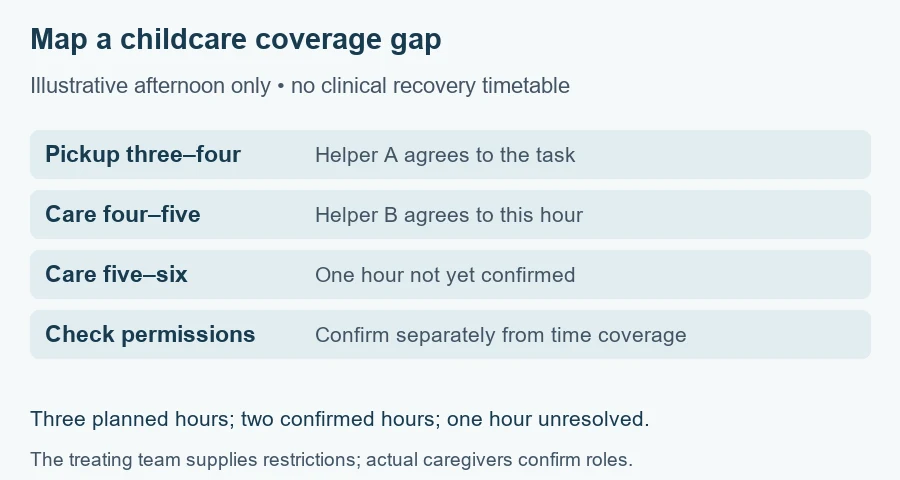
Consider an invented afternoon routine with two responsibility blocks: a pickup task from three to four, followed by an evening-care block from four to six. Helper A agrees to the first block. Helper B confirms availability from four until five, leaving the final hour unconfirmed. This example is a calendar exercise, not a recommended duration of support or a prediction about your recovery. The child’s actual needs and the clinician’s directions are not supplied by these fictional hours.
The planning period contains three hours of assigned tasks, while the confirmed availability covers two of those hours. The one-hour gap is five until six. Listing two helpers should not conceal that gap or turn it into an assumption that the recovering parent can automatically take over. Record the unresolved responsibility and ask the relevant people how the actual need will be addressed. The arithmetic identifies a scheduling question, not an acceptable level of supervision.
Now suppose a backup agrees to five until six but does not have the required pickup authorization for a different contingency. The original time gap may be addressed, while another practical condition remains unresolved. This shows why names and hours are only part of the plan. Confirm the actual role, permissions and capacity for the task. The worksheet should distinguish a confirmed period from an arrangement that still cannot be carried out as intended.
| Hypothetical plastic surgery childcare planning block | Agreed person and availability | Observation in this invented example |
|---|---|---|
| Pickup three–four | A agrees to the task | Time covered, actual authorization still must be confirmed |
| Evening care four–five | B agrees to this hour | Time covered for the stated role |
| Evening care five–six | Not yet confirmed | One-hour gap remains visible |
| Actual clinical clearance | Not part of the invented inputs | Must come from the treating team |
Confirm existing childcare arrangements before relying on them
If your child already attends a program, check the actual hours, pickup process, absence terms and arrangements for changes. Do not assume a usual routine automatically covers a different operation or appointment time. Ask the program about its actual procedure when another authorized adult will collect the child. This guide does not state a rule for every school or program; the relevant institution’s process needs to be confirmed.
The ChildCare.gov responsibilities guidance discusses clear care arrangements and contracts, including schedules, fees, absences and communication. Its general consumer guidance does not establish your program’s particular terms. Use it to ask what the actual arrangement says and what needs updating. An additional day of care, an absence and a different pickup person can create different questions even when the program is familiar.
Keep the child’s practical information separate from unnecessary details of your medical procedure. Share what the program or agreed helper needs to carry out the arrangement, using the appropriate channel and permissions. A broad public announcement is not necessary to confirm a pickup or a change in schedule. Record the response privately so the family knows which practical tasks are confirmed without circulating the parent’s clinical information more widely than needed. For organizing driving-related task and clearance questions, see driving after plastic surgery.
Plastic surgery childcare planning when a new program is considered
The ChildCare.gov finding-and-choosing guidance advises checking official licensing status and inspection information, asking about space and hours and reviewing the setting. These checks concern the actual program; a web search result or an advertised vacancy is not confirmation that care is available for your dates. This article does not name, rank or link to a childcare provider.
Its licensing explanation distinguishes minimum health-and-safety requirements from a guarantee of quality and notes that lawful exemptions vary by state or territory. Do not assume that every unlicensed arrangement is illegal or that a license guarantees suitability for your child’s needs. Use the appropriate official information to understand the actual setting, while asking the program about the relevant practical arrangement.
Confirm the start date, actual place, relevant hours and any required enrollment steps before counting the booking as complete. If the arrangement is only an inquiry or waitlist entry, label it that way. A price quote does not establish a confirmed place, and a confirmed place does not answer whether the hours cover the responsibility you need assigned. Keep availability, costs and the family’s clinical-support questions in separate fields.
Make the plastic surgery childcare planning backup specific
Identify which disruption the backup addresses: a helper’s absence, a program closure, a child’s illness, a changed appointment or another actual possibility. A person agreeing to school pickup may not be available for a full day or overnight responsibility. Ask about the specific role and limits rather than using a single name under every backup field. This guide does not prescribe a childcare response to illness or override a program’s actual policies.
Record who will contact the backup, what information is needed and whether any permissions or access arrangements are still incomplete. If the backup depends on transport, confirm the transport task separately. A chain of assumptions can make a contingency appear ready while every participant expects someone else to act. The worksheet should show the actual agreement and the remaining practical question, not simply a list of people who might be reachable.
If the backup cannot be arranged, make the gap visible in discussions with the clinical team and relevant family members. Do not solve it by assuming that the recovering parent can disregard a restriction or that a child can take responsibility for the parent’s care. The people responsible for clinical and dependent-care decisions need accurate information about the arrangement. This article does not declare that a limited plan is sufficient or tell you to proceed despite an unresolved support requirement.
Update plastic surgery childcare planning when the course changes
A changed clinical instruction, booking date or household circumstance may affect several tasks. Identify the actual change and which arrangements need reconfirmation. Preserve the earlier roster so the sequence is understandable, but make the current version easy to identify. Do not assume that moving the procedure date automatically moves a childcare booking or a helper’s work availability. Each relevant person or organization needs to confirm its own arrangement.
| Plastic surgery childcare planning change | Record to update | Confirmation question |
|---|---|---|
| Clinical instruction changes | Affected physical task and current direction | Which responsibility still needs another person? |
| Appointment time changes | Actual transport and dependent-care blocks | Who confirms the revised times? |
| Helper becomes unavailable | Specific gap and agreed backup | Is the replacement role actually confirmed? |
| Program hours or availability change | Booking status and affected routine | What alternative is actually arranged? |
Keep the planning budget grounded in actual terms
If you pay for care, use the actual quote and agreement for the relevant dates and services. Separate a deposit, confirmed booking, additional charge and refund status when applicable. This article invents no national childcare price or reimbursement benefit. Unpaid family help may still have practical limits or expenses; do not count it as unlimited availability merely because there is no service fee. The financial record and responsibility roster answer different questions.
Ask how the actual arrangement handles absences or changes, without assuming that cancellation of surgery automatically cancels or refunds a childcare commitment. If a booking changes, update both the financial record and the coverage status. A refund does not fill the newly created responsibility gap, and a new helper does not settle an old invoice. Keeping these records connected helps the family see the actual remaining tasks and obligations.
Use the plastic surgery childcare planning worksheet privately
Begin with the tasks and time blocks rather than personal identifiers. A private nickname or role label may be enough for the family to use the draft. Add sensitive contact or child information only when the actual arrangement requires it and share it through the relevant secure or agreed channel. Do not upload a completed worksheet to a public discussion to obtain informal approval. The printable version is a planning aid, not a clinical or childcare assessment service.
For each row, distinguish “asked,” “agreed” and “confirmed for this role.” A person may agree to help generally while the time or permission remains unresolved. Ask the actual follow-up question and update the status only when there is a response. This prevents a tentative conversation from being copied as a firm booking. The family should be able to tell which arrangement is ready and which still depends on another answer.
Review simultaneous assignments. If the same helper is listed for your own clinician-confirmed support and a child’s pickup at another location, record the practical conflict instead of counting both blocks as covered. Ask the relevant people how the arrangement can be changed, including the clinical team when its requirements are affected. The worksheet cannot decide that one responsibility is optional or that the parent can take over; it makes the conflict visible so the responsible people can address it.
Date the current worksheet and identify who maintains it. When changes occur, tell the relevant participants which version applies so an earlier printed roster does not continue to guide a superseded arrangement.
A useful planning outcome
Review the worksheet with the clinical team for the care-related questions and with the relevant helpers or programs for the actual arrangements. Confirm the responsibilities, practical permissions, availability and backup status. The printable version can be completed privately; it collects no information on this site and requires no public disclosure of a child’s name or your medical records. Keep sensitive details only where the relevant people need them.
Plastic surgery childcare planning should leave the family’s actual routines and unresolved gaps understandable. It does not guarantee that recovery will follow a chosen calendar or establish the parent’s readiness to resume a task. The treating team supplies individualized clinical advice, and the responsible adults or programs confirm dependent-care arrangements. A specific roster helps connect those decisions without replacing either with a generic recovery rule.
Sources and review scope
Plastic Surgery Editorial Team. Source records checked through October 12, 2026. Review scope: source and editorial checks for general education. No individual clinical assessment is represented.
- MedlinePlus: After surgery. medlineplus.gov. Publication/update date not stated. Checked 2026-10-12.
- ChildCare.gov: Responsibilities once you find care. childcare.gov. Publication/update date not stated. Checked 2026-10-12.
- ChildCare.gov: Finding and choosing child care. childcare.gov. Publication/update date not stated. Checked 2026-10-12.
- ChildCare.gov: Child care licensing. childcare.gov. Publication/update date not stated. Checked 2026-10-12.