
Driving after plastic surgery depends on the operation, anesthesia, medicines, your ability to control the vehicle and the treating team’s instructions. Arrange another way home and obtain individual advice before assuming you can drive. A general anesthesia restriction is only one part of the decision; the end of that interval does not demonstrate readiness after a breast, abdominal, facial or limb procedure. Do not use a short drive as a home test of safety.
Start by telling the clinic what you need driving for: getting home, attending follow-up, commuting, taking children somewhere or driving professionally. Those tasks create different practical demands. Ask what restrictions apply, who will reassess them and what alternatives you should arrange. This guide organizes transport planning and questions about function. It does not provide personal clearance, an insurance ruling or a universal number of postoperative days.
Why does driving after plastic surgery require several decisions?
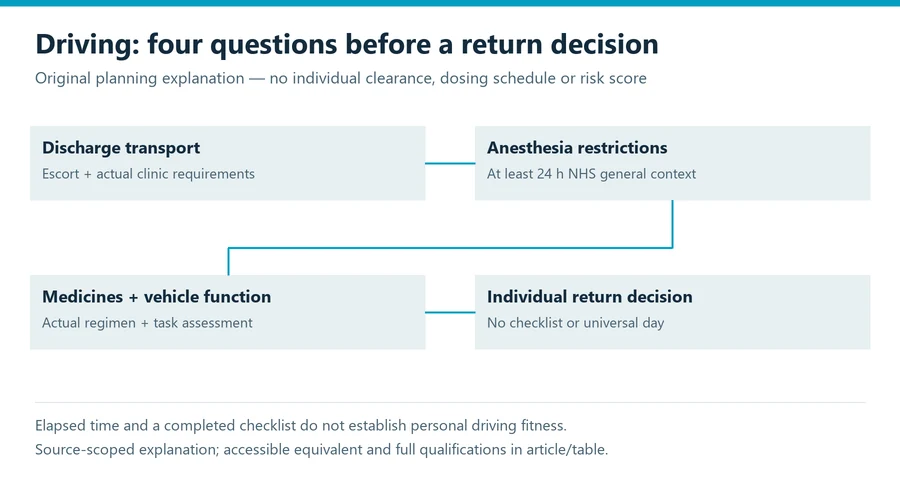
The NHS general-anesthesia guidance says effects can last around twenty-four hours and advises avoiding driving and cycling for at least that period. It also distinguishes anesthesia recovery from recovery after the procedure itself. That is general patient guidance reviewed November 29, 2024, not a promise that every person or every operation permits driving when a twenty-four-hour clock ends.
Ask the surgical team to separate anesthesia restrictions, medicine restrictions and movement-related restrictions in your own instructions. If a clinic gives you a minimum interval, clarify what additional conditions must be met afterward. Someone can be beyond the initial anesthesia period and still have an unresolved reason not to drive. Feeling alert enough to hold a conversation does not answer every question about controlling a vehicle.
Do not compare your proposed return with another patient’s online account without considering differences in operation and instructions. A passenger journey, a walk around the home and driving in traffic are different tasks. Use the appointment to identify the actual demands you need to meet. An individualized explanation is more useful than a single date that appears to cover every procedure and every driver.
How should you arrange the trip home?
Ask the clinic about its discharge and escort requirements before booking transport. Identify who will collect you, whether that person needs to receive instructions and what happens if the procedure finishes later than expected. A taxi or rideshare may be part of the arrangement, but booking a car does not establish that the clinic permits discharge without an appropriate companion.
The NHS postoperative page advises arranging help and explains that patients will not usually drive themselves home. Its general advice supports early planning, while your clinic’s actual discharge policy controls the arrangement. Tell staff if no one is available. Resolve that gap before surgery rather than hoping staff will make an exception when you are ready to leave. For assigning help, availability and backup tasks, see plastic surgery caregiver planning.
For driving after plastic surgery, also plan where the car will be. If you drive yourself to a preoperative appointment that unexpectedly includes treatment or sedating medicine, ask staff how transport should be handled. Avoid an arrangement that depends on retrieving a parked vehicle immediately afterward. Clarify when your driver should arrive and whether another person can act as backup if plans change.
Which vehicle tasks should you discuss?
Describe the actual vehicle, including whether it is manual or automatic and how you normally get into it. Ask how the proposed restrictions relate to steering, reaching, turning to check traffic, moving between pedals and responding quickly. These are consultation questions, not exercises prescribed by this page. The team may have a procedure-specific method for assessing readiness or may recommend another service if needed.
For driving after plastic surgery, separate ordinary comfort from the ability to respond to an unexpected event. A quiet route does not remove the possibility of abrupt braking, an evasive maneuver or a difficult junction. Nor does driving at a slow speed prove that a restriction has been satisfied. Ask what the team means by adequate function rather than creating a personal threshold based only on pain at rest.
Consider whether dressings, garments or equipment affect access to controls or safe seating. Do not remove or alter them to make a vehicle task easier without asking the team. If the suggested driving arrangement conflicts with wound care or positioning instructions, bring that conflict back to the clinic. A transport plan should work with the recovery instructions, not require you to disregard one set to follow another.
How do medicines affect driving after plastic surgery?
Bring the actual medicine list, including occasional products used for sleep or pain. Ask the prescribing team and pharmacist about the relevant warnings and the clinic’s return-to-driving instructions. The question concerns the exact medicine and its effects in your situation, not whether a product belongs to a category advertised as strong or mild. Do not alter a prescription simply to make a commute possible.
The ASA cannabis and surgery guidance cautions about impaired attention and judgment when cannabis is combined with opioids or other sedating medicines. This supports disclosure and an interaction review. It does not provide a medicine-by-medicine driving schedule or a safe cannabis restart date. Include cannabis and other nonprescription products in the conversation rather than assuming they do not count.
If postoperative medicines change, ask whether the earlier driving discussion still applies. Keep the finalized instructions accessible to the person helping you. A caregiver should not have to decide whether you look sufficiently alert or choose a different dose for you. When you have a medication question, use the prescribing team’s contact route before trying to solve a transport problem by changing treatment yourself. For organizing the actual discharge document and contact instructions, see plastic surgery discharge instructions.
What should a driving plan record?
| Decision | Information to discuss | Unresolved question |
|---|---|---|
| Discharge | Escort, pickup and destination | Does the arrangement meet clinic requirements? |
| Anesthesia | Actual anesthesia and restrictions | What minimum restriction applies? |
| Medicines | Exact prescriptions and other products | Which warnings affect driving? |
| Function | Vehicle, movement and urgent response tasks | How will readiness be assessed? |
| Return | Reassessment and alternative transport | Who confirms the next step? |
Use this original organizer to make open questions visible. It is not a validated fitness-to-drive checklist, and completing the rows does not authorize driving. Request the team’s actual instructions and note who supplied them. If a question remains unresolved, keep transport alternatives in place. Do not fill the blank with a day count from a different operation just to make the plan appear complete.
A useful record distinguishes a tentative expectation from an actual reassessment. For example, an office may discuss reviewing a restriction at follow-up without promising that it will end then. Write the review appointment and the decision separately. This prevents an appointment date from being treated as automatic permission, particularly when your recovery or medication regimen changes before that visit.
How does the procedure change the transport discussion?
Tell the team whether the operation involves the chest, abdomen, face, arms, thighs or several regions. Bring the exact proposed procedures rather than a package label. Ask how the surgeon’s activity restrictions relate to the movements needed for your vehicle. This page does not assign a driving date to each region because technique, scope, medicines and your individual recovery can differ.
If an additional procedure is proposed, return to the driving plan. Combining operations can change the practical problem even when the appointment remains on the same day. Likewise, a revision or unexpected postoperative issue may require new instructions. An earlier conversation about driving after plastic surgery should not be carried forward automatically when the operation that was assessed is no longer the actual proposal.
Follow-up transport deserves its own arrangement. Ask whether appointments require examination, dressing care, a procedure or medicines that could affect the return journey. Tell the office if you expect to drive yourself to the visit. The fact that an appointment is described as routine does not tell you whether your driving restriction has ended or whether the visit itself creates a transport need.
How can you plan work and family journeys?
List the journeys that cannot easily be postponed, then identify alternatives before surgery. Separate getting to work from being fit to perform work. A colleague driving you might solve the commute without resolving a manual-work restriction; working remotely might reduce travel without making you ready to care for children alone. Discuss each responsibility rather than using one broad “back to normal” date.
For driving after plastic surgery, make childcare transport arrangements that do not require lifting, fastening or carrying beyond the restrictions you have been given. Ask someone to handle the full journey if you cannot safely manage its non-driving parts. A passenger ride can still include practical tasks at either end. The plan needs to cover those tasks rather than focus exclusively on who sits behind the wheel.
If you drive for employment, tell the team about hours, loading, passengers, vehicle type and any occupational requirements. Ask your employer or the appropriate authority which documentation it needs. This guide cannot determine professional driving eligibility or certify compliance with local law. Keep the treating team’s clinical advice and any employer or licensing requirements separately documented so neither is mistaken for the other.
What should you ask your insurer or licensing authority?
Check the rules that apply to your jurisdiction and policy using the relevant insurer or authority. Ask about following medical advice, reporting obligations if applicable and any documentation required. Do not assume that a general NHS statement describes US law or that a surgical letter automatically establishes insurance coverage. The precise contract and legal requirements need their own confirmation.
If you receive an answer, keep the wording and date with the transport plan. Identify whether it concerns coverage, notification or medical fitness. Those are different questions. A customer-service explanation should not be used to override a clinical restriction, and clinical advice should not be represented as an insurer’s formal policy determination unless the insurer has actually confirmed it.
This administrative step is practical planning for driving after plastic surgery, not legal advice. If the answers conflict or are unclear, ask the responsible organizations to clarify them. Avoid relying on a forum claim that all policies become invalid after every operation or that none ever require notification. Broad statements can obscure the actual requirement you need to satisfy.
Can being a passenger solve every transport problem?
It solves the question of who controls the car, but it does not settle comfort, positioning, access or follow-up needs. Ask the clinic about passenger travel as part of the discharge plan. Describe the length of the journey, stops, assistance available and where you will recover. Follow the team’s instructions rather than making assumptions about garments, seating or equipment.
For longer journeys, ask whether the travel plan needs additional assessment. A short pickup from a local clinic differs from traveling hours to a hotel or another state. Identify who can help you get in and out and what service you would use if a problem occurred en route. Do not regard another driver as a substitute for medical advice about the journey itself.
Keep comfort modifications within the team’s guidance and normal vehicle safety requirements. Do not improvise a seating arrangement that prevents proper use of the vehicle’s safety features. If ordinary transport does not fit the postoperative instructions, ask the clinic for an appropriate alternative. A plan that requires ignoring a restriction has not resolved the problem.
What if your recovery does not match the expected timeline?
Contact the team for reassessment rather than turning the expected date into a deadline you must meet. Explain which task remains difficult, what has changed and which medicines you are currently using. Ask whether the planned follow-up is sufficient or another assessment is needed. Practical arrangements can be extended while the clinical question is clarified.
Pain, swelling, reduced movement or feeling unwell should not be tested by entering traffic. If you develop an urgent problem, use the appropriate medical service and arrange someone else to drive or emergency transport when necessary. Do not attempt to drive yourself because you are trying to reach the clinic more quickly. This guide cannot assess the cause or severity of postoperative symptoms remotely.
Driving after plastic surgery can also become an emotional deadline: people want to regain independence and reduce the burden on family. Tell the team about those pressures. They can help distinguish a transport problem from a readiness decision. Choosing an alternative for longer than expected is a practical response to uncertainty, not evidence that the operation has failed or that another patient’s recovery was better.
How can you keep alternative transport workable?
Keep the actual decision and current instructions together
Set up the essential journeys before the operation and identify which ones are flexible. A family member may be able to handle the first appointment but not every later visit. A friend may be available for a local journey while a work commute requires a different arrangement. Write those limits down. Planning driving after plastic surgery includes keeping an alternative usable if reassessment takes longer than you expected, rather than treating help as something needed only for the trip home.
Ask the office whether an appointment time can accommodate your driver and whether a change would interfere with necessary care. Check pickup arrangements and contact details. If travel costs are a concern, raise them early so you can discuss practical options without assuming that a remote appointment can replace examination. An appointment’s purpose should stay clear even when transport is difficult.
Keep the plan simple enough for the people helping you to understand. Record who is collecting you, where you are going, whether someone remains with you and what to do if a pickup fails. These organizational suggestions do not establish a clinically appropriate journey or replace discharge requirements. They help prevent a last-minute transport gap from becoming pressure to drive before the readiness question has been resolved.
How should you prepare for driving after plastic surgery reassessment?
Bring your actual restrictions, medication list and description of the journeys you need. Ask which conditions must be met, how they will be assessed and who can answer a question between visits. Request plain wording for the next step. If the team gives a review date, confirm whether it is an assessment appointment or a confirmed end to a restriction.
Keep a record of the advice and update it if anything changes. For driving after plastic surgery, the final decision should relate to your operation, current condition, medicines and applicable requirements. An internet checklist, an elapsed anesthesia interval or a comfortable passenger journey does not independently establish readiness. Use the procedure guides to understand the operation’s scope while keeping personal driving advice with the treating team.
Sources and review scope
Plastic Surgery Editorial Team. Source records checked through October 12, 2026. Review scope: source and editorial checks for general education. No individual clinical assessment is represented.
- NHS general anaesthetic. nhs.uk. Source date: 2024-11-29. Checked 2026-10-12.
- NHS after surgery. nhs.uk. Source date: 2024-07-09. Checked 2026-10-12.
- ASA sedating medicines and cannabis. madeforthismoment.asahq.org. Source date: 2023-08-08. Checked 2026-10-12.