
Preservation rhinoplasty vs structural rhinoplasty is not a reliable shortcut to choosing the best operation for a particular nose. The labels describe approaches to managing nasal structures, and they can be combined. Original randomized studies of specified dorsal techniques have not established one universal winner for every functional or appearance goal. A useful comparison identifies the exact part of the nose being treated, the proposed method and the endpoint you want to improve. 3, 4, 5
Begin with the anatomy and goal being discussed, rather than a promise that preserving more or rebuilding more must be better. Ask what is intended to remain, what is intended to change and why. This guide explains two original trials, a hybrid technical report and a practical comparison record without prescribing an operative technique or predicting your personal outcome.
Dorsal preservation is a narrower term than preserving everything
The dorsum is the nasal bridge region addressed in the trials discussed here. Dorsal preservation in those reports concerns a specified way of treating that region. It should not be interpreted as a promise that every tissue remains untouched or that no other part of the operation uses a structural technique. The original hybrid report explicitly describes combining the concepts. 3, 4, 5 The preservation rhinoplasty guide expands the narrower technique discussion.
Ask the surgeon what preservation means in the actual proposal. Which part is being preserved, which feature is being modified and what other work is included? A broad label cannot tell you whether the plan concerns the bridge, tip, another feature or several areas. That distinction is necessary before any research comparison is meaningful.
Similarly, structural should not be used as shorthand for changing every feature. Ask what support or reconstruction is proposed and which goal it serves. The reason for a component matters more than whether the operation fits a marketing category. A plan may have several components with different purposes.
Keep a preservation goal and a change goal beside each other. You may want to retain a recognizable characteristic while changing another feature. A consultation should explain how the plan responds to those preferences and where uncertainty remains, rather than assuming your desired result from the operation’s name.
The bridge, tip and breathing questions need separate explanations
ASPS describes rhinoplasty as addressing nasal appearance and, in some circumstances, breathing impairment associated with structural issues. That general scope does not mean every cosmetic alteration treats a breathing problem or that the appearance of a nose identifies its functional diagnosis. 1
Write your appearance goals and any breathing concerns separately. Ask which assessment addresses each concern and which part of the proposal is intended to respond. If the treatment is described mainly by its bridge technique, request an explanation of any other work rather than assuming the same label covers it.
Do not judge function only by a side-profile photograph. An image can communicate a shape preference, but it does not measure an airway symptom or establish its cause. Ask what information supports the functional assessment and how the relevant outcome would be evaluated. The answer should name a method, not just an improved-looking profile.
Also distinguish your own preference from an idealized proportion. This guide supplies no target angle or standardized nose shape. A measurement may describe a study endpoint without establishing an aesthetic rule for everyone. Ask why a particular proposed change fits your goals rather than treating a number as inherently correct.
| Goal area | Question for the actual proposal | Evidence to keep separate |
|---|---|---|
| Bridge appearance | What specific feature is being changed or retained? | A photograph does not measure every functional outcome |
| Tip appearance | What work is proposed beyond the dorsal method? | Bridge trials do not automatically answer tip questions |
| Breathing | What concern was assessed and how? | Appearance preference is not a functional diagnosis |
| Personal character | Which feature do you wish to preserve? | A study average is not a universal beauty target |
One randomized trial compared 25 people in each group
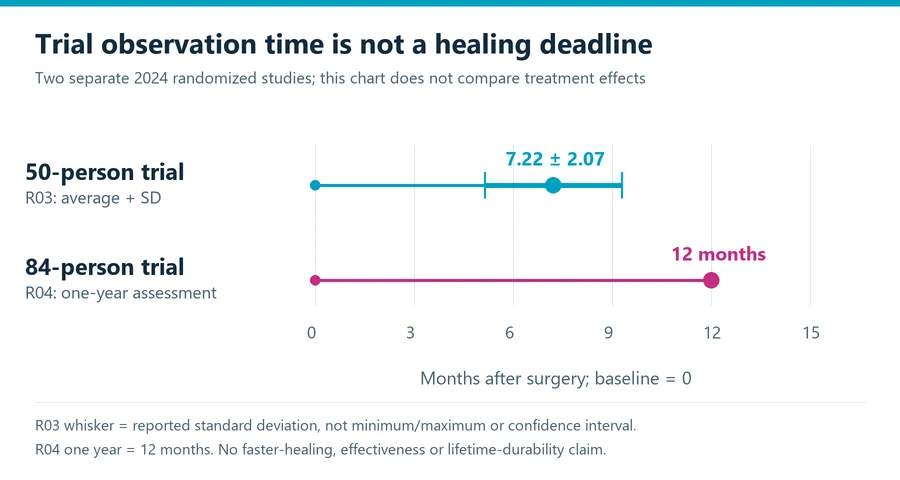
An original study first published online March 15, 2024 randomized 50 primary rhinoplasty patients with dorsal humps to dorsal preservation or conventional hump reduction, with 25 in each group. One surgeon performed the operations at a tertiary referral center. Assessment included questionnaires and cone-beam CT, with average follow-up of 7.22 months and a reported standard deviation of 2.07 months. 3
Both groups improved on the reported questionnaire measures, and the investigators did not find statistically significant between-group differences in the reported outcomes. That finding concerns these selected patients, techniques and endpoints. It does not establish universal equivalence or that every form of preservation has the same result as every structural operation. 3
The supporting graphic shows the reported observation interval, not a recovery forecast. Its whisker represents the reported standard deviation of follow-up, not the actual minimum and maximum, a confidence interval or a personal healing range. An average observation period should not be confused with a promise that a result is final on that date. 3
Another randomized trial observed specified techniques at one year
A separate original 2024 trial randomized 84 applicants to conventional dorsal hump resection with spreader-flap midvault reconstruction or dorsal preservation using a modified subdorsal-strip method. It evaluated appearance and functional outcomes after one year using questionnaires, image analysis and a visual-analog scale. 4
The report did not find statistically significant differences in the listed between-group endpoints, including residual hump, width, projection, rotation or questionnaire scores. This is evidence about those actual methods and the outcomes measured. It is not proof that the labels alone determine a result or that any two operations sharing the labels are interchangeable. 4
The graph places this one-year assessment beside the other trial’s reported average interval to make their observation windows visible. It does not compare effect sizes or combine the trials into a single patient cohort. A difference in observation time is a study-design feature, not evidence that one operation heals faster. 4
Improvement within a group is different from a difference between groups
When reading a trial, identify which comparison supports the statement. Improvement after surgery within one group does not by itself show that its treatment outperformed the alternative. The randomized comparison asks a separate question: whether the outcomes differ between the assigned groups under the study’s methods.
This distinction matters when a headline says preservation improved satisfaction. If the comparison group also improved, the headline does not establish superiority. Conversely, a nonsignificant between-group result does not prove that no meaningful difference can ever exist. The sample and measurement precision constrain what can be concluded.
Ask whether the source provides the actual size of the difference, uncertainty around it and the definition of the endpoint. A P value alone does not explain the magnitude or personal importance of a change. This guide does not construct outcome bars from unreported numerical means or convert a nonsignificant test into a zero difference.
Also identify the treatment question before using the result. A dorsal-hump trial does not automatically answer a revision case, a different tip goal or an unrelated functional problem. The more the proposed situation differs from the study, the more explanation is needed to show why the evidence is relevant.
Hybrid methods show why the categories are not mutually exclusive
An original technical report first published online June 5, 2024 describes a hybrid dorsal-preservation approach combining structural and preservation concepts. It discusses retaining specified regions while modifying other parts of the nasal framework. The report identifies itself as level-V evidence; it is not a randomized superiority trial. 5
The useful takeaway is the category distinction, not a promise that hybrid surgery is best. A surgeon may describe different components using different concepts. Ask how each component serves the goal and why the proposed combination is appropriate to the assessment, rather than expecting a pure label to explain the whole operation.
Technical descriptions and comparative outcome studies have different jobs. A methods paper can explain what its authors mean by an approach. It does not by itself establish the probability of your outcome or superiority over all alternatives. Do not treat a newly named method as a proven improvement simply because its description is detailed.
If a proposal changes during planning, ask for the updated component list. A plan may still be called preservation even when additional structural work is discussed. That is a reason to clarify the terminology and consent, not automatically evidence that the original explanation was false. The concrete plan should remain understandable as it evolves.
| Source type | What it can help explain | What it does not establish alone |
|---|---|---|
| Randomized technique trial | Specified alternatives and measured outcomes | A winner for every nose or surgical component |
| Technical methods report | What the authors mean by a described approach | Comparative superiority or personal risk |
| Questionnaire assessment | Responses to defined questions at an interval | Every aspect of anatomy, function and appearance |
| Imaging measurement | A specified structural observation | Personal experience or a universal beauty target |
| Before-and-after photograph | A documented appearance example | Isolated effect of each operative component |
Open or closed access is another question
Do not assume that the preservation-versus-structural distinction supplies the answer to every other technique question. Ask separately how the surgeon will access the areas being treated and what that choice means in the actual plan. The dorsal trials summarized here should not be presented as a universal verdict on open versus closed rhinoplasty. Use the open versus closed rhinoplasty comparison for the separate access question.
Similarly, a tool name does not define the entire treatment. If a consultation emphasizes an instrument or a branded phrase, ask which task it performs and how it relates to the proposed preservation or reconstruction work. The presence of one instrument is not a complete description of the operation.
Keep these dimensions in separate rows: treatment goal, anatomical component, method, access and any additional work. A proposal can differ from another in several of them. If you compare only one label, you may attribute the entire difference to the wrong feature.
This also helps when seeking another opinion. Bring the actual explanation and unresolved question, not only a request for a preferred technique name. Ask why the second plan differs and whether the disagreement concerns the assessment, expected benefit or component method. That creates a more useful comparison than collecting competing slogans.
Risk and revision claims need evidence matching the actual plan
ASPS lists rhinoplasty risks including infection, changes in sensation, breathing difficulties, poor healing, unsatisfactory appearance and possible revision surgery. Those categories are relevant to discussion but do not give a personal probability or prove that one philosophy eliminates a risk. 2
Be cautious with claims that a label guarantees fewer revisions, no airway problems or a permanently stable result. Ask which original evidence supports the particular claim, how a revision was defined and how long patients were followed. A technique’s intention to preserve a structure does not establish the incidence of every later event.
Separate an expected possibility of additional treatment from an assertion that it will certainly be needed. Also clarify whether a described later step is planned from the start or would respond to an unexpected issue. Those are different reasons for further care and should not be merged into one rate without a definition.
The actual treatment team should explain how concerns are assessed and managed after surgery. Request the follow-up arrangements and escalation pathway rather than relying on a reassurance that one named method is safe. This article cannot evaluate your medical history or grant surgical clearance.
Photographs and simulations should be tied to a specific question
An example photograph can help communicate a preference, but first identify what you are using it to discuss. Is it the bridge contour, a front-view feature, a tip detail or preservation of a recognizable characteristic? A single image may not show every feature important to your decision.
Ask what procedures were included in the documented example and when the postoperative image was taken. If several components changed, a photograph does not isolate the contribution of dorsal preservation. Do not assume an attractive image establishes a particular technique or functional result without the associated information.
If a simulation is offered, ask how it is intended to support the conversation and which uncertainties it cannot represent. A planning illustration is not a surgical result or a guarantee. Keep the actual explanation of achievable goals beside the visualization rather than replacing it with the image.
You can also name what you do not want changed. That preference deserves explicit discussion, especially when a proposed operation covers several regions. Ask how it affects the plan and where preserving the preferred feature may conflict with another desired change. The tradeoff should be described, not hidden by a general transformation image.
Compare a complete plan before comparing its price
A quote labeled preservation rhinoplasty and another labeled structural rhinoplasty may include different components, settings and follow-up arrangements. Before comparing the numbers, match the scope. Ask what appearance and functional work is included, what remains separate and how additional procedures are handled. The rhinoplasty cost worksheet records quote scope after the proposed plan is explained.
This guide supplies no invented technique surcharge or national cost gap. An operation’s label does not establish the services contained in the actual estimate. Request written clarification of surgeon, facility, anesthesia and follow-up fees, and record any proposed additional intervention in its own line.
Do not infer medical coverage from a cosmetic or functional label alone. A clinical assessment and the insurer’s actual terms answer different questions. Ask each responsible party for its own explanation rather than assuming that a named philosophy determines coverage.
For a proposed revision, ask what records and prior treatment information are needed to understand the case. Do not borrow a primary dorsal-hump trial’s findings as if they automatically describe that situation. The evidence and quote should both relate to the actual operation being considered.
| Plan field | What to record |
|---|---|
| Goal | Appearance preferences and breathing concerns separately |
| Dorsal method | Exact proposed technique and reason |
| Other components | Tip, support or additional work described individually |
| Evidence match | Population, method, endpoint and observation window |
| Follow-up | Responsible team and assessment arrangements |
| Financial scope | Included services and unresolved exclusions |
Ask what evidence would change the recommendation
A specific recommendation should make its reasoning understandable. Ask which finding in the assessment favors the proposed dorsal method and what different finding would lead the surgeon to consider another approach. You do not need operative instructions to understand that decision. The explanation should connect the feature being treated with the goal rather than rely on familiarity with a technique name.
If a trial is cited, ask whether its comparison actually matches the alternative being discussed. A study of one preservation variation and one reconstruction method cannot silently become evidence for every variation. Record any mismatch so it can be clarified before you make a decision.
Preserve the unanswered question
If the explanation remains uncertain, write the question rather than replacing it with reassurance from an unrelated case photograph. You might need clarification of the functional assessment, the tip component or how a revision history changes the evidence match. Naming that gap helps a subsequent consultation address it directly.
A useful choice is based on fit rather than a pure label
The best question to take into consultation is why this plan fits this assessment and these goals. The answer should identify the anatomical task, explain the component methods and distinguish what is supported by evidence from what remains uncertain. A preservation or structural label can help organize that explanation, but cannot replace it.
Use the observation-window graphic to remember that trial results have a time context. Neither an average several-month assessment nor a one-year evaluation is a lifetime guarantee. Keep those limits alongside any discussion of function, satisfaction or later treatment.
The rhinoplasty guide provides broader procedure context. The consultation questions guide can help organize differing proposals, and the cost comparison guide explains how to read the scope of a written estimate.
Sources and review scope
Plastic Surgery Editorial Team. Source records checked through October 12, 2026. Review scope: source and editorial checks for general education. No individual clinical assessment is represented.
- ASPS rhinoplasty overview. plasticsurgery.org. Publication/update date not stated. Checked 2026-10-12.
- ASPS rhinoplasty risks and safety. plasticsurgery.org. Publication/update date not stated. Checked 2026-10-12.
- Dorsal preservation rhinoplasty versus dorsal hump reduction: a randomized prospective study, functional and aesthetic outcomes. pubmed.ncbi.nlm.nih.gov. Source date: 2024-03-15. Checked 2026-10-12.
- Comparison of Functional and Cosmetic Outcomes Between Dorsal Preservation and Spreader Flap Rhinoplasty: A Randomized Trial. pubmed.ncbi.nlm.nih.gov. Source date: 2024-06-14. Checked 2026-10-12.
- Hybrid Dorsal Preservation Rhinoplasty: Reediting an Aesthetic Dorsum. pubmed.ncbi.nlm.nih.gov. Source date: 2024-06-05. Checked 2026-10-12.