
Rhinoplasty cost is best compared using a written plan for the nose operation you actually need, followed by an itemized account of professional, anesthesia, facility and follow-up charges. The American Society of Plastic Surgeons cost page displayed a $7,637 average surgeon fee when checked October 12, 2026. That figure excludes anesthesia, operating-room facilities and related expenses, and the page does not state its underlying fee year. It is a reference point for one component, not a national all-inclusive price, a revision estimate or your expected bill.
The most useful question is whether two quotes describe the same work. A cosmetic change to the bridge, surgery addressing breathing and reconstruction after a previous operation can have different plans and payment responsibilities. Identify those distinctions before judging either price. A lower headline may omit a necessary facility charge; a higher package may include it. A possible insurance benefit remains uncertain until the insurer and practice explain the specific covered service, authorization requirements and patient liability in writing.
What does the ASPS rhinoplasty cost figure include?
The ASPS rhinoplasty cost page describes the average as a surgeon fee and warns that the complete cost includes other expenses. It also identifies experience, the type of procedure and geographic location as fee influences. Those facts explain why the average cannot establish a fair total for an individual operation. The figure does not tell you the anesthesia arrangement, how long a particular case will take or whether a quoted fee includes all postoperative visits.
Record the observation date next to the number. A page checked in 2026 is not automatically reporting 2026 fees. Likewise, the organization’s separate 2025 procedural statistics report does not supply a fee year for this cost endpoint. Mixing those dates gives a quotation a precision its source does not support. If a practice cites another benchmark, ask which year, population and charge component it measures before using it to negotiate or choose care.
Use the average as a prompt to request an explanation, rather than a target that every quote must match. Your plan may involve different scope from the cases behind a broad average, whose detailed distribution is not provided on the page. A quote above the average does not by itself demonstrate overcharging; one below it does not establish a bargain. An itemized explanation gives you more actionable information than an unsupported price ranking.
Define rhinoplasty cost by the operation, not a marketing label
Start with your goals in ordinary language: appearance, breathing, a previous injury or concerns following earlier surgery. Then have the clinician translate those goals into the proposed procedure. The ASPS consultation guidance describes discussion of goals, medical history, medications and previous surgery alongside examination and treatment options. A budget worksheet supports that conversation; it cannot determine eligibility or choose a surgical technique.
A quote saying only “nose job” leaves important uncertainty. Ask whether it covers the cosmetic plan discussed, any separate nasal airway work and any anticipated graft-related service. Do not assume that terms such as open, closed, preservation or ultrasonic are interchangeable packages with predictable price premiums. The practice should explain the relevance of its proposed approach to your case and identify the associated billing scope. A named technology is not proof of a better result or a justification you can evaluate from price alone.
If earlier surgery is involved, tell the practice before requesting a firm figure. An advertised first-operation offer may not apply to revision work. Request a revised written quote after examination, rather than adding an arbitrary percentage to a primary-operation average. If the plan depends on information discovered later, record what is unresolved, when the quote becomes firm and how a changed plan would be approved. An unresolved component should remain visibly unknown instead of becoming a zero-dollar assumption.
| Rhinoplasty cost scope field | What to ask the practice | Why it changes comparison |
|---|---|---|
| Cosmetic plan | Which agreed changes are included? | Different goals can mean different operations |
| Breathing component | Is a separate functional service proposed and billed? | Coverage and personal liability may differ |
| Previous surgery | Does the quote explicitly account for revision history? | A primary-operation offer may not apply |
| Additional operative services | Are any anticipated related services included or separately priced? | A package title may hide exclusions |
| Setting and personnel | Which facility and anesthesia arrangement does the plan use? | Separate invoices can change the total |
| Follow-up | Which visits are included, where and for how long? | Travel and later charges affect practical affordability |
How does breathing coverage affect rhinoplasty cost?
The ASPS page explains that surgery performed to improve breathing can be reconstructive and may be covered, with detailed examination and prior authorization needed to establish the insurer’s position. That possibility does not turn an entire cosmetic operation into a covered benefit. A concern about airflow is not itself proof that a particular procedure qualifies. The clinician documents the diagnosis and proposed service; the insurer applies the terms of your own plan.
Ask for a billing explanation that separates the cosmetic portion from any proposed covered portion without allocating shared costs yourself. Anesthesia and facility services may be governed by their own billing arrangements. Network participation can differ among the surgeon, facility and anesthesia clinician. A statement that one participant accepts your insurance does not settle the others’ status. Ask the relevant billing offices for their written explanation and contact the insurer directly about benefits and authorization.
In your worksheet, distinguish estimated covered charges, estimated patient responsibility and confirmed cosmetic charges. Note whether the insurance estimate is conditional. An authorization is useful documentation, but the precise payment terms and remaining liability still need review. Do not subtract a hoped-for reimbursement from the amount you need available. If you would be unable to meet the obligation without that reimbursement, resolve the coverage question before making a nonrefundable commitment.
Build a complete rhinoplasty cost worksheet
Request the professional fee, facility charge and anesthesia charge separately even when the practice offers a package. A package can be easy to compare if it identifies its included services, conditions and exclusions. It becomes difficult to evaluate when “all-inclusive” is followed by an unspecified list of exceptions. Ask who sends each invoice, whether the amount is fixed or estimated and which circumstances could change it. Keep the latest dated version rather than combining figures from different conversations.
Add prescribed supplies, tests or medications only when the practice confirms that they are required and explains who charges for them. Do not create a universal shopping list from someone else’s recovery account. A separate column should capture your personal arrangements, such as transport, an accompanying adult, lodging when clinically appropriate and unpaid time away from work. These are not surgeon fees, but excluding them from planning can make an affordable medical quote impractical.
Use three statuses: confirmed included, confirmed additional and unresolved. The unresolved column is especially valuable because it prevents a incomplete quote from looking artificially inexpensive. Ask for clarification before replacing an unresolved field with a number. A line showing “included in package” should identify the package it belongs to so you can avoid adding it twice. A line showing “not applicable” should have a reason related to the actual plan, rather than simply disappearing from the comparison.
Worked example: rhinoplasty cost after package exclusions
The following example uses invented US-dollar inputs solely to demonstrate arithmetic. These are not market prices, practice offers or suggested budgets. Assume that examination has already established two clinically comparable plans and that both have the same follow-up scope. That assumption is necessary for the arithmetic comparison; real plans require clinical evaluation before you can treat their services as equivalent. Unknown services are not priced by this example.
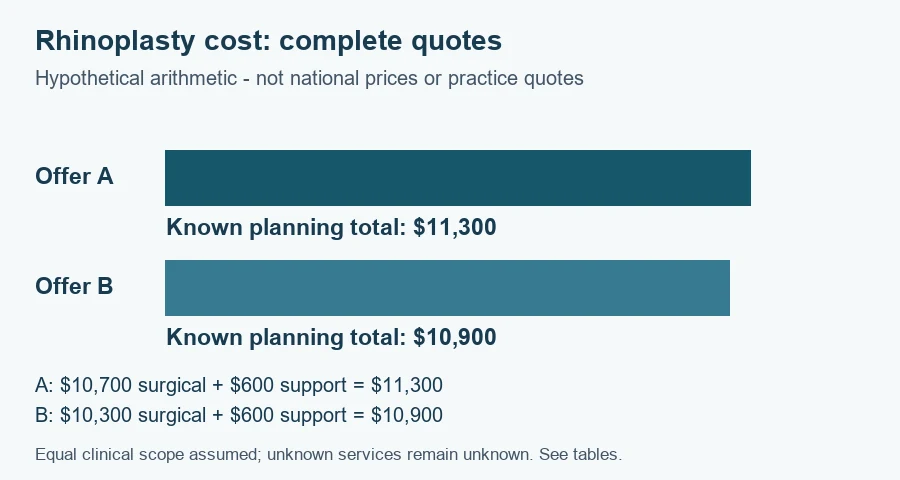
Offer A lists a $7,200 professional fee, $2,000 facility charge and $1,200 anesthesia charge. Other confirmed surgical expenses add $300, and personal support adds $600. The resulting known planning total is $11,300. Offer B lists a $10,000 package explicitly including the professional, facility and anesthesia services, followed by the same $300 other surgical expenses and $600 personal support. Its known planning total is $10,900. The higher headline therefore produces the lower known total by $400.
| Hypothetical rhinoplasty cost item | Offer A: separate charges | Offer B: documented package |
|---|---|---|
| Professional fee | $7,200 | Included in $10,000 package |
| Facility | $2,000 | Included in package |
| Anesthesia | $1,200 | Included in package |
| Other confirmed surgical expenses | $300 | $300 |
| Known surgical total | $10,700 | $10,300 |
| Personal support | $600 | $600 |
| Known planning total | $11,300 | $10,900 |
This example does not show which surgeon to choose. It shows the consequence of comparing a partial headline with a fuller package. If Offer B actually excluded anesthesia, the arithmetic would change; if its clinical plan differed, the comparison would need to be rebuilt. Copy the structure using the figures in your own written documents, and record their dates. Keep the clinical comparison and financial reconciliation as two separate steps, both completed before a final decision.
Deposits, quote expiry and rhinoplasty cost changes
A deposit credited toward the agreed bill is a payment toward that bill, not an additional expense. In the example, if a $1,000 credited deposit is paid toward Offer A’s $10,700 known surgical total, the remaining surgical balance is $9,700. Adding the deposit to $10,700 would count the same obligation twice. A separately charged consultation fee is different: whether it is credited needs an explicit answer in the practice’s payment terms.
Read cancellation, rescheduling and refund conditions before paying. Ask what happens if medical evaluation changes the plan, if insurance authorization is not obtained or if the surgeon recommends postponement. A quoted expiration date matters because a future operation may require a new fee agreement. Keep written evidence of any exception the practice agrees to. An oral assurance about a refundable deposit is much harder to reconcile with a contract containing different conditions.
Ask whether an estimate changes with operative time and who authorizes a change. Do not expect a billing office to promise that no unexpected medical situation can ever affect cost. Instead, request a clear distinction between foreseeable separately priced services and unplanned care. You can then identify what the quoted amount actually commits to and which liabilities remain outside it. Price certainty has value only when its boundaries are understandable.
Rhinoplasty cost and the limits of revision policies
Initial follow-up, treatment of a complication and elective revision are different issues. Ask the practice to explain its policy for each, including whether any waived professional fee still leaves facility, anesthesia, supplies or travel expenses payable. “Revision included” should be unpacked into eligibility conditions, time limits and covered charge components. It should not be interpreted as an assurance that surgery will be unnecessary or that every future concern will qualify.
Avoid adding a made-up revision probability to your budget. The cost page does not provide an individualized chance of further surgery, and a general average cannot supply one. Instead, document who assesses a concern, where care is available and how charges would be determined if further treatment were recommended. An emergency requires appropriate care rather than waiting for a price discussion; financial planning should clarify responsibilities before surgery without pretending to predict every clinical event.
Travelling for an operation can make these responsibilities particularly important. Ask who provides local follow-up, whether a return trip might be needed and what happens if travel must be extended. Lower quoted surgical charges do not automatically offset those costs. Include only travel assumptions you can actually support, and keep a separate contingency whose amount reflects your circumstances. Do not treat a hypothetical contingency as evidence of a standard recovery time or complication rate.
Compare payment terms without losing sight of the plan
If considering financing, reconcile the actual amount financed with the medical quote and any deposit already credited. Record the annual percentage rate, fees, payment schedule and total repayment rather than looking only at the monthly payment. A small monthly figure can reflect a longer repayment period. A promotional offer also needs its written conditions: the medical fee and the cost of borrowing are separate parts of the decision.
The Consumer Financial Protection Bureau explanation of deferred interest distinguishes such offers from a straightforward interest-free arrangement. Failure to meet the promotional payoff conditions can trigger interest calculated back through the promotional period. Read the actual agreement and repayment requirements before relying on a promotion. This worksheet does not assess your creditworthiness or recommend a lender.
| Final comparison question | Evidence to retain | Decision use |
|---|---|---|
| Are the clinical plans comparable? | Written proposed scope after consultation | Establish the basis for comparing totals |
| Is breathing coverage confirmed or conditional? | Insurer and billing explanations | Keep uncertain reimbursement out of guaranteed savings |
| What is the known surgical obligation? | Itemized current quote | Reconcile package and separate charges |
| Is the deposit credited? | Receipt and payment terms | Avoid counting the same bill twice |
| What care is included later? | Follow-up and revision policies | Identify responsibilities beyond the operation |
| What is the financed repayment? | Written credit agreement | Separate borrowing expense from medical fees |
How to reconcile conflicting rhinoplasty cost documents
Sometimes the consultation summary, financial estimate and insurance correspondence describe the same visit using different wording. Do not resolve that mismatch by assuming that the broadest description governs every charge. Send the practice a short list of discrepancies and ask for one current version of the proposed scope and payment agreement. In particular, distinguish a clinical recommendation from a service already included in the signed quote. A recommendation to discuss another option is not proof that its fee has been incorporated.
Keep a document log with the date, issuer, purpose and expiration of each estimate. Mark an older estimate as superseded after a replacement is confirmed, while retaining it for your records. This prevents an earlier facility allowance from being combined with a later professional package that already includes that facility. If the insurer changes its assessment, update the coverage status rather than editing the cosmetic fee to create an unsupported apparent discount.
Ask the billing contact to demonstrate the reconciliation using your actual figures: original obligation, credited payments, newly confirmed charges and remaining balance. Request written confirmation when the sum differs from the quote. This is a practical accounting check, not an instruction to challenge clinically necessary care or demand a particular treatment. It helps you understand the commitment you are making and identify an administrative misunderstanding while there is still time to correct it.
Questions to ask before accepting a rhinoplasty cost quote
Bring a copy of the proposed plan and ask the practice to explain every unmatched line between competing quotes. Confirm which concern each planned service addresses, who bills it and which follow-up arrangements are included. If a practice cannot yet answer because an examination or authorization is pending, keep that uncertainty visible. A provisional estimate can still help you plan, provided it is identified as provisional and you understand when it will be replaced.
For procedure context, read the rhinoplasty guide before using price to narrow your options. The consultation question guide can help organize discussion of training, setting, risks and goals. Neither a national fee observation nor the worked example establishes suitability. A useful budget supports an informed consultation and gives you a clear account of payment responsibility; the treatment decision still depends on your individual assessment.
Before committing, make sure your documents agree on the procedure, setting, fee version, payment deadlines and aftercare arrangements. Resolve missing information rather than selecting the lowest visible number. The strongest comparison is a pair of clinically appropriate plans with transparent financial scope, not a contest between advertising headlines. Once those conditions are met, you can compare the known obligation, remaining uncertainties and personal support requirements with considerably greater confidence.
Sources and review scope
Plastic Surgery Editorial Team. Source records checked through October 12, 2026. Review scope: source and editorial checks for general education. No individual clinical assessment is represented.
- ASPS rhinoplasty fee scope. American Society of Plastic Surgeons. Publication/update date not stated. Checked 2026-10-12.
- ASPS rhinoplasty consultation. American Society of Plastic Surgeons. Publication/update date not stated. Checked 2026-10-12.
- ASPS 2025 procedural statistics and methodology. American Society of Plastic Surgeons. Source date: 2025. Checked 2026-10-12.
- CFPB deferred-interest credit explanation. Consumer Financial Protection Bureau. Source date: 2024-01-22. Checked 2026-10-12.