
Preservation rhinoplasty is an approach to reshaping a nose while retaining selected native structures. It is not a promise that no tissue will be changed, that every nose is suitable, or that breathing and appearance will improve more than with another approach. Dorsal preservation concerns the bridge; it does not describe every part of the operation. Open or closed access is a separate choice, and a plan can combine preservation with structural work.
The useful question is what the proposed operation would preserve, what it would change, and why that combination fits your examination and goals. Original comparative studies have assessed both appearance and function, but their operations, populations and follow-up windows vary. This guide turns those differences into a practical evidence checklist rather than declaring one philosophy a universal winner.
Translate the name into a component plan
“Preservation” can describe a philosophy or a particular component of a rhinoplasty. Ask whether the proposed treatment concerns the bridge, tip, surrounding soft tissues or several components. A paper specifically describing open preservation shows that preservation can be used through an open approach and alongside structural modifications. The approach name therefore does not by itself tell you where incisions will be or what support work is planned. R01
ASPS distinguishes closed access, with incisions inside the nose, from open access, which includes an incision across the columella between the nostrils. Its general procedure information also describes possible cartilage grafting. Those are descriptions of rhinoplasty options, not a rule that a preservation case will require or avoid a particular incision or graft. R02
Make a simple inventory with the clinician: the feature you want changed, the part of the operation intended to address it, and the favorable feature you hope to retain. If you like part of the existing bridge or tip, say so. A request for less prominence does not automatically communicate which features matter to you. Nor does a preferred profile picture explain what should happen from the front.
| Question | Component to clarify | What the label alone cannot answer |
|---|---|---|
| What does preservation refer to here? | Bridge, tip, soft tissues or a combination | Which structures would actually remain unchanged |
| How will the surgeon gain access? | Open or closed access | Whether a preservation component is appropriate |
| Is structural work also planned? | Support or reconstruction components | Whether the operation is exclusively one philosophy |
| What is the breathing goal? | Identified functional concern and planned treatment | Whether changing the bridge addresses that concern |
| What do I want to keep? | Favorable appearance features | Whether a simulation is surgically achievable |
A useful plan is specific enough to question
If the explanation remains “a more natural operation,” ask what that means in this case. Natural is a preference, not a measurable description of surgical scope. You should be able to explain the proposed changes in ordinary language without learning operative steps. That makes it easier to compare the plan with your priorities and to recognize an unanswered question.
Use the existing rhinoplasty guide for the broader decision. This page concentrates on what the preservation label adds, what the comparative evidence actually assessed, and the claims it cannot support.
Keep breathing and appearance on separate tracks
A visible bridge concern and a breathing complaint are different starting points. Tell the clinician about both if both matter. Ask what examination findings explain the functional complaint, which proposed component addresses it, and how improvement would be assessed. Do not infer the cause of obstruction from a photograph or assume that a bridge technique treats every functional problem.
Comparative research illustrates why separate records help. An original 2024 trial assessed patient-reported outcomes together with cone-beam imaging, whereas another trial used questionnaires and image analysis at one year. A questionnaire records what a person reports; an image or an anatomic measurement addresses another kind of question. These measures can inform the same assessment without becoming interchangeable. R03 R04
Write down how each goal will be checked. For appearance, that may mean consistent views and an agreed feature description. For symptoms, it may mean a clearly identified assessment chosen by the clinician. A better-looking photograph cannot prove improved airflow, and a favorable symptom score does not establish that the visible change matches your preference.
If one goal improves and the other does not, the record should make that visible. A combined satisfaction statement can hide the difference. That matters when judging a proposed operation, interpreting a study, or deciding what needs attention at follow-up. It also reduces the temptation to interpret every favorable finding as proof of overall success.
Compare the original trials by what they actually tested
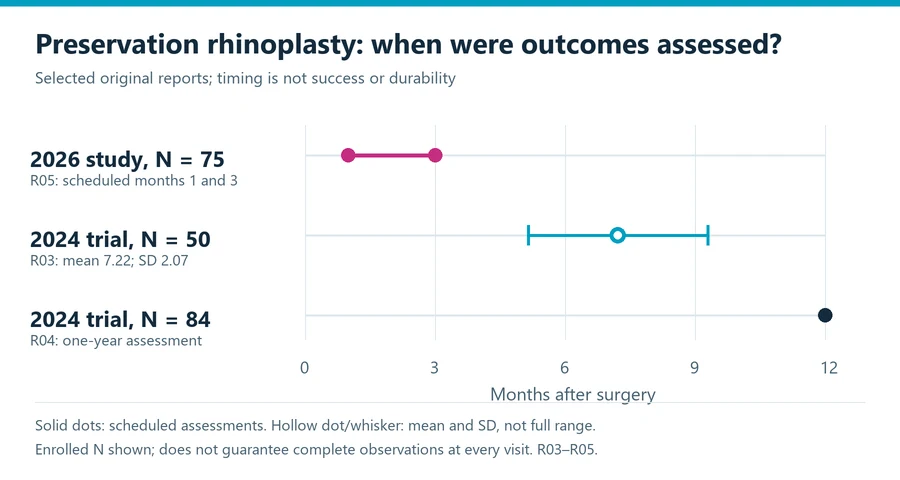
The March 15, 2024 online report of a randomized study included 50 people, with 25 assigned to dorsal preservation and 25 to conventional dorsal hump reduction. One surgeon performed the operations. Average follow-up was 7.22 months, with a reported standard deviation of 2.07 months. The abstract reported no statistically significant between-group outcome difference. This is evidence about its selected primary-rhinoplasty comparison, not every preservation variation or every long-term endpoint. R03
The other 2024 randomized trial enrolled 84 people and compared a modified preservation method with conventional hump resection plus spreader-flap midvault reconstruction. It evaluated outcomes after one year and reported no statistically significant differences in the listed appearance and questionnaire measures. The structural comparator included a specific reconstructive component; describing it simply as “removing tissue” would omit an important part of the comparison. R04
No statistically significant difference is not proof that two operations are identical. Sample size, variability, assessment choice and study design affect what a comparison can detect. It also is not evidence that neither operation helped. A study can observe improvement within both groups while failing to detect a difference between them. Keep the within-group and between-group questions separate.
| Original report | Comparison or population | Assessment window | Appropriate reading |
|---|---|---|---|
| March 2024 online randomized report | 50 participants, 25 in each group; one surgeon | Mean 7.22 months, SD 2.07 | Selected primary cases; average timing is not identical follow-up for everyone |
| 2024 spreader-flap randomized trial | 84 participants; specific preservation and reconstruction approaches | One year | Findings concern these particular operations and assessed endpoints |
| February 2026 comparative study | 75 participants; one surgeon | One and three months | Early assessments cannot establish multiyear durability |
Do not combine these participant counts into a pooled personal-risk estimate. The table is an evidence map of selected original reports, not a systematic review or a ranking. It does not establish the frequency of an uncommon event or tell you which option fits your anatomy.
Notice how early differences can change over time
The February 12, 2026 original comparative study included 75 people, of whom 39 underwent structural rhinoplasty. Surveys were completed before surgery and at one and three months. The abstract reported a preservation-group advantage in the obstruction domain at one month but equal group scores at three months; some other assessed domains did not show significant group differences. Its short follow-up is important when reading language about longer-term outcomes. R05
An early difference does not automatically persist, and an early similarity does not guarantee later similarity. The supporting timeline shows the observation windows in these selected reports. Scheduled assessments at one and three months are drawn differently from a mean assessment time of 7.22 months. A mean is a summary of varied timing, not a scheduled visit shared by all participants.
Ask when the finding was true
Before using a headline to judge an operation, locate its endpoint and timepoint. Was the outcome a symptom score, an appearance assessment, a satisfaction answer or another measure? Was it measured at three months or a year? Did the authors observe the same people at later intervals? If the information is unavailable in an accessible abstract, uncertainty should remain visible rather than being filled with a favorable assumption.
This distinction is useful when planning your own follow-up. A healing visit, an appearance review and a functional assessment can serve different purposes. The clinician should explain the intended sequence and why a particular concern is being assessed at a particular stage. A single early photograph is a poor substitute for that plan.
Build a claim check before accepting a comparison
Take one claim from a consultation or advertisement and identify the question it answers. “Better breathing,” for example, should lead to a defined functional endpoint rather than a photograph. “A more consistent bridge” should lead to an appearance assessment with a clear definition. “Faster recovery” needs a specified activity or recovery measure. Without those definitions, three different claims can be compressed into the same favorable label.
Next identify the comparator. A trial against hump resection with midvault reconstruction does not establish an advantage over every possible structural plan. Nor does it compare surgery with doing nothing. If a proposed operation differs materially from the studied one, ask why the clinician thinks the comparison remains relevant. That question helps reveal the bridge between published evidence and an individualized proposal without requiring the reader to become a surgeon.
Finally, distinguish statistical and practical importance. A reported group difference may be small enough that its relevance to a particular person’s goal needs explanation. Conversely, a study that detects no difference may still leave uncertainty about an outcome important to you. Ask what change would count as meaningful for your concern and how it would be recognized. Avoid treating a favorable probability value as a photograph of the result you will receive.
Keep a short record with four fields: the claim, its exact source, the studied operation and population, and the measured endpoint and timepoint. Leave a field blank when the information has not been supplied. An unanswered field is a reason to ask for clarification; it is not evidence that a treatment will fail. This small record makes comparisons less vulnerable to changing definitions and selective headlines.
Understand what selected participants leave unanswered
An operation can work well in a study’s selected population without being appropriate for every nose. Ask how your proposed case resembles the cases being used as evidence. Relevant differences might include previous surgery, the intended bridge change, additional tip work or a separate functional concern. The examination determines their significance; an online guide cannot assign candidacy from a checklist.
Be especially careful when applying primary-surgery findings to a previously operated nose. “Rhinoplasty” is a broad label, and a proposal after earlier surgery has a different starting history. Obtain previous operative information if available and ask which evidence supports the actual plan. Do not assume that a preservation-versus-structural comparison in primary cases answers a revision question.
Men and women can both have appearance and breathing goals, but neither group has one desired nasal shape. Discuss the features you want retained rather than copying a gendered template. The research should support an assessment of the proposed operation; it should not tell you that your nose must resemble a study photograph or a fashionable profile.
A simulation can help articulate a preference if its purpose and limits are explained. It is a discussion image, not a documented outcome or a surgical guarantee. Ask which requested changes the clinician considers feasible and which would conflict with the function or features you value. Keep that explanation alongside the image so that the visual does not outrun the plan.
Discuss risks without assuming preservation removes them
ASPS lists rhinoplasty risks that include breathing difficulty, sensation changes, infection, poor healing or scarring, an unsatisfactory appearance and the possibility of revision. Its general risk page does not provide a preservation-specific numerical rate or demonstrate that one method avoids these categories. R06
Ask the team how it discusses those concerns for the specific planned components. What unfavorable outcomes are most relevant to the proposal? How would a persistent breathing complaint or an appearance concern be assessed? What care is available if further treatment is considered? These questions are more useful than accepting “less invasive” as a complete safety explanation.
The possibility of further surgery also belongs in the initial decision. A revision policy can describe financial arrangements, but it cannot guarantee that another operation will be appropriate or that a particular result can be achieved. Separate clinical assessment from contractual terms. A promise about reduced fees does not answer a question about expected benefit or functional risk.
Plan recovery around the actual procedure
Preservation is not a personal recovery calendar. The planned components, accompanying care and your own circumstances determine the instructions you need. ASPS explains that rhinoplasty contour refinement can continue for up to a year and that swelling can fluctuate during that period. Its recovery guidance also emphasizes specific instructions for care, medication, concerning changes and follow-up. R07
Use that distinction when planning work, travel and social events. An early ability to participate in an activity is a different question from whether swelling has settled enough for an appearance judgment. Ask the team about each activity that matters to you, rather than translating an online downtime claim into permission. Obtain instructions for exercise, contact with the nose, dressings and prescribed medication from the treating team.
| Planning task | Information to obtain | Keep separate from |
|---|---|---|
| Returning to a particular job | Duties, exposure and the team’s activity instructions | Final visible refinement |
| Travel or an important event | Follow-up access and the timing questions relevant to the event | A guaranteed appearance date |
| Assessing breathing | The agreed symptom or clinical assessment | A profile photograph |
| Judging a visible concern | Consistent assessment and the clinician’s interpretation of healing | An immediate decision about revision |
| Seeking help for a change | Contact arrangements and urgency instructions | Self-diagnosis from a general guide |
The existing recovery planning guide helps organize practical support. Procedure-specific permission and treatment instructions still need to come from the team responsible for your care. This page does not prescribe a medication, maneuver or postoperative routine.
Compare the total plan rather than a technique premium
A general rhinoplasty fee is not a verified preservation-specific total. ASPS’s cost page distinguishes its average professional fee from anesthesia, facility and other expenses. It also notes that breathing-related care may require examination and insurer authorization; coverage is not established merely by attaching a functional label to the procedure. R08
Request a written component quote that identifies the operation, setting, professional fees, anesthesia if applicable, planned functional work and follow-up. If two proposals use different techniques, compare what each actually includes before interpreting the price difference. One estimate may include additional work or care that the other leaves outside the stated amount.
Ask about costs associated with additional assessment or surgery, including which fees a revision policy covers and which remain separate. If insurance is involved, confirm the documented scope and authorization with the relevant parties. Neither a procedure name nor an average fee answers those questions. The cost planning guide provides a framework for organizing the categories without inventing a preservation price.
Make the technique serve the decision
You should leave the consultation able to describe your desired changes, the features you want retained, the breathing assessment if relevant, and the reasons for the proposed components. The evidence record should identify comparable populations and the actual times at which outcomes were assessed. The care and financial records should make the scope equally clear.
If the clinician recommends a hybrid plan, judge the explanation rather than whether it matches a single fashionable label. If a requested change cannot be achieved within tradeoffs you accept, waiting or declining is a valid decision. Preservation rhinoplasty is useful to understand as an approach; the name alone cannot replace an examination, a balanced discussion of uncertainty, or a plan matched to your priorities.
Sources and review scope
Plastic Surgery Editorial Team. Source records checked through October 12, 2026. Review scope: source and editorial checks for general education. No individual clinical assessment is represented.
- Open preservation rhinoplasty: procedural review. pubmed.ncbi.nlm.nih.gov. Source date: 2023-07-12. Checked 2026-10-12.
- ASPS rhinoplasty procedure options. plasticsurgery.org. Publication/update date not stated. Checked 2026-10-12.
- Original randomized prospective comparison of dorsal preservation and hump reduction. pubmed.ncbi.nlm.nih.gov. Source date: 2024-03-15. Checked 2026-10-12.
- Original randomized comparison of dorsal preservation and spreader-flap rhinoplasty. pubmed.ncbi.nlm.nih.gov. Source date: 2024-06-14. Checked 2026-10-12.
- Original assessment of functional and aesthetic results in preservation and structural rhinoplasty. pubmed.ncbi.nlm.nih.gov. Source date: 2026-02-12. Checked 2026-10-12.
- ASPS rhinoplasty risks and safety. plasticsurgery.org. Publication/update date not stated. Checked 2026-10-12.
- ASPS rhinoplasty recovery guidance. plasticsurgery.org. Publication/update date not stated. Checked 2026-10-12.
- ASPS rhinoplasty cost scope. plasticsurgery.org. Publication/update date not stated. Checked 2026-10-12.