
Open rhinoplasty includes an incision across the columella, the tissue separating the nostrils. Closed rhinoplasty uses incisions inside the nose. That access difference does not describe every change to the nasal structure, the functional treatment or the complete recovery course. A useful open vs closed rhinoplasty comparison begins with your actual cosmetic and breathing goals, then asks why the proposed approach fits the work required. Neither incision label alone proves a better result, a risk-free procedure or a universal recovery advantage. 1
Ask the clinician to explain the planned structural changes separately from the approach used to reach them. If two consultations recommend different approaches, compare their diagnoses, intended components and reasons before assuming that one technique is inherently superior. The important question is whether the complete proposal addresses the assessed concern while making the expected benefits, limitations and uncertainties understandable.
Access and intended correction are different decisions
ASPS describes the open and closed incision approaches, possible cartilage grafting, septal correction and additional incisions when nostril size is altered. Those components are not all determined by the open or closed label. Do not interpret closed as a promise that every possible incision is absent, or open as evidence that every person requires the same amount of structural work. 1
| Proposal layer | Record separately | Do not infer from the access label |
|---|---|---|
| Intended change | Bridge, tip, nostril or other assessed concern | Every structural component |
| Functional work | Diagnosed breathing concern and planned treatment | Guaranteed improvement in breathing |
| Access | Open or closed and the reason given | A universal risk or recovery rank |
| Additional components | Grafts and any accompanying procedures | An identical complete course |
This distinction can prevent a conversation about a preferred incision from overshadowing the actual goal. If you strongly prefer one approach, explain why: concern about visible healing, previous experience or a particular recovery demand. Then ask how that preference fits the proposed work. A preference is an important part of the discussion, but it cannot substitute for the examination or establish what is technically appropriate in your case.
Keep the intended changes in your own words as well as the clinical description. For example, wanting a different profile and wanting easier breathing are separate concerns even if both are discussed during one operation. Ask what each proposed component is intended to address. That creates a clearer basis for consent than expecting the approach name to answer every question.
Early bruising evidence does not establish a long-term winner
An original June 2015 comparison studied 50 people undergoing hump removal and osteotomies, with 25 in each open and closed group. Eyelid swelling and surrounding bruising were scored on postoperative days one, three and seven. The authors reported no clinically or statistically significant difference in those measured early outcomes. That finding concerns this population, work and assessment period; it does not prove equivalence for all rhinoplasty outcomes. 2
The specific operation matters. A study involving particular bone work should not automatically supply the same early experience for a different structural proposal. Nor should a finding about eyelid swelling become a statement about nasal breathing, final shape or the need for revision. Those questions need their own measurements and follow-up. One useful result cannot do the work of several unmeasured outcomes.
No significant difference is not a guarantee of identical experience
A group comparison may fail to detect a difference while individual experiences still vary. The finding should be reported with its sample and endpoint, rather than translated into a promise that everyone will have the same bruising or recover at the same pace. Ask whether the evidence cited in your consultation measures the concern you actually raised and whether it matches the planned components.
If your main concern is returning to a public-facing task, discuss that task directly. A score for early bruising is not medical clearance and does not define whether you will feel comfortable attending an event. Conversely, concern about temporary appearance should not be dismissed merely because a study found no between-group difference. It remains a valid planning question whose answer needs the actual treating team’s expectations and instructions.
Skin sensation is not the same as smell or nasal airflow
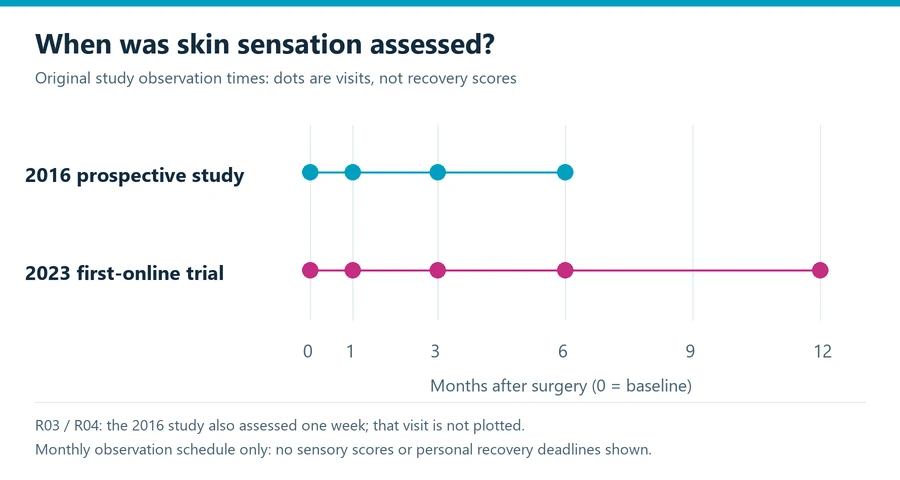
An original prospective comparison published in February 2016 included 15 closed and 15 open rhinoplasty patients. Researchers tested nine skin locations with monofilaments before surgery and at one week and one, three and six months afterward. Both groups showed reduced sensation in the first week; the upper columella differed between groups then. The abstract reported no other significant between-group regional differences at the later assessments. These were skin-sensation measurements, not smell or breathing tests. 3
The distinction matters when searching for information about nasal sense. Sensation of touch, perception of smell and the experience of airflow are different concerns. A paper measuring pressure detection at the skin cannot establish a change in smell or resolve an obstruction complaint. Likewise, a report of easier breathing cannot show that skin sensation at the tip has returned to its earlier measured level.
Describe a concern in specific terms when speaking with the team. Is it a change in touch sensation, a change in smell, difficulty moving air or a combination? Do not attempt to diagnose the cause from a study abstract. Precise description helps the clinician determine what assessment is needed and avoids borrowing reassurance from a paper that measured a different function.
The sensory studies observed different places and times
A randomized sensory study first published online in July 2023, with a March 2024 issue date, tested seven nasal skin subunits before surgery and at one, three, six and twelve months. It used objective monofilament testing and subjective ratings. The report found reduced tip and infratip sensation in the open group at one month, returning to the reported normal level by three months. The abstract does not supply the patient denominator, so none is invented here. 4
That report and the 2016 study should not be combined into one universal sensory calendar. They assessed different sets of locations and used different observation schedules. A report of a regional difference at one assessment is not a prediction that every person will develop the same concern or that it will resolve on the same date. Retain the region, measurement and timing when discussing the finding.
| Study endpoint | Actual observation schedule | What it does not establish |
|---|---|---|
| 2015 swelling and bruising | Days 1, 3 and 7 | Long-term shape, breathing or sensation |
| 2016 skin sensation | Baseline, 1 week, months 1, 3 and 6 | Smell or universal personal recovery |
| 2023/2024 skin sensation | Baseline, months 1, 3, 6 and 12 | A promised three-month deadline for everyone |
The schedule itself helps interpret a statement such as recovery by a particular month. Researchers observe people at scheduled visits; they do not necessarily measure every day between visits. A change seen at the later visit cannot establish its exact day of resolution for every participant. Keep that limitation visible rather than presenting a measured checkpoint as a precise biological timetable.
Breathing goals need their own assessment and follow-up
If breathing is part of your concern, explain the symptoms and ask what the examination identifies. Do not infer the cause from whether the nose looks crooked or whether a proposed operation is open or closed. The cosmetic change you want and the functional treatment proposed should both be described, including how the team intends to assess the result. Read the rhinoplasty breathing assessment guide for the distinct symptom-and-measurement question rather than using an access label as its answer.
Ask whether the clinician will use a symptom measure, examination or other assessment and what each is intended to show. A standardized score can help record an experience, but its meaning depends on the instrument and how it is used. A photograph may communicate shape; it does not replace a functional evaluation. If a study reports a satisfaction score, do not assume it measured every breathing concern unless that outcome was explicitly assessed.
Write the baseline concerns before surgery in a form you can later compare. Which side feels affected, under what circumstances and what treatments or prior procedures have occurred? Report what you know without creating a diagnosis yourself. The clinician can then identify the appropriate assessment and explain which part of the proposal addresses the actual findings.
Primary and revision surgery are different evidence populations
A first operation and an operation after previous nasal surgery may have different starting conditions. If your case is a revision, provide the available operative history and records requested by the team. An incision label does not reveal what was previously changed or what tissue is available. A photograph alone cannot supply the full history of an earlier procedure. For a previously operated nose, use the revision rhinoplasty guide alongside the available operative history.
Do not use the complaints of people attending a revision service to estimate the complication incidence of all primary open or closed operations. That population is selected precisely because people are seeking further care. It can identify concerns worth discussing without providing the denominator of everyone who originally underwent the procedure. A comparison needs the appropriate starting population before its rates can be interpreted.
Similarly, a primary-surgery trial should not automatically set expectations for a revision proposal. Ask what evidence or clinical experience supports the actual recommendation and which uncertainties arise from previous treatment. A clear explanation may be more individualized than a single published percentage. The important point is to distinguish that judgment from a claim that a broad approach name settles the question.
Discuss scars without accepting a scar-free promise
The main access distinction concerns the location of incisions. Ask the clinician to explain all planned incisions and the anticipated healing discussion for them. Closed access should not be used as a blanket promise of no scars anywhere in a complete procedure, particularly if additional nostril work is included. Open access should not be described as producing an identical visible result for every person. 1
Explain prior concerns about wound healing or previous scars to the team. Ask what can reasonably be discussed about placement and care, and what cannot be guaranteed. You do not need to select an incision design yourself. You need enough information to understand the proposed plan and the uncertainties that matter to your decision.
When viewing examples, identify the procedure components, view and time after surgery. A close-up can illustrate appearance without showing every other outcome. An early incision photograph and a later healed result answer different questions. Neither can establish your personal healing trajectory. Use the examples to communicate and ask questions rather than to turn someone else’s appearance into a promised result.
Recovery instructions outrank an approach-based timetable
ASPS describes possible splints or packing and individualized wound-care, medication and follow-up instructions. It also notes that nasal contour can continue refining well beyond the initial swelling period. The actual team should distinguish protection of the operated structures, activity restrictions and assessment of the evolving appearance. Open or closed alone is not clearance for work, exercise or contact activities. 5
Describe the demands of your work and daily responsibilities. Sitting at a computer, moving equipment and participating in a contact sport are different activities. Ask which restrictions apply to the actual planned components and when the team will reassess them. An estimated period away from work should not be interpreted as permission to resume every task at once.
Record the follow-up appointments and contact pathway. If you develop a new concern, use the treating team’s instructions rather than testing the nose or applying a technique from someone else’s recovery story. General comparative material cannot determine whether a change in your breathing, appearance or sensation is expected. It should help you ask a clearer question, not replace an assessment.
Compare risks by the actual event being discussed
ASPS lists risks including anesthesia complications, bleeding, infection, altered sensation, breathing difficulty, unfavorable scarring and possible revision. The consent discussion should address the actual operation and your assessment. A closed label does not eliminate those categories; an open label does not supply an individualized risk percentage. 6
If a clinician cites a rate, ask what event was counted, in whom and over what interval. Temporary altered sensation, persistent obstruction and further surgery are not the same endpoint. A score for early swelling cannot establish a complete complication profile. Keeping the event definition clear lets you judge whether the information answers your concern or simply provides context.
Ask what would happen if the expected goal were only partly achieved or a problem required further assessment. That is a contingency discussion, not a prediction that the operation will fail. It should identify the route for care and how the team distinguishes planned refinement, elective preference changes and treatment of an unanticipated problem. Those events should not be merged into a single undefined revision category.
Compare two complete proposals and their actual charges
This guide does not establish a universal total-price difference between open and closed rhinoplasty. Obtain itemized proposals for the intended structural and functional components, clinician, anesthesia, facility and follow-up. If one plan includes work absent from the other, make that difference visible before attributing the price difference to the incision approach.
| Written field | Record for each proposal |
|---|---|
| Goals and assessment | Cosmetic and functional concerns separately |
| Intended work | Actual components, approach and reason |
| Course and follow-up | Planned episode, instructions and assessments |
| Charges and contingencies | Itemized terms and arrangements for further care |
Ask the responsible office about the actual financial arrangement for additional assessment or surgery. Do not assume a quote includes every later event, or that a functional component guarantees insurance coverage. Keep clinical recommendations and administrative confirmation distinct. A research result does not establish what your insurer or service agreement will cover.
Finally, summarize why the proposed approach fits the intended work, how each goal will be assessed and which uncertainties remain. The meaningful choice is the complete, explained proposal rather than the preferred incision label alone. The evidence can illuminate specific early or regional outcomes while leaving the final decision dependent on your assessment, goals and informed discussion.
Related planning
For a practical comparison, imagine two written proposals for the same consultation concern. One describes a profile change alone; the other describes that change plus assessed functional work. These are hypothetical planning documents, not patient cases or recommendations. Their different scope must be resolved before comparing satisfaction figures, recovery estimates or prices. Otherwise, the approach may appear to explain a difference that actually comes from the intended components.
A second useful check is to match each claim to its evidence category. If the claim concerns bruising in the first week, look for that endpoint and interval. If it concerns touch sensation, look for the tested region and method. If it concerns breathing or final shape, neither of those earlier measurements is a substitute. Write down any claim whose evidence category remains unclear and ask the team to explain it.
This approach also helps if you obtain another opinion. Carry the same baseline goals and known treatment history, then compare the reasons for the recommendations. A difference in approach is informative only after the intended correction and case assumptions are made explicit. You can then discuss a concrete disagreement rather than choosing between competing labels.
Explore the procedure guides, consultation questions and complete-cost planning guide to organize the next discussion.
Sources and review scope
Plastic Surgery Editorial Team. Source records checked through October 12, 2026. Review scope: source and editorial checks for general education. No individual clinical assessment is represented.
- ASPS rhinoplasty access and intended components. plasticsurgery.org. Publication/update date not stated. Checked 2026-10-12.
- Original open/closed septorhinoplasty early swelling comparison. pubmed.ncbi.nlm.nih.gov. Source date: 2015-06. Checked 2026-10-12.
- Original prospective open/closed skin-sensation comparison. pubmed.ncbi.nlm.nih.gov. Source date: 2016-02-17. Checked 2026-10-12.
- Original randomized nasal-subunit sensory study. pubmed.ncbi.nlm.nih.gov. Source date: 2023-07-12. Checked 2026-10-12.
- ASPS individualized rhinoplasty aftercare. plasticsurgery.org. Publication/update date not stated. Checked 2026-10-12.
- ASPS rhinoplasty risk categories. plasticsurgery.org. Publication/update date not stated. Checked 2026-10-12.