
Rhinoplasty breathing changes need assessment that separates your reported experience from measured nasal airflow, appearance satisfaction and smell. An operation can have an appearance goal, a functional goal or both. Original studies use different measures and selected populations; their findings do not predict your breathing outcome or determine what a new concern means without clinical evaluation.
This guide explains two current original cohorts and the questions their methods make useful. It provides an original assessment-context chart and equivalent table, not a home test, severity score or treatment plan. Follow the responsible team’s actual instructions for postoperative concerns and contact. Do not wait for a research assessment date to address a problem or use an online average as proof that a particular symptom is expected.
What should you identify before discussing rhinoplasty breathing changes?
Begin with the exact operation and the purpose discussed in your consultation. Preserve whether the proposal addressed appearance, a breathing concern or both. If you do not know which components were performed, request clarification from the responsible team rather than inferring them from the external result. The operation’s familiar name may not describe every component relevant to the question.
The rhinoplasty procedure guide provides the broader assessment and operation context. Rhinoplasty breathing changes are a narrower functional-outcome question. An image that helps communicate an appearance concern does not independently show airflow or determine the source of a breathing complaint. Keep those goals separate in your record.
Describe what you actually experience in ordinary words. Record the date, what seems changed and the circumstances you want the clinician to understand. Do not assign the cause or decide that a structure has failed based on a description in a forum. If an assessment has not occurred, state that it is pending.
Also preserve the baseline when it is available. A current concern can be difficult to interpret if the preoperative breathing goal or previous assessment is missing. Ask what was recorded and what can reasonably be compared now. Do not reconstruct an unavailable baseline from memory as though it were a measured clinical value.
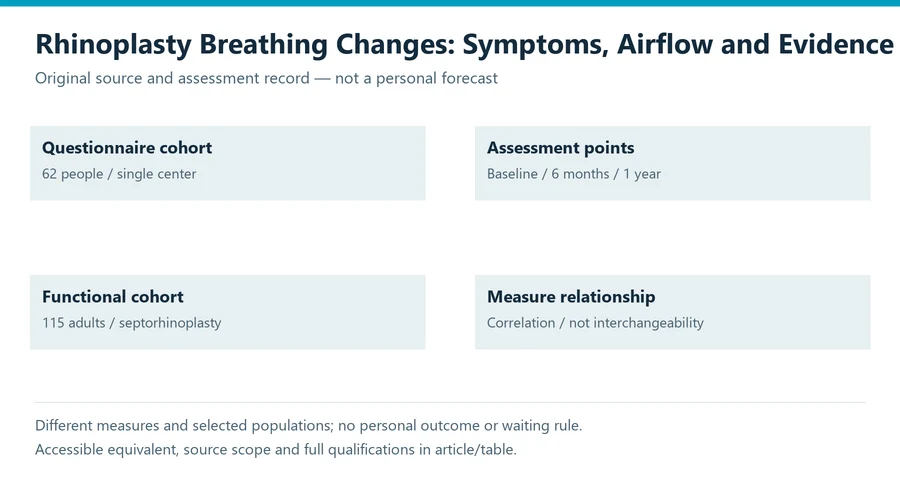
| Rhinoplasty breathing changes evidence | Actual measured context | Interpretation boundary | Source |
|---|---|---|---|
| Questionnaire cohort | 62 people; single center | Reported outcomes, not an objective airflow measurement | R01 |
| Assessment points | Baseline; six months; one year | Research intervals, not personal waiting instructions | R01 |
| Functional airflow cohort | 115 adults recommended septorhinoplasty | Selected obstruction population, not every cosmetic operation | R02 |
| Measure relationship | Single-sided airflow and symptom correlations | Correlation is not universal agreement or a treatment threshold | R02;R03 |
What did the 62-person longitudinal cohort measure?
An original single-center study included 62 people undergoing rhinoplasty and evaluated obstruction, appearance satisfaction and smell using questionnaires before surgery, at six months and at one year. The report describes favorable changes in selected outcomes, but those reported measures are not an objective airflow test or a personal prediction. It appeared electronically on February 10, 2025, before its July issue. The official indexed abstract was inspected; direct full text was unavailable. Original longitudinal rhinoplasty cohort.
For rhinoplasty breathing changes, preserve the separate outcome categories. Feeling less obstructed, being more satisfied with appearance and reporting a change in smell do not describe the same thing. If someone refers to a favorable study conclusion, ask which of those outcomes the claim concerns and how that relates to the question you are asking.
The time points also have a defined research purpose. They identify when the investigators collected information. They do not establish when your breathing should improve, when a concern should be ignored or when another operation should be considered. The responsible team’s current assessment and instructions remain separate from the study calendar.
A selected center’s findings cannot establish a universal result for all rhinoplasty techniques or patient circumstances. Keep the actual study setting attached to the finding rather than using its broad conclusion as a guarantee. If the abstract does not supply a numerical score change, do not invent one to make the answer appear more precise.
What did the 115-person functional airflow study add?
A separate original study enrolled 115 adults with nasal obstruction who were recommended functional septorhinoplasty. It compared single-sided and bilateral peak nasal inspiratory flow with symptom measures before and after surgery. Relationships varied by the symptom measure and subgroup; the measures did not universally agree. The February 2025 issue date is verified, while the precise online day is not. The official indexed abstract was inspected; direct full text was unavailable. Original single-sided airflow study.
For rhinoplasty breathing changes, this adds a measurement distinction rather than a universal test order. A clinician may discuss reported obstruction and an airflow measure as different pieces of information. The study does not authorize readers to perform a home test, interpret a result independently or select an operation from a number.
The functional operation context matters. People recommended septorhinoplasty because of obstruction are not automatically representative of everyone seeking an appearance-only change. Do not transfer their selected findings into a personal probability for a different proposal. Ask whether the evidence presented matches the population and purpose of the actual operation under discussion.
Correlation is another important boundary. A relationship between two measures does not mean they are interchangeable, that one is always correct or that a single cutoff determines treatment. Ask what each measure contributes to the examination and what uncertainty remains. That is more useful than treating a research association as a decision rule.
How are airflow and the experience of obstruction different?
An airflow measurement has a named method and a recorded value. A reported experience describes how the person perceives breathing in the circumstances being assessed. Research can examine the relationship between them without establishing perfect agreement. Rhinoplasty breathing changes should therefore be discussed with the actual measure and the actual experience clearly labeled.
If a report includes a test, ask what was measured and what the clinician believes it means. Preserve the method, the date and the explanation rather than extracting a value without its conditions. A number can appear decisive while leaving the reader unsure whether it refers to one side, both sides or a different outcome altogether.
If the discussion includes a questionnaire, ask what concern it addresses. This guide does not reproduce questionnaire items or provide a home scoring method. The existence of a published instrument does not replace an examination or establish that every score directly predicts a clinical result. Keep the interpretation attributed to the team that supplied it.
When measures appear to differ, record the unanswered question rather than deciding which to discard. Ask how the clinician brings the findings together and whether further assessment is needed. The original airflow study’s varying relationships are a reason to preserve the distinction, not proof that an individual concern is invalid.
How should appearance and smell remain separate in the record?
A favorable appearance statement cannot independently resolve a breathing complaint. Likewise, a discussion of nasal breathing should not silently become an explanation of smell. The longitudinal cohort measured several domains, and rhinoplasty breathing changes deserve their own clear field rather than being absorbed into a general satisfaction statement.
Write each concern as a separate question. Identify what has been assessed and what answer you received for that particular outcome. If the clinician’s explanation addresses appearance alone, mark the breathing question as unresolved. If more than one feature is being discussed, request clarification of which evidence supports each part of the explanation.
This also improves your use of research. A source might report several favorable outcomes without demonstrating that the same mechanism or assessment explains them all. Do not combine separate endpoints into a single success claim. Ask what the study measured, how it was measured and what its findings can reasonably support in the actual consultation.
Keep uncertainty explicit. A missing baseline, unavailable test or unassessed concern should remain identified as such. Do not fill the gap with an online statement that the operation usually helps. An accurate record of the question and the current assessment is more useful than unsupported certainty about the cause or likely result.
What do official risks guidance and follow-up instructions add?
ASPS includes difficulty breathing among rhinoplasty risks and advises discussing questions directly with the responsible surgeon. Its official safety page is undated. The risk listing is not an individual incidence estimate or a personal diagnosis, and it provides no waiting period for your concern. ASPS rhinoplasty risks guidance.
For rhinoplasty breathing changes, preserve the actual contact instructions issued by your team. If a concern arises, use the designated process and describe what you are experiencing. The fact that research measured outcomes at six months or one year should not be interpreted as permission to postpone communication until then.
The rhinoplasty recovery guide addresses a separate practical recovery discussion. Its general planning information does not replace your current postoperative instructions. Ask which team is responsible, how it wants concerns reported and what follow-up has actually been arranged for you.
If instructions are unclear or appear to conflict, request clarification rather than choosing whichever online timeline sounds reassuring. Save the updated response with its date. This guide does not supply symptom thresholds, medication changes, breathing exercises or a self-treatment regimen; it helps you preserve the assessment question and the actual communication plan.
What questions belong before an operation?
Ask how the proposed appearance change and functional goal have been discussed together. What breathing concern, if any, has been assessed? Which part of the proposal intends to address it, and which part concerns appearance? Rhinoplasty breathing changes should be included in the conversation without assuming that every aesthetic proposal has the same functional purpose.
Ask what evaluation has occurred and what further assessment the team believes is needed. Preserve the actual explanation rather than assembling a test list from this guide. The selected airflow study does not establish that every person needs its measurements, and the questionnaire cohort does not show that reported outcomes alone answer every clinical question.
Clarify how the outcome would be reviewed afterward. Ask which concerns will be discussed, who will assess them and how you should communicate a change. This is a coordination question, not a demand for a guaranteed result. The plan should distinguish the actual follow-up arrangement from the intervals chosen by a research team.
Finally, record the limits explained in the consultation. A favorable result in a cohort is not a promise made to you. Ask which uncertainties remain and which alternatives were actually discussed. This makes the reasoning reviewable without turning the paper’s conclusion into your individual treatment decision.
What questions make a later assessment or revision discussion clearer?
Start with the exact unresolved concern. Ask what has been assessed, what explanation was provided and whether additional evaluation is needed. Rhinoplasty breathing changes may be one question among several, so keep its goal separate from a request to change appearance. A new proposal should identify the feature it intends to address.
The plastic surgery second opinion guide explains the distinct task of organizing records and questions for another assessment. It does not guarantee that another clinician will recommend a different operation. Preserve the actual prior information so that the new discussion does not depend on a reconstructed or incomplete account.
Ask whether a proposed revision is being discussed for a functional concern, an appearance concern or both. Request the reasoning, alternatives and limits in plain language. Neither the cohort’s average outcome nor a correlation between measures independently determines that another operation is appropriate. The actual assessment and your goals require their own explanation.
Keep administrative and clinical statements separate. A consultation offer, policy or payment discussion does not establish suitability or expected benefit. If a research source is cited, ask which population and endpoint it concerns. Then record what individual findings support the proposal and what the clinician says remains uncertain.
How can you use the original assessment-context organizer?
The organizer has four fields: the operation context, the reported concern, the actual measure and the current explanation or next question. It is an original communication aid, not a validated clinical instrument. Use it to preserve what you know, identify missing information and make the next consultation question specific.
For rhinoplasty breathing changes, the operation field records the actual procedure and its stated purpose. The concern field uses your own observation without a diagnosis. The measure field identifies an assessment that has actually occurred, or explicitly says it is unavailable. The final field records the responsible team’s answer and any requested next step.
Do not calculate a severity score or predict a result from these fields. They organize information rather than decide treatment. A missing measurement should not be replaced with a group mean from a study. A research interval should not become your personal care schedule. Keep every imported fact attached to its original context.
Update the record after an assessment or response, preserving the previous date and wording when the plan changes. Mark which questions were answered and which remain unresolved. This helps prevent a statement about appearance or a general recovery expectation from being remembered as a specific explanation of your breathing concern.
Frequently asked questions
Does rhinoplasty always improve breathing?
The cited cohorts do not establish a universal result. They report selected populations and specific measures, while official safety guidance also recognizes difficulty breathing as a possible risk. Ask how your actual functional concern has been assessed and what the proposed operation intends to address. Do not transfer a favorable study conclusion into a personal guarantee.
Does an airflow number settle every breathing question?
The functional cohort found relationships that varied across symptom measures and subgroups. A recorded value needs its method and clinical interpretation. It is not a universal diagnosis or treatment threshold. Ask how the clinician relates the measure to your reported experience and the rest of the assessment.
Should I wait until one year to report a concern?
The longitudinal study’s one-year assessment is a research time point, not an instruction for you to delay communication. Follow your responsible team’s actual contact and postoperative directions. If the plan is unclear, request clarification through its designated channel rather than treating the study calendar as personal guidance.
What is the most useful consultation question?
Ask which outcome is being assessed, how it was evaluated and what the current explanation addresses. Keep reported obstruction, airflow, appearance satisfaction and smell separate. Then clarify the next agreed communication or assessment step and the limits of any proposal, without using this guide as a home diagnostic tool.
References and review scope
R01: Original 62-person longitudinal cohort, official indexed abstract inspected; February 10, 2025 electronic publication and July issue. R02: Original 115-adult functional airflow cohort, official indexed abstract inspected; February 2025 issue, exact online day unverified. Direct full texts were unavailable. R03: Official undated ASPS safety guidance, directly inspected. Sources checked October 12, 2026; retrieval dates are not new publication dates.
This is an editorial evidence and communication guide without qualified clinical review. Its chart is not an observed patient result, diagnostic score or test order. Individual symptoms, treatment decisions and postoperative instructions require the responsible clinical team.
Sources and review scope
Plastic Surgery Editorial Team. Source records checked through October 12, 2026. Review scope: source and editorial checks for general education. No individual clinical assessment is represented.
- Impact of Rhinoplasty on Nasal Breathing and Olfactory Function: A Longitudinal Prospective Cohort Study. pubmed.ncbi.nlm.nih.gov. Source date: 2025-02-10. Checked 2026-10-12.
- Single-Sided Peak Nasal Inspiratory Flow as an Adjunct Objective Measure in Functional Septorhinoplasty. pubmed.ncbi.nlm.nih.gov. Source date: 2025-02. Checked 2026-10-12.
- Rhinoplasty Risks and Safety. plasticsurgery.org. Publication/update date not stated. Checked 2026-10-12.