
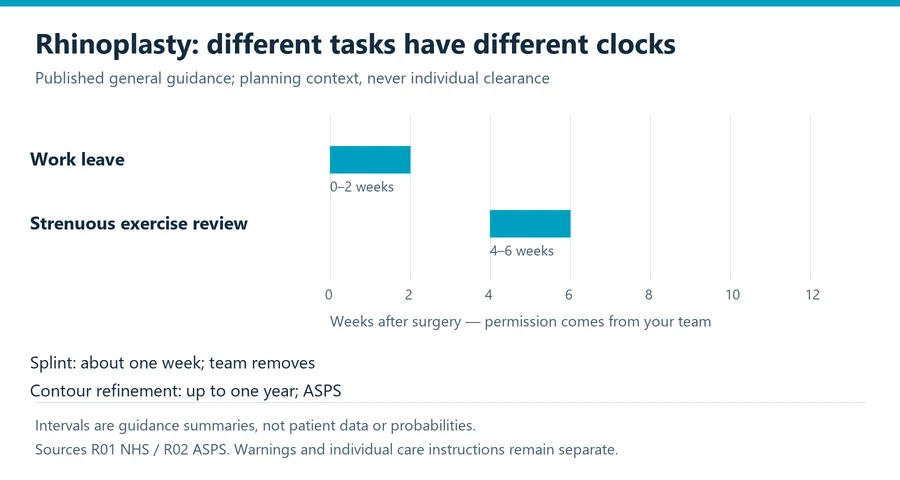
Rhinoplasty recovery has separate milestones for splint care, work, physical activity, breathing and appearance. NHS guidance describes up to two weeks away from work and a general four-to-six-week window before strenuous exercise. ASPS explains that contour refinement can continue for up to a year. These statements describe different endpoints. Your surgeon must apply the recovery plan to the operation actually performed; neither a better photograph nor the end of a calendar range gives automatic permission for an activity.
Use this guide to organize tasks and ask specific questions about postoperative care. It covers nasal surgery recovery planning rather than choosing an open, closed, structural or preservation technique. Additional septal work, a revision or a graft donor site should be identified in your own instructions. The most useful plan names the activities you need to resume and the service that will assess a concern, without presenting a universal schedule as a personal forecast.
Define the scope of your rhinoplasty recovery plan
Ask the team to list the procedures that will be performed and explain whether any additional site has its own care instructions. Keep the list with your recovery paperwork. A nasal operation that includes another component should not inherit the shortest estimate from a simpler operation just because both are called rhinoplasty. The clinician should explain which questions concern the nose and which concern another treated area.
Describe your ordinary demands before agreeing a tentative work date. A job involving face protection, physical contact, outdoor exposure or equipment may raise different questions from a desk role. Tell the team what you actually wear and do. Do not expect the clinician to infer those demands from a job title, and do not decide yourself that a familiar piece of equipment is harmless around a healing nose.
The NHS describes a splint for roughly a week and an appointment where it may be removed. It also discusses breathing difficulty through the nose early on and months before the full appearance effect is seen. Its severe-pain and unexpected-symptom advice is a contact instruction, not a reason to dismiss every early breathing complaint as expected. NHS nose reshaping recovery guidance
Keep room in the plan for a change after surgery. Ask the discharge team whether the operation performed differed from the proposal and whether that changes care or activity instructions. If a helper will assist you, let them hear the relevant explanation. Rhinoplasty recovery planning is most useful when it tracks the actual instructions instead of preserving an old estimate after the operative scope has changed.
Read the rhinoplasty recovery timeline by endpoint
Separate the first care appointment, the proposed work return, the activity review and later appearance assessment. Each date should answer a particular question. Removing a splint does not settle when a sport is permitted. Returning to an ordinary meeting does not show that the nasal contour has finished changing. The different timelines can all be valid because they concern different tasks and assessments.
| Rhinoplasty recovery endpoint | General source context | Decision for your team |
|---|---|---|
| Splint review | NHS describes about one week | When and where will the team remove or review mine? |
| Work leave | NHS describes up to two weeks | Does my work, commute or equipment require another arrangement? |
| Strenuous activity | NHS gives a four-to-six-week window | Which activity may I resume, under what conditions? |
| Appearance | NHS describes months; ASPS refinement up to a year | When is a particular appearance concern best assessed? |
The original planning graphic separates these endpoints and keeps the longer appearance horizon beyond the week-scale tasks. It does not plot patient outcomes or give the probability that you will be ready on a date. The table supplies the same source qualifications in text. Use both as a consultation organizer, with your own instruction and review date recorded beside each task.
Avoid averaging the appearance statements into one supposed best estimate. The NHS broad description and ASPS discussion of refinement use different wording and endpoints. ASPS also notes that swelling can fluctuate during that longer period. Ask what your team means by an initial result, a useful review and a later contour assessment. ASPS rhinoplasty recovery and refinement guidance
Make splint and dressing care a clear responsibility
Ask what is on or inside the nose, which items need care and who will remove them. Record the appointment rather than planning removal yourself. A published one-week example is not a universal instruction for an individual splint. Do not adjust it, remove tape or use an online demonstration to change the arrangement. If something seems displaced or unexpectedly uncomfortable, ask the team how to obtain advice or assessment.
Request a usable explanation before you leave the facility. Describe the plan back to the team and let it correct any uncertainty. Ask a helper to listen if they will be responsible for transport or other practical care. The written instructions should identify the items, the contact route and what to do if a question arises. A household organizer can support the plan, but it cannot make a medical decision about a dressing.
Ask about ordinary washing, showering and any instruction to keep a dressing dry. Do not make assumptions from the fact that another part of your body can be washed normally. Plan how you will carry out the actual instruction and whether you need assistance. If the arrangement is difficult because of your home or mobility circumstances, describe the issue before discharge so the team can advise an appropriate plan.
Keep photographs or records only as requested by your team. A photograph can help communicate a visible concern but cannot assess every complication or establish breathing safety. If the team asks for information, send it through the instructed route. Do not let taking the perfect picture delay the care response required by the symptoms. Rhinoplasty recovery questions about equipment and symptoms deserve the relevant assessment, not just an online appearance comparison.
Ask about nose care without improvising treatment
Confirm what the team wants you to do about the nose and which actions should be avoided. The NHS advises avoiding nose blowing or removing crusts until the specified review, but the team’s actual instruction is the relevant care plan. This guide gives no cleaning depth, pressure, rinse recipe or manipulation technique. Ask for a demonstration if one is necessary rather than relying on a text description intended for someone else.
Keep prescriptions and other products matched to their directions. Ask what to do if you have a question about a dose, cannot use a prescribed product or develop an unexpected symptom. Do not add a decongestant, supplement or nonprescription medicine based on a generic recovery list. The team should explain what belongs in your plan and how to obtain clarification without leaving you to choose between unrelated recommendations.
Write down which symptom changes the team wants reported and how to reach the appropriate service. Some care questions can be handled through the usual postoperative contact, while an emergency needs immediate assessment. Ask about the difference before you need to use the plan. Do not assume that an expected category such as swelling explains a new change in intensity, location or associated symptoms without asking the clinician.
Keep the instruction history clear when advice changes. Mark the new version with its date and let your helper know which direction supersedes the older one. A recovery calendar should not contain several conflicting care schedules. If two instructions seem inconsistent, contact the team instead of silently choosing the shorter or more convenient one. That is a practical way to preserve the relationship between the operation, assessment and current care.
Plan work around face contact and real duties
Describe equipment, clothing and tasks that come near your face. Glasses, masks, protective equipment and other items may require a specific conversation. This article does not tell you how to support glasses or modify safety equipment. Ask the surgeon and, where relevant, the workplace responsible for safety how the requirements can be met together. Do not remove required protection or improvise a device because a general timetable suggests you should be back at work.
Rhinoplasty recovery at work needs a duty list
Include physical effort, repeated bending, outdoor conditions and any risk of accidental contact. Ask the employer what temporary arrangements are genuinely available, then discuss that proposal with the surgical team. A light-duty label is not enough if the role still requires an unexpected physical response. Define who will cover the tasks that remain restricted and when the arrangement will be reviewed.
For a desk role, consider meetings, the commute and the ability to pause, rather than treating the laptop as the entire job. If appearance is a separate concern, ask whether temporary camera or meeting arrangements are possible. Distinguish that preference from a medical instruction. A person may prefer a later social return without claiming that every visible sign means they are unable to perform a permitted task.
Request the paperwork your employer needs and keep a proposed date linked to its clinical review. Avoid making an irrevocable commitment on the basis of a general estimate. Rhinoplasty recovery may require a changed arrangement after the actual operation or assessment. Update the relevant people together so that an old rota or equipment plan does not persist after the team has revised the instruction.
Discuss driving and travel as complete journeys
Ask about driving requirements, medicines and the ability to carry out the task safely. A work estimate or splint-removal appointment is not a driving assessment. Arrange transportation to planned visits and a backup if the appointment changes. Do not test readiness with a short drive, and check any insurance conditions that apply. The relevant decision should reflect the full task rather than your willingness to make the journey.
If you will travel as a passenger, describe the trip and ask whether it is appropriate at the proposed time. Include distance, access to care and the follow-up plan. A journey away from the operating team can make a concern harder to assess if the arrangement is not clear. Do not assume that being able to board a vehicle establishes that the itinerary is suitable during rhinoplasty recovery.
Public transport may add carrying, stairs or crowded conditions to the journey. Ask what help or alternative transport is advisable for a particular appointment. Arrange coverage for any trips you normally provide for others. A school run or another person’s appointment should not become a reason to drive or travel before the relevant question has been resolved. A backup plan keeps a tentative date from becoming the household’s only option.
Keep exercise, hobbies and accidental contact distinct
Describe the sport or activity you want to resume and the level of effort it involves. Ask whether the team will assess you before its return and what conditions apply. The general four-to-six-week exercise window does not tell you that every activity is included at the same point. A contact sport and an activity without face contact deserve separate questions, especially when protective equipment is part of the task.
Include household and leisure tasks you might not call exercise. Moving furniture, gardening or caring for a pet can involve effort or an unexpected movement. Ask which parts fall within your instruction rather than trying them as a test. A helper can take over a clearly identified responsibility, but cannot cover an unnamed category such as everything strenuous unless the household has discussed what that means.
Consider arrangements for close contact with children or pets. The issue is practical exposure to an accidental bump, not a claim that a specific ordinary event always damages a surgical result. Ask what precautions your team recommends for your circumstances. Explain the plan to helpers so that they understand which duties need coverage and when the clinician expects to review the instruction.
Record permissions by activity. If the team allows one form of movement, do not assume it releases every loading or contact restriction. Rhinoplasty recovery becomes more usable when each permitted task has a clear boundary and a review point. You can ask a direct question about an important hobby without converting the answer into a universal timetable for everyone who has nasal surgery.
Know the response route for unexpected symptoms
The NHS advises prompt clinic contact for severe pain or unexpected symptoms after nose reshaping and lists heavy nosebleeding among possible complications. Ask the team before discharge how it wants you to respond to bleeding or breathing concerns and when emergency assessment is needed. Do not use a statement about expected early congestion to dismiss serious or worsening difficulty breathing. Describe the change and obtain the appropriate assessment.
CDC guidance identifies new breathing difficulty, chest pain or fainting as reasons for immediate emergency help. CDC emergency blood clot symptom guidance
A serious breathing problem is not a contour question for the next appointment. In the United States, call 911 for an emergency. A photograph or a routine portal message cannot rule out a serious cause. This warning guidance is a response plan, not a diagnosis or a procedure-specific probability, and it supplies no home treatment for suspected complications.
For a non-emergency concern, keep the advice and any follow-up arrangement together. Ask what should prompt another call if the situation changes. An answer about one symptom at one time does not automatically cover a different symptom later. Your helper can organize contact details and transport, but should not be expected to decide whether a new change is medically reassuring from a rhinoplasty recovery photograph.
Use longer follow-up for the right questions
At each visit, ask which care or activity instructions change and which remain. Bring the task list so the answers can be specific. Keep breathing and other functional concerns visible alongside appearance questions, without assigning their cause yourself. Ask the clinician what each assessment is intended to establish and when a later concern should be reviewed. The purpose of follow-up is not simply to confirm the original calendar.
Keep appearance observations consistent if your team requests them, but do not repeatedly analyze pictures as a substitute for assessment. ASPS describes a longer refinement horizon, not proof that every concern should be ignored for a year. Ask when the particular issue you have noticed needs review. That preserves the distinction between recognizing that appearance changes over time and dismissing something the team should assess now.
Finish a practical plan containing the actual operation, care appointments, transport, work duties, activity questions and urgent contacts. Revise it when instructions change. Rhinoplasty recovery is then a sequence of understandable decisions: protect the current care plan, resume a named task when permitted and discuss appearance at an appropriate review, without making one milestone answer every question.
For related context, see the rhinoplasty procedure guide and the recovery planning hub.
Sources and review scope
Plastic Surgery Editorial Team. Source records checked through October 12, 2026. Review scope: source and editorial checks for general education. No individual clinical assessment is represented.
- NHS nose reshaping rhinoplasty recovery guidance. nhs.uk. Source date: 2023-09-22. Checked 2026-10-12.
- ASPS rhinoplasty recovery guidance. plasticsurgery.org. Publication/update date not stated. Checked 2026-10-12.
- CDC about venous thromboembolism. cdc.gov. Publication/update date not stated. Checked 2026-10-12.