
Plastic surgery leave from work requires separate answers about time away, job protection, pay and the clinical ability to resume particular duties. A surgeon’s estimated recovery period does not automatically create an employment benefit. Before relying on a leave arrangement, identify your employer’s process, the applicable rules and the documents needed. This guide organizes those questions; it does not determine an individual’s legal eligibility or give medical clearance.
Begin with the actual job rather than a generic number of weeks. A desk-based role, a job involving repeated lifting and a role that requires driving do not present the same return questions. Describe the tasks accurately for the treating team while asking the leave administrator about the employment process. Keep the two responses separate so a payroll date does not become an assumed clinical milestone.
Does cosmetic surgery automatically qualify for FMLA?
No. The Department of Labor’s FMLA advisor explains that cosmetic-treatment conditions generally are not serious health conditions unless inpatient hospital care is required or complications develop. Restorative plastic surgery after injury or removal of cancerous growths can qualify when the regulation’s other conditions are met. The fact that recovery requires time away is not, by itself, a complete eligibility determination. 1
For plastic surgery leave from work, state what is actually known about the planned care. Outpatient scheduling, a recovery recommendation and the operation’s purpose are different facts. Do not describe routine cosmetic care as an inpatient admission or assume an anticipated inconvenience is a qualifying complication. If circumstances change, obtain accurate clinical documentation and ask the responsible administrator to evaluate the changed facts.
This distinction also prevents a misleading all-or-nothing conclusion. Not qualifying under one federal route does not answer every employer-policy or other-law question. Ask what options actually apply to your situation, including the employer’s ordinary leave process. The response must come from the relevant rules and facts rather than an internet promise that all cosmetic surgery is covered or that none ever can be.
Establish the applicable employment framework
DOL Fact Sheet 28 describes eligible employees of covered employers. Its general employee criteria include at least 12 months with the employer, at least 1,250 service hours in the preceding 12 months and a location with at least 50 employees within 75 miles. These criteria belong to that framework; they are not a complete checklist for every worker or a substitute for the administrator’s eligibility review. 3
In plastic surgery leave from work discussions, identify whether you are an employee, which employer and work location are involved, and which leave framework the employer uses. If you do not know, ask for the relevant written policy and contact. Avoid copying the criteria into a spreadsheet that labels everyone below a threshold permanently ineligible for all kinds of leave.
Federal employees need particular care with the framework. OPM’s FMLA fact sheet explains that its federal-employee rules differ, including the treatment of the DOL 1,250-hour requirement. Do not apply the private-sector summary to a federal employment situation without checking the applicable agency process. Similarly, this guide does not inventory every state law, collective bargaining agreement or employer benefit. 4
Separate job protection, pay and clinical readiness
Plastic surgery leave from work may involve several decisions during the same absence. DOL explains that FMLA leave can be unpaid or used concurrently with employer-provided paid leave. A leave designation and a wage-replacement determination therefore should not be treated as interchangeable. Ask the administrator which benefits are being reviewed and whether the decisions are complete. 3
Make separate records for the absence approval, any paid-time-off use, any disability or other benefit request and the treating team’s work restrictions. An approval in one column should not silently turn the others green. The practical objective is to find the unanswered question before scheduling and budgeting depend on it, rather than to declare yourself eligible based on a single form.
A colleague’s leave experience may suggest questions, but it cannot establish your own benefits. Different employers, job duties, policy versions and reasons for absence can produce different results. Ask what decision applies to your actual request and obtain its scope. A statement that a form was received is not the same as a written determination about protection or pay.
| Decision | Responsible conversation | Keep distinct from |
|---|---|---|
| Time away and leave designation | Employer or leave administrator | A general recovery estimate |
| Pay or wage-replacement benefit | Applicable payroll or benefit process | Job-protection status |
| Clinical task restrictions | Treating clinician with actual job details | A calendar return date chosen for payroll |
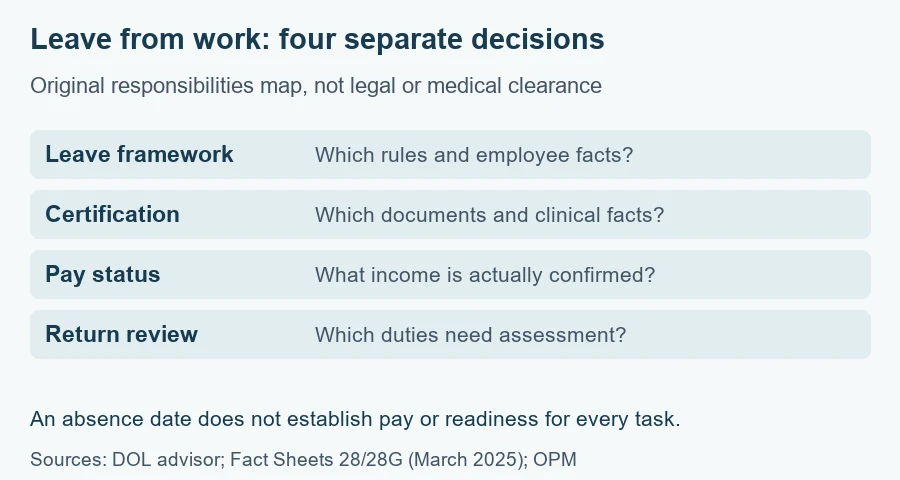
A plastic surgery leave from work responsibility map
The original four-part map for this guide separates framework, certification, pay and return. It is not a legal-eligibility score or a medical recovery chart. For each part, identify the document, responsible contact and unresolved question. The map helps you avoid sending the same broad request to everyone and assuming they are answering the same issue.
For example, you might have an estimate of treatment dates but no explanation of the employer’s submission process. That is a paperwork gap. You might have a leave designation but no confirmation of paid benefits. That is a budget gap. You might have a proposed return date but no assessment of repetitive lifting. That is a clinical-duty question. Name each gap rather than joining them into a vague approval status.
Add an actual-response field to the map. Record who answered, when, which facts were reviewed and what remains conditional. If a later change affects one part, update that part without rewriting all prior answers. Keeping the original responses visible helps the next person understand why an earlier plan no longer fits the current circumstances.
Build a useful job-description packet
For plastic surgery leave from work, provide the clinician with the real demands of your role. List tasks rather than conclusions: lifting particular objects, pushing equipment, prolonged standing, reaching, bending, climbing, commuting and driving as part of work. If demands vary by shift, say so. A job title alone can hide the task that determines whether a proposed return is practical.
Do not turn this packet into your own restriction prescription. The treating clinician assesses what is medically appropriate, while the employer evaluates work arrangements through its process. Your contribution is accurate information. If the employer supplies an essential-functions description, bring the current version and ask the clinical team how it wants that material incorporated into the relevant evaluation.
Include the difference between the ordinary job and a proposed temporary arrangement. Remote work may remove a commute while leaving concentration demands, long meetings or occasional physical duties unchanged. Reduced hours may change scheduling without changing lifting requirements. A proposed adjustment needs a concrete description so the clinician and employer can discuss the same arrangement instead of different imagined versions.
Certification is a specific documentation process
DOL’s March 2025 Fact Sheet 28G describes medical certification when an employer requests it for an FMLA serious-health-condition absence. It can address relevant medical facts, expected duration and the inability to perform essential functions. The guidance says a diagnosis may be provided but is not required, and medical-certification records are subject to confidentiality requirements. Use the actual process without assuming all clinical records must be shared widely. 2
For plastic surgery leave from work, ask who should receive the certification and what form or instructions apply. Provide the requested job information to the treating team and allow for its actual completion process. Do not assume the surgical appointment automatically includes immediate administrative paperwork. Record the employer’s due date and the practice’s stated turnaround without inventing a universal number of days.
When a response identifies incomplete or unclear information, locate the specific missing item. Ask the responsible clinician or administrator to clarify within the applicable process. Re-sending the same vague form may not address the problem. Keep a copy of the request and the response so you can distinguish a missing treatment date from an unrelated request for information about a different condition. For arranging dependent-care tasks and backup coverage, see plastic surgery childcare planning.
Keep notice and clinical dates on different lines
Plastic surgery leave from work planning should include the treatment date, anticipated absence, paperwork deadlines and employer notification dates as separately labeled entries. The employer’s requirements need to be checked from the applicable process. The clinical plan may still be provisional. Recording them together on a calendar is useful; treating them as the same event is not.
If treatment is planned, ask the leave administrator how advance notice should be provided and how later changes are reported. This guide does not replace the governing notice rules with a universal email template. Use a verified contact and the requested process. A message to a colleague who covers a shift may not serve the same function as a formal leave request.
For a sudden change, identify the appropriate clinical and administrative contacts without delaying necessary medical care for paperwork. The treating team addresses the medical situation. The employer or administrator addresses notification and leave procedures. Document the actual change when feasible and ask how to update the record. Do not characterize a change as urgent merely to obtain a preferred scheduling or benefit result.
| Calendar entry | Record the actual fact | Question to resolve |
|---|---|---|
| Proposed treatment | Date and whether confirmed | What changes if the plan changes? |
| Leave request | Submission and response status | What process and documents apply? |
| Benefit payment | Approved amount or unresolved status | What income is actually confirmed? |
| Return review | Clinical and employer requirements | Which duties and documents need assessment? |
Budget for the status that is actually known
Plastic surgery leave from work can have financial effects beyond the procedure quote. Separate confirmed paid leave, benefits still under review and unpaid time in your budget. Avoid treating a submitted claim as money already available. Ask payroll how the approved arrangement will appear in the actual pay cycle rather than estimating from a colleague’s check.
An original planning example illustrates the distinction without assigning legal eligibility. If ten scheduled workdays are involved and only four are currently confirmed as paid through the employer’s process, label the remaining six unresolved or unpaid according to the actual response. Do not call all ten paid because a clinician suggested that duration away. The example is a status worksheet, not a forecast of your own absence or benefit.
Also record ordinary obligations that continue during the absence. If pay timing is uncertain, show that uncertainty rather than borrowing against an expected benefit without understanding it. This guide does not advise a particular loan or provide wage-replacement calculations. Its purpose is to keep the employment and financial decisions traceable while clinical decisions remain with the treating team.
Changing the planned return
DOL Fact Sheet 28G discusses fitness-for-duty certification under applicable employer policy and notice conditions. That process is distinct from the original certification supporting leave. Ask whether a return document is required and what job functions it must address. A projected date in an earlier form should not be assumed to be a later, individualized assessment that every duty is safe. 2
For plastic surgery leave from work, ask the clinical team to review the actual duties if the plan changes. Provide updated information about a proposed reduced schedule or temporary task arrangement. The employer needs a clear description of the proposed arrangement, and the clinician needs a clear description of the physical and other demands. Neither can evaluate an undefined light-duty label consistently.
If restrictions continue, preserve the unresolved status rather than changing the spreadsheet to fit an anticipated payroll return. Ask how the employer’s process handles an extension or a different arrangement and what documentation is needed. This guide cannot promise an extension or determine an accommodation right. It provides a method for asking about the changed facts through the correct channels.
Protect the distinction between documents and permissions
A submitted form, a completed certification, an approved absence and a confirmed benefit payment represent different stages. For plastic surgery leave from work, use those stage names in your own record. A folder titled everything approved can obscure which decision was actually made and which still requires action. Precise status language helps when someone else assists with the paperwork.
| Record status | What it means in this worksheet | What to retain |
|---|---|---|
| Requested | A particular decision or document was asked for | Actual request and responsible contact |
| Submitted | The material was sent through the stated process | Copy and submission confirmation |
| Response received | An answer with stated scope was received | Decision, conditions and unresolved questions |
Limit the working packet to relevant information. Ask the appropriate administrator about secure submission and access rather than sending the entire medical record to a large workplace email group. Keep a personal index of what was submitted and where. The guide does not determine an individual privacy claim, but it encourages you to use the actual designated process instead of unnecessary broad disclosure.
Handoff when someone else helps with paperwork
A relative or trusted helper may organize your plastic surgery leave from work record without becoming the person who makes employment or clinical decisions. Write down the limited task you want help with: locating a form, tracking a submission, recording a response or reminding you about an actual deadline. Ask the relevant organization whether a representative authorization is needed before the helper contacts it on your behalf. For assigning help, availability and backup tasks, see plastic surgery caregiver planning.
The helper should be able to distinguish the latest version of a document from an older estimate. Keep a short index of current materials and unresolved questions rather than a collection of undated screenshots. If an administrator requests clarification, preserve the exact request so it can go to the appropriate professional. Do not ask the helper to fill in medical facts that the treating clinician has not provided.
When you resume handling the record yourself, review what was sent and which replies arrived. A clean handoff prevents an unanswered question from being remembered as an approval, particularly when paperwork and clinical appointments occurred during the same week.
Before the absence begins
Review the plastic surgery leave from work map one final time: applicable framework, clinical facts, requested documents, pay status and return process. Check that every confirmed item has an identifiable source. Mark remaining questions visibly. A calm administrative review is useful because many misunderstandings occur when several partial answers are remembered as one complete promise.
Keep the clinical team’s contact instructions separate from workplace reporting instructions. A medical concern should go through the clinical pathway; an absence record or payroll question should go through the employment pathway. If someone is helping you organize the records, explain that distinction and provide only the appropriate information. This prevents administrative convenience from becoming an accidental substitute for medical advice.
The final plan should describe what you know, which decisions remain pending and who will review changes. It should not claim that a general recovery timeline establishes paid leave or that an employer’s date establishes recovery. Accurate planning leaves room for both the actual clinical assessment and the actual employment rules to govern their own decisions.
Sources and their limits
These primary agency materials were inspected October 12, 2026. DOL Facts Sheets 28 and 28G identify March 2025 revisions; the advisor and OPM page do not show a publication date in the inspected material. No individual legal, benefits or medical review was performed.
| Source | What it supports | Important boundary |
|---|---|---|
| R01: DOL FMLA advisor, serious health condition | Cosmetic-treatment boundary and stated exceptions | Other eligibility conditions still apply |
| R02: DOL medical certification, March 2025 | Certification, confidentiality and return-document framework | Actual facts and employer process need review |
| R03: DOL FMLA overview, revised March 2025 | General covered-employer, employee and leave framework | Not every worker uses this framework |
| R04: OPM federal-employee FMLA fact sheet | Separate federal-employee scope | No assumption that DOL eligibility criteria apply identically |
Sources and review scope
Plastic Surgery Editorial Team. Source records checked through October 12, 2026. Review scope: source and editorial checks for general education. No individual clinical assessment is represented.
- DOL FMLA advisor: serious health condition. webapps.dol.gov. Publication/update date not stated. Checked 2026-10-12.
- DOL Fact Sheet 28G: medical certification. dol.gov. Source date: 2025-03. Checked 2026-10-12.
- DOL Fact Sheet 28: FMLA overview. dol.gov. Source date: 2025-03. Checked 2026-10-12.
- OPM federal-employee family and medical leave. opm.gov. Publication/update date not stated. Checked 2026-10-12.