
Gender affirming chest surgery cost requires an assessed procedure scope and a complete written estimate, including the way facility and anesthesia charges are calculated. Ask which services are included, who bills each component, which payment basis applies and whether any quoted amount depends on a specified billing duration. This guide provides an original hypothetical worksheet showing how different documented rounding rules can change a bill even when the modeled clinical course and elapsed time are identical.
No verified national contemporary complete patient price is supplied here. Chest masculinization and chest feminization are different assessed procedures, and this umbrella guide does not treat their techniques or clinical goals as interchangeable. The example’s dollar amounts, included hours and elapsed duration are invented accounting inputs. They are not typical surgery times, actual prices, recommendations to shorten surgery, individual coverage approvals or promises about a particular billing arrangement.
What does gender affirming chest surgery cost describe?
Start by naming the actual procedure proposed after consultation. The American Society of Plastic Surgeons maintains separate chest masculinization and chest feminization cost resources. Their expense categories can help identify professional, facility, anesthesia, medication, garment and testing charges. Those resources do not supply a numeric national complete average. A financial estimate should describe the assessed operation and its inclusion boundaries, rather than rely on the broad term top surgery alone.
If you are comparing proposals, preserve their clinical differences before comparing totals. Different techniques, scope or related care may produce different bills, but price does not determine which option is suitable. Ask the treating team about your goals, assessment, options and limitations. The worksheet’s task is to document the proposed financial components. It cannot select a technique, decide eligibility or forecast an appearance or functional result.
For each component, identify whether the number is a cash quote, submitted charge, applicable allowed amount or estimated patient responsibility. These are different denominators. A published professional fee cannot automatically become a complete insured or self-pay total. Ask which biller supplied each amount and what information was used. Where an estimate is incomplete, keep a named unresolved row rather than quietly substituting a guessed related charge.
Why historical gender affirming chest surgery cost figures differ
A peer-reviewed study of United States gender-affirming surgery analyzed adult inpatient records from the National Inpatient Sample between 2012 and 2019. Its indexed abstract reports historical inflation-adjusted chest-cost figures and other utilization findings. This setting is different from obtaining a current outpatient patient quote. The study was published online April 15, 2024, with a May 1, 2025 issue date; neither date changes the underlying period into current surgery prices.
Hospital study costs, submitted bills, insurer allowances and personal responsibility cannot be treated as the same number without evidence about their definitions. A historical inpatient mean also cannot establish what a contemporary outpatient proposal includes. This guide does not convert the study’s endpoints into an advertised present-day price range. Its value here is the boundary it makes visible: the data’s care setting, period and measured financial outcome must be retained.
Nor should a study-wide mean or payer association be used to predict an individual’s claim or choice of setting. A lower recorded cost in one study subgroup is not proof of equivalent care or a recommendation to travel there. Obtain the actual proposed procedure and current financial terms instead. That gives your comparison a traceable denominator while keeping historical research in its original context.
Which gender affirming chest surgery cost components need written terms?
Ask for the professional inclusion statement, facility estimate and anesthesia estimate separately if different organizations provide them. If the quotation is a package, ask which categories are included and which can still generate separate charges. A category listed in general guidance is not automatically an extra payable amount. Likewise, a professional estimate mentioning facility use does not establish that the facility’s charge has already been paid or included.
When time affects an amount, obtain the billing clock definition, included duration, additional rate, billing increment and any stated maximum or exception. Different clocks can refer to different periods, and the estimate must identify which one applies to each biller. Do not equate clinical operating time, facility occupancy and anesthesia billing duration merely because they are all expressed in hours. Ask the actual organizations to explain their own written terms.
For covered services, the payer’s allowance and responsibility calculation may replace a cash billing formula. Obtain the relevant estimate instead of applying this self-pay example automatically. ASPS notes that benefits can be limited; that is a reason to verify the actual proposal and plan, not a coverage guarantee. Keep unresolved benefit status distinct from confirmed cash terms, and request an updated response if the assessed scope changes.
| Quote component | Information to record | Avoid assuming |
|---|---|---|
| Professional scope | Assessed task and included care | One broad label defines every service |
| Facility calculation | Included duration, clock, increment and applicable rate | Operating time equals the facility’s billing clock |
| Anesthesia calculation | Its own clock and financial terms | Facility and anesthesia round identically |
| Payment basis | Cash arrangement or verified payer calculation | A submitted charge is patient responsibility |
| Practical expenses | Actual travel, assistance and specified items | Related expenses are included without confirmation |
Original gender affirming chest surgery cost worksheet: rounding rules
The invented base estimate totals $9,000. It consists of $5,000 professional work, $2,400 facility use, $1,200 anesthesia, $200 specified care and $200 practical travel. Assume the facility and anesthesia base amounts each include two hours under their respective written clocks. To isolate the accounting issue, the worksheet explicitly assumes both clocks later report the same three hours and ten minutes. That coincidence is a simplifying assumption, not a statement that the clocks normally match.
Assume the written additional facility rate is $600 per hour and the written additional anesthesia rate is $400 per hour. Version A rounds each additional duration upward to fifteen-minute increments. Ten minutes beyond three hours means the time beyond the included two hours is one hour and ten minutes. Under the invented quarter-hour rule, that becomes one hour and fifteen minutes, or 1.25 hours. The additional facility amount is $750 and anesthesia is $500, adding $1,250 to the base.
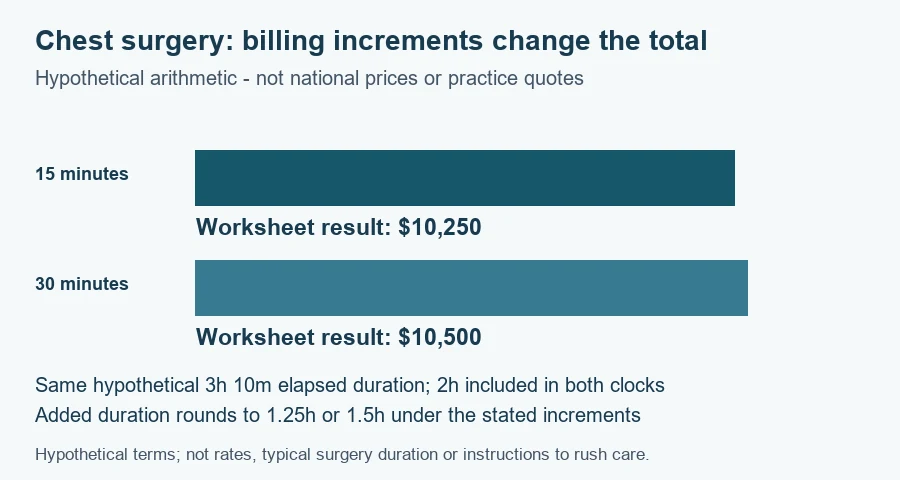
Version B uses a different documented half-hour increment, with every other modeled input unchanged. One hour and ten minutes of additional duration rounds upward to one hour and thirty minutes, or 1.5 hours. The additional facility amount is $900 and anesthesia is $600. That adds $1,500 to the same base. The complete modeled outlay is therefore $10,250 in version A and $10,500 in version B, a $250 difference caused only by the specified increments.
| Hypothetical calculation | Fifteen-minute increment | Thirty-minute increment |
|---|---|---|
| Same included duration | 2 hours per modeled clock | 2 hours per modeled clock |
| Same elapsed duration | 3 hours 10 minutes | 3 hours 10 minutes |
| Additional billed duration after stated rounding | 1.25 hours | 1.5 hours |
| Additional facility amount at $600/hour | $750 | $900 |
| Additional anesthesia amount at $400/hour | $500 | $600 |
| Fixed base estimate | $9,000 | $9,000 |
| Complete worksheet result | $10,250 | $10,500 |
The original chart compares the two complete worksheet results. It does not show typical times, local market rates or a recommended clinical sequence. The example assumes an applicable agreement without other discounts, insurer interactions or caps. Real billing terms may differ. Both versions use identical elapsed duration; nothing in the comparison suggests that care should be rushed or shortened to reach a lower number.
Recalculating gender affirming chest surgery cost from actual clocks
Begin with the documented included duration for each applicable component. Subtract it from the relevant actual duration, with no negative additional duration in this simplified model. Then apply that component’s confirmed increment and rate. Calculate facility and anesthesia independently before summing. If the clocks or inclusion periods differ, their additional amounts will differ even when the quote lists the same nominal number of included hours.
For a second hypothetical check, keep three hours and ten minutes on the facility clock but assume the anesthesia clock reports three hours and forty minutes. Under the fifteen-minute rule, the additional facility duration remains 1.25 hours and its amount remains $750. Anesthesia has one hour and forty minutes beyond its assumed two-hour inclusion; rounded upward to one hour and forty-five minutes, it is 1.75 hours at $400, or $700. The complete modeled result becomes $10,450.
This sensitivity example demonstrates clock matching, not how anesthesia time is measured in a real case. Obtain the actual recorded periods and terms from the relevant biller. Do not reconstruct a bill from a family’s estimate of time spent waiting or a timestamp on a message. Ask for the financial explanation if a later charge differs from the quote, and preserve the records used. A correct arithmetic result requires the correct billing inputs.
What if gender affirming chest surgery cost uses a fixed package?
A fixed written package can make an hourly model inapplicable. Ask whether its amount is fixed for the assessed scope, which categories it includes and which stated exceptions can produce an additional charge. Do not invent an overtime rate because a general guide discusses one. Conversely, do not assume a headline package amount has no conditions if the actual agreement contains defined limits. The actual terms determine whether duration is relevant to the financial estimate.
If a package includes a task breakdown, clarify whether those lines are included allocations or separate payable amounts. Add the complete package once. A descriptive allocation does not become a second charge simply because it is displayed separately. Where an actual excluded service has its own quote, add that amount under its own inclusion statement. Keeping these distinctions prevents a complete package from being compared with a professional-only headline or inflated by duplicate allocations.
Ask which changes require a revised estimate. A new assessed scope or different billing arrangement may alter the proposal, but the financial worksheet should not infer the new amount without confirmation. Preserve both versions and document the changed assumptions. A later contingency should remain separately labeled until it is actually proposed and estimated. An agreement’s refund, rescheduling or adjustment provisions must be obtained directly rather than assumed from this educational example.
Comparing gender affirming chest surgery cost without false precision
Use the same clinical description, known related care and financial basis for a fair comparison. If two assessed proposals differ, name the differences before discussing the totals. If one amount is a cash package and another is an insured estimate, show the different bases rather than ranking them as identical prices. An insurer’s response concerning one clinician does not necessarily describe every related billing entity; obtain the relevant information for each actual component.
For duration-dependent quotations, compare their inclusion boundaries and terms, not just their hourly rates. A lower added rate with a different included period or increment can yield a different complete bill. The original example demonstrates that the increment alone can matter, even at identical rates and elapsed time. It does not establish which contract is preferable after considering actual scope, other terms and clinical care.
Maintain a separate practical-budget column for confirmed travel, assistance, garments or other specified needs. Do not create a universal post-operative shopping list or assume a common time away from work. These arrangements depend on the treating team’s instructions and your own situation. A realistic financial record uses actual assumptions with dates, while a generic recovery schedule cannot establish your personal expense or care requirements. For recording expense-eligibility questions and supporting documents, see plastic surgery FSA and HSA.
| Question to ask | Useful financial answer | What remains clinical |
|---|---|---|
| What assessed scope does this amount cover? | Exact inclusions and billing entities | Which technique is appropriate |
| Does duration change any component? | Confirmed clock, inclusion and increment | How much time care safely requires |
| Which payment basis applies? | Cash terms or actual payer estimate | Suitability and expected limitations |
| What could change the estimate? | Defined scope changes or financial exceptions | Whether additional care is indicated |
| What practical arrangements are needed? | Actual expenses and assistance terms | Individual post-operative instructions |
Checking gender affirming chest surgery cost after billing
Compare each final component with its original estimate and written terms. Record the actual scope, applicable denominator, clock information where relevant and stated responsibility. Track deposits separately as credited payments. An advance collection reduces a remaining balance when it is actually applied; it does not change the underlying service amount or create another service. Obtain an account statement identifying where a payment was credited if several organizations are involved.
For an insured estimate, reconcile the billed statement with the processed explanation of benefits and ask about differences. For a self-pay duration-dependent arrangement, request the relevant calculation and recorded clock if an added charge is unclear. Do not assume the two billing bases can be combined. A disputed or unresolved amount belongs in a separate row while the actual biller and payer clarify the basis; this guide cannot decide contractual liability.
Keep a brief revision log so a changed total can be traced to changed scope, terms, clock inputs, benefit information or practical needs. The most useful gender affirming chest surgery cost comparison is a complete, dated and explainable estimate. It respects the assessed procedure and individual goals while keeping historical costs, hypothetical formulas and actual financial obligations distinct.
Financial boundaries in gender affirming chest surgery cost quotes
If a gender affirming chest surgery cost agreement states a financial maximum for a component, obtain the exact amount, scope and exceptions. A cap on an additional facility charge is not automatically a cap on anesthesia, professional work or the entire course. Likewise, a capped cash component does not establish an insurer’s allowance or remove every excluded expense. Put the cap next to the component it actually modifies and preserve the written basis before using it in a calculation.
For example, suppose version B independently confirms that its additional facility charge cannot exceed $800 under the modeled scope, while its additional anesthesia remains $600. The modeled facility calculation would otherwise be $900, so this hypothetical cap reduces that component by $100. The complete result would be $10,400 instead of $10,500. This is a separate financial assumption, not a standard protection, a promised contract term or an instruction to influence clinical duration.
Also distinguish a quote’s estimated amount from an expressly fixed price. Ask whether the organization is providing an estimate based on a stated assumption or agreeing to a defined amount for the assessed scope. Record its actual answer, not the label you would prefer. An estimate may be useful for planning even when it cannot predict every eventual detail; a fixed amount still requires an inclusion statement so its boundaries are understandable.
These questions make a gender affirming chest surgery cost comparison more useful than an isolated hourly rate. They identify which uncertainty belongs to scope, clock information, payment basis or contractual terms. Keep any unanswered financial boundary visible until the relevant organization clarifies it, and continue to leave safe clinical duration and treatment decisions with the care team. For comparing contract obligations and financing costs, see plastic surgery financing.
Sources and scope
ASPS chest masculinization cost categories, ASPS chest feminization cost categories and original historical inpatient cost study were inspected October 12, 2026. The original study was online April 15, 2024 / May 1, 2025 issue and analyzes 2012–2019 adult inpatient records; it is not a current patient-price survey. ASPS underlying dates are unspecified. No actual billing increment, clinical duration, coverage, patient identity or individualized clearance was established.
Sources and review scope
Plastic Surgery Editorial Team. Source records checked through October 12, 2026. Review scope: source and editorial checks for general education. No individual clinical assessment is represented.
- ASPS chest masculinization expense categories. American Society of Plastic Surgeons. Publication/update date not stated. Checked 2026-10-12.
- ASPS chest feminization expense categories. American Society of Plastic Surgeons. Publication/update date not stated. Checked 2026-10-12.
- Original historical inpatient gender-affirming cost study. Annals of Surgery. Source date: 2024-04-15. Checked 2026-10-12.