
Gender affirming chest surgery changes chest form to better fit an individual’s goals. It can involve reducing or removing breast tissue, reshaping the chest, or creating breast volume. These are different treatment courses, not interchangeable meanings of “top surgery.” A useful decision begins with the contour you want, what matters to you about nipples and sensation, the scars you are willing to consider and the care commitments of the proposed method. Gender identity alone does not specify an operation or a single ideal chest.
Describe the result in your own words rather than assuming the clinician understands what you mean by masculine, feminine, flat or androgynous. Those words can refer to different contours and preferences. You may have a strong preference about nipple appearance, want to reduce rather than remove volume, or want to understand augmentation options. The consultation should identify those priorities before moving to a technique name.
This guide is a decision framework for adults exploring the topic. It does not determine eligibility, recommend treatment to a minor or set universal hormone, documentation or age requirements. Individual assessment, local services and applicable rules need to be established with the treating team. The research discussion identifies the population actually studied so that evidence about one group is not silently extended to everyone seeking chest surgery.
Separate reduction, tissue removal and volume creation
The American Society for Reproductive Medicine’s 2026 committee opinion discusses gender-affirming mastectomy, chest reduction and augmentation separately. It recognizes that some people want options outside conventional binary appearances and that not everyone seeking tissue-removal surgery wants hormone therapy. Its chest section should not be read as a universal administrative rule for every service or payer. ASRM committee opinion on gender-diverse care
Make the intended direction of change explicit. If you want less chest volume, ask whether the discussion concerns a reduction or a tissue-removal and contouring course. If you want volume creation, ask whether a device or another assessed method is proposed. These questions do not tell the clinician how to operate; they establish what you are considering and prevent assumptions about your goals from becoming part of the plan without discussion.
Avoid treating a particular identity as evidence that a person wants a particular nipple position, scar pattern or volume. You can explain which features matter to you without adopting a standard example. Likewise, photographs of other people should be used to clarify preferences, not define what your chest ought to look like. An individualized conversation leaves space for goals that differ from the images most commonly shown.
| Goal under discussion | Clarification needed | What the label cannot establish |
|---|---|---|
| Reduce volume | Desired remaining contour and tissue scope | That reduction and mastectomy are identical |
| Create a flatter contour | Tissue, skin, nipple and incision plan | That every flatter-chest operation uses the same method |
| Create breast volume | Proposed method and continuing responsibilities | That augmentation is covered by tissue-removal outcome studies |
| Change nipple presentation | Desired appearance and actual available options | That gender identity dictates a nipple choice |
| Preserve valued sensation | What can be discussed for the assessed method | That the preferred appearance guarantees a sensory result |
A chest plan has several connected components
UCSF’s educational guidance, published in June 2016, describes tissue, skin envelope, nipple and incision as separate planning components in masculinizing chest surgery. It distinguishes the goals and execution from cancer mastectomy and gynecomastia surgery. The dated guidance is useful for those conceptual distinctions; this guide does not adopt its older screening statements as a current universal rule. UCSF educational chest-surgery guidance
Consider the components together rather than selecting one in isolation. An incision discussion should include the reason the skin and tissue plan needs that approach. A nipple discussion should explain appearance, blood-supply or graft considerations and the limits of sensation expectations. A contour discussion should include what the assessment supports, not just what is visible in a preferred photograph.
Ask the team to describe the proposed chest in plain language before showing you technical labels. Which tissue change is intended? What happens to the skin? What is proposed for the nipples? Where would scars be located, and which details remain conditional? You should be able to repeat the plan accurately without pretending you can assess your own anatomy from an online diagram.
Scars and sensation are separate from contour
The Hull NHS patient leaflet explains that nipple and skin sensation can change and that nipple sensation cannot be guaranteed. It also describes possible asymmetry, fluid collections, healing problems and loss of a nipple graft or compromised nipple tissue. These are matters for individualized risk discussion, not a personal numerical forecast. NHS top-surgery patient information
A contour you like does not answer a sensation question. Specify what you mean when discussing sensation: touch awareness, discomfort, sensitivity or the importance of erotic sensation to you. Ask what is known for the proposed method and what remains unpredictable. Do not assume that keeping a nipple in one way, moving it in another or choosing a particular incision provides a guarantee.
Scars also deserve an independent conversation. Ask where the proposed scars would be, why that pattern is being considered and how the team discusses variation in healing. A scar pattern can be part of achieving a particular contour, but a desired contour should not make the scar discussion disappear. You may value visibility differently from another person; that preference belongs in the consultation.
Nipple choices should be discussed rather than presumed
Ask whether your goals include retaining nipples, changing their size or position, or exploring a chest without nipples. Discuss the options actually appropriate to your assessment. If the team uses the words graft, attached tissue or reconstruction, ask what those terms mean for the proposed course. Appearance, blood supply, healing and sensation are distinct questions even when the explanation involves the same structure.
If you are uncertain, request time to compare those priorities. Do not treat uncertainty as a need to adopt the most common example. A written preference record can distinguish a strong priority from an open question. For instance, you might be confident about reducing volume while still wanting more information about nipples. The plan should preserve that distinction until you have enough information to decide.
Ask whether any later tattooing or reconstructive work is a separate possibility rather than part of the initial operation. Do not assume that an optional later step is required, included in the price or guaranteed to produce a particular appearance. Equally, do not let the availability of an additional option obscure the limitations of the initial procedure. Each step should have an explained purpose.
Augmentation brings a different set of commitments
For volume-creating surgery involving an implant, the device becomes part of the decision. The FDA explains that breast implants are not lifetime devices and that future procedures may be needed. Its information includes device labeling and monitoring considerations. Those obligations apply to understanding an implant course; an outcome study of gender-affirming tissue removal cannot answer them. FDA breast implant information
Ask what method is proposed and what the team expects it to address. Explain your contour preferences without assuming that a volume figure establishes the result. Request the actual product information if a device is being considered, and ask how your existing anatomy and health affect the recommendation. A discussion of device choice should include the longer course, not only the appearance immediately after the first operation.
If a non-device method is discussed, ask for its actual scope and evidence. Do not interpret “own tissue” or “fat” as a promise that the course is simple, permanent or free of complications. The comparison should explain what is proposed, what additional decisions may remain and how the result is assessed. This guide does not provide a grafting recipe or choose between techniques for you.
Keep eligibility, clinical planning and payment separate
Ask the service for its current assessment and documentation requirements. Record which requirements are clinical, which are administrative and which belong to the payer. Do not copy an older clinic webpage’s criteria as a universal standard. A service-specific threshold, a guideline discussion and a coverage rule can answer different questions even when they are all presented under the word “eligibility.”
Explain the care you are already receiving and bring your actual medication information. Ask how the teams will coordinate any relevant questions. Do not start, stop or alter hormone or other treatment because a guide describes someone’s surgery course. If instructions differ between services, request clarification from the treating clinicians before relying on either account.
Privacy and communication arrangements can also affect the practical experience. Tell the service which name and contact details should be used and ask how documents, billing and appointments are handled. This is especially useful when administrative records differ from the information you use in daily life. The goal is a workable care process, not an assumption that every institution handles the issue identically.
Prepare support around the actual instructions
Ask for a procedure-specific recovery plan and contact arrangements. The practical questions include travel, assistance at home, wound checks and your work or caring responsibilities. Do not use a general top-surgery story as an instruction for a different technique. The team should explain the planned aftercare and the findings that could change it.
Separate routine review from urgent contact. You need to know how to report a concern between appointments and who responds if you are away from the treating facility. Request written instructions before discharge. This guide cannot determine whether a postoperative change is safe to watch at home, and an immediate emergency requires emergency care rather than an online assessment.
Describe physical tasks specifically. Reaching, carrying, household work and caring for another person can create different constraints from sedentary work. Ask what the team recommends for the actual procedure and how you will know when an activity can resume. Do not turn a clinic’s general timeline into a guarantee that everyone recovers at the same pace.
| Planning topic | Record to obtain | Distinction to preserve |
|---|---|---|
| Initial procedure | Tissue, skin, nipple and incision scope | A technical name versus your individual plan |
| Early care | Written instructions and contact route | Routine appointment versus concern needing assessment |
| Work and support | Guidance based on your actual tasks | General timeline versus individual recovery advice |
| Later review | What is assessed and which decisions remain | Healing review versus an automatic additional operation |
| Ongoing health | Individual follow-up and screening discussion | Gender-affirming contouring versus cancer treatment |
What the outcome evidence actually studied
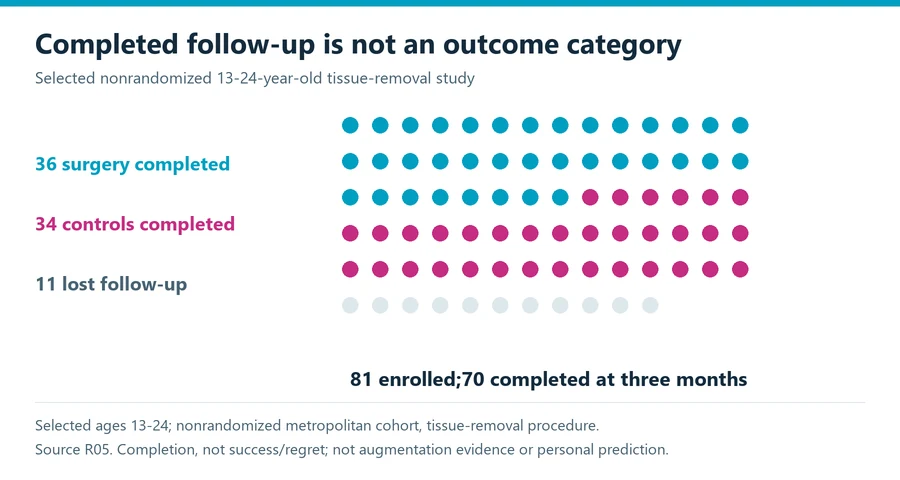
An original prospective study compared surgery and matched nonsurgical groups among transmasculine and nonbinary people designated female at birth, aged thirteen to twenty-four. It enrolled eighty-one people; eleven were lost to follow-up. Thirty-six surgical participants and thirty-four controls completed outcomes at three months. The comparison was not randomized, and most baseline variables remained insufficiently comparable after weighting. The investigators reported associations with improved chest dysphoria, gender congruence and body image scores. Original three-month chest-outcomes study
Those findings are relevant evidence within the reported population, but they do not become an individual recommendation for every reader. The age range includes minors, the procedure was gender-affirming mastectomy and follow-up was short. This adult planning guide does not use the study to advise a minor, extrapolate to augmentation or establish a lifetime result. Keep the population and timepoint attached to the claim.
An improved questionnaire score is not a guarantee about every aspect of a chest. Chest dysphoria, gender congruence, body image, nipple sensation and complication outcomes are different endpoints. A study reporting some of them should not be presented as if it answers all of them. Ask which measure relates to your priority and what the study leaves unmeasured.
Loss to follow-up also needs an honest label. The eleven people without completed outcomes cannot be counted as satisfied, dissatisfied or clinical failures simply because their responses are unavailable. The supporting visualization shows enrolled participants, missing follow-up and the two completed groups. It makes the evidence population visible without converting missing data into a success or regret rate.
Nonrandomized comparison means the groups were not assigned to treatment by a random process. The reported limitations on comparability are therefore important when interpreting an association. The study does not supply a universal causal estimate for all gender-affirming chest procedures. It can inform a discussion while still leaving substantial questions about different ages, methods, priorities and longer follow-up.
Photographs illustrate appearance, not the entire experience
When looking at documented clinical examples, ask what procedure occurred, which additional treatments were included and when the photograph was taken. Comparable lighting and position matter to interpreting appearance. A clothed editorial photograph, by contrast, should not be presented as a patient example or proof of a surgical result. Keep the purpose of each image clear.
Ask what an image cannot show. It does not measure nipple sensation, the person’s experience of recovery or whether the appearance matches your goals. It also cannot establish that an individual had no complications or needed no additional care. A helpful image discussion accompanies an explanation of limitations rather than treating an appealing contour as the whole decision.
Be cautious about interpreting another person’s identity or satisfaction from appearance. Those are not visual diagnoses. You can use an example to explain a contour preference without claiming that the person had your priorities or obtained the same kind of benefit you seek. Your own goals and assessment still need to guide the plan.
Cost and coverage should describe the proposed course
Request a written estimate naming the actual procedure and included components. A reduction, a tissue-removal course and an implant augmentation should not be compared under one undifferentiated price. Ask which professional, facility, anesthesia and follow-up services are included and how optional later work would be considered. This guide does not invent a national price or a personal coverage promise.
Confirm the payer’s current requirements for the specific proposed course. Keep the coverage decision separate from the clinical assessment, and record any unresolved documentation or authorization issue. If travel and home assistance are necessary, plan those using your actual circumstances. A quoted surgery fee cannot describe every practical cost of attending care.
| Estimate question | Information needed | Avoid this assumption |
|---|---|---|
| Which procedure is quoted? | Reduction, tissue removal/contouring or augmentation | Every top-surgery quote describes the same course |
| Which components are included? | Nipple work, device, contour and stated follow-up | A brief label establishes every included service |
| What might occur later? | Optional and response-dependent decisions | Later possibilities are either certain or automatically free |
| What is covered? | Actual payer decision and required documentation | General discussion establishes personal reimbursement |
A good decision preserves your own priorities
If priorities conflict, ask the team to make that conflict explicit. You may place a higher value on a particular contour than another person, or on sensation and nipple choices over a commonly illustrated appearance. Record which tradeoff you understand and which still needs explanation. A preference is not a guarantee of what the assessment can support, but it should be visible in the discussion rather than silently replaced by a standard example.
Leave with a description you can understand: the intended volume and contour change, nipple plan, scars, sensation uncertainties and care commitments. Record unanswered questions rather than filling them with assumptions from photographs or technique names. A plan can be individualized and still contain uncertainty, provided the team explains what remains unknown and how it will be addressed.
Gender affirming chest surgery should be discussed as a course serving the person’s stated goals. The most useful comparison keeps tissue, skin, nipples, scars and continuing care visible, uses evidence within its actual population and avoids imposing a single ideal appearance. You can value a particular change while still asking careful questions about its tradeoffs. Those questions are part of informed choice.
For related planning, see breast augmentation, consultation questions and recovery planning.
Sources and review scope
Plastic Surgery Editorial Team. Source records checked through October 12, 2026. Review scope: source and editorial checks for general education. No individual clinical assessment is represented.
- ASRM gender-diverse care committee opinion. asrm.org. Source date: 2026. Checked 2026-10-12.
- UCSF academic educational chest-surgery guidance. transcare.ucsf.edu. Source date: 2016-06-17. Checked 2026-10-12.
- Hull NHS patient leaflet. hey.nhs.uk. Source date: 2023-12-31. Checked 2026-10-12.
- FDA implant consumer information. fda.gov. Publication/update date not stated. Checked 2026-10-12.
- Original prospective chest dysphoria comparison. pubmed.ncbi.nlm.nih.gov. Source date: 2022-11-01. Checked 2026-10-12.