
Fat transfer breast augmentation cost should identify the assessed harvesting and breast-grafting plan, its related charges and any separately proposed body contouring. Liposuction used to obtain fat is part of the clinical process, but it does not automatically promise every contouring result you might want from a standalone liposuction operation. Ask the surgeon to distinguish the harvesting task from an additional aesthetic task before comparing prices.
This guide provides an original hypothetical incremental-scope worksheet. It separates an assessed fat-transfer plan from independently proposed additional contouring and counts every added obligation. All example dollars are invented inputs, not actual clinic prices or complete national averages. The example does not recommend additional surgery, choose donor sites or predict retained breast volume. The clinical plan comes first; the arithmetic explains its written financial scope.
What does the published fat transfer breast augmentation cost figure cover?
The ASPS breast augmentation cost page, checked October 12, 2026, displays $5,719 for augmentation with fat grafting. It identifies a partial average excluding anesthesia, operating-room facilities and other related expenses. Its underlying fee year is not verified here. This is more specific than a combined augmentation category, but it still does not establish a complete personal price or a charge per donor site.
Do not use the page’s separate implant figure to calculate the supposed savings from choosing fat transfer. The approaches have different clinical tasks and exclusions. Subtracting two partial averages would not establish the difference between your complete assessed plans. Obtain actual estimates if you are discussing suitable alternatives. A fee observation describes the published category; it does not determine which method can appropriately address your goals.
Ask how the quoted professional component handles harvesting, processing and breast grafting. These may appear as one package or separate descriptive lines. An itemized description does not necessarily mean each line is an additional charge. Record included amounts and separately payable amounts clearly. Related facility, anesthesia, specified care and logistics still need confirmation, even when the professional package names both the donor and breast components.
Why fat transfer breast augmentation cost needs a donor-scope description
The ASPS procedure overview describes taking fat from another body area by liposuction and injecting it into the breasts. That dual-site process explains why the estimate should identify donor and recipient scope. It does not establish a standard number of donor areas, a guaranteed cup-size increase or an entitlement to additional contouring. The surgeon must assess suitable sites and realistic goals.
Write down the donor sites proposed for harvesting and ask what contouring objective, if any, is included in that task. Do not assume a brochure’s “two procedures in one” phrase means a complete independent body-contouring plan plus a guaranteed breast result. Equally, do not assume that harvesting provides no contour change. Ask the surgeon to explain the actual intended task rather than assigning a financial value to an outcome that has not been assessed.
The ASPS safety page discusses risks including cysts, infection and fat-cell loss, and notes that further injections may sometimes be needed. It does not give your personal probability or future price. This guide therefore does not promise a one-time lifetime bill, assign a retained-volume percentage to you or invent an expected repeat-treatment allowance.
Which fat transfer breast augmentation cost quote lines should be matched?
Identify the assessed breast task, donor sites, included harvesting scope, relevant setting and specified care at both sites. Ask which additional services are merely being discussed and which are actually part of the agreed plan. A quote containing optional contouring should not be compared directly with a base harvesting plan as if the scopes were identical. Mark the added task before interpreting the difference in totals.
| Scope field | Question for the surgeon or billing office | Financial record |
|---|---|---|
| Breast grafting | What assessed task does the plan address? | Named recipient scope |
| Donor harvesting | Which sites and harvesting task are included? | Included scope, not an assumed standalone result |
| Additional contouring | Is it a distinct proposed objective? | Separate incremental estimate |
| Facility and anesthesia | What base and added charges apply? | Confirmed amounts by entity |
| Specified care | What applies to donor and breast sites? | Included or separately priced items |
| Future reassessment | What review is included and what is conditional? | Actual policy, no probability invented |
If a donor-site line is already included in a professional package, count it once. Do not add a national liposuction average on top of that package as a proxy for harvesting. Conversely, do not remove a genuinely separate contouring charge just because both tasks involve liposuction. The distinction is the written assessed scope and actual obligation, not a shared procedure word.
Original fat transfer breast augmentation cost worksheet: the incremental task
Assume a hypothetical assessed base plan has a $6,400 professional charge explicitly including its harvesting, processing and breast-grafting scope. Add $1,800 facility, $1,000 anesthesia, $200 of specified care and $600 of identified personal logistics. Its known planning amount is $10,000. Every input is invented. The example does not establish an appropriate donor site, expected volume or typical fee.
Now assume a separate contouring objective is independently assessed as appropriate and is offered alongside the base plan. Its additional professional charge is $2,400. The actual incremental estimate also adds $400 facility, $300 anesthesia, $100 specified care and $200 personal logistics. The complete incremental commitment is $3,400, producing a combined known planning amount of $13,400. The added task is a different scope, not a discount on the base plan.
| Hypothetical fat transfer breast augmentation cost input | Base plan | Added contouring increment |
|---|---|---|
| Professional charge | $6,400 including assessed harvest/graft scope | $2,400 for separate additional task |
| Facility | $1,800 | $400 additional |
| Anesthesia | $1,000 | $300 additional |
| Specified care | $200 | $100 additional |
| Personal logistics | $600 | $200 additional |
| Known amount for this column | $10,000 | $3,400 |
| Combined selected-scope amount | Not applicable | $13,400 including base |
The base formula sums to $10,000. The added formula is $2,400 plus $400 plus $300 plus $100 plus $200, which equals $3,400. Adding only the advertised $2,400 professional increment would give $12,400 and understate the full invented combined plan by $1,000. The additional related obligations are not negligible simply because they are smaller than the professional component.
The $1,000 omitted portion represents about 29.41% of the complete $3,400 increment. The professional component is about 70.59% of that increment. These percentages describe the hypothetical breakdown, not a clinical benefit or a usual industry allocation. The full incremental amount is 34% of the $10,000 base planning amount. Naming those denominators helps explain exactly what an apparently modest add-on changes financially.
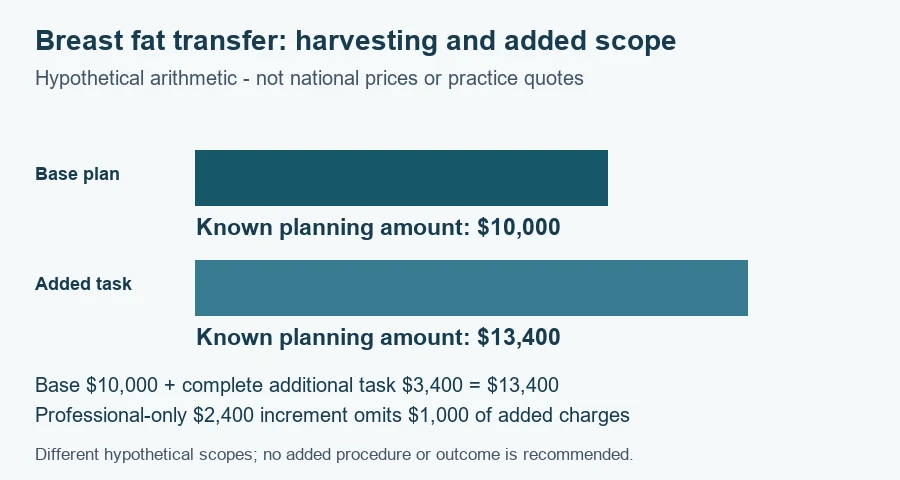
How can harvesting and separate contouring affect fat transfer breast augmentation cost?
Ask the surgeon to describe where the base harvesting objective stops and the additional contouring objective begins. The distinction may involve sites, extent or another assessed task, but this guide does not define it for you. A financial estimate should follow that explanation. If an added charge seems to repeat harvesting already included, request reconciliation rather than assuming either an error or a free extra procedure.
The original worksheet assumes all incremental facility and anesthesia expenses are identified. A real professional-only add-on estimate may leave those charges unresolved. Ask each relevant entity whether its charge changes under the expanded plan and obtain the actual estimate. Do not assume shared operating-room time makes every related expense unchanged, and do not invent an extra full facility bill if the office confirms a smaller incremental charge.
If no separate contouring task is desired or appropriate, the base plan is the relevant financial scope. Do not add a procedure merely because its incremental professional rate looks favorable. The $3,400 worksheet increment buys a different assessed task under the fictional assumptions; it is not money you save by accepting it. A valid choice can be to keep the narrower appropriate plan, seek clarification or decline surgery.
Does a standalone liposuction quote prove the combined plan saves money?
No. A standalone quote may describe a different contouring objective, setting, scope and care arrangement. To compare complete financial commitments, obtain clinically appropriate estimates that name the actual tasks. Do not subtract a generic national average from the combined plan and call the difference a savings figure. That would mix unrelated pricing bases and potentially different clinical goals.
If a separate clinically appropriate operation is being considered, compare its actual complete charges and logistics with the actual incremental charges of a suitable combined plan. State which expenses are shared, repeated or unresolved. The arithmetic can explain a documented financial difference, but it does not establish that combining operations is appropriate or that the outcomes are equivalent. Those questions remain with the clinical team.
Keep the standalone and incremental worksheets as different documents. A standalone $5,000 hypothetical professional charge cannot be compared with the example’s $2,400 incremental professional line and called $2,600 saved without confirming the complete matched scopes. Related expenses, care needs and personal logistics may change. A clean worksheet identifies the comparison you can actually make and leaves unsupported savings claims out of the decision.
How should possible later treatment enter fat transfer breast augmentation cost planning?
Keep later treatment conditional until the surgeon actually assesses it. Ask what routine review is included, how concerns are evaluated and what financial policy applies to a newly proposed procedure. Do not assume that “fat transfer package” includes every future harvesting or grafting session. Equally, do not assume a future operation will be necessary and add an invented complete second bill to the primary estimate.
An actual later procedure may have a different donor scope, setting or care requirement. The primary plan’s harvesting amount cannot automatically be reused as its price. Request a new assessed estimate and identify any real credit or waiver. This guide gives no personal repeat-treatment rate, retained-fat forecast or expected lifetime spending. A precise-looking future total based on assumed repetitions would hide those missing facts.
Avoid treating anticipated retained volume as a financial unit. Dollars per predicted retained milliliter would require reliable personal measurements and a meaningful outcome definition that this worksheet does not have. The relevant purchase is the assessed procedure and care plan, not a guaranteed amount of surviving fat. The cost record can be transparent without converting an uncertain biological result into a fabricated per-unit return.
Which care expenses belong in fat transfer breast augmentation cost?
Ask which care items are specified for the actual donor and breast sites and whether they are included in the quote. Do not assume one garment, product or appointment covers both obligations. Conversely, do not purchase duplicate items solely because the procedure has two site types. The clinician provides care instructions; the billing office identifies which specified items are already included and which require separate payment.
Personal logistics also need an actual plan. Record transport, support and other identified arrangements without borrowing a universal number of days or a generic lost-income estimate. If the added contouring task changes those needs, ask the team to explain the care implications before altering the financial allowance. The worksheet’s $200 incremental logistics is invented and is not an expected recovery expense for all patients. For a separate discussion of recovery tasks and questions after that procedure, see fat transfer breast augmentation recovery.
Distinguish identified spending from opportunity costs. A paid caregiver invoice belongs in one column; unpaid help from a friend is a different arrangement. If you include lost income, base it on your own circumstances and the clinician’s actual work guidance, not on a guaranteed recovery deadline from a price page. Keep assumptions visible so a household plan can be revised without pretending those figures are clinical facts.
How do you request a clearer fat transfer breast augmentation cost estimate?
Ask for the base harvesting/grafting scope and a separate incremental estimate for any additional proposed task. Request all relevant professional, facility, anesthesia, care and logistics changes. A simple question is: “Which harvesting is already included, which contouring objective is additional, and what complete charges change if that additional task is selected?” The answer should connect each dollar change to a named scope change.
| Unresolved issue | Clarification to request | Record to retain |
|---|---|---|
| Harvesting package unclear | Define the included donor task | Assessed base scope |
| Contouring added | Name the distinct additional objective | Separate incremental scope |
| Professional-only increment | Obtain related entity charges | Complete incremental estimate |
| Two-site care ambiguous | Identify specified and included items | Actual care instructions |
| Future session mentioned | Separate conditional policy from primary scope | Written review and further-treatment terms |
When the plan changes, update scope and estimate together. Preserve the original and revised documents so a final invoice can be reconciled. If an additional charge appears, ask which newly agreed task it represents rather than assuming that every donor-site charge is already included. Similar procedure terminology can refer to different obligations; the current assessed description and written inclusion determine the financial comparison.
Before paying, separate complete charges from remaining balances. A credited deposit reduces what is due later; it does not increase the full procedure price. Apply each payment to the correct entity and scope. If an additional task is declined or changed, obtain the actual credit or refund terms rather than assuming the entire increment is automatically refundable. This guide does not invent a universal cancellation or procurement policy.
Frequently asked fat transfer breast augmentation cost questions
If the additional task is removed from a proposed plan, ask which incremental lines actually disappear. In the fictional worksheet all $3,400 belongs to that additional scope, so removing it returns the amount to the $10,000 base. A real contract may have incurred assessment charges or other conditions that do not reverse in the same way. Obtain the actual revised estimate rather than subtracting every previously listed increment yourself. This is especially important if the base harvesting plan also changes: that creates a different clinical and financial scope, not merely removal of an optional line. Keep the updated fat transfer breast augmentation cost record tied to the revised assessed task and confirmed credits. The fat transfer breast augmentation vs implants comparison examines those alternatives as a separate decision.
Is $5,719 a complete national price?
No. The checked ASPS page identifies a partial fat-grafting average with related expenses excluded. Its underlying fee year is not verified here. Obtain the complete estimate for the assessed harvesting and breast-grafting plan. Do not add guessed percentages to the partial average and label the result a verified national total.
Does included harvesting mean all desired body contouring is included?
The actual assessed scope determines that. Ask the surgeon to explain the harvesting task and any separately proposed contouring objective. The worksheet does not promise an independent contouring result from the donor process or deny that harvesting changes a donor site. It identifies which task the quote actually purchases before additional prices are compared.
Why does the example’s $2,400 addition become $3,400?
Because its separately documented hypothetical related increments total $1,000: facility $400, anesthesia $300, specified care $100 and personal logistics $200. The complete fictional added task therefore costs $3,400. That is a different scope from the base plan, not an automatic saving or an appropriate addition for every reader.
What is the next step in comparing fat transfer breast augmentation cost?
Request a written base scope, named donor sites and complete incremental charges for any separately proposed task. Keep future procedures conditional and care instructions specific to the assessed plan. That makes fat transfer breast augmentation cost a transparent purchase-and-scope comparison without promising retained volume, importing unrelated liposuction prices or allowing an attractive add-on rate to determine clinical treatment.
Sources and review scope
Plastic Surgery Editorial Team. Source records checked through October 12, 2026. Review scope: source and editorial checks for general education. No individual clinical assessment is represented.
- ASPS partial fat-grafting augmentation fee scope. American Society of Plastic Surgeons. Publication/update date not stated. Checked 2026-10-12.
- ASPS donor harvesting and breast transfer process. American Society of Plastic Surgeons. Publication/update date not stated. Checked 2026-10-12.
- ASPS fat-transfer risk and further-treatment scope. American Society of Plastic Surgeons. Publication/update date not stated. Checked 2026-10-12.