
Fat transfer breast augmentation uses your own harvested fat; implants add a manufactured device. The useful comparison is the amount and kind of change you want, the tissue available, the whole treatment course and the future responsibilities you accept. ASPS describes fat transfer as an option for a relatively small increase with natural-looking results. Neither approach can be selected safely from a cup-size wish alone. 1
For fat transfer breast augmentation versus implants, separate three questions: what is added, what remains after healing and what another operation would be intended to accomplish. An additional fat session to increase volume is different from an implant revision for a complication. A chart that calls both simply “reoperation” can hide the very tradeoff you need to understand.
Define the change before choosing its material
Write your goal in observable terms. You might want more upper-breast fullness in a particular garment, less visible asymmetry or a modest increase while avoiding a device. These are more informative requests than “natural” or “large,” because those words do not specify the view, position, clothing or feature that matters. Bring separate examples of the contour you like and changes you would not accept.
Avoid treating another person’s photograph as a transferable blueprint. The planning question is which features can reasonably be approached in your own tissues. A useful discussion identifies the starting point, proposed change and limiting factor together. If the proposal addresses volume but your main concern is position, the comparison has already drifted away from your task.
A lift is a separate scope: ASPS describes reshaping and raising breasts by removing excess skin and tightening surrounding tissue. Adding volume is not the same operation. 2 Ask whether the proposed plan contains augmentation alone, a lift, or a combination. Record each component rather than accepting one package name that leaves you uncertain about scars and responsibilities.
| Reader goal | Clarification to request | Avoid assuming |
|---|---|---|
| A modest change without a device | Intended contour, donor availability and possible repeat session | A device-free operation is risk-free |
| A defined volume addition | Exact device or intended graft plan and later assessment | Inserted volume equals visible cup-size change |
| A position or skin concern | Whether a separate lift is being proposed | Either augmentation method replaces a lift |
| Uneven appearance | Which views and features the plan addresses | Equal added amounts guarantee symmetry |
These are planning questions, not an at-home suitability test. A surgeon’s examination must establish what the tissues can support. A useful written plan can also identify the feature that will probably remain imperfect. That boundary gives you a more honest comparison than a collection of idealized photographs.
Understand the two meanings of volume
Fat-transfer discussions should distinguish harvested material, prepared material, injected material and later retained volume. Ask which quantity appears in the quote or proposed plan. They describe different stages, so they should not be used interchangeably. You do not need an operating recipe; you need to know what the stated number actually measures.
Implant discussions should identify the exact device and its dimensions rather than relying on a volume number alone. Ask how the proposed device relates to the intended contour and available tissue. A numerical match between an implant’s stated volume and an amount of transferred fat does not establish equivalent appearance, recovery or long-term care.
Use a simple record with four columns: proposed input, intended visible change, assessment time and uncertainty. Leave a field unresolved when the surgeon has not yet established it. This prevents an early consultation estimate from quietly becoming a promise after you have begun comparing deposits, travel or leave from work.
A bra label is particularly unhelpful as the only outcome measure. Instead, agree on the aspects of contour the surgeon will assess and the photographs or clinical measures used for that purpose. Ask what would count as a satisfactory result when standing, moving and wearing ordinary clothing, rather than choosing a number detached from those priorities.
Treat retained fat as a measured outcome, not a sales guarantee
A prospective MRI study included 28 patients and 46 breasts. Its modeled steady-state retention was 46%, with a 95% confidence interval of 35% to 58%; the modeled time was 253 days, with an interval of 185 to 283 days. It first appeared online in October 2024 and in a June 2025 issue. This was not an implant comparison. 3
The study also examined weight changes. That association is a reason to discuss the timing of your plan and how later changes would be interpreted, not a prescription to gain weight to obtain a particular result. The estimate cannot be applied to a reader by multiplying a proposed injection volume by the average retention percentage.
Several distinctions matter when interpreting this evidence. Forty-six breasts are not forty-six independent people. A model describing the studied group is not a personal deadline. A confidence interval expresses uncertainty around an estimate, not a guaranteed range for every individual. Those boundaries should remain attached to the number wherever it appears.
Ask whether a clinic’s retention statement refers to its own documented follow-up, published evidence or a general expectation. Request the assessment method and timepoint. “After treatment” might mean after the first session, after a later session or after a specified interval; without that information, two percentages are not necessarily comparable.
Separate another augmentation session from an adverse-effect revision
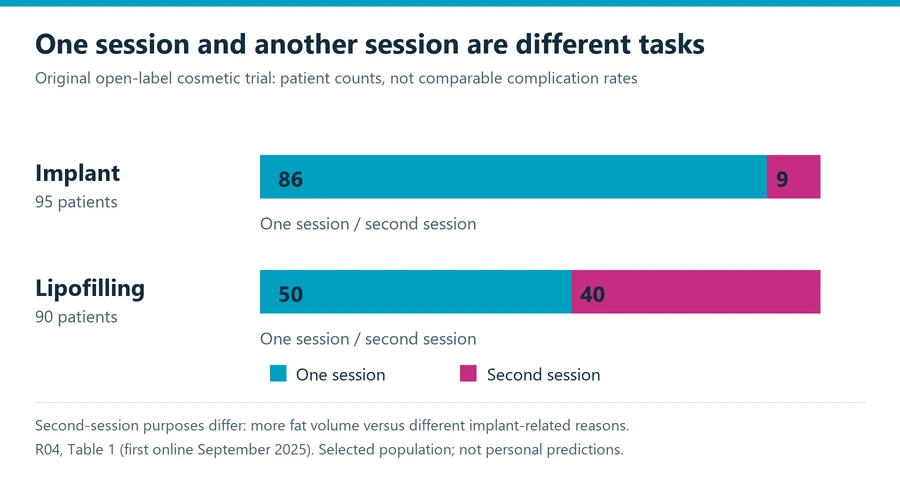
An open-label randomized cosmetic trial first published online in September 2025 reported one session in 86 of 95 implant patients and 50 of 90 lipofilling patients. Its second-session counts were nine and forty, respectively. The fat sessions sought additional volume; implant second procedures involved different reasons. The counts are not equivalent complication rates. 4
| Original trial group | One session | Second session | Interpretation boundary |
|---|---|---|---|
| Implant, 95 patients | 86 | 9 | Additional procedures had different purposes |
| Lipofilling, 90 patients | 50 | 40 | Additional volume sessions are not the same endpoint as adverse-effect revisions |
The trial’s reported satisfaction categories and later follow-up descriptions contain inconsistencies. We therefore do not use it to declare a universal success rate or winner. Its selected cosmetic population also does not represent every lift or reconstructive situation. The original methods and their setting must be checked before assuming that any proposed local technique is equivalent. 4
The useful lesson is a question about your own course: is another session a possibility, an anticipated part of the plan, or a response to an unwanted outcome? Request that distinction before comparing quotes. A staged approach can be acceptable to someone who understands it, but frustrating to someone who believed the first payment bought a final predetermined size.
Similarly, a revision provision in an implant agreement should state what it covers. Changing a personally selected size, addressing a device issue and correcting an unwanted tissue response are not identical tasks. Do not assume that a warranty, a surgeon’s fee policy and payment for facility or anesthesia expenses are interchangeable protections.
Read a session chart without converting it into a prediction
The supporting chart displays the trial’s actual patient counts. Its bars describe that study, not the chance that you will need another operation. The denominator belongs to the selected participants, and the reason for a second procedure remains attached to the group. This is a comparison of treatment-course reporting, not a calculator.
Before accepting a similar statistic in advertising, ask for its definition. Does it count patients or breasts? Does it include only scheduled extra augmentation, only adverse-effect surgery, or both? How long were people observed? What happened to those who did not return? A percentage without those answers can suggest precision while concealing important differences.
Compare risks without pretending the lists are balanced rates
ASPS lists fat-transfer risks including cysts, infection, microcalcification and fat necrosis, and notes that additional injections may be needed. 5 Device avoidance therefore does not mean that the transferred tissue has no possible complications. Ask how a new lump or unexpected imaging finding would be assessed, who would arrange that evaluation and which records would be available.
FDA implant guidance describes local complications including capsular contracture, rupture, pain and further surgery. It also discusses implant-associated cancers and reported systemic symptoms. 6 These are reasons for a specific consent discussion, not evidence that every implant recipient will develop every listed problem. The device, tissue situation and individual health context matter.
Do not construct a homemade risk score by counting the entries in the two lists. One source may separate several related outcomes while another combines them, and possible events are not measured frequencies. The important comparison is which responsibilities and uncertainties you understand well enough to accept, and which require more investigation before consent.
Ask for a care pathway rather than reassurance alone. Who assesses an unexpected change? What information must you supply? Is imaging arranged locally if you have travelled? How are urgent and routine concerns separated? A clear answer identifies the responsible team and next step without promising that a problem can never occur.
Keep the discussion proportionate to your medical history. Share previous breast procedures, imaging findings and relevant diagnoses rather than assuming a general comparison applies unchanged. If a clinician recommends a different scope because of those facts, request an explanation that ties the change to your actual situation rather than simply to a preferred technique.
Make future device care part of the present decision
FDA states that breast implants are not lifetime devices and that longer use increases the likelihood of complications. Its considerations include follow-up, further surgery and the possibility of removal. 7 A successful initial result does not eliminate those future decisions. Device records and the current product information belong in your long-term plan.
Ask for the manufacturer’s patient information and the relevant decision checklist before the operation, with enough time to read them. Identify the device’s model and the instructions that apply to it. A general online discussion cannot substitute for product-specific information or show that a device used in a foreign study has the same authorization where you will receive treatment.
Retain records where you can find them after moving or changing doctors. Include the procedure date, device details if applicable, treating facility and the plan for routine follow-up. For fat transfer, retain the procedure history as well. The practical aim is to give a future evaluating clinician an accurate account, not to create a private self-diagnosis system.
Consider what care you could realistically maintain. Travel costs, access to assessment and the ability to attend follow-up may influence the feasibility of either option. They should be discussed openly rather than discovered when a later appointment is due. Choosing an initial procedure and choosing a sustainable care arrangement are related decisions.
Compare the whole treatment budget without inventing a price
There is no defensible universal total in this comparison. Request a dated, itemized quote for the actual plan. Separate the surgeon’s fee, anesthesia, facility, tests, garments, medications and follow-up provisions. Ask which items are included, excluded or contingent on another session. An attractive initial fee cannot answer the total-course question by itself.
For fat transfer, the quote should explain the donor-area component and how another volume session would be priced if considered. For implants, distinguish the device charge and the policies for future size changes or problems. These are questions to ask, not assertions that every practice uses the same billing structure or that one method always costs less. Use the fat transfer breast augmentation cost worksheet to organize that procedure’s quoted services and financial assumptions separately.
| Budget item | Fat-transfer question | Implant question |
|---|---|---|
| Initial procedure | Which donor and breast components are included? | Which device and operative components are included? |
| Additional treatment | How would another volume session be quoted? | How are size changes and problem-related revisions handled? |
| Evaluation | What postoperative assessment is included? | What product-specific follow-up is planned? |
| Personal logistics | What travel, leave and support are feasible? | What travel, leave and support are feasible? |
Request the policy in writing when it affects your decision. “Touch-up included” does not specify the reason, timing, extent or expenses covered. Clarifying those boundaries is not adversarial; it helps you judge whether the proposed arrangement matches the uncertainty you are willing to carry.
Do not add hypothetical lifetime expenses to produce a supposedly exact bargain calculation. A more honest worksheet contains the confirmed initial quote, stated exclusions and separately labeled future possibilities. You can compare the clarity of those commitments without pretending to know which future event will occur.
Evaluate appearance claims in their actual context
“Natural” should be unpacked into something observable: appearance in a particular position, movement, feel or the absence of a certain contour. Those are different outcomes. Ask which one a claim refers to and whether it reflects standardized assessment, a patient’s report or an impression from a selected photograph.
Photographs are especially easy to overinterpret. Confirm the procedure or combination, the interval after the last treatment and whether the comparison uses consistent views. A photograph after multiple sessions should not be presented as proof of what one session provides. Nor does a pleasing photograph tell you what the person experienced during recovery or later care.
Keep your own preferences separate from a study’s rating scale. A group can report satisfaction with a change that you would not choose, or dislike a tradeoff that you consider acceptable. The purpose of evidence is to inform the discussion, not to replace your priorities with a population’s average aesthetic preference.
Ask whether the proposed outcome assessment will revisit the goals recorded before treatment. That gives both sides a shared reference when reviewing results. It is more useful than changing the definition of success after the operation or relying entirely on how another person describes a photograph.
Build a decision record you can actually use
Create one page with your main goal, acceptable tradeoffs, unresolved clinical questions and the proposed scope. Include an explicit line for another session and a line for future care. Where answers differ between consultations, preserve the reasoning rather than merely recording which option was recommended.
A useful comparison can end with an unresolved question. Perhaps you need an examination of donor availability, more detail about a device or clarification of whether a lift is involved. Treat that as a next step rather than pressure to choose from incomplete information. You can postpone a deposit while an important part of the plan remains unclear.
Compare like with like when requesting a second opinion. Share the same goals and relevant history, and ask each clinician to identify limitations. If one proposal is augmentation alone and another includes a lift, the disagreement may concern scope rather than the relative merits of fat and implants. That distinction deserves an explanation before a price comparison.
Finally, record what would cause you to defer surgery altogether. An unaffordable uncertain second stage, inaccessible follow-up or a proposed change that does not address your main concern can be legitimate reasons to pause. Fat transfer breast augmentation versus implants is a decision about a complete course of care, not a contest between two materials.
Related planning guides
Explore procedure guides, questions to ask a plastic surgeon and how plastic surgery costs are structured.
Sources
1 ASPS: Fat transfer breast augmentation. 2 ASPS: Breast lift. 3 Original prospective MRI retention study. 4 Original open-label implant-versus-lipofilling trial. 5 ASPS: Fat-transfer risks and safety. 6 FDA: Implant risks and complications. 7 FDA: Things to consider before implants.
Sources and review scope
Plastic Surgery Editorial Team. Source records checked through October 12, 2026. Review scope: source and editorial checks for general education. No individual clinical assessment is represented.
- ASPS fat transfer breast augmentation. plasticsurgery.org. Publication/update date not stated. Checked 2026-10-12.
- ASPS breast lift scope. plasticsurgery.org. Publication/update date not stated. Checked 2026-10-12.
- Long-Term Volume Retention of Breast Augmentation with Fat Grafting Depends on Weight Changes. pubmed.ncbi.nlm.nih.gov. Source date: 2024-10-28. Checked 2026-10-12.
- Breast Implants or Lipofilling in Augmentation Mammoplasty? A Randomized, Open-Label, Controlled Trial. pmc.ncbi.nlm.nih.gov. Source date: 2025-09-04. Checked 2026-10-12.
- ASPS fat transfer risks and safety. plasticsurgery.org. Publication/update date not stated. Checked 2026-10-12.
- FDA breast implant risks and complications. fda.gov. Publication/update date not stated. Checked 2026-10-12.
- FDA things to consider before breast implants. fda.gov. Publication/update date not stated. Checked 2026-10-12.