
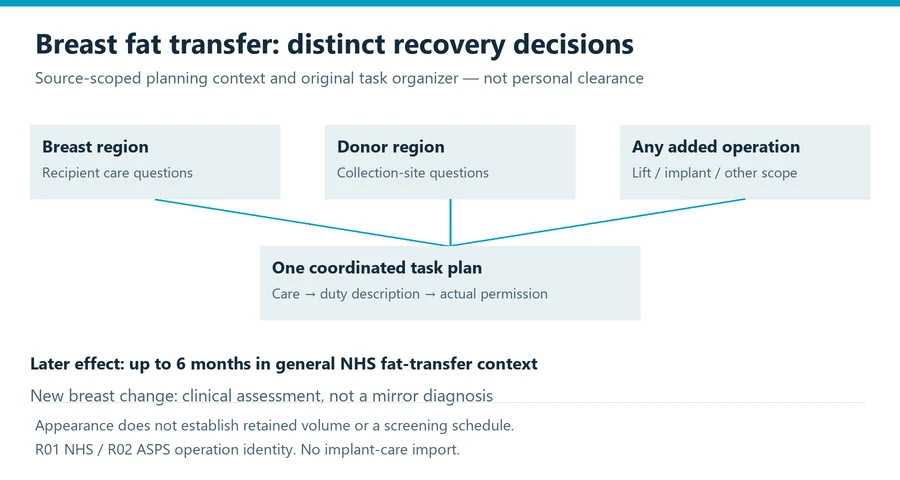
Fat transfer breast augmentation recovery needs coordinated instructions for the breasts and the areas where fat was collected. A breast-only recovery plan can overlook donor-site clothing, movement and care questions. Identify the actual operation, the assistance you will need and the daily tasks you hope to resume. Separate surgical healing, task readiness, later breast appearance and any breast-health concern. A general timeline cannot predict retained fat volume or decide whether a lump or other new change is harmless.
This guide provides practical questions, not instructions for compression, massage, washing, medicines or exercise. Fat grafting alone is different from fat grafting alongside a lift, implant operation or reconstructive procedure. If more than one procedure is involved, ask for one coordinated plan that explains which instructions apply to each site. Do not combine advice from separate internet recovery guides into your own regimen.
What should a fat transfer breast augmentation recovery plan identify?
Start with the operation record as explained by the team. Name the breast procedure, donor regions and any added operation. Ask whether there are care items at either region, where follow-up will occur and who will respond to questions. The purpose is to make the plan complete without assuming that every patient has the same incisions, garment or postoperative needs.
The ASPS procedure overview describes liposuction collection followed by transfer to the breasts. That supports treating the donor area and recipient area as parts of one operation. It does not supply an individual return-to-work schedule or imply that a breast augmentation guide written for implants provides all the instructions needed for fat grafting.
Write down the routine clinical contact, the out-of-hours route and the planned review. If someone will help you, clarify which ordinary tasks they will handle and whether they have any assigned care role. A helper can arrange food or transport without being expected to make decisions about a dressing or a new symptom. Training for a care task should come from the team responsible for that task.
Make the first discussion concrete
Bring a short description of your home and duties. Mention stairs, a shower arrangement, pets, children, work equipment and anything you normally carry. These details do not determine medical clearance on their own, but they help turn a vague request to resume normal life into questions the team can answer. You can also identify which responsibilities can be postponed and which need another person before surgery occurs.
How should fat transfer breast augmentation recovery estimates be read?
The NHS surgical fat transfer overview gives broad context: a couple of weeks away from work may be wanted, bruising or swelling may last several weeks, and the full effect can take up to six months. These are general surgical fat-transfer estimates, not breast-specific permission dates. The appearance estimate also does not establish retained volume for an individual.
| Fat transfer breast augmentation recovery endpoint | General source context | Question for your team |
|---|---|---|
| Work | NHS broad fat transfer: a couple of weeks may be wanted | Which actual duties can resume, and after what review? |
| Early appearance | Bruising and swelling can last several weeks | What pattern is expected at each treated region? |
| Later effect | Up to six months in the overview | When will breast appearance and volume be assessed? |
| Daily tasks | Individual instructions needed | How do breast and donor-site requirements interact? |
For fat transfer breast augmentation recovery, distinguish an estimate used for leave planning from permission for lifting, exercise or travel. A leave discussion can remain provisional until review. A later appearance discussion can acknowledge uncertainty without delaying assessment of an unexpected symptom.
The NHS overview notes that some transferred fat may be reabsorbed. This guide does not give a retention percentage, recommend a method to increase retention or infer the eventual result from early swelling. If you want to understand how the surgeon will judge the outcome, ask which measurements or examinations they use and when those assessments are meaningful for the operation performed.
What should be clarified about breast and donor-site care?
Ask about the care items that actually apply to you. These may be different at the breast and donor site, and their instructions should remain separate even when the overall plan is coordinated. Identify who may handle an item, what its purpose is, how questions are reported and when it will be reviewed. Do not assume that a garment used for one area belongs on another.
Clothing questions can be described precisely. Mention a work uniform, a bra you normally wear, a waistband over a donor area or equipment that touches the chest. Ask what is appropriate within the current care plan rather than choosing a product because someone online used it. The team can address fit and pressure in the context of the actual sites treated.
If washing instructions are unclear, ask for an explanation of the instruction you received. This guide does not tell you when to shower or how to clean incisions. The same applies to medicines and skin products: bring the actual names, identify who prescribed them and ask who will authorize changes. Avoid adding a home massage, heat treatment or supplement routine in the hope of controlling fat survival.
Prevent mixed instructions
Keep the current breast and donor-site instructions in one place, with the date and team contact. If a new instruction replaces an old one, mark that change clearly. A helper should not have to guess which version applies. If two instructions seem incompatible, ask the clinical team to resolve them before improvising a compromise.
How can work and ordinary chest tasks be planned?
Break the workday into the tasks that place demands on either region. For some people the main concern is a commute, reaching shelves or carrying a laptop. For others it is lifting stock, pushing equipment, prolonged standing or a required uniform. Describe the weight, repetition and movement where relevant, without treating this guide as a source of safe limits.
A return plan for fat transfer breast augmentation recovery should answer more than whether you can sit at a desk. Ask how the actual operation affects the full day, whether a review is needed before changing duties and what to do if the plan becomes difficult to follow. A label such as light duty is only useful when you and the employer understand what the duty contains.
Remote work may offer scheduling flexibility, but it still involves concentration, calls and care appointments. Consider which commitments you could adjust if a visit is needed or if the team changes instructions. You may want to agree a provisional arrangement with your employer and confirm it after review. This is practical scheduling, not a claim that remote work accelerates recovery.
For privacy, decide what information you want to share. You can discuss a temporary medical restriction without describing the cosmetic goal in detail. Do not let a wish for privacy force an unsupported return date. The useful outcome is a truthful arrangement that fits the current instructions and provides a way to revise duties when the team reassesses them.
How should home help, driving and exercise be discussed?
Map assistance to tasks rather than asking a helper to cover everything indefinitely. Groceries, childcare, pet care, laundry and transport can each have a named arrangement. If a task requires lifting or reaching, bring that actual demand to the clinical discussion. A child needing to be picked up is a different question from a child needing company while another adult handles physical care.
Plan the journey home using the facility’s requirements. Ask when driving can be reconsidered and which factors the team will assess, including the operation, medicines and movement required to drive. A general fat-transfer statement about comfort is not the whole decision for your own procedure. Do not test driving readiness by undertaking a trip without the required advice.
Exercise questions during fat transfer breast augmentation recovery should identify the activity. Walking for errands, swimming, resistance training and high-impact classes do not have identical demands. Ask how both treated regions affect that activity and whether an additional procedure changes the answer. This guide intentionally gives no independent exercise progression, weight limit or pressure-avoidance schedule.
Travel deserves a separate conversation about follow-up, luggage and access to care. Explain the proposed journey and where you will be staying. Ask whether it interferes with a planned examination or makes an urgent concern harder to assess. A travel booking is a logistical commitment, not evidence that the operation is ready for travel.
Arrange a backup without prescribing care
If your first helper becomes unavailable, identify another person who can handle ordinary errands or transport. Care decisions still belong with the clinical team. A backup plan can include the location of instructions and contact information without giving another person permission to alter treatment. This distinction prevents practical help from becoming an improvised clinical role.
How should a breast change be assessed separately from appearance?
The ASPS risks discussion lists cysts, infection, microcalcification and fat-cell necrosis among possible concerns. The list is not a diagnosis, an incidence estimate or permission to dismiss a new lump. If you notice a breast change, ask the treating team what evaluation is needed and communicate the fat-grafting history to clinicians involved in your breast care.
Do not decide that a new lump must be transferred fat or that every change is dangerous. The useful next step is appropriate assessment. Ask how the operation will be documented for future examinations or imaging, and who should receive those records. This guide does not set a screening interval or replace the plan from the clinician responsible for your breast health.
Appearance questions during fat transfer breast augmentation recovery can be kept on a separate list. You may want to discuss asymmetry, volume or the timing of later photographs. A symptom should not be hidden on that appearance list if it needs earlier evaluation. Likewise, an early appearance concern should not lead to massage, pressure or another intervention that the team has not prescribed.
If a future touch-up is discussed, ask how that conversation relates to the current assessment. Do not treat a general statement that another session may be needed as a decision about your own timing or treatment. The present task is to understand healing and follow-up for the operation already performed.
Which symptoms require attention before routine follow-up?
For surgical-site redness or pain, drainage or fever, contact a healthcare provider immediately. CDC surgical infection guidance provides that general response framework. It does not identify the cause or give a fat-grafting complication rate. Describe whether the concern is at the breast or a donor site and how it differs from the pattern discussed at discharge.
CDC blood-clot guidance calls for prompt assessment of new limb swelling, pain or warmth and immediate help for possible lung-clot symptoms. New breathing difficulty, chest pain or fainting needs emergency assessment; call 911 in the United States for an emergency. This is general guidance, not a prediction that your operation will cause a clot.
Follow the team’s route for other unexpected or worsening symptoms. If the office cannot be reached and the concern is urgent, use the alternative care route provided or seek appropriate urgent help. Do not wait for a published week estimate to expire before reporting a problem. An appearance timeline never establishes that a symptom is safe.
When calling, identify the procedure, affected site, onset and change. Have the discharge information and current medicine list available if practical. A photo can support triage when requested, but it cannot guarantee assessment without examination or immediate reading of a message. The priority is reaching the appropriate clinician or emergency service, not obtaining reassurance from a comparison photograph.
How can fat transfer breast augmentation recovery questions be handed over?
If another clinician sees you after surgery, a clear operation summary can make the conversation more specific. Ask the surgical team what information should be available about the breasts, donor regions and any added procedure. You are not expected to explain the surgical technique yourself. The aim is to provide the actual record rather than an uncertain description based on a general article.
For fat transfer breast augmentation recovery, distinguish the reason for the visit. A wound concern, a donor-site question and a later breast-health assessment may need different information. Tell the clinician what is worrying you and where it is occurring. Do not describe every concern as cosmetic merely because the initial operation was cosmetic. The next step should follow the clinical assessment of the actual change.
Ask how new advice will be shared with the original team if you receive care elsewhere. If instructions differ, request clarification rather than deciding independently which version to follow. A useful handover includes the current plan, relevant prescriptions and the contact responsible for follow-up. It does not mean that another clinician must rely only on a photograph or that a local assessment can be replaced by a distant message.
Practical responsibilities can be handed over too. If one helper is leaving, identify which ordinary tasks still need coverage and which care responsibilities belong with trained staff or the clinical team. Another person can collect groceries without becoming responsible for evaluating a breast change. Keeping the roles explicit protects both privacy and communication.
At review, bring the questions that have become urgent for your daily schedule, such as a proposed work assignment or a journey needed for an appointment. Preserve any qualification in the answer, including which region or activity it applies to. A fat transfer breast augmentation recovery record should not turn a permission for one task into clearance for every breast and donor-site demand. Its value is that it keeps the actual operation, the current instruction and the next unanswered question together.
What should follow-up make clearer?
Begin review with unresolved care questions and symptoms. Then discuss tasks that need a specific answer, including work, home responsibilities and exercise. Ask which instruction is continuing, which has changed and what the next review should address. If the answer applies only to one region, record that scope rather than assuming it clears every treated area.
For later appearance, ask what can reasonably be assessed now and what remains unsettled. A record of your questions may help you notice whether the same uncertainty is persisting without claiming to measure graft survival. Photographs taken for personal reference can vary with posture, lighting and clothing; they are not a substitute for clinical evaluation or a quantified outcome assessment.
The fat transfer breast augmentation guide addresses the broader procedure decision. The general recovery planning guide helps coordinate support. A useful fat transfer breast augmentation recovery plan keeps two-region care, task permissions, appearance and breast-health assessment connected but distinct, with clear ownership of the questions that remain.
Sources and review scope
Plastic Surgery Editorial Team. Source records checked through October 12, 2026. Review scope: source and editorial checks for general education. No individual clinical assessment is represented.
- NHS surgical fat transfer. nhs.uk. Source date: 2023-10-19. Checked 2026-10-12.
- ASPS breast fat transfer overview. plasticsurgery.org. Publication/update date not stated. Checked 2026-10-12.
- CDC blood-clot guidance. cdc.gov. Source date: 2025-03-05. Checked 2026-10-12.
- CDC surgical infection guidance. cdc.gov. Source date: 2024-04-11. Checked 2026-10-12.
- ASPS breast fat transfer risks. plasticsurgery.org. Publication/update date not stated. Checked 2026-10-12.