
Round vs anatomical implants compares one device characteristic: shape. It does not replace the separate decisions about filler, shell surface, size, projection, placement or whether an implant fits your goal at all. A teardrop-shaped implant should not automatically be assumed to create a more natural result, and a round implant does not by itself define the appearance of the whole breast. Original studies assess different questions, from photographic ratings to shape identification and intraoperative measurements. 1, 2, 3, 4
The useful decision begins with your desired appearance and the exact proposed device. Ask which characteristics are changing between the alternatives and what evidence supports those specific choices. This guide explains the study differences and practical comparison fields without recommending a model, promising a particular contour or treating a shape label as a safety guarantee.
Shape is separate from filler and surface
FDA guidance identifies saline-filled and silicone gel-filled devices and describes shell surfaces as smooth or textured. Its labeling guidance separately names shape, profile, volume and other device characteristics. These are different dimensions of a proposal. A comparison called round versus anatomical may also change the surface, gel properties, projection or other features, making a shape-only conclusion difficult. 1, 5 The breast augmentation guide supplies context for the broader procedure discussion.
Record the full device identity in each column of your comparison. Include the manufacturer, model, filler, shell surface, dimensions, volume and profile as supplied in the actual documentation. If the proposal changes more than shape, ask which expected difference is attributed to which characteristic. A general description such as a more natural implant is not enough to evaluate the alternative.
This matters when reading an older paper. Its devices may differ from those currently being proposed, and some may have a different market or regulatory history. A favorable appearance rating does not establish current availability or appropriateness. Keep the device and treatment context beside the result instead of borrowing the outcome for every product with a similar silhouette.
Shape is also separate from surgical placement. If one option changes the implant and the pocket, the comparison includes two decisions. Ask why each is proposed and how the clinician expects them to affect the goal. The same volume label does not make differently dimensioned devices or different treatment plans interchangeable.
| Device field | What to record | What it does not mean |
|---|---|---|
| Shape | Round or the exact shaped configuration | Surface or filler has also been established |
| Shell surface | Actual manufacturer description | A shape label determines every safety issue |
| Dimensions and profile | Width, height and projection as applicable | Equal volume creates equal dimensions |
| Filler and formulation | Actual device documentation | Every silicone gel model behaves identically |
| Surgical plan | Placement and any additional work | Device shape alone explains the whole result |
Define natural appearance before using it as an endpoint
The word natural can refer to different things: upper breast contour, proportion, movement, softness, how the breast looks under clothing or how it appears in a particular photograph. Ask which of those you mean and which the proposal can reasonably address. A study’s rating of natural appearance is a defined observer task, not a universal aesthetic standard.
Write down a change goal and a preservation goal. You might want a particular increase while preserving a feature of the current appearance. Another reader may prefer a different contour. Neither preference should be inferred solely from age, identity or a device’s marketing language. The target should be discussed before deciding which evidence is relevant.
Avoid using a reference photograph as a promise. You do not know every device dimension, placement choice, tissue characteristic or additional procedure behind the image. A photograph can communicate a preference, but it does not establish that the result is reproducible with the proposed implant. Ask what part of the reference is relevant and what remains uncertain.
Also separate a larger breast from a different breast shape. A change in volume can affect the observed form, which complicates a comparison that changes both volume and shape. If the goal is mostly size, ask why a shape change is also being proposed. If the goal is contour, ask how it will be evaluated apart from size.
A 60-patient study did not establish a universal winner
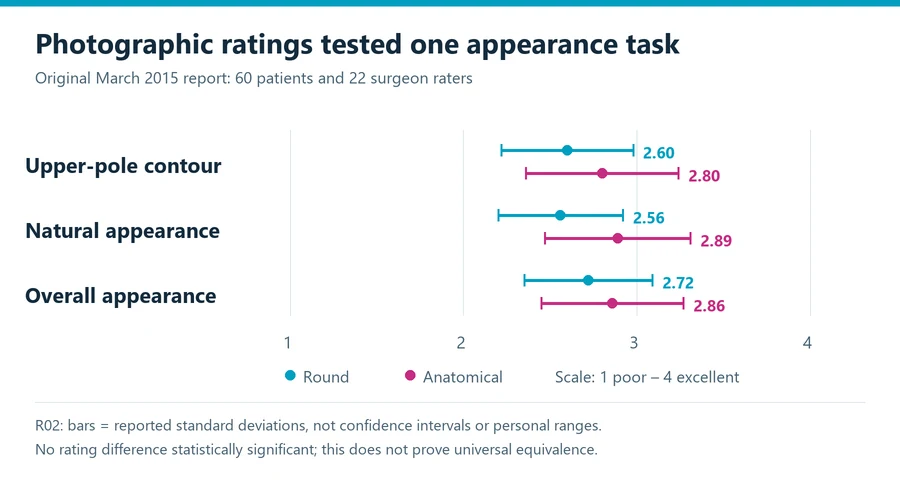
An original March 2015 report reviewed photographs of 60 consecutive augmentation patients: 33 had round and 27 had anatomical form-stable implants. Twenty-two plastic surgeons rated overall appearance, upper-pole contour and natural appearance on a four-point scale and tried to identify implant shape. The report did not find statistically significant differences in its rating comparisons. 2
The supporting graphic plots the reported means and standard deviations for those three rating tasks. Standard deviation describes spread; it is not a confidence interval or a personal outcome range. The numerical differences should remain beside the study’s statistical result rather than be promoted as proof that the higher mean always represents the better choice. 2
This is an observer-based photographic assessment. It does not directly measure how the patients felt, how the breasts moved, how the devices behaved over years or the exact outcome you would have. A photograph can support a defined visual task without answering every aspect of satisfaction or device safety.
Nor does a failure to detect a significant difference prove that the shapes are equivalent for every person and endpoint. The sample, comparison design and measured task constrain the conclusion. The useful takeaway is to avoid a blanket assumption that anatomical shape necessarily produces the more natural result, while retaining room for an individual device recommendation.
A shape-swap study asked a different question
An original September 2023 report studied 14 patients who replaced their implant with a different shape while retaining the same stated volume and projection. Standardized photographs at 12-month follow-up were blinded and randomized for assessment by ten surgeons and ten nurses. All 20 observers distinguished the shapes in all 14 cases. Several authors disclosed relevant device-industry relationships. 3
That result concerns identification under the report’s conditions, not a probability that you will prefer one shape. Being able to distinguish two appearances does not establish which better matches a particular goal. A difference can be visible without being desirable or undesirable in a universal sense.
The same-patient design addresses some differences that arise when comparing separate groups of people. However, these were selected patients who chose a shape replacement, not a broad randomized initial-augmentation population. Their course also includes a second operation. It should not be presented as a direct prediction of a first-time patient’s result.
The 2015 and 2023 reports therefore should not be reduced to one slogan about whether shape matters. They used different populations and tasks. One asked surgeons to rate photographs from separate patients; the other examined recognition after a shape swap in the same selected patients. A thoughtful comparison preserves those distinctions rather than choosing whichever conclusion sounds more favorable.
Intraoperative measurements are another endpoint
An original study published December 28, 2021, performed intraoperative three-dimensional assessments in ten women, producing 130 single-breast scans across native and augmented conditions and several implant sizes and shapes. Its analysis did not detect a significant shape difference in the reported topographic-shift endpoint. The 130 scans were not 130 separate patients. 4
This is an important distinction between an observation unit and a participant. Repeated measurements on the same people can explore how a parameter changes under controlled conditions, but they do not create a large independent patient sample. The evidence should retain both the ten-person population and the scan count.
An intraoperative scan also answers a different question from a healed postoperative photograph or a patient’s later experience. It should not be treated as a long-term clinical outcome study simply because its technology provides precise-looking measurements. Precision of measurement and relevance of the endpoint are separate issues.
Ask what the evidence offered in your consultation actually measures. If the goal concerns movement or long-term appearance, an intraoperative topography result is a narrower observation. If the goal concerns recognizing shape in a static image, a satisfaction statement is a different endpoint. A suitable device explanation can acknowledge those gaps without claiming that evidence has no value.
| Study discussed here | Actual task | Main interpretation limit |
|---|---|---|
| 2015 photographic cohort | Observer ratings and shape identification | Separate patients; not personal preference or safety |
| 2023 shape replacement series | Same-patient photographic distinction | Selected replacement patients; identification is not preference |
| 2021 intraoperative study | Three-dimensional topographic measurements | Repeated scans in ten people; not healed long-term experience |
A useful evidence packet can contain three different kinds of information without confusing their roles. The device documentation identifies what is proposed and the applicable warnings. A research report explains a measured result in a selected setting. Your written goal describes which result matters to you. None of those records replaces the others: a research photograph does not establish a product label, and a product label does not decide your preferred appearance.
Ask the clinician to identify the part of the recommendation supported by each record. If an older paper is being used, confirm whether the actual device, dimensions and surgical plan resemble the proposal. If they differ, ask how the evidence is being applied and which uncertainty remains. This creates a more transparent discussion than treating a collection of studies as a single endorsement.
You can also compare the alternatives without accepting every feature of the first proposal. For instance, a hypothetical reader may be comfortable with the size recommendation but uncertain about a concurrent shape and surface change. Separating those questions helps the practice explain what is necessary, what is optional and what is constrained by the available model. The example is a planning prompt, not a recommendation to select or reject any device.
Orientation questions belong beside the exact model
Ask how the proposed device’s orientation relates to its intended appearance and how displacement would be assessed. A shaped device has a specified configuration; its behavior and fixation context should be discussed using the actual model and surgical plan. Do not infer a rotation rate from its silhouette or from an unmatched study of another device.
FDA risk information includes implant malposition or displacement as a complication. It also lists unsatisfactory style or size and wrinkling or rippling among possible problems. Those categories should not be converted into shape-specific incidence estimates without the relevant device labeling and outcome definitions. A round device is not a guarantee that position problems cannot matter. 6
For a practical comparison, ask what a change in position could look or feel like, how it would be evaluated and what follow-up process applies. You do not need instructions for manually manipulating an implant. The important information is how the treating team defines a concern and which assessment would follow.
Keep the possible response separate from the cause. A visible change does not let an online article determine whether it reflects device position, another complication or a tissue change. Contact the appropriate clinical team for an unexpected or persistent concern rather than diagnosing it from a comparison photograph.
Surface and recall history cannot be hidden inside a shape choice
FDA’s July 24, 2019 announcement described a recall of specified Allergan BIOCELL textured products, including Natrelle 410 anatomically shaped silicone implants as well as other products. That was a product-specific textured-device action, not a recall of every anatomical implant or a finding that every round device was unaffected by the action. 7 Keep the surface question separate with the smooth versus textured implant comparison.
This is why device identity belongs in the discussion. A research paper’s favorable contour assessment does not erase a later safety action affecting the studied model. Conversely, the inclusion of a particular shaped product in a recall does not establish that shape alone caused the issue. Keep model, surface and regulatory history distinct.
Ask for the actual patient labeling and current status of the proposed device before deciding. If you already have implants, use your device card and operative record to identify them. An appearance description such as teardrop is not enough to determine recall status. The relevant record should identify the manufacturer and model.
This guide does not tell existing implant recipients to remove or replace a device based on shape. That decision requires the appropriate clinical discussion of symptoms, device history and current guidance. A comparison intended for choosing a new device should not silently become a recommendation for additional surgery in someone who already has one.
Long-term obligations are not solved by the shape label
FDA states that breast implants are not lifetime devices and that complications may require additional surgery. Its risk information does not guarantee a satisfactory cosmetic result after reoperation. Neither round nor anatomical should be sold in this guide as a one-time solution without future assessment or potential additional treatment. 6 Review breast implant lifespan evidence without treating a shape choice as a lifetime guarantee.
Discuss the follow-up responsibilities for the actual device. Ask which examinations or imaging may apply, how records will be retained and who handles a future concern if you move or the original practice is unavailable. The plan should identify responsibilities rather than assume that choosing a particular shape settles them.
Separate a planned future stage from an unplanned complication response. A practice may quote a later step differently from the initial episode, and a warranty may cover a device without covering every surgical or facility charge. Read the actual written terms. A headline warranty description is not a complete estimate of future expenses.
The possibility of later treatment also belongs in your preference discussion. If avoiding additional operations is a major priority, ask how the proposal addresses that concern and what it cannot assure. The answer should not be a universal promise attached to a shape label. It should connect the device, treatment scope and known uncertainties.
Compare the full proposal without inventing prices
The sources used here do not provide a defensible national like-for-like total-price difference between round and anatomical implants in your proposed course. This guide therefore does not invent a surcharge or total range. A device price, surgeon fee and episode estimate are different measures.
| Comparison field | First proposal | Alternative proposal |
|---|---|---|
| Device identity | Manufacturer, model and full characteristics | Which characteristics actually change? |
| Desired endpoint | Size, contour and preservation priorities | Is the same goal being compared? |
| Other treatment | Placement, lift or additional work | Is a second component also changing? |
| Evidence | Population, device and measured task | Does it match this model and goal? |
| Complete course | Included device, surgery, facility and anesthesia | Same scope and possible additions |
| Future care | Follow-up, records and reoperation policy | Actual terms rather than assumptions |
Keep a proposed lift separate from a shape change
If a breast lift or another procedure is included, ask which finding it addresses and why an implant change alone would not address the same concern. A combined plan has more than one intervention. Its resulting photograph cannot automatically prove that device shape explains every visible difference.
Retain any alternatives the clinician does not recommend and the reason. That can help distinguish an anatomy-based explanation from a claim that one shape is always superior. You should understand the target, the exact device and the tradeoff well enough to explain the decision in your own words.
Round vs anatomical implants becomes a useful comparison when shape is kept separate from surface, filler and treatment scope. Read appearance studies by their actual task, distinguish recognition from preference and include device safety and future care in the plan. A universal winner is less informative than a specific, documented proposal that fits the agreed goal.
For broader planning, see our breast augmentation guide, questions to ask a plastic surgeon and complete-course cost guide.
Sources and review scope
Plastic Surgery Editorial Team. Source records checked through October 12, 2026. Review scope: source and editorial checks for general education. No individual clinical assessment is represented.
- FDA types of breast implants. fda.gov. Publication/update date not stated. Checked 2026-10-12.
- Assessing the augmented breast: a blinded study comparing round and anatomical form-stable implants. pubmed.ncbi.nlm.nih.gov. Source date: 2015-03. Checked 2026-10-12.
- Evaluation of Different Breast Implant Shapes in the Same Patient: Is There Really a Difference between Round and Anatomical Implants?. pubmed.ncbi.nlm.nih.gov. Source date: 2023-09-25. Checked 2026-10-12.
- Intraoperative 3D Comparison of Round and Anatomical Breast Implants: Dispelling a Myth. pubmed.ncbi.nlm.nih.gov. Source date: 2021-12-28. Checked 2026-10-12.
- FDA breast implant labeling recommendations. fda.gov. Source date: 2020-09. Checked 2026-10-12.
- FDA breast implant risks and complications. fda.gov. Source date: 2023-12-14. Checked 2026-10-12.
- FDA action on specified Allergan BIOCELL textured devices. fda.gov. Source date: 2019-07-24. Checked 2026-10-12.