
Smooth vs textured implants is a comparison of the implant shell surface, not a complete choice of breast size, filling, shape or surgical plan. The FDA states that breast implant-associated anaplastic large cell lymphoma, or BIA-ALCL, is more likely with textured than smooth surfaces. Historical contracture studies answer a different question and do not cancel that safety concern. Someone choosing a new implant and someone already living with an implant need different conversations. Start with the exact device and your actual situation, rather than an online declaration that one surface solves every problem. 1, 2, 3
A useful decision has several parts: what the proposed device is intended to accomplish, what evidence concerns that model and operation, which risks remain, and what monitoring will involve. It should also include alternatives to the proposal. This comparison helps organize those questions without assigning a personal risk percentage, recommending a brand or deciding whether an existing implant should be removed. A clear explanation of uncertainty is more useful than a confident answer assembled from incompatible studies.
Surface, filling, shape and placement are different dimensions
A saline-filled implant still has a silicone outer shell. Silicone gel-filled implants also have a silicone shell; the contents differ from saline. FDA descriptions include smooth and textured surfaces within these filling categories. Consequently, asking whether an implant is silicone does not establish its surface. Likewise, a shape description does not replace the model name or the actual shell description. Ask the team to describe each characteristic separately. 2
This distinction improves comparison even before discussing risk. Imagine two written proposals with the same requested breast appearance but different device descriptions. If one says only “silicone” and the other names filling, shell surface, shape and placement, they are not equally informative. The missing details are questions to resolve, not evidence that the less detailed proposal is equivalent. A photograph or sample device can help explain appearance, but the final written description should identify what would actually be implanted. For the wider operation and device-choice context, read the breast augmentation guide while keeping each implant characteristic separately recorded.
The same discipline applies to placement. A study involving one pocket should not quietly become evidence for all pockets. Device and operative choices can appear together in a published series, making it difficult to isolate which feature explains an outcome. A comparison becomes stronger when the team identifies which parts are supported by the exact study and which parts rely on individualized judgment. That division does not make judgment illegitimate; it makes its role visible.
| Dimension | Record separately | Comparison error to avoid |
|---|---|---|
| Shell surface | Exact device surface and model | Treating silicone filling as a surface description |
| Filling | Saline or silicone gel and named device | Assuming filling settles the texture question |
| Shape and dimensions | Actual proposed shape, size and projection | Treating one photograph as a device specification |
| Placement and other work | Named pocket and accompanying procedure | Assigning a combined result to surface alone |
Define the purpose before comparing the claimed advantage
ASPS describes textured implants as tending to adhere to surrounding scar tissue and being less likely to move within the breast. Its implant overview also distinguishes shaped and round devices. These are descriptions of proposed behavior, not guarantees that a particular patient will achieve a desired appearance or avoid another operation. Ask what specific problem the proposed device is intended to address and why that objective matters in your plan. 1
“Better stability” is incomplete unless the intended endpoint is named. Does the explanation concern orientation, movement, visible shape or an anticipated revision problem? Those questions can involve different evidence. An answer should connect the proposed feature to the actual goal rather than accumulating attractive adjectives. If a feature is presented as essential, ask whether the same goal has another available approach and what tradeoffs would change. The explanation should remain understandable without relying on a brand slogan.
It is also reasonable to ask what the recommendation would be if you decline the proposed surface. The answer may involve a different device, a different operative plan, postponement or choosing not to have an implant. That discussion should not be framed as a test of whether you are willing to accept the surgeon’s preferred product. You are comparing a course of care. Knowing the alternatives makes the recommendation easier to evaluate and helps distinguish a necessary element from a preference.
Contracture evidence and lymphoma evidence answer different questions
Capsular contracture refers to tightening of the scar capsule around an implant. BIA-ALCL is a distinct lymphoma associated with implants, rather than ordinary scar tightening or breast cancer. The FDA identifies a higher BIA-ALCL risk with textured surfaces. Neither a claim about contracture prevention nor an aesthetically pleasing result resolves that separate safety issue. Conversely, the surface association does not describe every possible complication of a smooth device. 3, 4 Read the BIA-ALCL guide for the distinct lymphoma evidence and assessment question rather than merging it with ordinary capsule tightening.
A useful evidence discussion therefore has separate lines for separate endpoints. Ask which evidence concerns contracture, which concerns device movement, which concerns lymphoma and which concerns the need for another operation. When someone uses the single word “safer,” request the event, time horizon and comparison behind it. Without those details, the word can conceal a decision about which adverse outcome was measured. A study may answer one question well while leaving another question completely unaddressed.
This approach also prevents false arithmetic. It is not appropriate to subtract a historical contracture percentage from a cancer-report count and call the remainder a net benefit. The quantities may concern different populations, observation periods and reporting systems. They also represent outcomes with different consequences. A decision can weigh multiple considerations without pretending they share a common numerical scale. If the team offers an individual estimate, ask where it comes from and which assumptions are specific to you.
The 1991 trial separates patients from breasts
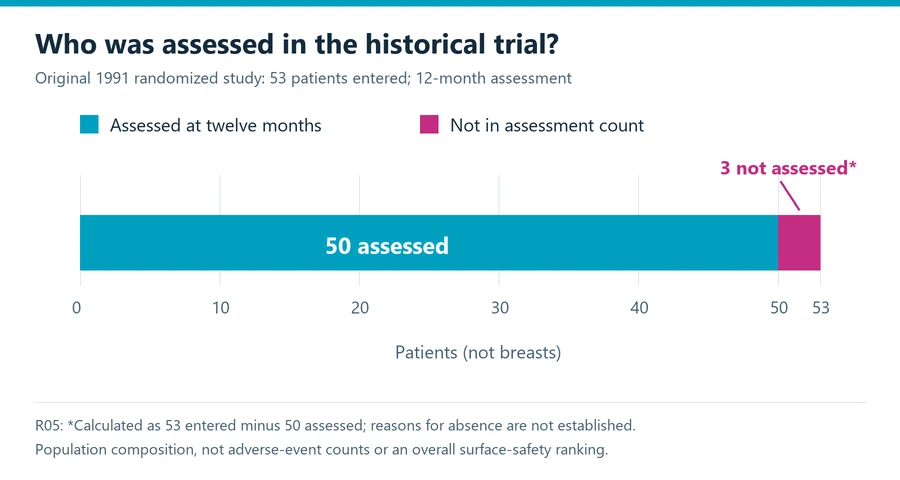
An original randomized study published in August–September 1991 entered 53 patients and assessed 50 at twelve months. It compared smooth and textured silicone implants in the submammary plane, using observers unaware of the surface assignment. The abstract reports adverse contracture by breast, with 28 smooth-implant breasts and four textured-implant breasts affected. That breast-based outcome should not be relabeled as a count of patients. The study concerns historical devices and one placement context, not all implants currently offered. 5
The supporting graphic shows the enrollment and assessment population: 53 entered, 50 assessed, and a calculated difference of three not included in the twelve-month assessment count. It is not an effectiveness graph. The abstract does not establish why those three were absent, so the difference is not labeled a complication, failure or refusal. Displaying the denominator is useful because it makes the boundary of the observation visible without inventing an explanation for missing data.
A careful reader should preserve the distinction between participants and bilateral observations throughout the discussion. Two breasts belonging to one person do not automatically provide two independent experiences. If a result is reported by breast, ask how the original analysis handled that structure before applying it to a patient-level question. The short abstract is not enough to reconstruct every analytic choice. It is better to retain that limitation than to reverse-engineer an exact denominator from rounded percentages.
A favorable endpoint does not establish an overall winner
Random allocation strengthens a study’s comparison, but it does not change the event being measured or make older devices identical to current ones. This trial can inform the historical contracture question within its stated scope. It cannot, by itself, decide the balance of all present-day device risks. The measured endpoint and the current decision must match. That is why the manuscript does not turn the reported contracture results into a recommendation to select textured implants today.
The ten-year report is not a new randomized population
A September 2000 follow-up describes the same original 53-patient trial, initially divided into 26 smooth and 27 textured recipients. Its abstract explains that the later review focused on patients not already known to have developed contracture: 11 of 14 in the smooth group and 18 of 24 in the textured group were reviewed. It reports ten-year patient-level contracture estimates, but the follow-up structure matters. This is not a fresh set of 53 completely assessed participants at ten years. 6
Do not add the early and later reports together as if they were two independent trials. Doing so would count the original population more than once and create an impression of evidence volume that the records do not support. Also notice the reporting unit: the earlier abstract describes affected breasts, whereas the later abstract describes patient-level incidence. Those summaries cannot be placed side by side as an unqualified trend line showing how an individual person’s risk evolved.
The later paper also discusses a larger database, but an additional observational database is not the same randomized comparison. Before using it to support a personal decision, the relevant groups, devices, placement and follow-up would need to be examined. This guide does not adopt its database rates or present a contemporary pooled surface estimate. The useful lesson is methodological: long follow-up is valuable, but completeness, reporting unit and device era remain part of the result.
| Evidence record | Population and observation | What this guide retains |
|---|---|---|
| 1991 randomized trial | 53 entered; 50 assessed at twelve months | Historical breast-based contracture endpoint, with placement limits |
| 2000 follow-up | Original 26 smooth and 27 textured patients; selected later review described | Same trial population, not another independent trial |
| Current FDA guidance | Device-safety guidance rather than the historical trial | Separate surface-associated safety considerations and individual evaluation |
Identify an existing device before planning a change
If you already have implants, first establish what you have. The FDA advises retaining manufacturer and model information and suggests obtaining operative records when the device card is unavailable. A present smooth implant does not, by itself, document every earlier implant or tissue expander. Ask the treating team to reconcile the available history rather than treating a remembered brand name or a recent photograph as the complete record. 3
A practical record can have one row for each known operation and each side. Write down what is confirmed by an operative note or card and what remains uncertain. Preserve the original document rather than rewriting a vague recollection as a verified fact. If records conflict, keep both versions visible until the clinical team resolves them. A missing detail is not proof of a particular surface, and searching for similar packaging online does not authenticate the implanted device.
This preparation changes the conversation from “Should everyone with textured implants do the same thing?” to “What is known about my actual devices, symptoms and options?” It also makes any proposed exchange easier to understand. If another operation is discussed, request a written description of the purpose and the expected device afterward. A surface change should not be presented as erasing the need to consider the rest of the history or the risks of the proposed operation.
Symptoms and symptom-free concerns require different conversations
The FDA does not recommend routine implant removal solely because of BIA-ALCL concern in patients without symptoms. Persistent swelling, a mass or pain near an implant warrants discussion with a healthcare provider and evaluation; choosing a replacement surface is not a substitute for assessing a new change. This general guidance is not a personal instruction to retain or remove your implant. Your team needs to evaluate the actual situation. 3
When seeking an appointment, distinguish the reason for the conversation. You may want records clarified, need a new symptom evaluated, or wish to discuss an elective change after receiving safety information. Those purposes can overlap, but stating them clearly avoids an appointment that addresses only product choice while leaving the symptom question unanswered. Keep a factual description of when a change appeared and what prompted the visit, without trying to diagnose it from pictures or online testimonials.
A comparison page cannot tell whether a symptom is related to an implant or determine the appropriate operation. It can help you avoid an unsupported shortcut: neither a reassuring surface name nor an alarming headline establishes a diagnosis. Ask what evaluation is needed before any recommendation about surgery is finalized. If you receive a recommendation for additional assessment, understand who will perform it and how the results will affect the next decision, rather than treating testing as a routine purchasing step.
Use current labeling for the exact proposed device
FDA labeling resources provide product-specific documents. Its description of the October 27, 2021 actions includes a boxed warning, patient decision checklist, device description and patient device card. The checklist is to be reviewed with the prospective patient and signed through the stated process. An educational comparison does not replace that device-specific discussion, and a generic sample checklist does not establish the contents of the model actually proposed. 7, 8
Before agreeing to a device, ask to receive the applicable documents early enough to read them. Mark questions alongside the exact passage that prompted them. If the explanation refers to a newer version, request that version rather than relying on a verbal assurance that the differences are minor. Record the model and document revision together. This is especially useful when comparing proposals from different visits, because otherwise the discussion can move between products without making the change apparent.
Regulatory labeling and commercial availability are also different questions. An overview describing a device category does not prove that every historical model remains available for new implantation. Confirm the proposed model’s current status through the treating team and the relevant official records. This guide does not supply an inventory, endorse a manufacturer or infer availability from an old clinical paper. A named proposal can be checked; a broad category alone cannot support the same level of verification.
Compare the full course rather than the initial implant alone
The FDA explains that implants are not lifetime devices and may require later surgery. It lists complications including rupture, contracture, pain, infection and further operations. Choosing smooth surfaces does not make the rest of the course disappear. Ask the team to separate the initial procedure, planned follow-up, device monitoring and the circumstances that would lead to reassessment. An initial purchase price is not a complete description of future care. 4, 7
This guide does not invent a surface-specific price premium or a fixed replacement interval. Instead, ask what the written quote includes and which future services would be billed separately. Distinguish a product warranty from the costs of surgery, anesthesia, facility use and evaluation. If a promise sounds broad, request the actual terms and ask which expenses are excluded. These questions clarify financial responsibility without suggesting that all possible future events can be predicted or prepaid.
Monitoring questions should also remain specific. Ask which recommendations concern the device’s filling, which concern symptoms and which concern the original reason for surgery. A general checkup, an investigation of a new change and a device-focused examination are not interchangeable descriptions. Write down the plan in the team’s own terms and ask whom to contact when circumstances change. The goal is an understandable course of care rather than an unsupported calendar assembled from unrelated implant discussions.
| Decision checkpoint | Information to obtain | Reason it matters |
|---|---|---|
| New implantation | Exact model, surface, filling, intended purpose and alternatives | Makes the recommendation testable against relevant records |
| Existing device | Card or operative history and unresolved details | Avoids assuming a complete history from the latest device alone |
| New change | Clinical evaluation plan before elective exchange decisions | Keeps a symptom question separate from a product choice |
| Long-term course | Monitoring responsibilities and separate cost terms | Prevents the initial implant quote from standing in for all future care |
Judge photographs and marketing by what they can show
A photograph may illustrate the appearance of a particular person after a particular operation. It cannot identify every device characteristic or establish the probability of an event not visible in the image. Ask what accompanying work was performed and when the photograph was taken before using it to compare proposals. A polished gallery should not be interpreted as a controlled surface study. No example can establish that you will have the same appearance or experience.
Likewise, a descriptive word such as natural, stable or advanced needs an explanation tied to the actual proposal. Does it describe a material property, a measured clinical endpoint or a preference in appearance? Ask for the relevant source and the context in which the statement holds. A technical sounding surface name is not enough to establish a particular safety advantage. Keep the exact device description separate from promotional terminology so that the clinical explanation can be examined on its merits.
A useful decision ends with documented reasons, not a slogan
A well-explained surface decision identifies what is being proposed, why it fits the intended goal, what evidence applies, and what remains uncertain. It recognizes the current FDA texture-associated BIA-ALCL concern without pretending that a historical contracture trial answers every safety question. For an existing implant, it begins with the actual history and distinguishes a symptom evaluation from an elective discussion. Those are concrete tasks that can be checked, even when an individual outcome cannot be guaranteed.
You do not need to memorize every published percentage to participate in the decision. You do need to understand the event, population and time period behind a claim that influences your choice. Ask the team to explain unresolved tradeoffs in plain language and to document the proposed device and follow-up plan. If important details remain unclear, they remain questions to resolve; they should not be filled with assumptions from a comparison chart. That preserves the difference between education, device selection and individualized medical care.
Related planning guides
Continue with the procedure library, questions to ask a plastic surgeon and plastic surgery cost planning.
Sources and review scope
Plastic Surgery Editorial Team. Source records checked through October 12, 2026. Review scope: source and editorial checks for general education. No individual clinical assessment is represented.
- ASPS breast implant surface, filling and shape overview. plasticsurgery.org. Publication/update date not stated. Checked 2026-10-12.
- FDA types of breast implants. fda.gov. Publication/update date not stated. Checked 2026-10-12.
- FDA BIA-ALCL questions and answers. fda.gov. Publication/update date not stated. Checked 2026-10-12.
- FDA breast implant risks and complications. fda.gov. Publication/update date not stated. Checked 2026-10-12.
- Textured or smooth implants for breast augmentation? A prospective controlled trial. pubmed.ncbi.nlm.nih.gov. Source date: 1991-08/1991-09. Checked 2026-10-12.
- Ten-year review of the original smooth/textured subglandular trial. pubmed.ncbi.nlm.nih.gov. Source date: 2000-09. Checked 2026-10-12.
- FDA considerations and device-specific decision checklist. fda.gov. Publication/update date not stated. Checked 2026-10-12.
- FDA labeling for approved breast implants. fda.gov. Publication/update date not stated. Checked 2026-10-12.