
Breast implants do not have a predictable lifetime or a universal replacement date. The FDA describes them as devices that are not intended to last a lifetime: the longer they remain implanted, the greater the chance of complications and additional surgery. That does not mean every implant must be replaced at ten years. To answer “How long do breast implants last?” use the actual device, symptoms, examination and monitoring plan, rather than treating an anniversary as an automatic surgical indication. FDA implant decision facts
This resource separates device age, rupture surveillance, breast changes and the decision to operate. It explains why a screening interval is not a replacement interval and why reassuring appearance does not prove an implant is intact. It also helps you prepare a focused appointment without assuming that a routine scan, an older device or a symptom automatically determines a particular operation.
What does “How long do breast implants last?” actually ask?
There are several possible endpoints behind the question. One person means how long an implant can remain physically intact. Another means how long breast appearance remains satisfactory. Someone else wants to know when further surgery will become necessary or how long a warranty lasts. These endpoints overlap imperfectly. A manufacturer agreement concerns its stated terms; it does not establish that your implant is intact, replace clinical evaluation or pay every associated expense.
Device age is useful history because complications become more likely over time. It is not a countdown that predicts the exact day of rupture. A new change in a younger implant deserves attention, while an older implant may prompt a monitoring discussion without an automatic decision to replace it. The FDA says implant life cannot be predicted for an individual. There is no responsible calendar that turns that uncertainty into a personal expiry date. FDA implant risks and complications
Keep the question practical: what has changed, what device is present, what assessment is appropriate, and what would the finding change? Those questions give an appointment a purpose. They are more useful than choosing a replacement year first and trying to make the medical evidence fit it.
Is ten years a mandatory replacement date?
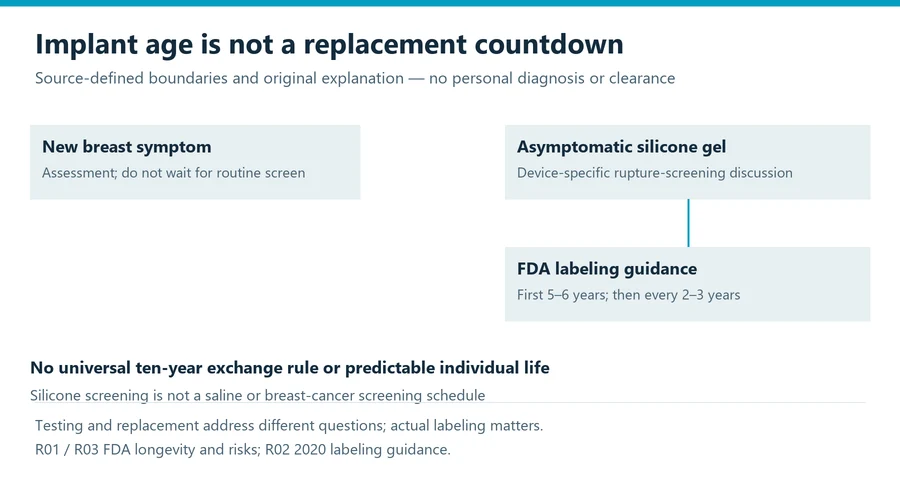
The FDA’s non-lifetime warning does not create a universal ten-year exchange requirement. Reaching ten years is a reason to know your records and discuss continuing care; it is not itself a diagnosis of rupture or a command to undergo surgery. Equally, being below ten years does not mean that symptoms or a suspected problem can be ignored. The device and clinical situation matter at both ages.
When someone answers “How long do breast implants last?” with a single number, ask what that number represents. Is it a manufacturer’s limited warranty, a study follow-up duration, a clinic’s scheduling policy or a complication estimate for one device and population? A follow-up period is not the maximum lifespan of every device, and a group estimate does not forecast your individual implant. This guide does not combine unrelated studies into a replacement promise.
An elective change may still be reasonable for reasons other than failure, such as a discussed appearance goal or a different implant preference. That decision has its own surgical risks and alternatives. Ask the surgeon to state the actual indication, what the proposed operation addresses and what it does not. A cosmetic preference should be described plainly rather than presented as an unavoidable age-based medical requirement.
What changes the monitoring discussion for silicone and saline?
The fill material changes how a rupture can present and how ongoing assessment is organized. FDA guidance describes silicone gel rupture as potentially silent: a physical examination alone may not detect it. Saline rupture usually causes a noticeable loss of volume or shape as the implant deflates. These differences explain why identical outward appearance or identical implant age cannot support the same conclusion for every person.
The FDA identifies MRI as the most effective method for detecting silent silicone gel rupture and ultrasound as an acceptable alternative for screening asymptomatic patients. The appropriate examination still depends on symptoms, findings, the device’s labeling and the clinician’s assessment. This is not an instruction to choose or interpret an imaging test yourself. A report should be discussed with the clinician responsible for your implant care. FDA rupture and screening explanation
For saline, visible deflation can occur quickly or over days. A change in size or shape merits contacting the treating practice; it does not establish every detail about the shell, surrounding tissue or recommended operation. Conversely, stable appearance with silicone does not demonstrate integrity. This is the key distinction when asking “How long do breast implants last?” without new symptoms: appearance and device surveillance answer different questions.
Is the five-to-six-year scan a replacement schedule?
No. FDA labeling guidance recommends that asymptomatic patients with silicone gel-filled breast implants have their first ultrasound or MRI at five to six years after implantation and then every two to three years. For symptoms or an equivocal ultrasound, that guidance recommends MRI. These intervals concern rupture screening in a defined device and symptom context. They do not prescribe implant replacement at the first scan or after every screening interval. FDA 2020 breast implant labeling guidance
The document is labeling guidance, and your actual device instructions and clinician’s plan remain relevant. Do not transplant this schedule to every saline implant, replace breast cancer screening with it or use it to delay evaluation of a new symptom. Routine surveillance and symptom-driven investigation serve different purposes. A calendar reminder can help arrange an appointment; it cannot determine which examination is required or whether an operation is indicated.
| Question | What the guidance concerns | What it does not establish |
|---|---|---|
| How long do breast implants last? | No predictable individual lifetime; complications become more likely over time | A universal ten-year exchange rule |
| First silicone rupture screen | Five to six years, asymptomatic silicone gel scope | A replacement appointment |
| Later silicone rupture screening | Every two to three years in the guidance | Permission to wait with symptoms |
| Saline shape or volume change | Possible deflation needs assessment | A self-confirmed diagnosis or fixed surgery plan |
Make the next monitoring appointment answer a specific question
Bring the implantation date, device card and any previous imaging reports. Ask whether the recommended examination is routine rupture surveillance, investigation of a symptom, breast cancer screening or another concern. If two appointments are needed, clarify which professional receives each report and who explains the findings. This administrative distinction prevents a completed test from being mistaken for a complete ongoing care plan.
Which new changes need assessment rather than an anniversary reminder?
Contact a clinician about a new breast shape or size change, increasing firmness, pain, swelling or another persistent concern. FDA implant guidance lists rupture, capsular contracture and other complications; an online symptom list cannot distinguish them reliably. The useful response is to describe the change and arrange appropriate evaluation, not to label the implant “expired” or assume a single cause.
Persistent swelling, a mass or pain around an implant also deserves clinical assessment because FDA guidance for breast implant-associated anaplastic large cell lymphoma, or BIA-ALCL, identifies these as relevant symptoms. That condition is distinct from ordinary breast cancer and from the label breast implant illness. Mentioning it here supports evaluation, not a prediction that a particular symptom is cancer. A diagnosis can change the required surgical approach, so assessment should come before choosing an operation. FDA BIA-ALCL questions and answers
Do not use a future routine screening date to postpone assessment of a new or worsening breast change. Contact the treating clinician for the appropriate response; severe acute illness or an emergency needs immediate medical care. A website cannot judge urgency from device age or photographs. When speaking to a practice, state whether the change is new, persistent or progressing and ask what to do if it worsens while you are awaiting an appointment.
How long do breast implants last when the breast still looks unchanged?
An unchanged appearance can be reassuring about your current cosmetic experience, but it does not answer every device question. Silicone rupture may be silent. Screening recommendations exist precisely because appearance and physical examination can miss that particular problem. Continue the actual monitoring discussion rather than treating a stable photograph as a substitute for it.
Appearance also changes for reasons beyond implant integrity. A clinician can evaluate the implant, surrounding breast and your goals together. This guide does not diagnose which factor explains a change or assign an operation from a photograph. If your concern is primarily appearance, make that explicit so the appointment can distinguish an elective preference from a complication investigation.
Avoid comparing yourself with someone else’s implant anniversary. Two people with the same number of years since surgery can have different fill materials, device models, operative histories, symptoms and findings. “How long do breast implants last?” remains a device-and-person question even when the calendar looks similar. Records and examination reduce useful uncertainty; another person’s reported lifespan does not replace them.
What should the device record contain?
The FDA advises keeping the implant patient device card. It can identify the manufacturer, model and other device information such as serial or lot details. If the card is missing, ask the operating practice or facility about obtaining the operative report and implant records. Do not guess the brand, fill material or surface from an image, scar or remembered marketing name.
Write down the date of the first operation and subsequent exchanges or revisions, noting uncertainty when a detail cannot be confirmed. The current device may not be the original one. Bring prior reports rather than trying to remember that “the scan was fine.” Knowing what was examined, when and why helps the clinician decide whether an old result is relevant to the present concern.
For appointment planning, separate verified device facts from your questions. A short page with the known model, surgery dates, symptoms and previous imaging is easier to use than a long collection of unrelated online claims. Keep copies accessible if you move or change clinicians. This organizational suggestion does not create a clinical monitoring interval; it makes the appropriate interval easier to establish and follow.
What happens if replacement or removal is discussed?
The decision can involve removal, replacement, capsule surgery, breast reshaping or another operation, depending on the actual indication and findings. Ask for the proposed scope in plain language. Replacing an implant and removing all surrounding capsule tissue are different decisions; neither should be inferred simply from years since implantation. A suspected implant-associated condition may require a specific diagnostic and surgical plan.
Discuss the alternatives, expected limitations, recovery responsibilities and possible need for further procedures. If systemic symptoms are part of your concern, FDA guidance says their causes are poorly understood and some patients report improvement after removal. That is not a guarantee of symptom relief and does not establish that every symptom was caused by an implant. Keep the symptom-assessment and surgical discussions connected without assuming the answer to either in advance.
For operative planning, the breast implant revision guide and breast implant removal guide address different procedural choices. This resource answers longevity and surveillance questions. It does not replace the surgeon’s explanation of your proposed procedure or a clinician’s evaluation of an unexplained symptom.
How can you compare advice without comparing incompatible numbers?
If clinicians or online sources give different answers, start with the endpoint and scope. A silicone rupture-screening interval, a manufacturer’s warranty duration and an elective exchange recommendation are not competing measurements of the same thing. Ask each source to identify the actual device and what action the number supports. That often resolves an apparent contradiction without choosing the shortest or longest figure.
Also ask what would change the recommendation. A stable asymptomatic assessment may lead to one plan, while a new symptom or uncertain imaging finding may lead to another. A useful plan explains those triggers and where to seek help. It should not rely only on “come back in a few years” without addressing what to do between visits.
If you are comparing a proposed operation with ongoing monitoring, ask about the findings behind the recommendation and the consequences of either choice. You can seek another qualified opinion using the same records. “How long do breast implants last?” should lead to an understandable plan, not pressure to purchase an operation because an arbitrary anniversary has arrived.
How long do breast implants last when records are incomplete?
Missing records do not create an expiry date. They create an information problem that should be discussed with the clinician. Ask the original facility about the implant card and operative report, and explain which details remain uncertain. Avoid interpreting a scar or remembered size as proof of fill material or model. A qualified assessment can consider what is known while determining the appropriate next step.
If the original practice is unavailable, tell the assessing clinician that directly. Keep the dates and documents you can verify, and label estimates as estimates. An old imaging report may still be useful even if the device card is absent, but a clinician must decide how it relates to the present question. This guide cannot reconstruct device identity from appearance.
The answer to “How long do breast implants last?” should therefore include an explicit record limitation when needed. It should not default to immediate exchange or indefinite reassurance solely because paperwork is missing. Ask what information would change the monitoring or intervention recommendation and who can help obtain it.
When someone offers a firm lifespan despite uncertainty about the actual device, ask what evidence supports it. “How long do breast implants last?” is a reasonable question; an exact answer requires more than confidence. A plan that explains uncertainty and symptom triggers is more useful than an unsupported number.
How long do breast implants last, and what should you bring to an appointment?
Gather the device card, operative history, prior imaging reports and a brief description of any changes. List the question you most need answered: routine surveillance, a new symptom, a device concern or an appearance goal. Ask the practice what records it needs and who will review them. If you have new symptoms, tell the practice when arranging the appointment rather than presenting it as a routine anniversary visit.
Leave with the reason for the next step, who is responsible for it and the circumstances that should prompt earlier contact. For a recommended test, clarify its purpose and report pathway. For an operation, clarify the indication and exact scope. For continued monitoring, clarify the device-specific plan. None of these choices requires pretending that a universal implant lifespan exists.
The practical answer to “How long do breast implants last?” is that there is no fixed individual expiry date. Breast implants require informed ongoing care because they are not lifetime devices. Use current FDA guidance, the actual device labeling and clinical assessment to organize that care, keeping rupture surveillance, symptom evaluation and replacement decisions as separate but connected tasks.
Sources and review scope
Plastic Surgery Editorial Team. Source records checked through October 12, 2026. Review scope: source and editorial checks for general education. No individual clinical assessment is represented.
- FDA implant consumer information. fda.gov. Publication/update date not stated. Checked 2026-10-12.
- FDA implant patient communication guidance. fda.gov. Source date: 2020-09-29. Checked 2026-10-12.
- FDA implant risks and rupture section. fda.gov. Source date: 2023-12-14. Checked 2026-10-12.
- FDA BIA-ALCL questions. fda.gov. Publication/update date not stated. Checked 2026-10-12.