
Plastic surgery medical necessity is not a coverage guarantee that a website can issue. Separate the clinician’s actual reason for recommending a service, the definition in your health plan and the plan’s determination about the proposed service. Obtain the relevant plan documents and ask what information is required. This page does not certify a condition, select a billing code or determine whether an individual operation will be paid for.
A procedure can have a clinical purpose without every associated charge being covered under a particular plan. An appearance goal, a symptom or a procedure name alone does not settle the benefit question. Use this resource to organize the documents and unanswered questions before making financial assumptions. It is a documentation guide, not an appeals algorithm or personal legal advice.
What does plastic surgery medical necessity mean in a general glossary?
HealthCare.gov defines medically necessary services in relation to diagnosing or treating an illness, injury, condition, disease or symptoms, consistent with accepted medical standards. That is an educational definition. It does not assess your condition or decide which operation is appropriate. A general definition can help frame a question, but it should not be used as a certificate that a particular proposed service qualifies for coverage. HealthCare.gov medical necessity definition
The glossary page is undated; its retrieval on October 12, 2026 is recorded separately. We do not assign a new publication date from a footer or search crawl. Nor do we copy the definition into a self-completed medical certification. Ask the treating clinician to explain the actual condition and proposed intervention, and ask the plan how its own terms apply to the submitted service.
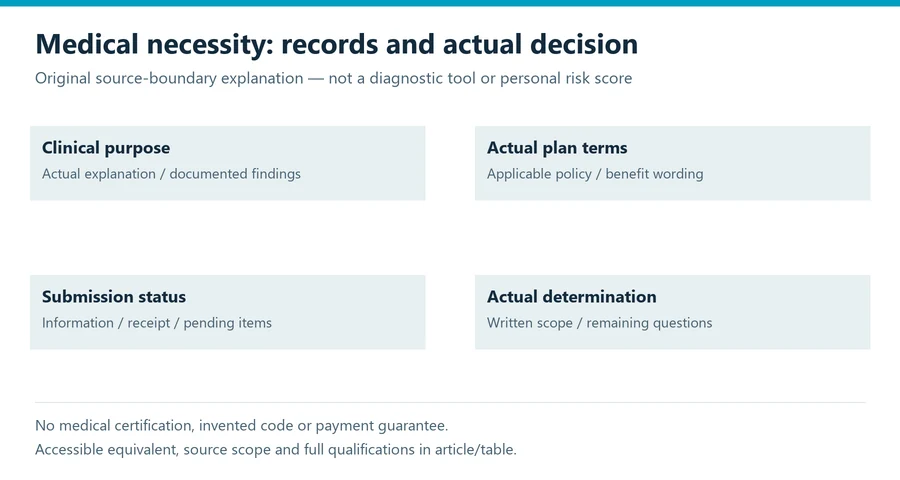
Plastic surgery medical necessity documentation should keep those two conversations identifiable. One entry records the clinical explanation, while another identifies the actual policy wording and requested determination. If either is missing, mark it missing. Do not bridge the gap by assuming that a procedure described as reconstructive must be covered or that a service described as cosmetic can never involve a covered indication.
| Plastic surgery medical necessity question | Actual document or answer needed | Boundary of this organizer |
|---|---|---|
| Clinical purpose | Clinician’s actual explanation and records | No website certification |
| Plan language | Applicable policy and benefit terms | Glossary does not replace the plan |
| Submission | Required information and confirmed status | No invented diagnosis or code |
| Determination | Actual decision, scope and remaining costs | No payment guarantee |
Distinguish a description from a determination
A clinician may describe why an operation is being considered, while a plan determines a benefit under its contract and process. The words can overlap without meaning the decisions are identical. Record who made each statement and what it applies to. This prevents a brief comment about a clinical goal from being remembered as confirmation that every provider and facility charge will be covered.
Why does the actual plan document matter?
HealthCare.gov’s coverage glossary states that its definitions are educational and may differ from the definitions in a policy or plan. The actual policy or plan governs. It points readers to their Summary of Benefits and Coverage for information about obtaining the plan document. This is a useful boundary for any website explaining insurance terminology: a general glossary is not your own contract. HealthCare.gov glossary and plan-document boundary
For plastic surgery medical necessity, ask which plan document and version apply to the date and proposed service. If you have more than one document, identify their purposes rather than treating them as interchangeable. A benefits summary, a clinical policy and an individual determination can answer different questions. Ask the plan to explain where the relevant requirements and exclusions are found.
Keep the exact document and its date in your record. If a representative describes a requirement over the telephone, ask how to obtain the written information or a record of the answer through the plan’s process. Do not manufacture a policy quotation from memory. Mark uncertain wording as uncertain until the source can be confirmed.
This page does not interpret a specific contract for you. It helps identify what needs to be reviewed by the appropriate service or professional. If the meaning remains disputed or unclear, ask for the plan’s explanation and consider appropriate assistance. A generic definition, an advertisement or another patient’s successful claim does not resolve the wording that applies to your own situation.
How does Medicare illustrate the importance of indication scope?
Medicare’s cosmetic surgery page says most cosmetic surgery is not covered, while describing specified exceptions related to accidental injury, function of a malformed body part and breast reconstruction after mastectomy because of breast cancer. The page also warns that a clinician may recommend services that Medicare does not cover. These statements concern Medicare’s scope; they do not determine every private plan’s benefits or a reader’s individual eligibility. Medicare cosmetic surgery coverage scope
Plastic surgery medical necessity should not be reduced to a procedure name. The indication and actual service being proposed matter to the benefit question. This page does not advise relabeling a cosmetic goal, adding an unestablished symptom or choosing a diagnosis code to obtain payment. Ask the clinician to document the actual clinical findings and ask the plan what information it requires for its determination.
We did not establish a revision date for this Medicare page. Its current text was checked October 12, 2026, and its Medicare-specific limits are retained. A current page’s examples should not be transferred into a universal promise that every service with a similar purpose is covered. The actual plan, setting and determination process still need to be identified. For that specific benefit topic, the breast reconstruction coverage documentation addresses its own plan and statutory scope rather than a universal necessity certificate.
If Medicare or another plan is relevant to your case, ask which requirements apply to the proposed service and where to find the written explanation. Do not assume that a statement about one care setting automatically describes another. This organizer records questions and responses; it does not make a coverage decision or provide a coding recipe.
Does preauthorization settle the final payment question?
HealthCare.gov’s preauthorization glossary explains that a plan may require authorization for a service and expressly states that authorization is not a promise the plan will cover the cost. That distinction matters when a scheduled procedure depends on several separate facts. The page is undated, and the source does not certify an individual claim or explain every plan’s process. HealthCare.gov preauthorization and payment limit
For plastic surgery medical necessity, record whether authorization is required, requested, pending or actually issued. Keep those statuses separate. A request submitted is not an approval, and an approval needs its actual scope identified. Ask which service, date, provider or other condition it concerns and where the written determination can be obtained. Do not assume a broad statement covers every associated item.
Ask what remains to be confirmed about benefits and patient responsibility. This article supplies no personal deductible, coinsurance calculation or network conclusion. The plan and billing entities should explain the actual information needed. A practice’s estimate may assume a particular benefit outcome; ask which assumptions are confirmed and which remain provisional.
If a proposal changes, ask whether the authorization or determination needs review. Do not assume a new operation, date or setting fits the earlier answer. Keep the updated information with the record and identify who will communicate with the plan. This is original document organization, not a legal conclusion that a specific change invalidates or preserves a benefit.
Which clinical information should be documented honestly?
Ask the clinician what findings and history are relevant to the proposed service. Provide accurate information and identify uncertainty. If another professional has assessed the concern, ask how the records should reach the treating team. Do not invent a symptom, duration, previous treatment or functional limitation because a form contains a space for it or an online example suggests it is useful.
Plastic surgery medical necessity records should describe what is actually established. A patient observation can be communicated as an observation; a clinical diagnosis should come from the appropriate assessment. Keep the clinician’s explanation and the plan’s document request separate so that an administrative requirement does not become a reason to self-diagnose.
If a requested item does not exist, ask the team how to handle that gap. The answer may involve another assessment or clarification of the request, but this website does not prescribe a test or treatment solely to create documentation. A completed application should reflect the facts, including missing or pending information, rather than a story assembled to fit a desired outcome.
Use dates accurately. The date a concern began, the date of a visit and the date a report was issued can differ. If you are estimating an event, mark it as an estimate. This original record practice improves transparency; it does not show that the underlying clinical condition meets a plan’s criteria or guarantee a favorable determination.
How should a submission record be organized?
Create separate entries for the proposed service, the relevant document, the requested information, the person responsible for submitting it and the actual submission status. Keep a copy of the material through the appropriate privacy process. An organizer can help you notice an unanswered request without reproducing a plan’s official form or replacing its required submission channel.
For plastic surgery medical necessity, record a reference number only when the service actually supplies one. Do not create an artificial confirmation to make the record look complete. Note the date and source of an answer, and distinguish a representative’s explanation from a written determination. Ask how to obtain clarification when those materials appear inconsistent.
If information is sent by the clinician, ask how you will know whether the submission was received and whether further items are requested. Receipt is not the same as review or approval. Keep the next contact visible and ask who owns it. This page does not provide a universal processing deadline or promise that a complete-looking file produces payment.
Preserve the actual result when it arrives. Identify what was decided and what remains unanswered, including any proposed services outside its scope. If a response is unfavorable or unclear, follow the plan’s actual information and seek appropriate assistance. The separate appeals resource should address review processes; this page’s purpose is an accurate determination record before assumptions about coverage become financial commitments.
How do mixed goals and separate charges affect the record?
An operation discussion can include more than one goal or component. Ask the clinician to describe the actual proposal and ask the plan which submitted service is being considered. This guide does not divide an operation into billable codes or determine whether a component is covered. It provides space to identify an unanswered scope question that the relevant professionals should resolve.
Plastic surgery medical necessity documentation should also identify the billing parties whose charges are being discussed. Do not assume that a statement about the surgeon’s service covers anesthesia, a facility or another item. Ask each relevant service and the plan for the applicable information. The actual cost and benefit documents should be retained without treating an overall estimate as proof of a completed coverage determination.
If some charges are expected to be self-paid, ask for the actual written terms and clarify any assumptions about the covered portion. This page does not recommend a financing arrangement or decide whether a contract is enforceable. For a payment contract, the financing contract and total-obligation questions addresses a different question from medical readiness or an expected charge. It helps separate the clinical purpose, benefit question and payment agreement so that one answer is not used to fill all three spaces.
A change in the proposal should trigger a question about the record’s currency. Ask whether updated clinical information, authorization or estimates are needed. Do not revise the clinical description yourself to preserve an earlier financial assumption. The responsible services should explain what applies to the actual changed plan.
What if two sources appear to give different answers?
First identify whether they describe the same plan, service, indication and care setting. A general glossary and a plan-specific policy may use similar terms without having the same scope. A clinician’s recommendation and a benefits representative’s answer also perform different roles. Record the apparent difference accurately and ask the appropriate service to clarify it.
For plastic surgery medical necessity, avoid comparing an isolated sentence from another patient’s experience with your own complete determination record. Their plan and circumstances may differ. Ask what the current written terms say and how the relevant decision was made for your submission. This original comparison method does not rank insurers, establish fault or determine an individual’s legal rights.
If a document cannot be obtained, keep that limitation visible. If an actual determination needs review, use the insurance appeals process rather than treating this documentation organizer as an appeal submission. A missing policy should not be replaced with a guessed definition, and a pending answer should not be marked covered. Ask what assistance is available through the plan or an appropriate professional. A clear unresolved question is more useful than an unsupported assurance.
How can a telephone explanation be retained accurately?
Write the date, the service contacted and the question you actually asked. Record the answer in ordinary language and identify whether it concerned a definition, a document request or a determination. Ask how to obtain the applicable written information. Do not turn a representative’s general explanation into an approval number or a promise that every charge will be paid.
For plastic surgery medical necessity, a reference number can help identify a conversation when one is supplied, but it does not itself establish coverage. Keep the actual question with the number so a later contact can understand what was discussed. If the answer depended on information still being submitted, record that condition. Pending documentation should remain pending until the actual process advances.
If the written response differs from your notes, ask the relevant service to explain the difference. Preserve both records instead of silently rewriting the earlier account. This original record practice does not establish which statement legally controls or show that either party acted improperly. It helps make the uncertainty precise enough to discuss with the plan, clinician or appropriate adviser using the actual documents.
What should be clear before financial commitments are made?
Identify the actual proposal, the plan documents, the status of any required determination and the assumptions in the cost estimate. Ask what happens if the plan’s answer changes or the service differs from what was submitted. Those questions belong to the actual billing and contract process; this page provides no refund guarantee or personal instruction about payment.
Plastic surgery medical necessity remains a scope and documentation question on this website. The primary sources were checked October 12, 2026, and this article has not received qualified clinical review. Its original organizer is not a medical certification, insurance form or validated coverage predictor. Use it to prepare accurate questions and retain actual decisions, while leaving clinical assessment and benefit interpretation to the responsible professionals and plan.
For operation-specific information, see the procedure guides and ask about the actual indication and payment arrangement for your proposal.
Sources and review scope
Plastic Surgery Editorial Team. Source records checked through October 12, 2026. Review scope: source and editorial checks for general education. No individual clinical assessment is represented.
- HealthCare.gov medical necessity definition. healthcare.gov. Publication/update date not stated. Checked 2026-10-12.
- HealthCare.gov glossary and actual plan language. healthcare.gov. Publication/update date not stated. Checked 2026-10-12.
- Medicare cosmetic versus covered indication scope. medicare.gov. Publication/update date not stated. Checked 2026-10-12.
- HealthCare.gov preauthorization limits. healthcare.gov. Publication/update date not stated. Checked 2026-10-12.