
Plastic surgery home preparation starts with the treating team’s actual instructions and the home where you will recover. Record the relevant task, location, access question, required supply if any and unresolved issue. Ask the team about needs you cannot confidently arrange. This original worksheet helps connect individualized instructions to a real environment; it does not prescribe a bed position, equipment list, bathing plan, lifting limit or universal period of help. A prepared-looking room does not establish clinical readiness or replace discharge assessment.
Download the home preparation worksheet (printable PDF). Complete it privately and bring unresolved care questions to your treating team.
What should plastic surgery home preparation accomplish?
Make the plan specific enough to describe how an actual task will work. “Recovery area ready” is vague if you have not considered the route to it, the instructions that apply or the items you need to reach. Identify what is known and what still requires clarification. You can organize a communication point or identify a loose cable without deciding that a particular chair, device or room arrangement is suitable for your medical situation. Keep environmental observations separate from clinical conclusions.
Start before purchasing supplies when possible. A recommended product in an online recovery story may not be required, suitable or compatible with your actual instructions. Ask the team what is needed, whether you will receive it, whether training is required and who can answer questions about its use. The goal is a usable plan, not the largest collection of recovery products. Plastic surgery home preparation should reduce avoidable uncertainty about arrangements rather than make equipment ownership look like evidence of adequate care.
MedlinePlus’s general home-preparation education, reviewed July 3, 2025, advises asking health professionals about the home setup and notes that not every suggested change is needed. It discusses access to everyday items and household obstacles. That is general posthospital education, not an individualized plastic surgery plan. This guide does not adopt its suggested equipment, caregiver periods or activity instructions as universal requirements, and the original worksheet does not copy the source’s checklist. 1
Build the plastic surgery home preparation instruction-to-room record
Use the actual instruction as the starting point for each row. If the team has not supplied an instruction about a task, record a question instead of filling the blank with a guessed restriction. Identify the relevant location and what needs to be arranged there. A room can serve several tasks, and one task can involve several rooms. The worksheet follows the task rather than assuming that a bedroom alone is the complete recovery environment. Keep the current instruction source next to the entry. Use the discharge instruction record as the source of actual individualized requirements for this environment record.
| Preparation record | What to observe or confirm | What remains an individualized question |
|---|---|---|
| Entry and movement route | Actual steps, obstacles, lighting and access arrangements | Suitability for your circumstances and any required assistance |
| Rest area | What the team instructed and whether the arrangement is available | Position, transfers, devices and clinical restrictions |
| Everyday items | Where the needed items are and how they can be accessed | What movements or activities are permitted |
| Bathroom task | Actual setup and unresolved access or supply questions | Bathing, wound care, equipment and timing instructions |
| Communication point | Accessible contacts, instructions and a backup method | Clinical response process and assessment of new concerns |
Describe a practical observation plainly. “The phone charger crosses the walking route” is more useful than “the room is unsafe,” because it identifies something concrete to address. “The requested supply has not arrived” is more useful than “I am not ready,” because it identifies a dependency for the team to review. Avoid diagnosing a mobility problem or certifying the home yourself. The record organizes observations so that the right professional can assess what they mean in your actual situation.
Separate the question about a supply from the question about using it. Having a device at home does not establish correct fit, appropriate setup or ability to use it. If the team recommends something, ask who provides the necessary instruction and what to do if it is delayed, damaged or difficult to use. Your plastic surgery home preparation record should preserve those stages. An item being ordered, delivered and understood are different events, and any unresolved clinical issue should be taken back to the responsible team.
Walk through the environment without inventing restrictions
Look at the places involved in your actual plan: entry, rest area, bathroom, food access and communication. Note where a practical arrangement depends on a clinical answer. For example, the usefulness of a proposed rest area may depend on an instruction that has not yet been clarified. Record that dependency rather than assuming you should change rooms, buy a particular chair or adopt a position from a procedure video. The clinician’s explanation supplies the medical context that an environmental checklist cannot establish.
Review ordinary household obstacles such as clutter, poor lighting or a cable in a commonly used route. General home-safety information can help you notice these issues, but it does not tell you what movement is suitable after your specific procedure. If a change involves installation, building access or a device, obtain the appropriate assessment and permissions rather than improvising a support. A household object that seems sturdy is not automatically suitable equipment. This guide provides no construction or device-fitting instructions.
NIA’s home-safety tips are directed at older adults aging in place. The actual official page transcript, updated June 5, 2025, includes lighting, access and fall-hazard context. Those environmental questions can be relevant when discussing an older adult’s arrangements, but they are not universal postoperative requirements for every reader. This guide uses the limited context and creates an independent record; it does not reproduce the agency’s infographic or claim a measured reduction in falls from using this worksheet. 2
An original plastic surgery home preparation example
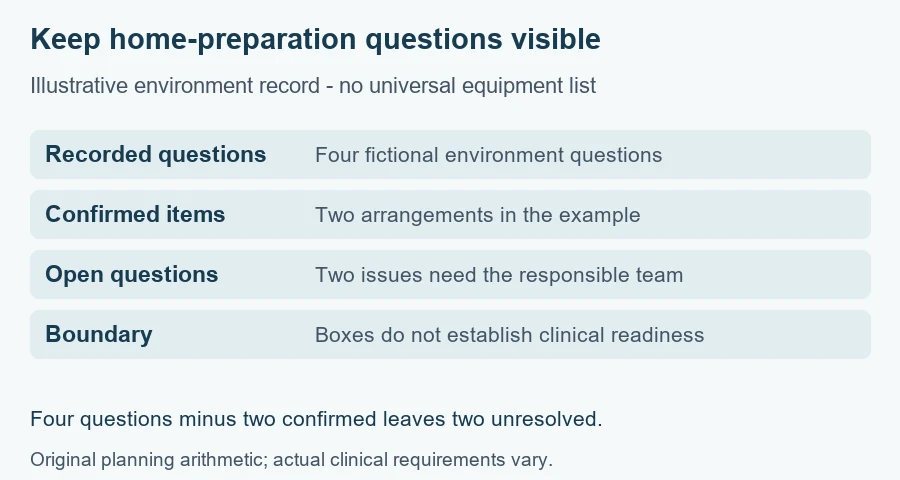
Consider a fictional plan with four environmental questions: the entry route, the location of everyday items, the communication point and a bathroom arrangement that needs professional clarification. Suppose two questions have confirmed arrangements and two still need answers. Four recorded questions minus two confirmed arrangements leaves two unresolved questions. These counts are invented to show how an open issue remains visible. They do not establish a required number of rooms, suitable equipment or permission to go home after surgery.
The two unresolved questions might depend on different roles. A missing household delivery can require contacting the supplier or person arranging it. A question about a clinical restriction needs the treating team’s explanation. Record which role can answer each issue and how the answer will be confirmed. Do not treat a supply arriving as resolution of an unrelated clinical question. Likewise, a clinician’s instruction does not automatically mean the practical arrangement has been made or that another person has agreed to assist.
Avoid labeling the fictional plan “half safe” because two of four questions are confirmed. The questions are an editorial planning list, not a validated assessment instrument. One unanswered issue can be consequential even if many other details have been organized. Plastic surgery home preparation should expose the type of uncertainty, not turn it into a readiness percentage. The actual treating team must assess the patient and relevant arrangements, including what happens if a needed item or practical solution is unavailable.
Use older-adult fall resources within their actual scope
CDC’s STEADI Check for Safety brochure is an older-adult home fall-prevention resource with a printed 2018 year. Its two pages include questions about floors, stairs, lighting and bathroom surroundings. Those categories can help a reader notice environmental issues to discuss, but they do not establish postoperative restrictions or certify a home. This guide does not infer that every plastic surgery patient has the same fall risk, needs the same changes or should follow a generic equipment prescription. 3 The disability access planning record keeps an actual access request distinct from a general household checklist.
Keep a household observation and its proposed solution distinguishable. Noticing a dark route is an observation. Deciding which lighting change is suitable may involve practical constraints, electrical work or landlord permission. Noticing a possible access problem is an observation. Choosing a device or assistance method may require professional assessment. The original worksheet records both the observation and the next question so that a broad agency suggestion is not mistaken for a complete individualized solution.
Do not import exercise, walking or balance instructions from a general fall-prevention resource into an actual postoperative plan. The team must explain what activity is appropriate and how its instructions relate to your circumstances. The purpose of plastic surgery home preparation is to organize the environment around that plan. If existing mobility equipment or assistance is part of your life, tell the team accurately rather than assuming a new generic recovery list overrides the arrangements you already use.
Keep supplies, instructions and permissions separate
A supply list should identify the actual item requested, who supplies it and whether any use instructions have been received. Do not replace a specific item with a product that looks similar without asking the team. Keep packaging or product information available when it is needed for clarification, and use the practice’s appropriate channel for questions. This guide does not select wound products, dressings or medicines. It helps you record what is actually requested and what remains unresolved.
Storage and access are also practical questions. Keep necessary instructions and contacts available, while protecting medicines, private documents and other sensitive items from inappropriate access. If children, pets or other household members use the same space, discuss how ordinary household routines intersect with the actual plan. Do not assume that moving an item means you have resolved every risk or clinical need. The worksheet can identify the question without prescribing a universal child, pet or medicine-management arrangement.
| Item status | Meaning in the original record | Next question if unresolved |
|---|---|---|
| Requested | The actual team identified an item or information need | Who supplies it, and is the request understood? |
| Ordered | An arrangement has been made to obtain it | What happens if delivery or access fails? |
| Available | The specified item or document is actually present | Are use instructions, fit or setup still needed? |
| Clarified | The responsible role explained the relevant question | Does the practical arrangement now match that explanation? |
| Changed | The plan or item requirement has been revised | Which earlier assumptions must be revisited? |
Ask about a plan for a delayed or missing item rather than treating a substitute purchase as the automatic answer. A team may need to assess whether the proposed arrangement should change. Preserve that dependency in the record. Buying something quickly can solve a practical availability issue while leaving suitability unclear. The useful evidence is the actual request, availability and explanation, not a receipt alone. Plastic surgery home preparation should make those facts easy to distinguish when you ask for help.
Coordinate the home record with actual support arrangements
The environmental worksheet does not replace a caregiver roster. A room may be organized while a required task has no willing and able person assigned. A helper may be available while the relevant location or item remains unsuitable or unclear. Keep the records separate and cross-reference the actual dependency when needed. This guide concentrates on the environment and instruction source; the care team and the people providing help must clarify the task, ability, availability and responsibility in their own actual arrangements. Connect agreed practical tasks to the caregiver planning worksheet so an available room is not mistaken for confirmed support.
Describe tasks rather than making assumptions from a person’s presence. Someone who can receive a delivery may not be able or authorized to help with another activity. A visitor may not know where the current instructions are kept. If you want a person involved, agree what information they need and how to share it privately. The worksheet can point to the current instruction and unresolved question without placing your complete medical history into a widely shared household message.
Keep communication arrangements practical. Identify where the team contacts and actual instructions can be found if a device is unavailable. Ask the team what route to use for questions and what applies outside routine hours. Do not make a home-preparation calendar the basis for waiting on a new concern. The record contains no diagnosis or symptom urgency threshold. Appropriate medical assessment follows the actual instructions and circumstances, not whether an environment checklist has been completed.
Update plastic surgery home preparation when instructions change
Date a change and record its source. If a revised instruction affects access, supplies or an ordinary task, revisit the relevant row instead of leaving the earlier arrangement silently in place. Mark an old entry as superseded or awaiting clarification as appropriate. A change log prevents a purchased item or an attractive room layout from becoming a reason to ignore a new professional explanation. The actual instruction governs the planning question; the worksheet preserves how the arrangement responds to it.
If two directions seem inconsistent, take both to the responsible team and ask for clarification. Do not decide that the latest message automatically cancels every earlier document, especially when different roles supplied the information. Record the question and the answer when obtained. Your plastic surgery home preparation record should represent uncertainty honestly until it is resolved. It cannot reconcile clinical advice by itself, and it does not provide a rule for choosing between individualized instructions.
A printable plastic surgery home preparation worksheet
The printable version has fields for the actual instruction or question, relevant place, observed arrangement, responsible role and unresolved dependency. Its separate sections record changes and next confirmations. It is an original private planning aid, not an agency form or discharge certificate. Leave a clinical field blank if the team has not supplied the information. A blank marked for clarification is preferable to a confident entry copied from a recovery story that may describe a different situation.
Use the worksheet to prepare a focused discussion before making changes or purchases. After the team supplies an answer, record the actual practical action and whether it has occurred. Review the sheet when the instructions or household arrangement changes. Do not assign a readiness score or infer that a completed set of boxes guarantees a favorable recovery. The value comes from finding a specific problem or uncertainty and connecting it to the role that can address it.
| Review moment | What to update | Boundary to preserve |
|---|---|---|
| Before purchases | Actual requirements and unresolved questions | Online product lists do not establish need |
| When arranging the room | Access, available items and instruction source | Layout does not establish clinical readiness |
| After a professional answer | Practical action and confirmation status | Explanation and completed arrangement are different |
| When the plan changes | Dependent tasks and outdated assumptions | Do not silently reuse superseded instructions |
Questions about the environment record
Does plastic surgery home preparation require special furniture?
No universal purchase list is given here. Ask the actual team what your circumstances require and whether existing arrangements can meet those needs. Equipment choice, fit and use may need professional assessment. An item being marketed for recovery does not establish that it is suitable for you. Record the question before buying, and keep the answer beside the actual arrangement so that a commercial claim does not become a clinical instruction.
Can I use an older-adult checklist if I am younger?
You can recognize ordinary household observations, but preserve the resource’s population and purpose. Its equipment and fall-prevention suggestions do not automatically become a postoperative plan for a younger person or for a specific operation. Ask which issues are relevant to your actual circumstances. This guide uses older-adult sources within their scope and supplies no comparative fall-risk estimate, universal change requirement or promise that an original worksheet prevents complications.
What if a practical question remains unanswered?
Keep it visible and contact the responsible role. Explain the actual task, instruction and home circumstance rather than only saying that the room is unfinished. Ask what arrangement is appropriate and how a change will be confirmed. A plastic surgery home preparation record is useful when it reveals a concrete dependency that can be discussed; it should not make an unresolved situation look settled because most other entries have been filled in.
Sources and review scope
Plastic Surgery Editorial Team. Source records checked through October 12, 2026. Review scope: source and editorial checks for general education. No individual clinical assessment is represented.
- MedlinePlus: Getting your home ready after the hospital. medlineplus.gov. Source date: 2025-07-03. Checked 2026-10-12.
- NIA: Home safety tips for older adults. nia.nih.gov. Source date: 2025-06-05. Checked 2026-10-12.
- CDC STEADI: Check for Safety, home fall prevention for older adults. cdc.gov. Source date: 2018. Checked 2026-10-12.