
Plastic surgery disability access means being able to use the consultation, examination and follow-up services, not simply reaching the front door. Before booking, describe the assistance, equipment and communication arrangements you need and ask the practice to confirm how the actual visit will work. An accessible parking space or a general website statement does not establish that the assigned examination room, transfer equipment or discharge arrangements meet your needs.
This guide helps you prepare a service-confirmation record for a US practice. It separates physical access from surgical eligibility and distinguishes the consultation location from any later operating facility. The original appointment-stage worksheet records what is confirmed, who is responsible and what remains unresolved. It does not certify a named facility, prescribe transfer techniques or determine your individual rights in a dispute. Accessibility planning should support an appropriate assessment, not replace it.
What should plastic surgery disability access cover?
Think through the whole visit in order: booking, arrival, entering the room, examination, discussion and leaving. Identify the task at each stage that could create a barrier. You do not need to predict every architectural detail yourself. Describe what you use, what assistance works for you and which tasks need a clear answer. The practice can then explain its arrangements rather than replying only that the building is accessible.
Keep the access task separate from a request for medical clearance. A clinician assesses whether a proposed operation is suitable; the practice also needs to make its services accessible. Needing help to transfer does not by itself answer the medical question. Conversely, having a confirmed accessible room does not establish that surgery is appropriate. Write the two decisions separately so practical arrangements do not silently become a substitute for individualized clinical assessment.
Plastic surgery disability access can differ between visits even within the same practice. A face consultation might not require the same positioning as an abdominal assessment, and a later facility may have different equipment. Ask what the planned examination involves and how your needs will be addressed there. Reconfirm the actual appointment and location when they change rather than assuming that an earlier arrangement automatically follows you.
Separate an accessible entrance from an accessible examination
DOJ medical-care guidance explains that access involves the service and the examination equipment as well as the route through the building. It identifies accessible tables, transfer assistance and appropriate staff preparation as relevant examples. The document also distinguishes situations in which lying down is needed from examinations that can be completed while seated. Its purpose is equal access to the required examination, not a universal requirement for every patient to use the same position. [1]
Ask whether the room assigned to your appointment has the relevant equipment and space. A practice may own an accessible table but need to reserve the room in which it is located. Request confirmation for the actual visit, including any anticipated positioning assistance. Do not infer readiness from a photograph of equipment elsewhere in the building. The useful answer is how the service you are booking will be provided.
For plastic surgery disability access, discuss equipment compatibility with the practice rather than attempting to plan a transfer from an online diagram. Tell the team what usually works and what creates difficulty. Ask who will assess the transfer arrangement and whether trained staff and suitable equipment will be available. This guide gives no lifting or handling instructions. A practical plan should protect both you and the staff while supporting the required examination.
An appointment-stage access record
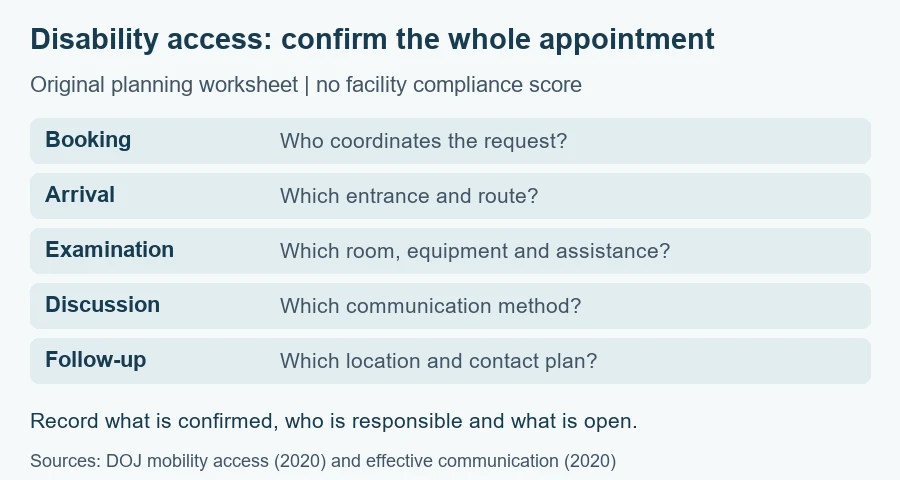
Use the following worksheet to turn a broad assurance into a specific confirmation. Its stages are an original planning structure, not an accessibility score or a clinical checklist. A blank field means a question remains open; it does not prove that the practice cannot provide the service. Record the date and the person who supplied the answer so it can be revisited if the appointment changes.
| Plastic surgery disability access stage | Question to confirm | Record the actual arrangement |
|---|---|---|
| Booking | Who coordinates the access request? | Named role, contact method and confirmation date |
| Arrival | Which entrance and route should you use? | Directions tied to the actual location |
| Examination | Which room, equipment and assistance are arranged? | Confirmed resources rather than a general building claim |
| Discussion | What communication or format support is needed? | Method agreed for the relevant task |
| Leaving and follow-up | How will departure and the next contact work? | Separate arrangements for each setting |
Keep confirmation and assumption visibly different. If a receptionist says that staff will call back, record it as awaiting confirmation, not completed. If a room is reserved for one appointment, do not extend that confirmation to a later operating facility. This simple distinction prevents an access record from looking complete while the most important practical question is still unanswered.
Describe assistance needs without surrendering the conversation
You are the source of information about assistance that works for you. Describe it in your preferred terms and ask the team to address questions to you. A companion may help with travel, notes or a task you choose, but that does not mean the companion should replace you in the consultation. Clarify whether you want them present for the examination and discussion, and which information you authorize them to receive. Use the plastic surgery caregiver planning guide to distinguish agreed practical help from control of the person’s consultation.
DOJ mobility guidance states that a patient should not be required to bring someone to provide examination assistance that the provider needs to arrange. Choosing to bring support is different from making your companion the practice’s default transfer plan. Ask how the staff will provide the necessary assistance and keep the companion’s optional role separate. This helps avoid a booking agreement that depends on a friend doing an unassessed physical task.
Plastic surgery disability access planning may involve personal information, so ask where the request will be recorded and who needs it for the visit. Provide the details necessary to coordinate the task rather than assuming every person in the practice needs your complete history. If you use a written access note, make clear that it describes preferences and practical needs; the treating team still needs to perform its own assessment and agree suitable arrangements.
Confirm communication access as a separate task
Physical access does not settle communication. You may need an accessible document, a communication aid, captioning or a qualified interpreter depending on the situation. Explain the method you use and the task for which it is needed. A brief scheduling exchange and a complex consent conversation can require different arrangements. Do not let a successful phone booking stand in for a plan for understanding the examination findings and proposed treatment. Read the plastic surgery interpreter access guide for the separate language-support arrangements described here.
DOJ effective-communication guidance emphasizes the nature, length and complexity of the interaction and the person’s usual method of communication. It describes different aids and services rather than one method for every situation. Ask the practice to discuss what will work for you and confirm the arrangement for the appointment. The separate interpreter-access guide covers language and interpreting questions in more detail. [2]
When considering plastic surgery disability access, include written instructions and later contacts in the request. A communication arrangement that ends as soon as the consultation finishes may leave you unable to use follow-up information. Ask for the necessary format and a contact method you can actually use. Distinguish routine contact from urgent instructions, and have the treating team explain how both will be communicated.
Different rules have different provider boundaries
DOJ’s mobility guidance explains that private medical offices fall within ADA Title III, while state and local government services fall within Title II. Section 504 concerns programs and activities receiving federal financial assistance. These are distinct legal scopes. An access request should not rely on the assumption that every office has identical funding, building circumstances or regulatory obligations. The guidance helps frame the discussion; it does not decide the facts of your individual dispute.
HHS’s Section 504 materials address recipients of its financial assistance and include accessible medical diagnostic equipment. In May 2026, HHS announced an extension concerning specific web and mobile accessibility compliance dates. That announcement is not a general suspension of disability access or a statement that equipment and services can remain inaccessible. Keep the subject of a deadline clear before using it to interpret what a practice says about your request. [3][4]
For plastic surgery disability access, ask the practice to explain its own arrangements rather than asking it to certify compliance with every law during a booking call. If an access problem remains unresolved, you can consult the relevant agency’s information and complaint resources. Keep factual records of the request, response and event. This guide does not determine which legal remedy applies or promise a particular outcome from a complaint.
A later surgical facility needs its own confirmation
The consultation office and operating facility may be different locations with different staff, equipment and routines. Ask who coordinates access at each site. A confirmed office arrangement should not be interpreted as confirmation of transport, positioning or discharge support elsewhere. If surgery is proposed, obtain an explanation tied to that setting before assuming your consultation plan is sufficient.
Explain the practical tasks that matter after treatment: using your mobility device, transferring, dressing, reaching supplies or receiving assistance. The treating team must assess how its instructions interact with your usual routine. Do not replace that discussion with generic exercise or recovery advice. An existing way of doing a task may need clinical review after an operation; this guide cannot determine which method or timing is appropriate.
Plastic surgery disability access planning should distinguish facility services from the support you independently choose at home. Ask what is arranged on site and what the discharge discussion expects after you leave. Write unanswered questions down. A companion’s availability, a vehicle reservation or a home-care service is not automatically confirmed because the operation date has been selected. Coordinate practical needs without treating them as proof of medical readiness.
| Setting | Confirm independently | Avoid carrying over this assumption |
|---|---|---|
| Consultation office | Examination room, equipment and communication | The entrance alone establishes complete access |
| Operating facility | Site-specific access and assessed positioning plan | The office’s equipment exists at this location |
| Discharge process | Instructions, departure and contact arrangements | A companion is automatically available or sufficient |
| Follow-up visit | Actual location and assistance needs | Earlier room reservations continue indefinitely |
| Home planning | Tasks and chosen support discussed with the team | The clinic has arranged services it never confirmed |
What if a service animal is involved?
DOJ’s service-animal resources distinguish access to ordinary public areas from settings such as an operating room where a sterile environment can create a specific concern. They also address responsibility for the animal’s care. Discuss the relevant setting and the care arrangement in advance instead of interpreting a general welcome statement as permission for every clinical space. The animal’s role and the planned location matter. [5][6]
Keep this request separate from your own clinical support plan. If you expect a period when you cannot provide the animal’s care, identify who will handle that task and confirm the arrangement. Do not assume medical staff will provide animal care or that separation is inevitable in every setting. Ask the facility for an explanation of the particular issue and how it will be addressed, using the current DOJ resource where clarification is needed.
For plastic surgery disability access, a service-animal question should become one recorded task, not a reason to overlook examination equipment or communication. Your own access needs still require confirmation. A complete planning record can show both the clinical-service arrangement and any animal-care question that remains unresolved, without treating either as a substitute for the other.
If the plan changes, check the dependency that changed
An appointment moved to another room or site can change the access arrangement even when the clinician and procedure remain the same. Ask what changed and which confirmation must be repeated. Keep the original record instead of replacing it silently; record the new location or date alongside the new answer. This makes it easier to identify a missed handoff between scheduling and clinical staff.
Use a simple status for each item: requested, confirmed for this visit, changed or unresolved. These are organizational labels, not ratings of a practice. If the practice proposes an alternative, ask how it provides the service you need rather than accepting or rejecting it based solely on the label. The important question is whether the actual examination and communication can be completed appropriately in the proposed arrangement.
Plastic surgery disability access is easier to coordinate when responsibilities are explicit. Ask which person or team will contact you about the open issue and how you will receive that answer. A plan that depends on several people should not leave each assuming someone else has confirmed the equipment or support. Recheck the issue before travel, particularly if the appointment changed after the original discussion.
| Access item status | Meaning in your record | Useful next question |
|---|---|---|
| Requested | Need communicated, arrangement not yet confirmed | Who will provide the answer? |
| Confirmed for this visit | Specific resource or assistance agreed | Does the date and location still match? |
| Changed | A relevant detail differs from the earlier plan | Which confirmation must be repeated? |
| Unresolved | A question still prevents confident planning | What information or alternative is needed? |
Check the booking process as well as the visit
If an online form, patient portal or electronic document prevents you from completing a task, describe the specific barrier to the practice. A form that cannot be used is different from a question about surgical suitability. Ask how you can supply the necessary information and receive the response in a usable way. Do not assume a portal message has been received simply because you attempted to send it; request a confirmation through an accessible contact method.
For plastic surgery disability access, record the alternative arrangement alongside the original task. For example, if staff arrange a different way to complete registration, note what information remains needed and who will confirm completion. Avoid entering duplicate requests without explaining the earlier barrier, since that can obscure which record is current. The goal is a usable route to the service and a clear confirmation, not learning every detail of the practice’s software. Revisit the arrangement if another document or later contact uses a different system.
When is the access discussion complete enough to travel?
You should know the actual location, who coordinates the request, how the planned examination will be accessible and how you can use the communication and follow-up arrangements. An unresolved essential task deserves clarification before you rely on an assumption. This is a practical planning check, not a medical clearance or a certification that the building complies with every applicable standard.
Before attending, summarize your plastic surgery disability access plan in ordinary language and ask the practice to correct any misunderstanding. Keep the confirmation available in the format you use. If you encounter a barrier, describe the specific event and request the assistance needed to receive the service. Appropriate clinical assessment and accessible service should be considered together, while remaining distinct decisions with their own evidence and responsibilities.
Sources and update record
Primary government resources checked October 12, 2026. Their scope varies by provider type, funding and service; this guide does not determine an individual legal claim. No facility assessment, legal review or clinical review is claimed.
| Source | Observed date | Scope |
|---|---|---|
| DOJ medical care and mobility access | Updated June 26, 2020 | Services, examination equipment and assistance; provider-type boundaries |
| DOJ effective communication | Updated February 28, 2020 | Context-specific aids and services |
| HHS Section 504 detailed fact sheet | Reviewed July 24, 2026; underlying 2024 rule distinguished | HHS financial-assistance recipients; not every office’s identical obligations |
| HHS web and mobile deadline extension | May 7, 2026 | Specific web/mobile compliance dates, not a blanket access suspension |
| DOJ service-animal topic guidance | Undated topic page | Setting-specific access boundaries |
| DOJ service-animal questions | Updated February 28, 2020 | Care arrangements and hospital context |
Sources and review scope
Plastic Surgery Editorial Team. Source records checked through October 12, 2026. Review scope: source and editorial checks for general education. No individual clinical assessment is represented.
- DOJ mobility access: service, room, equipment and assistance. ada.gov. Source date: 2020-06-26. Checked 2026-10-12.
- DOJ effective communication: context and method. ada.gov. Source date: 2020-02-28. Checked 2026-10-12.
- HHS Section 504: recipients and access scope. hhs.gov. Source date: 2026-07-24. Checked 2026-10-12.
- HHS web/mobile deadline extension: limited subject. hhs.gov. Source date: 2026-05-07. Checked 2026-10-12.
- DOJ service animals: setting-specific boundary. ada.gov. Publication/update date not stated. Checked 2026-10-12.
- DOJ service animals: care and hospital questions. ada.gov. Source date: 2020-02-28. Checked 2026-10-12.