
A plastic surgery follow-up schedule should come from your actual treating team and identify the purpose, place, responsible professional and next action for each planned contact. A generic calendar cannot tell you which visits, tests or assessments you need. This original coordination record helps you keep an individualized plan usable, distinguish a requested appointment from a confirmed one and find unanswered questions when arrangements change. It supplies no universal visit frequency, wound-care regimen or permission to postpone assessment of a new concern.
Download the follow-up coordination worksheet (printable PDF). Complete it privately and bring unresolved care questions to your treating team.
What should a plastic surgery follow-up schedule show?
Record more than a date. A calendar entry is useful only when you understand what the contact is for and how to attend or connect. A postoperative assessment, a pending-result discussion and an administrative question can require different people and different arrangements. Do not assume that one booked interaction covers every purpose. Ask the team to explain the plan in ordinary language, including which questions can be handled through a particular channel and which require a different assessment.
The plan may evolve after surgery or after another examination. Keep the current version accessible and identify who provided a change. A new proposed appointment does not automatically cancel an earlier one, and a message saying that a call is expected does not confirm the call’s time or purpose. Your plastic surgery follow-up schedule should preserve the distinction between a clinical plan, a request made to arrange it and the actual arrangement that has been accepted.
MedlinePlus’s general surgery-day education, reviewed July 6, 2026, describes receiving follow-up and home-care instructions when going home. That broad resource does not determine the appointment frequency for a particular plastic surgery procedure or provide sufficient discharge criteria for an individual. Use it as a reminder to obtain the actual plan from the team. The specific requirements and any assessment of a changed situation remain individualized. 1
An original plastic surgery follow-up schedule record
Create one row per planned purpose, then attach the confirmed arrangement to it. If two purposes will be addressed at the same visit, ask the team to confirm that rather than merging them because the times look convenient. Keep the role responsible for clinical assessment separate from the role helping schedule it. A coordinator may arrange a visit without being the person who can interpret a result or advise about an activity question. The record makes that division visible.
| Follow-up record | What to capture | What not to infer |
|---|---|---|
| Purpose | Team’s explanation of what this assessment or discussion addresses | That a general check-in covers every postoperative question |
| Responsible role | Who performs the assessment or reviews the information | That the person scheduling is supplying clinical advice |
| Actual arrangement | Confirmed date, time, place or connection method | That a requested appointment is booked |
| Preparation | What the team actually asks you to bring or do | A test, photo or medicine change not instructed by the team |
| Next action | Open question, responsible role and confirmation route | That a completed visit closes unrelated issues |
Use a source or version field next to the plan. Identify whether an entry came from the discharge instructions, a later clinician message or an administrative confirmation. If you are unsure whether a message changes a clinical instruction, ask before treating it as a replacement. Your own note can record uncertainty without resolving it. Keeping the distinction between what was said and what you understood helps the team clarify the issue without having to reconstruct the entire message history.
AHRQ’s RED hospital-discharge framework separates arranging follow-up, addressing barriers and identifying responsibility for pending results. Its Tool 3 page was reviewed in March 2025 and originated in March 2013. These coordination principles help structure questions, but the toolkit’s hospital workflow is not a plastic surgery timetable. This guide does not adopt its call or records-transfer intervals as requirements for every reader. 2
Confirm a visit rather than assuming it exists
An instruction to arrange an appointment is not the same as the office accepting a particular appointment. Record the request, the response and any outstanding action. Confirm practical details through the team’s appropriate route: which location, which professional, the actual start time and what to do if you cannot attend. Do not let an unanswered request disappear because a reminder was added to your personal calendar. An unresolved arrangement belongs visibly in the questions section of your plastic surgery follow-up schedule. The caregiver planning worksheet can record the person who has actually agreed to help with an appointment task.
When a practice uses multiple locations, verify the location attached to the appointment. A familiar office address may not be the place where a particular assessment occurs. Likewise, a telephone conversation, video connection and an in-person examination are not interchangeable simply because they are all called follow-up. Ask which method the clinician intends and what happens if that method cannot address the question. This is a request for an actual plan, not a judgment that one method is always better.
Record transport and access questions separately from the appointment confirmation. A visit can be booked while the way to reach it remains unresolved. If an actual restriction, access need or support arrangement affects attendance, tell the team and ask how it should be handled. Do not cancel, substitute a remote contact or alter an individualized plan on the basis of this worksheet. The record should help identify the barrier early enough for the responsible team to address it.
A plastic surgery follow-up schedule example with two open tasks
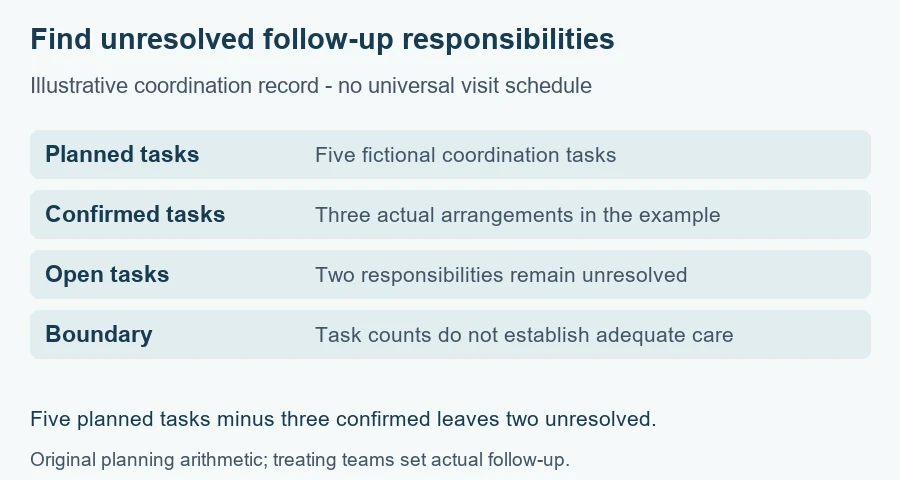
Consider a fictional plan with five coordination tasks: confirm a visit, confirm its location, identify the result-review role, obtain the required records and clarify what happens if transport changes. Suppose three tasks have actual confirmations while the result-review role and transport contingency remain open. Five planned tasks minus three confirmed tasks equals two unresolved tasks. Those numbers are invented to demonstrate record keeping; they do not establish the required number of visits, adequate follow-up or clinical readiness.
The two open tasks need different answers. Identifying the result-review role requires the team to explain who is responsible and how the information will be communicated. The transport contingency requires an agreed process for contacting the team if the planned attendance becomes impractical. Completing one task does not resolve the other. A confirmed driver cannot interpret a pending result, and a known result reviewer cannot guarantee that a missed visit can be postponed without clinical consequences.
Do not use a completion percentage as a reassurance score. The importance of an open item depends on the actual situation, not its place in a list. A single unconfirmed clinical arrangement may matter more than several completed administrative entries. A useful plastic surgery follow-up schedule shows the nature of uncertainty and the person responsible for resolving it. The fictional arithmetic simply prevents two unfinished tasks from being mistaken for a completely arranged plan.
Pending results need a responsible team
If the actual care plan includes a test or another result that is not yet available, ask who will review it and how you will receive the explanation. Record the agreed process rather than assuming that silence means the result is normal or that every professional involved will automatically see it. This guide does not say which tests you need, what a result means or when it must be obtained. It helps you identify the responsibility and communication questions that belong with the actual team. Keep the actual result and contact responsibilities alongside the discharge instruction record.
Keep a requested document, a received document and an interpreted result as separate statuses. Downloading a file can make it available without establishing that the appropriate clinician has reviewed it. An online portal notice may announce availability without answering your question about its significance. Ask the team how to obtain the relevant explanation and what to do if the expected communication does not occur. Avoid replacing that explanation with a guessed interpretation from a general website.
The older AHRQ IDEAL discharge-planning framework includes explaining results and making follow-up appointments alongside plain-language communication and patient concerns. Its page was reviewed in December 2017, not newly issued for plastic surgery. The limited point used here is that result understanding and visit arrangements are related but distinct tasks. The original record is not a validated implementation of the agency’s hospital program or a claim to reduce complications. 3
Keep new concerns separate from routine scheduling
A routine future appointment is not a reason to ignore a new concern. Obtain the team’s actual instructions about contacting them and seeking appropriate assessment, including what applies outside routine hours. Keep those instructions with the plan so that an administrative reminder is not mistaken for the only available route to care. This guide does not diagnose symptoms or set urgency thresholds. The actual professionals and local circumstances determine the appropriate response to a possible clinical problem.
Clarify whether a message channel is monitored for the purpose you intend. A portal, scheduling email and telephone line may have different functions and response processes. Ask the team which to use for routine arrangements and which route applies when the situation is different. Do not assume that sending a message is equivalent to receiving medical advice. Your plastic surgery follow-up schedule can record the contact process and its limits, while leaving the clinical assessment to the responsible professionals.
If an earlier plan changes after another assessment, document the source and the dependent arrangements that need attention. A revised visit purpose may affect which records are needed or where the interaction occurs. A changed clinical instruction may also require a practical discussion about work, travel or support. The record helps you notice those dependencies; it does not supply the new instruction. Ask the team to reconcile apparently contradictory directions rather than choosing whichever version best fits an existing reservation.
Maintain the plastic surgery follow-up schedule when plans change
Use a change log that includes the date, item changed, source of the update and next action. Preserve the older entry for context but mark it as superseded or awaiting clarification as appropriate. This avoids two problems: losing the reason a plan changed and continuing to rely on a date that is no longer current. You do not need complicated software. A clear paper record or private local document can be effective if the people using it know which version applies. If a changed proposal needs another explanation, use the second opinion preparation record rather than treating scheduling as consent.
| Change to the plan | Question to clarify | Dependent record to revisit |
|---|---|---|
| Appointment location changes | Where will the actual assessment take place? | Transport, access and arrival details |
| Contact method changes | What purpose can the revised method address? | Preparation, records and unresolved clinical questions |
| Responsible team changes | Has the receiving role accepted the arrangement? | Records handoff and communication route |
| Attendance becomes difficult | What process does the team want you to follow? | Confirmed booking and practical barrier |
| New information arrives | Who will interpret it and communicate the meaning? | Pending-result status and next action |
Discuss role sharing with any helper you want involved. A helper can remind you about an appointment or keep a document organized without being responsible for clinical interpretation. Agree what information they may receive and how they will communicate with you. If a helper changes, review the practical arrangement and permissions rather than assuming the replacement person knows the existing plan. The record should make responsibilities clear without requiring disclosure of more private information than the task needs.
Keep a backup way to find essential contacts and appointment details if a phone is unavailable. This might be a private printed copy that contains only the information you need for the task. Avoid writing a complete medical history into every reminder or sharing it across broad group messages. The goal is access to a usable plan with appropriate privacy. A plastic surgery follow-up schedule is an organizational aid, not a public diary or a substitute for the official care record.
Reconcile reminders with the actual care plan
Automated reminders can be useful, but they may contain only the appointment details available to the scheduling system. Compare a reminder with the actual team instruction when something appears inconsistent. A reminder for one location does not explain why an earlier note mentioned another location. A message about a general check-in may not identify the assessment the clinician intended. Ask the relevant team to reconcile the discrepancy rather than deciding that the most recent automated message supplies a complete clinical explanation.
Record whether an expected reminder arrived, but do not make receiving one the only evidence that an appointment exists. Conversely, an old reminder may remain in a calendar after an arrangement changes. Your plastic surgery follow-up schedule should point to the current confirmation and the source of any update. The purpose is a reliable practical record, not a rule that every message system behaves the same way. Practices use different processes, and the responsible team can explain its actual method.
If multiple people help manage reminders, agree who checks for changes and how the current version is shared. Avoid duplicate requests that give the team conflicting information, while preserving a route for you to ask your own questions. A helper’s record should not silently replace yours. Keep the agreed arrangement and any uncertainty visible so that everyone involved can distinguish a proposed change from one the relevant party has accepted.
A printable plastic surgery follow-up schedule worksheet
The printable record includes purpose, responsible role, actual confirmation, preparation or records and an open-question field. Use the separate change section to identify dependent arrangements. Leave dates blank until the actual team supplies them or an arrangement is confirmed. The worksheet contains no preset first-week, first-month or annual visit requirements. You can add rows for the plan you actually receive rather than forcing your circumstances into an invented universal schedule.
Review the sheet after each relevant communication. Mark an entry as requested, confirmed, completed or requiring clarification and preserve the source. A completed interaction may lead to another action, so capture what remains rather than simply crossing the row out. Ask the team to correct your understanding when necessary. The record is useful when it helps you explain the current plan and its unresolved parts; its appearance or number of filled boxes says nothing about clinical adequacy.
| Worksheet status | Meaning in this original record | Limit |
|---|---|---|
| Requested | An arrangement or answer has been asked for | No accepted appointment or clinical advice inferred |
| Confirmed | The relevant party supplied an actual arrangement | Only the stated purpose and details are confirmed |
| Completed | The planned interaction occurred | Unrelated questions or next actions can remain open |
| Needs clarification | The meaning, role or arrangement is uncertain | Do not fill the gap with a generic calendar |
Questions about the individualized plan
Is there one plastic surgery follow-up schedule for everyone?
No universal calendar is supplied here. The appropriate plan depends on the actual intervention, circumstances and professional assessment. Ask what each planned contact is for, who will perform it and how changes are communicated. A calendar published for another person cannot establish what you need. If you have not received a clear plan, ask the treating team to explain the arrangement rather than choosing an online schedule and treating it as an instruction.
Can remote contact replace an in-person visit?
That depends on the actual purpose and clinician assessment, not the convenience of a video connection. Ask what information can be evaluated through the proposed method and what happens if an examination or another service is needed. A photograph may provide some information without answering every clinical question. Record the intended method and its limitations in the worksheet. Do not change a confirmed visit method independently on the basis of this general planning guide.
What if my appointment is confirmed but another task is not?
Keep both facts visible. A booked visit does not automatically arrange transport, transfer records or identify responsibility for pending results. Put the unresolved task beside the role who can answer it and contact the team through the appropriate process. Your plastic surgery follow-up schedule should represent the actual state of the plan, including its gaps. It should not make an unfinished arrangement look complete merely because one date has been added to a calendar.
Sources and review scope
Plastic Surgery Editorial Team. Source records checked through October 12, 2026. Review scope: source and editorial checks for general education. No individual clinical assessment is represented.
- MedlinePlus: The day of your surgery – adult. medlineplus.gov. Source date: 2026-07-06. Checked 2026-10-12.
- AHRQ RED Tool3: Delivering re-engineered discharge. ahrq.gov. Source date: 2025-03. Checked 2026-10-12.
- AHRQ IDEAL discharge planning. ahrq.gov. Source date: 2017-12. Checked 2026-10-12.