
Burn reconstruction cost needs a complete assessed course, not merely a price for one scar procedure. Ask which operation or treatment is proposed, which follow-up or rehabilitation services are included, who bills them and what your specific payer has confirmed. A rehabilitation visit limit is a financial rule, not a clinical instruction to stop care. This guide provides an original hypothetical worksheet separating the number of planned visits from the number assumed eligible for a particular benefit.
No verified contemporary United States national complete burn reconstruction average is supplied here. Burn-related scars can present different functional and appearance concerns, and their treatment is individualized. Historical hospital reimbursement research and payer associations do not establish what you personally will pay. The worksheet’s dollars and visit counts are invented planning inputs, not market prices, prescribed rehabilitation, individual coverage approval or a prediction of how many procedures you will need.
What should burn reconstruction cost include?
To document burn reconstruction cost, start with the burn team’s assessment and a written description of the proposed task. Identify the area, intended goal, proposed treatment and known related care. Restoring movement restricted by a contracture differs from seeking an appearance change, even when both involve scars. The American Society of Plastic Surgeons explains that contractures can restrict movement following tissue loss such as a burn and that scar-treatment techniques depend on the scar. That scope resource does not tell you which technique or benefit applies to your case.
Describe the proposed course using the team’s language. If an operation is followed by specified therapy, distinguish the operation from those separately delivered services. If a later intervention remains only a possibility, record it as a contingency instead of adding it to the planned total. A single-session quote cannot silently become a complete-course quote. Conversely, a frightening online story about repeated surgery is not evidence that every survivor will require that sequence.
Ask whether the estimate is a cash price, submitted charge, applicable allowed amount or expected patient responsibility. Different figures can describe the same service without being comparable prices. Keep the payer’s confirmed amount separate from the billing organization’s estimate and from practical personal expenses. Mark uncertain rows explicitly. An unresolved category is a question to answer, not a zero-dollar item or a reason to invent a national average.
Why historical burn reconstruction cost research needs boundaries
A 2015 original German study examined inpatient reimbursement and questionnaires relating to burn sequelae using 2006–2009 data. Its purpose and setting differ from obtaining a current United States outpatient quote. The research illustrates that repeated admissions and related care affect the cost denominator. It does not establish a present-day dollar price, personal surgery count or coverage entitlement. A per-admission amount and a per-person total are not interchangeable even within the original dataset.
Do not convert an old reimbursement result into a patient cash bill by applying an exchange rate. Currency conversion cannot reconcile the health system, billing definition, care setting, included services or study period. Similarly, a reported ratio between study groups is not a multiplier to apply to your surgeon’s quote. Describe what a study actually measures before deciding whether its numbers belong in a personal financial comparison. Here, no German reimbursement value is used as a current price input.
A separate 2025 Burn Model Systems study assessed reconstruction utilization in adults enrolled between 2015 and 2022. Its adjusted analysis included 717 participants and found associations with payer and other characteristics. Utilization is a different outcome from approval probability, billed price or treatment effect. An association with a payer category cannot tell an individual that a claim will be accepted. It also cannot establish that selecting a particular payer will cause a particular clinical outcome.
Separate burn reconstruction cost from benefit authorization
Obtain the actual benefit response for the assessed treatment and proposed billing organizations. Record the services or codes discussed, the response date, its stated conditions and what remains unresolved. A general statement that reconstruction is covered does not specify every operation, therapy service, device or appointment. An approval concerning one intervention is not automatically an approval for other services delivered afterward. Your treating team and payer must interpret those details using the actual proposal.
For rehabilitation, ask which benefit applies, how the plan measures its units and whether any remaining limit has been confirmed. A visit, a timed therapy unit and a dollar allowance may refer to different quantities. Do not substitute one for another. The benefit’s administrative definition also does not establish the medically appropriate number of sessions. If a proposed course and a benefit limit differ, raise that difference with the care team and payer rather than changing care independently.
The original worksheet below assumes a dollar amount per eligible visit for simplicity. It does not establish that your plan bills this way. If your actual benefit uses different unit rules, copayments, deductibles or exclusions, replace the assumptions with its confirmed terms. The purpose is to prevent a counting error: applying an eligible-visit payment rule to every planned visit when only part of the planned course has been assumed eligible.
| Course record | Keep this quantity separate | Confirm with the relevant team |
|---|---|---|
| Assessed clinical plan | Proposed operations and related care | What is planned versus merely possible |
| Rehabilitation prescription | Clinically proposed visits or services | Appropriate course and reassessment points |
| Benefit measure | Visits, timed units or dollars | The payer’s actual counting definition |
| Remaining benefit | Verified eligible quantity at the estimate date | Prior use, conditions and unresolved requests |
| Personal budget | Travel, supplies and assistance arrangements | What is included and who pays |
Original burn reconstruction cost worksheet: eligible visit counts
Consider an invented assessed course with twelve rehabilitation visits. The example does not recommend twelve visits or imply that every burn reconstruction requires this course. Assume each visit has a $100 applicable allowance and that an eligible visit leaves the patient 20%, or $20, to pay. Also assume the proposed visits have no remaining deductible in this example. These simplified conditions must all be replaced if the actual plan works differently.
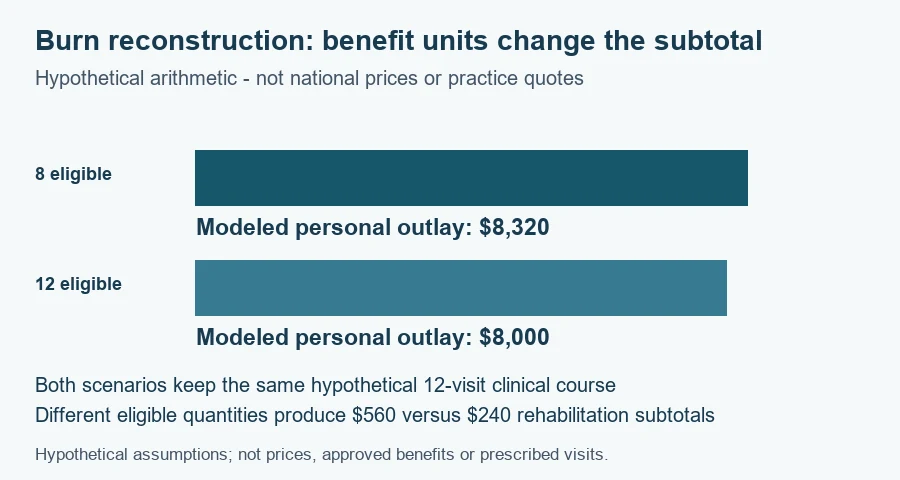
Version A assumes only eight of the twelve visits are confirmed eligible under the modeled benefit. Those eight create $160 of patient responsibility. The remaining four are assumed not covered and cost $100 each in this particular worksheet, creating another $400. The rehabilitation subtotal is therefore $560. Treating all twelve visits as if they generated a $20 patient payment would produce $240, understating the modeled subtotal by $320.
Version B assumes all twelve are independently confirmed eligible under otherwise identical terms. Its rehabilitation subtotal is $240. This is an alternative benefit assumption, not a promised exception, appeal outcome or different medical course. Both versions have twelve planned visits, the same $100 visit denominator and the same clinical scope. The difference is the expressly specified number to which the eligible-visit rule applies. For organizing a coverage decision and appeal record, see plastic surgery insurance appeals.
| Rehabilitation arithmetic | Eight assumed eligible | Twelve assumed eligible |
|---|---|---|
| Clinically planned visits in hypothetical course | 12 | 12 |
| Eligible visits multiplied by $20 | $160 | $240 |
| Remaining visits multiplied by assumed $100 | $400 | $0 |
| Rehabilitation subtotal | $560 | $240 |
| Other modeled clinical responsibility | $7,000 | $7,000 |
| Care items and practical travel | $760 | $760 |
| Complete modeled personal outlay | $8,320 | $8,000 |
The other clinical responsibility is an invented $5,000 operation-related amount plus a separately specified $2,000 related clinical amount. Care items are $400 and practical travel is $360. Together these fixed inputs total $7,760. Adding rehabilitation produces $8,320 in version A and $8,000 in version B. The original chart compares these complete personal-outlay results. Neither bar is a market quote, a universal covered benefit or a recommended way to change the course.
How to recalculate burn reconstruction cost without counting mistakes
Use two columns for the rehabilitation course: the clinically planned quantity and the confirmed benefit quantity. The count to which a payment rule applies cannot exceed the relevant planned count merely because a plan lists a larger unused allowance. In the simplified example, eight eligible visits create eight patient-share calculations, not twelve. Four remaining visits use their separately assumed payment basis. Add the two subtotals once, then add the fixed operation and practical components once.
For a sensitivity check, hold the same twelve visits and all other assumptions constant, but assume ten are eligible. Ten times $20 is $200 and two times $100 is another $200. The rehabilitation subtotal is $400; adding the fixed $7,760 gives $8,160. This sits between the two charted values because the invented benefit quantity differs. The $160 reduction from version A is not a lower surgeon fee, less rehabilitation or improved clinical outcome.
If the plan instead uses timed units, rebuild the calculation using its actual confirmed rules rather than renaming a unit as a visit. If a therapist’s estimate includes several services in one appointment, ask how those services will be billed. Administrative quantities must be matched to the billing basis before arithmetic begins. A mathematically correct multiplication can still produce a misleading total if its input units describe different things.
Keep burn reconstruction cost supplies and travel honest
Ask which specified care items are included in the clinical estimate and which are separate. Record the actual item, quantity, unit price and reason for the estimate. A generic shopping list is not a prescription, and buying additional products is not automatically necessary or beneficial. Follow the burn team’s instructions rather than allowing a financial worksheet to create a treatment regimen. If an item is optional, preserve that label instead of hiding it inside mandatory care expenses.
Travel should follow actual appointment arrangements. In the example, the $360 is simply a disclosed practical-budget assumption, not an estimate of where you live or how many journeys every survivor needs. Several services might occur during one trip, while some visits may involve separate travel. Obtain the intended appointment pattern before multiplying a travel amount by a treatment count. A clinical service count and a journey count are different denominators.
If assistance, accommodation or income effects are relevant, add separate rows with verified assumptions. Do not imply that every survivor has the same support needs or employment situation. Confirm any reimbursement or assistance before subtracting it, and preserve the payment timing. An expected reimbursement is different from an amount already paid directly. Personal financial planning improves when these practical details are explicit, even when the clinical claim estimate remains unchanged. For comparing contract obligations and financing costs, see plastic surgery financing.
Which burn reconstruction cost questions reveal missing scope?
Ask the treating team which related services are already part of the assessed course and which depend on reassessment. Ask the billing organizations what their estimate includes, whether later appointments generate separate claims and which financial assumptions were used. Then ask the payer about the actual named services and unit definitions. A precise description of the proposed task creates a more useful response than asking whether burn reconstruction is generally covered.
For a repeated treatment proposal, request a complete-course estimate with its assumed count and boundaries. This does not mean accepting that count as a universal norm. It means knowing whether an advertised per-session amount includes facility, anesthesia or related charges each time. Ask what happens to unused prepaid sessions and whether the terms identify when an updated assessment or estimate is required. Obtain the actual written arrangement; this guide establishes no refund or cancellation entitlement.
| Question | Useful written answer | Avoid assuming |
|---|---|---|
| What course is assessed? | Named tasks, known related care and contingencies | A scar-treatment quote covers every future intervention |
| What does the payer count? | Exact visit, timed-unit or dollar definition | Every appointment equals one eligible unit |
| Which quantity remains eligible? | Dated confirmation and relevant conditions | A general benefit statement covers the whole proposed course |
| What is included in each charge? | Professional, facility and related components | A headline session fee is a complete price |
| What requires revision? | Clinical and financial reassessment triggers | The original estimate cannot change |
Reconciling burn reconstruction cost as care progresses
Maintain a course ledger with the service date, task, billing organization, applicable denominator and stated responsibility. Keep payments and reimbursement separate from the treatment-charge columns. A deposit applied to a later bill is not a new service; subtracting it from the denominator and then counting it again as a payment would double-count the same money. Obtain account statements identifying where advance payments were applied, particularly when several billing organizations are involved.
For rehabilitation benefits, update the confirmed remaining quantity from the payer’s actual records. Do not subtract an unprocessed appointment automatically if the plan counts units differently or has not yet processed it. Preserve the date of each benefit report and ask about pending claims when balances differ. A changing balance can reflect processing information rather than a change in the clinical plan. Keep that distinction visible in the revision log.
When a cost estimate conflicts with the assessed course or appears unaffordable, discuss the problem promptly with the burn team and benefits staff. The worksheet helps identify which assumption needs clarification. It does not decide which treatment can safely be omitted, delayed or substituted. Preserving functional goals and individualized clinical instructions matters more than making a hypothetical spreadsheet fit an unverified benefit quantity.
What a usable burn reconstruction cost comparison looks like
A meaningful comparison names the assessed task, includes known related care and separates every financial denominator. It identifies what the payer has actually confirmed, which administrative quantities remain unresolved and which personal expenses sit outside the claim. If two proposals differ in technique, goals or related services, state those differences before ranking their totals. A lower initial operation charge can coexist with different later expenses, and that accounting observation cannot establish equivalent clinical value.
Keep historical research in its original setting and maintain an updateable record of your actual proposal. The most useful burn reconstruction cost total is a dated, complete-course planning estimate with traceable inputs. Recalculate when the clinical proposal, confirmed benefit quantities or practical arrangements change. This makes the uncertainty manageable without inventing current prices, coverage probabilities, universal session counts or clinical recommendations.
For a long course, create a burn reconstruction cost checkpoint alongside the team’s actual reassessment point. Compare completed services with the original scope and ask whether the next proposed work has a current estimate. Preserve the remaining planned work separately from what has already been paid. This prevents an accumulated historical total from being mistaken for the amount still required to proceed. It also prevents a new estimate from accidentally counting completed services again.
If several areas are treated, label which area and task each estimate addresses. An amount for one restricted joint or one scar area should not be described as whole-body reconstruction. Likewise, a general scar appearance quote should not be presented as the price of restoring function after an assessed burn injury. These scope labels make the financial record understandable without asking the spreadsheet to decide the clinical relationship between treatments.
Sources and scope
ASPS scar and contracture scope, original German burn-sequelae cost study and original Burn Model Systems utilization study were inspected October 12, 2026. The German study was published September 30, 2015 and uses 2006–2009 data; the utilization study was online April 15, 2025 with an August 1, 2025 issue date. The ASPS record’s underlying date is unspecified. No national complete price, patient eligibility, individual rehabilitation count or clinical clearance was established.
Sources and review scope
Plastic Surgery Editorial Team. Source records checked through October 12, 2026. Review scope: source and editorial checks for general education. No individual clinical assessment is represented.
- ASPS scar and contracture task boundaries. American Society of Plastic Surgeons. Publication/update date not stated. Checked 2026-10-12.
- Original German burn-sequelae cost denominators. Annals of Burns and Fire Disasters. Source date: 2015-09-30. Checked 2026-10-12.
- Original adult burn reconstruction utilization cohort. Annals of Plastic Surgery. Source date: 2025-04-15. Checked 2026-10-12.