
CoolSculpting cost is easiest to understand when a written quote defines the device, proposed body sites, billable units, visits and any separately priced reassessment. A per-area price does not automatically mean one cycle, one side or one appointment. The broad ASPS nonsurgical fat-reduction average is not a verified CoolSculpting course price. This guide uses an original hypothetical worksheet to show how the same total billing quantity can be scheduled across different numbers of visits without changing its treatment subtotal.
The clinician must determine whether the device and proposed treatment are appropriate for your circumstances. This guide does not prescribe a number of applications, a treatment interval or an expected response. All dollar amounts and quantities in the worksheet are invented accounting inputs, not branded treatment instructions or surveyed prices. Establish the actual plan first, then use the worksheet to reconcile what the practice will charge and what remains uncertain.
Is the broad society average a CoolSculpting cost estimate?
The ASPS nonsurgical fat-reduction cost page displays a $1,157 average when checked October 12, 2026. It covers a broad category with multiple technologies and excludes related expenses. The page does not state the underlying fee year or provide a CoolSculpting-specific per-cycle, per-area or complete-course breakdown. Calling its figure a current branded treatment price would give it a specificity the source does not supply.
Keep that figure as category context and obtain a practice quote for the exact proposed plan. Do not divide it by an assumed number of applicators or multiply it by a guessed series of appointments. Those operations would manufacture a denominator and course that the fee source never defined. A transparent quote should state whether the charge is per billable application, per named area, per visit or a package with its own terms.
A displayed CoolSculpting cost can therefore differ from another amount because the billing unit differs, even before comparing rates. One office’s area could mean both sides of a region while another describes each side separately. Ask each office to translate its terminology into the same written scope. A smaller headline price is not yet evidence that the same proposed plan costs less.
What should a CoolSculpting cost quote call a cycle?
Ask the practice to define every unit on its own quotation. If it bills each specified applicator treatment separately, obtain the number assigned to each site and side. If it uses another billing arrangement, preserve that arrangement instead of forcing it into a per-cycle model. Do not assume that all device models, applicators or practices use an interchangeable unit solely because their advertisements use the word cycle.
Also separate the number of billable units from the number of visits. Ask whether the proposed applications occur within one appointment or several, and which costs change with that scheduling. Simultaneous treatment capacity, appointment length and clinical suitability are device- and plan-specific matters for the clinician. The financial worksheet does not establish whether a particular scheduling arrangement is possible or appropriate.
The ASPS cryolipolysis overview describes assessment of the target and applicator selection and notes that more than one area or repeat treatment may be considered. It does not validate a standardized billing unit or guarantee that every reader needs a repeat. Ask for the actual proposed site-by-site plan and its reassessment conditions rather than purchasing a guessed sequence based on a promotional number.
| CoolSculpting cost denominator | Written definition to obtain | Frequent comparison error |
|---|---|---|
| Named area | Actual region and one-side or both-side status | Assuming an area means the same boundary everywhere |
| Billable cycle or application | Device-specific service charged as one unit | Treating every applicator or session as interchangeable |
| Visit | Which proposed units occur at that appointment | Assuming more visits necessarily mean more treatment units |
| Course or package | Exact included scope and reassessment terms | Treating a package quantity as a clinical requirement |
Why does device identity belong in the CoolSculpting cost discussion?
Request the exact device and the clinician’s proposed body sites. A brand word in an advertisement does not establish the equipment in the treatment room or whether the proposed use matches its authorization. The FDA body-contouring guidance explains that device authorization concerns particular intended uses and body sites. It also makes clear that noninvasive body contouring is not weight-loss treatment or a health improvement substitute.
The same FDA guidance describes risks including paradoxical adipose hyperplasia, in which treated fat enlarges rather than shrinking and surgery may be needed. This price guide assigns no individual incidence, expected corrective expense or guarantee of a particular result. Those questions need qualified clinical discussion. A lower fee or a reassurance that a procedure is nonsurgical cannot establish that there are no potentially serious complications.
Do not use the price comparison to replace screening. Tell the clinician about relevant health conditions and prior treatment so they can assess the proposed service. The financial calculation remains useful after that assessment: it can show the price of a defined plan and its exclusions. It cannot clear a device, body site or application count for an individual reader.
Original CoolSculpting cost worksheet: four units, different visits
Suppose a hypothetical practice quote defines one billable unit clearly and proposes four units under a clinician-confirmed plan. For accounting only, assign $600 to each unit, giving a $2,400 treatment subtotal. We also assign a separate $100 assessment amount and $60 of transport per treatment visit. These are invented inputs, not actual brand prices or a recommendation for four treatments. The practice’s real definitions and plan must replace them.
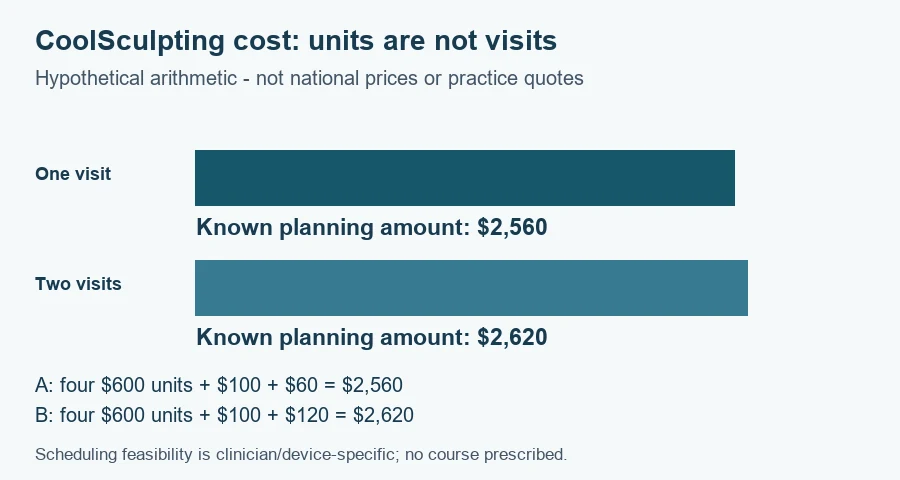
Scenario A schedules the four hypothetical units in one treatment visit, if the actual clinician and device permit that arrangement. Its known planning amount is $2,400 plus $100 plus $60, or $2,560. Scenario B distributes those same four units across two visits under a different permitted arrangement. Its treatment subtotal remains $2,400, while transport becomes $120. Its known planning amount is $2,620.
| Hypothetical CoolSculpting cost input | A: one treatment visit | B: two treatment visits |
|---|---|---|
| Defined billable units | 4 × $600 = $2,400 | 4 × $600 = $2,400 |
| Separate assessment | $100 | $100 |
| Transport at $60 per treatment visit | $60 | $120 |
| Known planning amount | $2,560 | $2,620 |
The chart compares $2,560 and $2,620. The $60 difference comes entirely from one additional transport input. Dividing treatment subtotal by visits would give $2,400 per visit in A and $1,200 per visit in B, yet both scenarios buy the same four hypothetical billing units. This is the original denominator lesson: a lower per-visit amount does not prove a lower total or less expensive equivalent treatment.
Neither scenario establishes equal clinical results, equal inconvenience or universal feasibility. We assume matching treatment quantity and rate only to isolate the accounting issue. If the clinician recommends a different device, site, quantity or follow-up arrangement, the proposals are different scopes and need new columns. Preserve the difference rather than describing every number as a bargain comparison for an identical service.
How can a side count distort CoolSculpting cost comparisons?
If a quote concerns a paired region, ask whether its quantity covers the left side, right side or both. Do not multiply by two until the office confirms what its original quantity represents. Conversely, do not treat one-side pricing as the complete paired-area amount. Record each proposed site and its assigned billing quantity, then sum those quantities once before applying the documented rate.
The worksheet’s four units could be described in many administrative ways, so no clinical placement map is assigned to them. If a real quote explicitly lists two billable units for one side and two for the other, its stated total is four. If it instead includes both sides in a single package, use the package total. The point is to avoid guessing how an anatomical label translates into charges.
This matters when shopping by area price. A practice may charge a larger amount for an area whose definition includes more proposed work. It may also use a flat package without an individual unit rate. Ask for the complete amount for the clinician-confirmed plan rather than constructing a universal cost per square inch or per visible bulge. Such denominators are not established by the fee evidence here.
How should possible retreatment affect CoolSculpting cost?
Keep the initial proposed plan separate from a possible later proposal. Ask when the treating team reassesses, what is included in that review and whether another treatment would need a new quote. Do not assume another appointment is inevitable or that buying additional applications in advance improves outcomes. A practice package should explain what happens if the clinician decides that further treatment is unsuitable or unnecessary.
For financial planning, an optional scenario can show the actual quoted amount for a later service once its scope is known. Label it conditional, not expected. If the office has not defined that scope or price, leave it unresolved. Multiplying an initial quote by an assumed number of repeat sessions would turn a possible clinical decision into an unsupported forecast of both treatment and spending.
Reassessment is also different from a paid repeat procedure. A scheduled review can be included while another treatment remains separate. Ask whether photographs, clinical review or other specified assessment services are included and whether the office charges for an additional consultation. Keep that answer in its own row. The initial per-unit rate does not by itself define the future review or repeat-treatment policy.
What package terms can change the effective unit price?
Ask whether unused units can be refunded, transferred or retained, and whether they expire. If a package contains six hypothetical billing units but only four are actually used after assessment, dividing its purchase price by six describes purchased units, not used units. Both calculations can be shown if the terms are clear. Neither calculation is a measure of clinical value or a reason to use treatment that the clinician does not recommend.
For example, a hypothetical $3,000 six-unit nonrefundable package has a purchase rate of $500 per unit. If four units are used, its effective payment per used unit is $750. A separate four-unit offer at $600 per unit totals $2,400 before other charges. The package’s lower advertised unit rate can therefore require more cash for the smaller actual purchase. This is contract arithmetic, not a recommendation about the correct number of applications.
Do not add that package example to the main chart: it represents a different transaction and set of assumptions. Maintain it as a separate sensitivity question when relevant. Ask the office how a medically revised plan affects unused units and obtain the written answer before paying. A limited-time rate cannot establish whether all of the purchased quantity will be appropriate or used.
Which external expenses belong in a CoolSculpting cost plan?
Use the actual visit arrangement to price transport, work scheduling or help needs. The example assigns $60 per treatment visit only to make the visit denominator visible. It omits lost income and other personal expenses rather than assuming they are always zero. If they apply to you, add your actual amounts with their assumptions. Do not adopt a universal number of missed workdays from a marketing claim.
If more than one person travels, identify shared and separate expenses. A shared car journey should not be counted twice simply because a companion attends. A separate fare or a real loss of income may belong in the personal planning column. Keep those amounts distinct from the practice bill so a change in transport does not look like a change in the clinician’s treatment rate.
An unexpected concern is outside the scheduled-visit model. Ask the clinical team how concerns are assessed and the office which services are included or separately billed. A chosen personal reserve can remain visible as a contingency, but do not label it an expected complication cost without a verified probability and appropriate evidence. Cost questions should never delay seeking appropriate care for a developing problem.
How do you reconcile payments without counting them twice?
If a deposit is credited to the quoted treatment amount, subtract it from the remaining balance rather than adding it to the total. In a hypothetical $2,400 treatment purchase with a credited $300 deposit, the unpaid treatment balance is $2,100. The assessment and transport inputs remain separate according to their actual terms. A noncredited booking fee would instead be another expense and needs explicit documentation.
For financing, compare the actual repayment schedule and charges separately from the treatment subtotal. Make sure the credited deposit and any outside payments are correctly reflected in the financed balance. An attractive monthly amount does not define the billable units, refund conditions or clinical plan. Save the dated quote and payment terms together so the transaction can be reconstructed if the proposal changes.
How do you compare the invoice with the original CoolSculpting cost proposal?
Retain the original site-by-site quantity and check the invoice against it. If the billing unit is individually priced, multiply the documented quantity by the documented rate and reconcile any discounts once. If the quote uses a fixed package, check the package inclusions and amount instead. Do not invent an individual-unit price from an invoice that never priced units separately; an inferred average does not establish the practice’s billing rule.
If the clinician changes the plan, ask for the revised scope and administrative amount before assuming that the earlier payment covers it. Record which previously purchased units were used, which remain unused and which new services are proposed. This distinguishes a transfer of an existing payment from a new purchase. It also prevents a remaining balance from being confused with the complete price of the revised plan.
Finally, separate a billing correction from a clinical outcome complaint. An arithmetic mismatch can be resolved by checking quantities, credits and inclusions. A concern about a result needs clinical assessment and cannot be settled by multiplying the invoice by an advertised response percentage. Keep the financial record precise while directing medical concerns to the appropriate clinician. The worksheet is useful because it narrows the billing question without claiming to measure treatment success.
Save the quote version and invoice together. A new rate or quantity should have a documented explanation, rather than silently replacing the assumptions that supported the original comparison.
Before paying: a CoolSculpting cost denominator checklist
| Checkpoint | Evidence to retain | Uncertainty to resolve |
|---|---|---|
| Device and proposed sites | Named equipment and clinician-confirmed plan | Advertisement alone does not identify the actual service |
| Billing quantity | Each side, area and defined unit counted once | Area, cycle and visit used interchangeably |
| Included and conditional care | Assessment, review and possible repeat terms | Package quantity treated as a clinical requirement |
| Payment terms | Deposit credit, unused units and expiry policy | Lower unit rate hides a larger cash commitment |
The useful CoolSculpting cost answer is the amount for a defined proposed plan with its billing denominator and unresolved conditions attached. The broad society average cannot supply that definition. The original worksheet helps distinguish units from visits, paired-area labels and package purchases. Return to the nonsurgical fat-reduction guide for context and discuss device-specific suitability with a qualified clinician before making a purchase.
Sources and review scope
Plastic Surgery Editorial Team. Source records checked through October 12, 2026. Review scope: source and editorial checks for general education. No individual clinical assessment is represented.
- ASPS broad nonsurgical fat-reduction average and exclusions. American Society of Plastic Surgeons. Publication/update date not stated. Checked 2026-10-12.
- ASPS cryolipolysis assessment and possible repeat scope. American Society of Plastic Surgeons. Publication/update date not stated. Checked 2026-10-12.
- FDA device-specific body-contouring limits and fat-freezing risks. U.S. Food and Drug Administration. Publication/update date not stated. Checked 2026-10-12.