
CoolSculpting uses cryolipolysis, commonly called fat freezing, to reduce a localized fat bulge without a surgical incision. It belongs to a wider group of nonsurgical fat-reduction technologies, which address different concerns and have different risks. It is not a weight-loss treatment, does not remove loose skin and cannot promise the contour you want. The useful decision is whether a specific visible bulge, the proposed device and its likely change justify the treatment burden and possible complications. FDA body-contouring overview
Start by naming the concern rather than asking for a package of cycles. A lower-abdominal bulge, loose skin after weight change and a desire to reduce your weight are different tasks. A clinician needs to assess what contributes to the appearance and whether the device is appropriate for that area. A persuasive photograph or an available appointment cannot establish that match. You can also decide that the expected difference is too limited to be worthwhile.
CoolSculpting is one technology, not a name for every option
ASPS describes nonsurgical or minimally invasive fat-reduction options using cooling, heat or an injected medication. Cryolipolysis is different from radiofrequency, laser-based treatment and injection lipolysis. A practice offering more than one modality should explain which is proposed and why. The word contouring describes a goal, not the specific mechanism or evidence supporting a device. ASPS nonsurgical-fat-reduction overview
A branded treatment name is also incomplete without the device model, applicator and intended treatment site. FDA reviews intended uses and sites for marketed devices; it does not authorize every possible use of a machine just because the brand has clearance somewhere. Ask for the proposed device’s patient information and how its evaluated use relates to your concern. Do not confuse a model change with proof that every possible risk has disappeared.
| Proposed option | Clarify the actual task | Keep this distinction visible |
|---|---|---|
| Cryolipolysis, including CoolSculpting | A localized bulge assessed for that device and applicator | Cooling is not surgery or a weight-loss program |
| A radiofrequency device | The device, site and measured contour outcome | Heat-based evidence does not automatically establish cooling outcomes |
| A laser-based device | Whether treatment is external or involves an invasive procedure | The word laser alone does not describe the procedure |
| Injection lipolysis | The exact drug and its approved site | An injected treatment is not a surface-only device procedure |
The worksheet prevents a broad menu from becoming a vague recommendation. It does not rank these options or identify which one you need. The correct comparison begins with the same anatomical concern and the same outcome: a visible contour change, for example, rather than comparing one device’s circumference measurement with another treatment’s satisfaction headline.
A fat bulge, loose skin and weight are separate goals
ASPS describes cryolipolysis as a way to reduce volume in a localized fatty bulge and notes that loose skin or poor tone may make someone unsuitable. That means assessment needs to address what would remain after any change in the bulge. If your main concern is hanging skin, the discussion should not quietly replace that goal with a smaller area of fat. ASPS cryolipolysis scope
Write the visible concern and the desired change in separate fields. For example, wanting a waistband to sit differently is a personal goal, while the proposed procedure may target only one part of the tissue contributing to the contour. Ask which part of that goal the clinician thinks is realistic. Keep any broader promises about health, weight or overall body transformation outside the proposal unless a separate evidence-based care plan actually addresses them.
Declining surgery does not make every nonsurgical alternative equivalent. ASPS explicitly distinguishes these options from liposuction. If you are comparing a device treatment with an operation, compare the tissue task, likely scope, risks, recovery and cost rather than assuming one provides the same result with a shorter appointment. A less invasive approach may suit your priorities while still leaving a concern untreated.
What happens over time after CoolSculpting?
The intended change develops after treatment rather than being a surgical removal visible immediately. Plan around an agreed assessment point, not an expectation that the day-of-treatment photograph demonstrates the final contour. Ask what the practice will assess, whether it will use photographs or measurements, and how an unwanted change will be evaluated. This keeps the follow-up connected to your original concern rather than simply to another booking.
A consistent photographic record can help discuss the change. Use a similar stance, camera distance, clothing and lighting, and keep the date visible. A relaxed abdomen in one image and a strongly braced pose in another can make a comparison misleading. Such a personal record is useful for communication, but it does not become proof of a controlled treatment effect or evidence that another patient will obtain the same result.
Separate an assessment from a repeat treatment decision. If another cycle or area is proposed, ask what the original result shows and which remaining concern the additional treatment would address. A preset package does not need to determine the medical decision. You may prefer a smaller scope, a different option, more time for assessment or no further treatment.
Reading CoolSculpting results: volume is not body weight
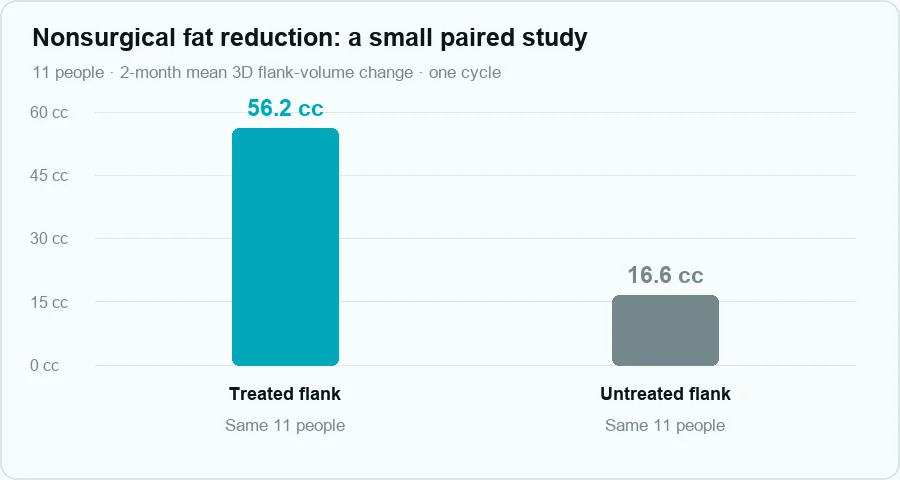
An original prospective flank study enrolled eleven people, treated one flank and used the untreated opposite flank as an internal control. At two months, the mean calculated volume reduction was 56.2 cubic centimeters on the treated side and 16.6 on the control side, a reported mean difference of 39.6. This small, short study supports a defined local measurement; it does not establish kilograms of weight loss, every body site’s outcome or long-term risk. Original controlled flank-volume study
Keep the comparison and measurement method together
A local volume change is not the percentage of your body fat lost. A caliper measurement, a circumference measurement, a photographic contour assessment and a satisfaction questionnaire also answer different questions. Ask which measurement underlies a headline claim. A reduction measured by one method cannot be translated automatically into another, and a favorable satisfaction response does not tell you the exact size of the contour change.
In the flank study, the comparison was between two sides of the same eleven people, not two independent groups of eleven. That internal control helps account for changes shared by both sides, but it also limits the setting in which the estimate can be interpreted. Do not turn the treated-side mean into the amount every patient should expect, or apply it to a different applicator, treatment area or repeated course without relevant evidence.
The practical evidence request is concise: identify the device, site, number of sessions, measurement, comparator, follow-up and population. If these fields are missing, a percentage may be describing something quite different from your own proposal. You do not need to reject all evidence because a study is small; you need to understand what it can support and what still remains uncertain.
A mean is a summary of the study group, not a measurement promised to each participant. The eleven-person study also reports variation around its average. Showing the average alone can make a result look more uniform than the data support. A source-based chart should include that variation if its statistical meaning is clearly labeled, or use a simple mean comparison with an explicit limitation rather than inventing an individual range or confidence interval.
Keep the untreated-side change visible in that comparison. Subtracting it from the treated-side mean produces the study’s reported between-side difference, but it does not tell you that another person will experience that difference. It also does not establish the appearance of an entire torso. The study’s value is its defined, measured local question; treating it as proof of a broad transformation weakens the decision instead of strengthening it.
CoolSculpting risks and paradoxical adipose hyperplasia
Fat freezing can cause discomfort and visible reactions, and more serious complications are possible. One important complication is paradoxical adipose hyperplasia, or PAH: the treated fatty area enlarges rather than shrinking. FDA describes a firm, often applicator-shaped bulge reported months after treatment that does not disappear on its own and may require surgery. Nonsurgical treatment therefore does not guarantee that future surgical care will be unnecessary. FDA cryolipolysis risks
Ask how the practice evaluates delayed enlargement and what follow-up route remains available months later. A new bulge should not be assumed to be ordinary weight change or treated automatically with another cosmetic session. Document when you noticed it and obtain assessment. Do not use a photograph online to diagnose PAH, prescribe corrective treatment or decide that a particular shape is harmless.
PAH numbers need especially careful interpretation. An original multicenter evaluation reviewed 8,658 treatment cycles in 2,114 people at eight Canadian centers, with treatment records from 2015 through 2019. Its incidence calculations were based on cycles, and device generation was part of its analysis. Those historical selected-center observations cannot be presented as a universal personal risk for a current device or multiplied into a private prediction for your course. Original multicenter PAH evaluation
A cycle denominator and a patient denominator are not interchangeable
One person can receive more than one treatment cycle. A study counting events per cycle therefore answers a different question from a study counting affected people. Ask what the denominator represents before comparing complication rates. Also ask how the study identified cases and how long patients were followed; a delayed complication requires an observation system capable of detecting it.
A clinician can discuss available risk evidence without promising an exact individual percentage. A useful consent conversation identifies the complication, recognizes uncertainty and explains the assessment and care pathway. A very small quoted number is not a substitute for that discussion. Nor does selecting a newer device establish zero risk or guarantee that every older estimate describes the current proposal accurately.
Agree on how delayed concerns remain part of the treatment record. If a practice checks only the early appearance, ask how you should report a later change, whether an assessment is included and what happens if you move or the original operator leaves. Keep the date, treated regions and device information somewhere you can retrieve. This is particularly useful for distinguishing a concern about the treated area from an unrelated change elsewhere; it is not a way to diagnose yourself.
Before accepting another procedure for an unwanted contour, request an explanation of what the clinician thinks is causing it and which evidence supports the next step. A new intervention deserves its own scope, risks and consent discussion. A promised correction should not obscure the uncertainty of the diagnosis or make additional treatment feel like an automatic obligation to complete the original purchase.
A specific CoolSculpting applicator recall belongs in the device discussion
FDA recall records describe a voluntary discontinuation and recall initiated June 9, 2022 for certain CoolSculpting parallel-plate applicators after increased PAH complaints in 2019–2021. Named affected applicators include CoolCore, CoolCurve, CoolCurve+, CoolMax and CoolFit. The record concerns specified applicators; it should not be paraphrased as a recall of every treatment carrying the brand name. FDA applicator recall record
For a proposed treatment, ask what model and applicator would be used and how the practice checks device safety notices. For an earlier treatment, keep the treatment date and device record if available. This helps connect a specific notice to a specific procedure without guessing from a photograph or a broad brand label. The absence of an affected applicator in your plan does not make the overall procedure risk-free.
The FDA’s 510(k) documentation for another CoolSculpting system describes model and applicator characteristics. Regulatory documentation is useful for confirming what device is being discussed, but a clearance summary is not a personalized prediction or a guarantee of satisfaction. Keep the device identity and the clinical outcome evidence as related but separate records. FDA system clearance summary
CoolSculpting candidacy: cold-related conditions and the treatment area
ASPS identifies cold-related disorders such as cryoglobulinemia, cold urticaria and paroxysmal cold hemoglobinuria among reasons not to have cryolipolysis. Disclose known cold reactions and relevant diagnoses rather than treating a comfortable experience outdoors as proof that controlled cooling is suitable. Also discuss prior operations and concerns in the proposed area; this is part of an actual medical assessment, not a questionnaire that can clear you online. ASPS candidacy cautions
FDA guidance also flags hernia and structurally weak abdominal areas in fat-freezing assessment. A bulge is not automatically a fat target. If you have a known hernia, a surgical scar or a concern about the abdominal wall, ask what needs evaluation before a device plan can be considered. Do not press, pinch or compare your own body with a diagram to decide whether a bulge qualifies for treatment.
ASPS consultation guidance includes goals, medical conditions, allergies, medications and earlier procedures. Bring an accurate history and ask what would require postponement or a different approach. Pregnancy or breastfeeding should also be discussed; ASPS advises against these nonsurgical-fat-reduction procedures during those periods. The fact that treatment avoids an incision does not replace a suitability assessment. ASPS consultation guidance
CoolSculpting cost: areas, applicators, cycles and follow-up
A body area, applicator placement, treatment cycle and appointment may be different billing units. Ask how the practice defines each one. A quote for one area may not cover the entire region you had in mind, while a package of cycles may not specify how they will be distributed. Obtain a scope diagram or written list before comparing offers; these are purchasing records, not instructions for applicator placement.
ASPS publishes a broad nonsurgical-fat-reduction average and explicitly says related expenses can be additional. The category contains multiple technologies, and the displayed page does not give a dated CoolSculpting-only individualized total. Do not multiply that headline into a course price or treat it as a national per-cycle benchmark. Ask for the actual proposed service, included assessment and possible extra charges. ASPS cost scope
| Quote field | Obtain this detail | Avoid this shortcut |
|---|---|---|
| Treatment region | Exact areas included and excluded | Assuming one area means the whole abdomen or torso |
| Billing unit | What a cycle, application or appointment means here | Comparing differently defined units as equal |
| Follow-up | Assessment timing and included services | Assuming repeat treatment is automatically included |
| Additional care | How an unwanted result is assessed and charges discussed | Believing a nonsurgical purchase cannot lead to further care |
If financing is offered, read the total obligation and cancellation terms separately from the treatment plan. A low monthly payment says little about the entire course or whether you can pause after assessment. Deciding that the first result is sufficient should remain a clinical and personal decision, rather than being dictated by an assumption that every prepaid unit must be used.
A comparison that keeps your original goal visible
| Decision field | Nonsurgical device proposal | Surgical proposal or no treatment |
|---|---|---|
| Actual concern | Identify the localized bulge or other evaluated task | Identify what would be addressed or left alone |
| Expected scope | Ask what the device can realistically change | Compare tissue scope rather than a shared marketing word |
| Evidence | Device, site, endpoint and follow-up | Ask equivalent questions for the alternative |
| Burden and risk | Visits, assessment, delayed concerns and cost | Compare recovery and responsibilities, or retain the untreated baseline |
Choosing no treatment is a useful comparison because it preserves the baseline against which the expected change has value. You do not have to choose another intervention merely because one technology does not suit the concern. Ask what happens if you wait, what is elective about the decision and whether the proposed benefit is meaningful enough for you to accept its burden and uncertainty.
For related planning, see the liposuction guide, tummy tuck versus liposuction comparison and cost planning guide.
Sources and review scope
Plastic Surgery Editorial Team. Sources checked October 11, 2026. Review scope: source and editorial checks for general education. No individual clinical assessment is represented.
- FDA non-invasive body contouring. fda.gov. Publication/update date not stated. Checked 2026-10-11.
- ASPS modality scope. plasticsurgery.org. Publication/update date not stated. Checked 2026-10-11.
- ASPS cryolipolysis. plasticsurgery.org. Publication/update date not stated. Checked 2026-10-11.
- Original controlled flank volume study. pubmed.ncbi.nlm.nih.gov. Source date: 2013-12-03. Checked 2026-10-11.
- Original multicenter PAH study. pubmed.ncbi.nlm.nih.gov. Source date: 2020-11-20. Checked 2026-10-11.
- FDA parallel-plate applicator recall. accessdata.fda.gov. Source date: 2022-06-09. Checked 2026-10-11.
- FDA K193566 system summary. accessdata.fda.gov. Source date: 2020-01-21. Checked 2026-10-11.
- ASPS consultation. plasticsurgery.org. Publication/update date not stated. Checked 2026-10-11.
- ASPS nonsurgical fat cost scope. plasticsurgery.org. Publication/update date not stated. Checked 2026-10-11.
- FDA K193566 database. accessdata.fda.gov. Source date: 2020-01-21. Checked 2026-10-11.