
Neck lift revision is another operation intended to address an assessed concern after previous neck surgery. The useful starting point is the particular problem: returning bands, persistent fullness, an uncomfortable or conspicuous scar, or a contour that differs from the agreed goal. Another operation is not automatically the right response. Examination, the previous operative record, the stage of healing and your priorities must come before a technique name or a promise of correction.
This guide separates three decisions that can otherwise become blurred: what has changed, what an additional intervention could reasonably address, and what evidence supports the proposed result. It provides an original consultation worksheet and a way to read the small revision literature without treating selected case reports as your personal odds. It does not determine whether you need surgery or give instructions for changing an existing recovery plan.
What does neck lift revision mean in your situation?
The word revision identifies prior surgery, but says little about the new task. A person bothered by a scar beside an ear is asking a different question from someone concerned about a returning band beneath the chin. Both may describe an unsatisfactory neck, yet they need separate assessments. Write the concern in ordinary language before adopting a label from an advertisement. Where is it visible, when did you first notice it, and what would count as a worthwhile improvement?
A useful description can be precise without becoming a self-diagnosis. For example, “I see a ridge when I turn my head” records an observation. “My muscle repair failed” assigns a cause that you cannot establish from appearance alone. Bring the first description to the consultation and ask what findings support any proposed explanation. This leaves room for the surgeon to distinguish the structure involved and explain uncertainty rather than agreeing prematurely with an internet diagnosis.
Neck lift revision can also involve more than one goal. You may want a contour change while placing greater importance on avoiding another visible scar or a lengthy disruption to work. Record those priorities separately. A technically possible intervention may not offer the tradeoff you want. A consultation that ends with a narrower goal, continued observation or no additional operation can still resolve the decision if its reasoning is clear.
Separate persistent changes, returning changes and healing concerns
Build a dated account of the original procedure and subsequent changes. A concern that was present from the first settled photographs differs from one that appeared after an interval of satisfaction. Record the dates you actually know; label estimates as estimates. This chronology helps frame questions without proving the cause. A photograph taken during early swelling cannot establish the final contour, and a later photograph cannot reconstruct what happened during the original operation.
Ask the treating team whether the current concern can be meaningfully assessed now and what information would make the assessment more reliable. There is no universal waiting period in this guide. Different concerns and clinical circumstances require different decisions. New or worsening symptoms after surgery belong with the treating team promptly, not in a shopping exercise for another cosmetic operation. Use the urgent instructions provided by your clinician rather than waiting for a routine revision consultation.
Distinguish the date of review from the date of treatment. Someone may be ready to obtain records or discuss expectations while a treatment decision remains premature. This distinction can reduce the pressure to choose an operation during the first conversation. Request a written explanation of what is known, what remains unresolved and what would trigger reassessment. A future review date should be an agreed clinical plan, not an inference from a generic online recovery calendar.
Why does the previous operation matter?
Previous surgery changes the information needed for another assessment. The 2021 narrative review of revision face and neck surgery emphasizes the complexity of evaluation after earlier operations. It is a clinical discussion, not a trial showing that one method is best. Its relevance here is the importance of understanding the prior work and current findings; it does not supply a personal correction rate or a guaranteed path to the result you want.
Ask for the operative report, anesthesia record where relevant, postoperative notes and available photographs. The clinic’s marketing name may not describe the actual work. A report can help the reviewing surgeon understand which areas were treated and what was documented. If records cannot be obtained, say so clearly. Missing information is an uncertainty to discuss; it should not be replaced by an assumption based on the location of a scar or the price originally paid.
A second opinion is most useful when it explains a different assessment or tradeoff, rather than merely offering a different branded technique. Ask each surgeon to describe the same concern using the same available records. If opinions differ, identify whether the disagreement concerns the diagnosis, the expected benefit, the extent of treatment or your priorities. Those are separate questions. Comparing them directly is more informative than collecting competing promises about an entirely new neck.
A neck lift revision concern-to-question worksheet
Use this worksheet as a discussion aid. Its rows are observations and questions, not diagnoses or recommended procedures. Bring the original records and allow the clinician to change the description where examination suggests a different explanation. The purpose is to obtain an explicit link between your concern, the assessed finding and the proposed goal.
| Neck lift revision concern | Question to ask during assessment | What should remain separate |
|---|---|---|
| A band is visible again | What finding explains this band, and how does prior treatment affect the options? | A visible band versus a confirmed cause |
| Fullness remains beneath the chin | Which structures contribute to the appearance, and which would the proposed treatment address? | A general fullness complaint versus a selected tissue target |
| A scar attracts attention | What aspect of the scar can reasonably change, and what new scar tradeoff would result? | Improving a scar versus erasing it |
| The neck and lower face look mismatched | Is the proposed goal limited to the neck, or does it require a wider assessment? | A neck-only quote versus broader surgical scope |
| The result differs from the agreed aim | Which documented aim is still achievable, and which expectation needs revision? | A feasible improvement versus recreating a photograph |
Before leaving, try to restate the explanation in your own words. “The proposed operation addresses this assessed structure, with this limitation” is more useful than remembering only its name. Ask the surgeon to correct that restatement if it is incomplete. A clear explanation also helps you later compare the consent discussion with the written quote and recovery arrangements.
Read neck lift revision evidence without inventing a success rate
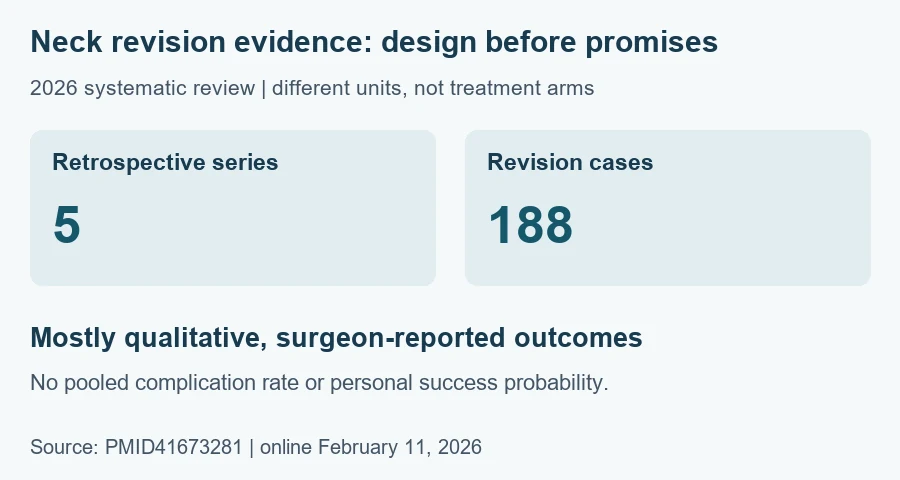
The systematic review published online February 11, 2026 found five retrospective series comprising 188 revision cases. Outcomes were largely qualitative and surgeon-reported; standardized objective or patient-reported measures were uncommon. The studies were heterogeneous, and complications were described without pooling. These findings make the review useful for understanding the evidence boundary, not for calculating a dependable percentage chance that your particular concern will improve.
The original graphic below therefore connects study design, case count and outcome reporting. Five is the number of included series, and 188 is the number of revision cases across them. These are different units, not treatment arms. Neither count is the number of successful results. The graphic intentionally supplies no success bar, risk ranking or comparison between techniques because the review does not establish those conclusions.
| Evidence item | Actual reported unit | Appropriate interpretation |
|---|---|---|
| Included studies | Five retrospective series | A small observational evidence base |
| Included cases | 188 revision neck lift cases | Selected cases in those series, not all people with prior surgery |
| Outcome reporting | Mainly qualitative and surgeon-reported | Limited standardized measurement of the patient experience |
| Complication synthesis | Descriptive; no pooled estimate | No personal risk calculator or demonstrated zero-risk conclusion |
An absence of a particular event in a small, inconsistently reported collection is not proof that the event cannot happen. Likewise, a photograph showing improvement does not measure every patient’s satisfaction or durability. Ask how the surgeon will describe both benefit and harm in your consent discussion when the literature cannot provide a robust, directly applicable number. Acknowledging that limitation is part of informed assessment, not a reason to substitute an unsupported percentage.
Does an older revision series show when another operation is needed?
The historical 2016 secondary-neck-lift series reported 101 secondary or revision patients within the authors’ experience of 1,089 neck lifts. Those selected practice records are not a population survey. They do not show that every neck lift has a particular revision probability or that every result expires on a predictable schedule. This is especially important when a study mixes people whose original procedures were performed in different circumstances or settings.
A reported interval in a historical group also cannot become a personal countdown. Your concern might relate to persistent anatomy, a scar, later changes or an expectation that needs clarification. Timing alone does not explain which applies. Ask why the proposed intervention is appropriate for your assessed situation now, and what the clinician expects if you choose continued observation. A reasoned comparison of the available choices is more useful than an assumed deadline.
Neck lift revision discussions should distinguish durability from satisfaction at one visit. Ask when outcomes were assessed, how satisfaction was recorded and whether longer follow-up was available. If a practice presents only selected early photographs, those images cannot establish how every result changes over time. You can request relevant examples and their context without treating other people’s images as a promise about your own anatomy or healing.
Choose a defined goal before choosing the extent of treatment
The ASPS neck-lift overview describes surgery addressing selected jawline and neck aging concerns and notes that surgery does not stop aging. That general scope is not a revision-specific guarantee. A returning or persistent concern requires an individualized assessment, particularly after previous treatment. Do not assume that a larger operation necessarily provides a better answer or that the smallest-sounding intervention will be sufficient.
Ask the surgeon to distinguish the main target from optional additions. If the explanation includes the lower face, scar work or another procedure, request a description of what each addition contributes. This makes it possible to evaluate the proposed scope rather than accepting an all-or-nothing bundle. Ask whether omitting an addition changes the achievable goal, the assessment or the recovery arrangements. The answer should concern your findings, not the popularity of a combined package.
For neck lift revision, success should be described in terms you can revisit. A goal such as improving an assessed contour while accepting residual asymmetry is more concrete than looking younger. Ask how the team will document the starting concern and evaluate the result later. Standardized photographs and a written description can support that discussion, but they should not replace your own account of satisfaction or imply that every aesthetic judgment can be reduced to a measurement.
Discuss risk and recovery as part of the decision
The ASPS neck-lift safety page identifies surgical risks including bleeding, infection, healing difficulties, sensation changes, nerve injury and unsatisfactory appearance. It is general educational information, not a rate estimate for revision surgery. Ask which issues are particularly relevant to your assessed plan and previous treatment. Obtain the surgeon’s explanation of how uncertainty affects the consent discussion rather than borrowing a percentage from an unrelated primary-procedure advertisement.
The ASPS recovery page describes individualized instructions and follow-up. Arrange to receive your own written plan from the treating team. Do not reuse an old plan merely because you have had neck surgery before. The extent of treatment, your circumstances and the surgeon’s instructions may differ. Clarify who to contact, how routine questions are handled and where urgent concerns should go when the office is closed.
Neck lift revision planning also needs a realistic account of practical support. Discuss transport, help at home, work demands and attendance at follow-up. These are planning questions, not a substitute for medical clearance. Avoid assigning yourself a return-to-driving or exercise date from another person’s experience. A job requiring physical effort, public appearance or travel may create different practical concerns; explain those tasks to the team so the plan addresses what you actually do. For a separate discussion of recovery tasks and questions after that procedure, see neck lift recovery.
Compare consultations using the same decision record
Create a single page containing your concern, prior records, stated priorities and unanswered questions. Use it at each consultation. This makes disagreements easier to identify and prevents the conversation from changing every time a new technique name is introduced. Record what the surgeon actually assessed, which benefit was described, what remained uncertain and whether further information was requested. Do not convert a cautious explanation into a stronger promise when summarizing it afterward.
| Neck lift revision decision record | What to write down | Why it helps |
|---|---|---|
| Main concern | One observable change and its chronology | Keeps the goal consistent across consultations |
| Assessed explanation | The clinician’s findings and stated uncertainty | Separates observation from diagnosis |
| Proposed scope | Included work and optional additions | Makes differently sized plans comparable |
| Expected improvement | A specific benefit and accepted limitations | Supports a meaningful consent discussion |
| Follow-up and support | Written contact arrangements and planned reviews | Avoids assuming an old recovery plan still applies |
| Financial scope | Itemized included services and unresolved charges | Prevents a quoted fee from standing in for a complete plan |
A revision policy is a financial arrangement, not a clinical recommendation. A waived surgeon fee may leave other services chargeable, and an offer of another operation does not establish that it is appropriate. Ask for the terms in writing and keep them separate from the assessment of benefit and risk. This allows you to consider the medical decision on its own merits rather than interpreting a discount as evidence of necessity. Use the neck lift cost worksheet to organize that procedure’s quoted services and financial assumptions separately.
Which photographs help a neck lift revision consultation?
Choose photographs that document the concern rather than photographs selected only because you dislike them. Note the approximate date and whether they were taken before surgery, during recovery or after an interval of satisfaction. Describe different lighting or head position when those conditions change the appearance. Consistent photographs can make a question clearer, but cannot establish the cause of a contour change or replace examination. Avoid using a single close-up to decide which internal structure should be treated.
For a neck lift revision consultation, consider writing a short caption beside each relevant photograph: the change you see, whether it is also noticeable in ordinary circumstances, and what you want the clinician to explain. Keep the description factual. If you are comparing a before-and-after pair, identify differences in angle rather than treating them as proof of improvement or deterioration. The surgeon can then explain what additional documentation is needed.
Ask how the team will capture and store assessment photographs and who may use them. Consent to clinical documentation and consent to public marketing are different decisions to clarify with the practice. For neck lift revision, a useful photographic record supports an agreed treatment goal and subsequent review; it should not pressure you to consent to another operation or to let your image become an advertisement. You can request an explanation of the documentation process before making either decision.
When is continued observation a meaningful alternative?
An additional operation should have a defined purpose. If the cause of your concern is uncertain, the anticipated improvement is small, or the tradeoffs conflict with your priorities, ask what continued observation would involve. Observation should be explained rather than presented as abandonment. It can include obtaining records, reassessment of a specific unresolved finding or revisiting the goal after an agreed interval, as determined by your clinician.
Before deciding, identify the question that still prevents a choice. It might be whether the proposed scope addresses the concern, whether the expected change is worth another recovery, or whether you understand the uncertainty well enough to consent. Neck lift revision is easier to evaluate when that question is explicit. The useful endpoint is a documented, understandable decision with a follow-up plan, not simply a booking date.
Sources and update record
Sources checked October 12, 2026. Organization pages below are undated educational resources; their check date is not a publication year. Study findings describe their own designs and populations. This guide has no claimed human or clinical review.
| Source | Observed date | Scope |
|---|---|---|
| 2026 systematic review of revision neck lift | Online February 11, 2026 | Five retrospective series, 188 cases; limited outcome measurement |
| 2016 secondary neck lift series | April 2016 issue | Selected historical practice experience; not personal durability odds |
| Revision facelift and neck lift narrative review | Online June 8, 2021; May 2021 issue | Evaluation after previous facial and neck surgery |
| ASPS neck lift scope | Undated | General indications and limits of neck surgery |
| ASPS neck lift safety | Undated | General risk discussion, no revision-specific rates |
| ASPS neck lift recovery | Undated | Individual instructions, contact questions and follow-up |
Sources and review scope
Plastic Surgery Editorial Team. Source records checked through October 12, 2026. Review scope: source and editorial checks for general education. No individual clinical assessment is represented.
- Revision neck lift review: evidence design and reporting. pubmed.ncbi.nlm.nih.gov. Source date: 2026-02-11. Checked 2026-10-12.
- Secondary neck lift: historical selected practice series. pubmed.ncbi.nlm.nih.gov. Source date: 2016-04. Checked 2026-10-12.
- Narrative review of revision facelift and neck lift. pubmed.ncbi.nlm.nih.gov. Source date: 2021-06-08. Checked 2026-10-12.
- ASPS neck lift: scope and aging limits. plasticsurgery.org. Publication/update date not stated. Checked 2026-10-12.
- ASPS neck lift: general surgical risks. plasticsurgery.org. Publication/update date not stated. Checked 2026-10-12.
- ASPS neck lift: individual instructions and follow-up. plasticsurgery.org. Publication/update date not stated. Checked 2026-10-12.