
Neck lift cost should be compared using the exact proposed operation, all billing entities and a feasible follow-up plan. The ASPS page displays a $7,885 partial average, checked October 12, 2026; it excludes anesthesia, operating facilities and related expenses and does not state the underlying fee year. Your complete quotation needs those charges plus any practical costs of receiving care away from home. A lower treatment amount can become a higher known planning amount once travel and follow-up are included.
This guide uses an original hypothetical worksheet to show that difference without recommending travel or a shorter stay. Clinical suitability, the proposed operation, the permitted setting and the follow-up arrangement must be discussed with the treating clinician. The example numbers are US-dollar accounting inputs, not observed practice prices, a national range or a prediction of your recovery. Their value is that every assumption is visible and can be replaced by an actual written answer.
What is included in the society neck lift cost figure?
The ASPS neck lift cost page displays $7,885 while expressly excluding anesthesia, operating facilities and related expenses. It describes fee variation with experience, procedure and location. The average therefore belongs in a context column rather than serving as your complete budget. Its retrieval date does not identify the year of the underlying fee observations, and the page does not supply the missing amounts for your operation.
Ask the office whether its neck lift cost quotation includes a facility, anesthesia provider, tests, prescribed items and scheduled reviews. Some may be separate bills. Record the billing entity and the amount or estimate for each rather than assuming that a single package number covers everything. If a charge is unresolved, mark it unknown and ask who can provide the answer. An incomplete subtotal should remain visibly incomplete.
Do not create an all-in national price by adding guessed averages to the published figure. Likewise, do not judge a quote by how closely its professional amount matches that average. A statistic cannot confirm identical operative scope, identical terms or appropriate follow-up. The individualized written proposal is the evidence for the transaction you are actually considering; the society figure provides narrower context.
Does a neck lift cost quote identify the actual proposed work?
The ASPS procedure description explains that neck lift surgery can involve different incision approaches and work on fat, underlying tissues, muscle and skin. It also notes that a limited-incision approach can have more limited results. This educational scope does not select a technique for you. It shows why a marketing label alone cannot establish that two prices cover the same operation.
Have the clinician describe the intended scope in terms you understand. Ask whether the quote concerns the neck alone, includes any separately named facial work, or includes another service that should have its own indication and consent discussion. Administrative terms such as mini lift or neck package may be used differently. Record the actual named proposal rather than trying to translate a promotional label into a universal procedure or price category.
If the plan changes after examination, obtain a revised quote. A more extensive proposal may carry different clinical tradeoffs and a different price; a cheaper limited proposal may address a different concern. Neither is a like-for-like comparison until the clinician has explained the difference. Financial arithmetic can expose an inclusion gap, but it cannot decide whether a particular anatomical concern requires the proposed operation.
| Neck lift cost comparison field | Written evidence | Why it matters |
|---|---|---|
| Exact operative scope | Clinician-confirmed named proposal | A limited or combined package may be a different service |
| Treatment bills | Professional, facility, anesthesia and exclusions | Partial fees cannot be compared with complete quotations |
| Location and follow-up | Where reviews and concerns are handled | Travel changes both practicality and cash requirements |
| Quote conditions | Expiry, deposit and change-of-plan terms | An early estimate may not remain valid after assessment |
Why can location change the neck lift cost comparison?
Location affects more than an airfare line. Ask where scheduled reviews will occur, whether you need to remain nearby, when travel is considered appropriate for your plan and how concerns would be handled after returning home. These answers require the clinical team. Do not use the cheapest hotel arrangement or an assumed rapid return to construct a favorable price comparison before those questions have been resolved.
A local option can also involve transport, help at home or another visit, so it should not automatically receive zero practical costs. Use your actual circumstances and the clinician’s instructions. Separate costs that are genuinely different between locations from those that occur in both. This avoids exaggerating travel expenses while still making visible the additional commitments of receiving care farther from home.
The ASPS consultation guidance describes individualized discussion of health, goals, options, risks and anesthesia. Use that assessment to establish the plan before shopping for a financial workaround. An inexpensive away-from-home quotation is not automatically suitable, and a more expensive local quotation is not automatically safer. The worksheet measures known cash differences, not clinical quality or permission to travel.
Original neck lift cost worksheet: treatment savings versus travel
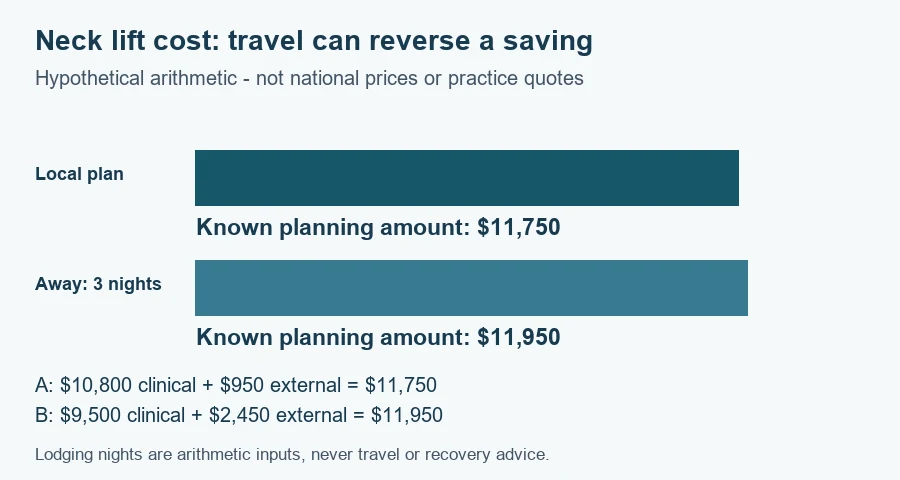
Imagine two hypothetical offers for a clinician-confirmed equivalent scope. Scenario A is local and has a complete clinical amount of $10,800 under its written inclusions. We add $100 for specified external supplies, $250 for transport and $600 for practical support. The known planning amount is $11,750. We assume the scheduled follow-up arrangement has no separate treatment charge beyond that complete clinical amount; a real quote needs to confirm this.
Scenario B is away from home and has a lower complete clinical amount of $9,500. Its hypothetical external planning amounts are $100 for supplies, $500 for initial travel, $600 for practical support and $350 for a separately budgeted return trip. We also assign $300 per lodging night. Those inputs do not establish how many nights anyone should remain nearby. The permitted arrangement and actual required visits must come from the treating team.
At three hypothetical lodging nights, B includes $900 of lodging and reaches $11,950. That is $200 above A despite its clinical amount being $1,300 lower. The original chart compares these known planning amounts under the stated assumptions. It does not show actual market prices or prove that travel is unwise. It shows that a treatment-price saving and a complete cash saving are different results.
| Hypothetical neck lift cost worksheet | A: local | B: away, three example nights |
|---|---|---|
| Complete clinical amount within the confirmed scope | $10,800 | $9,500 |
| Supplies and practical support | $100 + $600 = $700 | $100 + $600 = $700 |
| Initial transport and separately budgeted return trip | $250 | $500 + $350 = $850 |
| Lodging | $0 under this scenario | 3 × $300 = $900 |
| Known planning amount | $11,750 | $11,950 |
The equation for B is $11,050 plus $300 multiplied by the number of lodging nights. At two hypothetical nights the result is $11,650, which is $100 below A. At three it is $11,950, which is $200 above. The arithmetic threshold is $700 divided by $300, or about 2.33 nights; actual lodging is usually booked in whole-night units under its contract. This threshold is purely financial and must never be used to shorten a clinically required stay.
If the actual plan requires more nights or more visits, replace those inputs. If a return review is included in the initial stay and the team confirms no separate planned return trip, remove the duplicated trip. If local transport is different, revise A as well. A useful neck lift cost worksheet remains responsive to the plan rather than selecting assumptions that make one location win.
How do you prevent a travel package from hiding exclusions?
Ask whether lodging and transport are paid to the practice or separate vendors, whether amounts are fixed and what happens if dates change. A package that includes a named number of nights may not include additional nights. An airport transfer may not cover transport to every review. Those are contract questions, not allegations about a particular practice. Get the actual terms before replacing your own planning amounts with a package inclusion.
Also distinguish a stated lodging inclusion from medical monitoring. A room reservation does not by itself establish who provides clinical care or how concerns are assessed. Ask the treating team about the care arrangement and the relevant contact pathway. Do not infer that an accommodation advertised as recovery lodging supplies a particular level of clinical service without a clear description and appropriate confirmation.
For date changes, ask which deposit applies to treatment and which applies to accommodation or transport. Different contracts may have different refund rules. Keep the vendors’ terms together but do not assume that a medical rescheduling decision automatically refunds every outside booking. If a cost is uncertain, retain it as unresolved rather than adding an unsupported probability-weighted amount to the chart.
How does follow-up affect neck lift cost after returning home?
Ask who handles routine reviews and whom to contact if a concern appears while you are away from the operating practice. Determine whether the team expects a return visit, whether remote contact is appropriate for any particular review and which expenses remain separate. These answers need to be specific to the plan. A website’s general promise of virtual follow-up does not establish that every assessment can safely occur remotely.
If another local clinician might be involved, ask how that arrangement would be organized and billed. Do not assume that an unrelated practice will provide included care because it is geographically convenient. An emergency or a developing concern deserves appropriate care; the financial worksheet is not a reason to wait for a cheaper visit or to travel without clinical guidance.
Keep scheduled follow-up travel separate from an uncertain additional episode. The example’s $350 return-trip input is a stated planning assumption, not a predicted complication bill. No individual complication likelihood or expected corrective surgery price is established here. A personal financial reserve may be sensible for your circumstances, but it should be labeled as your chosen contingency and kept out of claims about the known quoted total.
What if the quote combines a neck lift with a facelift?
A combined proposal needs its own scope and total. Do not add a national facelift average to the partial neck average, subtract a guessed facility saving and call the result a verified combined price. A complete combined quotation may share some charges while increasing others. Ask which services are included, which are separately priced and why the clinician recommends the proposed combination for your individual concerns.
For the financial decision, request the base neck-only proposal if that is a clinically appropriate option being discussed, plus the combined proposal and the incremental amount. That makes clear how much additional money the larger plan requires. It does not mean the options are clinically equivalent. If the clinician says one plan does not address your concern, record that limitation rather than presenting the cheaper number as the same result for less money.
Location calculations should follow the chosen scope. A combined proposal could have different follow-up and support requirements, so the original travel inputs cannot simply be carried forward unchanged. Ask the clinical team to revise the practical plan and the office to revise the quote. Keep the earlier worksheet as a dated version rather than mixing the smaller operation’s practical assumptions with the larger operation’s treatment amount.
How do deposits enter a neck lift cost plan?
A credited deposit is a timing item within the price, not an additional expense. Suppose a hypothetical $1,000 deposit is credited against a $10,800 clinical amount. The unpaid clinical balance is $9,800; the clinical total remains $10,800. Record when the balance is due and whether outside billers require separate payments. This avoids counting the deposit twice while still showing how much cash must be available on each date.
Ask what happens if examination, testing or another clinical consideration changes the proposal. A deposit transfer or refund depends on actual written terms, not on the reassuring description of a package. Save the terms that applied when you paid. If borrowing is involved, reconcile the financed balance with the credited deposit and compare the actual repayment obligation separately from the clinical and travel amounts.
How should a neck lift cost worksheet handle changing travel prices?
Record whether a travel amount is a purchased fare, a refundable reservation, a current estimate or an unanswered item. These are different levels of certainty. If airfare has not been bought, keep its quote date and conditions beside the amount. If lodging is booked, note taxes, cancellation terms and whether an extension uses the same nightly rate. The worksheet’s $300 rate is a hypothetical flat input; it does not establish how a real accommodation contract charges.
Use one change at a time when testing the total. If the away clinical amount stays $9,500 but the required lodging arrangement changes, revise only the lodging input and describe why. If the clinical proposal also changes, create a new scenario rather than suggesting that all of the difference came from travel. This makes the source of the revised amount understandable and prevents a price comparison from becoming a confusing mixture of old and new assumptions.
When a booking contains an included transport allowance, check whether it replaces the initial travel line, the return-trip line or neither. An included transfer between accommodation and the practice may leave airfare and a later return visit untouched. Deduct only the charge that is actually duplicated. A broad transport included phrase cannot justify deleting every travel expense from the worksheet without a defined service list.
Can a companion’s expenses change the neck lift cost comparison?
Ask the clinical team what practical assistance is needed for the specific plan, then price the arrangement you can actually provide. If a companion travels, distinguish their separate fare and accommodation needs from your own. If a shared room has no extra charge, do not invent a second room expense. If their work absence creates a real income loss, record that personal amount separately from the treatment bill.
This avoids two opposite errors: treating help as automatically free and counting every shared expense twice. The example’s $600 support input is only a stated planning assumption. It is not a recommendation for paid care, a universal caregiver requirement or a market rate. Replace it with the arrangement agreed with the team and the actual personal costs before using the model to compare locations.
Before choosing: a neck lift cost and location checklist
| Checkpoint | Confirmed input to use | Keep unresolved if missing |
|---|---|---|
| Matching scope | Actual named operative proposal | Different limited or combined services |
| Complete clinical bill | All included entities and charges | Outside facility or anesthesia amount |
| Practical location plan | Team-confirmed visits and travel guidance | Assumed early departure or remote review |
| Cash timing | Credited deposit and separate booking terms | Refund or transfer rule not documented |
The most useful neck lift cost result is a documented treatment amount linked to a practical care arrangement. The partial society average cannot supply that plan. The worksheet makes the travel threshold explicit while preserving the clinician’s authority over care and travel. Use the neck lift guide for procedure context and keep financial questions alongside, rather than in place of, an individual consultation.
Sources and review scope
Plastic Surgery Editorial Team. Source records checked through October 12, 2026. Review scope: source and editorial checks for general education. No individual clinical assessment is represented.
- ASPS neck lift partial fee and exclusions. American Society of Plastic Surgeons. Publication/update date not stated. Checked 2026-10-12.
- ASPS neck lift operative scope. American Society of Plastic Surgeons. Publication/update date not stated. Checked 2026-10-12.
- ASPS individualized neck lift consultation. American Society of Plastic Surgeons. Publication/update date not stated. Checked 2026-10-12.