
Facial feminization surgery cost depends on the actual procedures proposed, their related expenses and the exact parts your health plan has confirmed. Do not apply a covered-service payment percentage to an entire mixed quote automatically. Ask for task-specific scope and a written financial breakdown separating covered, excluded and unresolved components. This guide provides an original hypothetical worksheet showing why partial coverage can leave a substantially different personal total from a simple percentage of the headline bill. For comparing contract obligations and financing costs, see plastic surgery financing.
No verified national complete facial feminization surgery price is supplied here. The same umbrella name can describe different assessed combinations and stages. All dollar figures below are invented arithmetic examples, not market quotes, personal coverage determinations or recommended procedures. Your own goals, assessment and clinical options belong with a qualified treating team. The financial record should describe that individualized proposal, rather than imposing a standardized face or a shopping list of treatments.
What does facial feminization surgery cost cover?
The American Society of Plastic Surgeons describes facial feminization as an individualized set of procedures that may occur in one or several stages. The proposed work can address different facial structures. That overview explains why scope varies, not why every person needs every listed procedure. Start your financial comparison with the clinician’s actual proposal and your priorities. Record which tasks are planned, which are optional alternatives and which remain undecided after assessment.
A facial feminization surgery cost quote should identify the professional work and relevant facility, anesthesia, imaging, medication or other related categories. ASPS lists these kinds of expenses in its cost guidance without giving a numeric national average. The presence of a category on a general list does not mean it must be billed separately in your case. Obtain the specific inclusion statement and identify the billing organization responsible for each amount.
Use the exact names from the proposal when asking for estimates. An umbrella package label may hide whether one task is included, an alternative or a separate charge. If a written quote changes, keep a task revision log alongside the new amount. A lower total after removing an assessed procedure is not a discount on the same clinical scope. Conversely, a descriptive allocation within a package is not necessarily an additional payable bill.
Why a single facial feminization surgery cost range misleads
An online total may omit anesthesia, facility charges or imaging, or may describe a different combination of work. Some figures are cash prices and others are submitted insurance charges or allowed amounts. Even when two totals are in the same currency, their denominators may differ. Before comparing them, identify the proposed tasks, related services, care setting, payment basis and known later work. If these are missing, a narrow-looking range offers less certainty than it appears to provide.
There is also a difference between the clinical course and the financial timing. A first-stage amount does not represent the whole planned course if another stage is already proposed and separately billed. However, a possible future adjustment is not automatically a mandatory stage to add today. Preserve the distinction between planned work and contingencies. A useful estimate labels its uncertainty rather than treating every possible future intervention as inevitable or pretending that no later expense could arise.
Do not infer a universal procedure count from someone else’s experience. Their priorities, anatomy, assessment, health circumstances and proposal may differ. Photographs or personal accounts cannot establish your billing scope or a clinically appropriate combination. The financial worksheet can compare assessed proposals with clearly stated differences. It cannot rank identities, define a required appearance or replace the discussion of individual goals and risks.
How partial coverage changes facial feminization surgery cost
ASPS notes that coverage can be limited to certain procedures or only part of the total fee. That statement establishes a need for specific verification, not a coverage guarantee. Ask your plan about the actual proposed services and billing organizations, and obtain the relevant response in writing. A general gender-related benefit statement or an approval for one task does not answer every component in a combined quotation.
Separate the payer’s coverage determination from the amount used to calculate responsibility. A submitted charge is not automatically the allowed amount for a covered claim. For uncovered components, the payable basis may require a different confirmed arrangement. Do not assume an insurer’s discount applies to excluded work. Keep unclear amounts in an unresolved column until the billing organization and plan explain which basis is actually relevant.
For a mixed proposal, classify each financial component as confirmed covered under stated terms, confirmed outside the modeled benefit or unresolved. This classification concerns the benefit response, not whether a procedure is necessary, worthwhile or appropriate. A task’s coverage status does not determine your goals or clinical suitability. Discuss the proposal with the treating team and resolve benefits using your actual plan, without interpreting a financial table as individual medical advice.
| Component record | Obtain a written answer | Do not substitute |
|---|---|---|
| Assessed professional tasks | Exact planned work and inclusion boundaries | A generic umbrella procedure name |
| Facility and anesthesia | Actual billing entities and scope allocation | Coverage confirmation for the surgeon alone |
| Imaging or preparation | Clinically requested items and billing basis | An assumed universal testing package |
| Benefit classification | Covered, excluded or unresolved component | A blanket percentage applied to every charge |
| Personal arrangements | Actual assistance, travel and payment timing | A clinical claim total presented as complete outlay |
Original facial feminization surgery cost worksheet: mixed scope
Consider an invented multi-component clinical proposal whose applicable financial amounts total $30,000. The example deliberately leaves procedure labels generic: the clinical task selection is outside this worksheet. Assume $15,000 relates to components confirmed eligible under the modeled benefit and $15,000 relates to components explicitly outside that benefit. For simplicity, assume the eligible amount has no remaining deductible, a 20% patient share and no applicable cap interaction in this calculation.
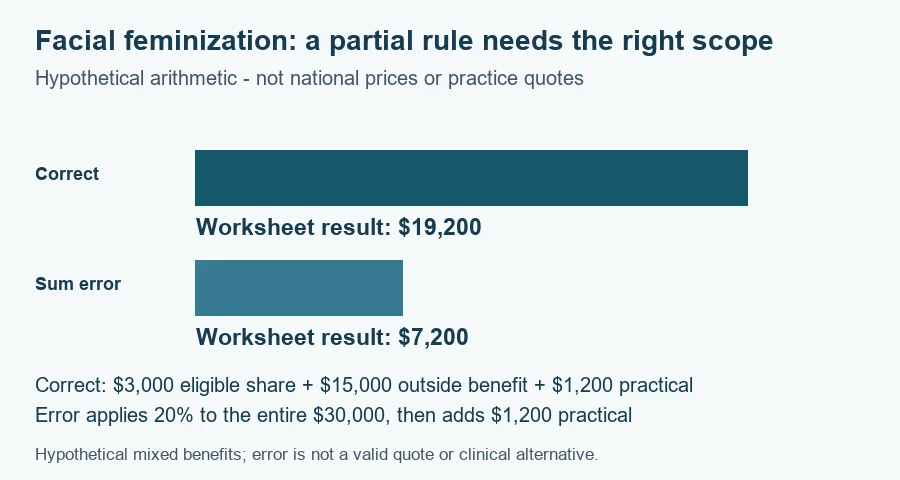
The eligible $15,000 is broken into $9,800 professional work, $3,000 related facility services and $2,200 related anesthesia services. At 20%, these create $1,960, $600 and $440 respectively, totaling $3,000 of patient responsibility. The other $15,000 is assumed payable in full by the patient under the stated hypothetical arrangement. Combined clinical responsibility is therefore $18,000. This is not a claim that any particular procedure will have either classification.
The counting error is to multiply the whole $30,000 by 20%, producing $6,000. That wrongly assigns the eligible payment rule to the $15,000 outside the modeled benefit. The $12,000 understatement comes from paying only $3,000 on that excluded amount instead of the assumed $15,000. Neither the total quotation nor the 20% rule is enough information by itself; the scope to which the rule applies is essential.
| Hypothetical responsibility | Correct mixed classification | Incorrect whole-quote percentage |
|---|---|---|
| Eligible component denominator | $15,000 | Mistakenly treated as $30,000 |
| Patient share on eligible components | $3,000 | $6,000 on the wrong denominator |
| Components outside modeled benefit | $15,000 | Incorrectly omitted as a separate full-pay amount |
| Clinical responsibility result | $18,000 | $6,000 |
| Same practical arrangements added | $1,200 | $1,200 |
| Complete worksheet result | $19,200 | $7,200 |
The $1,200 practical budget is another explicit assumption, composed of $700 travel and $500 assistance. It does not become an eligible clinical claim merely because the operation has some coverage. The chart contrasts the correct $19,200 personal-outlay calculation with the erroneous $7,200 result. The second bar is a counting error, not a second provider quote, a benefit promise or a valid lower-cost treatment alternative.
Recalculating facial feminization surgery cost when scope is uncertain
If a component has no confirmed benefit answer, keep it unresolved instead of automatically moving it into the eligible column. Obtain enough detail for the payer and billing organization to identify the proposed service and related charges. A more precise question is whether a named task and its relevant components were considered in the response, rather than whether the umbrella operation is covered. Preserve the response date and stated conditions alongside the quote.
For a second hypothetical calculation, suppose $4,000 of the original excluded amount is independently confirmed eligible under the same simplified 20% rule. That moves the eligible denominator to $19,000 and leaves $11,000 outside the modeled benefit. Responsibility becomes $3,800 plus $11,000, or $14,800 clinically. Adding the unchanged $1,200 practical budget gives $16,000. The $3,200 difference is caused by a changed explicit benefit classification, not a promised appeal result or surgeon discount.
If a deductible, copayment, applicable limit or different allowance changes the actual calculation, replace the model rather than adding a guessed adjustment. A simple worksheet cannot simulate every plan or claim interaction. Ask the insurer to verify the responsibility estimate for the actual components. The procedure-specific task list helps the questions become precise; it does not establish that all listed work can share one reimbursement rule.
What consultation adds to facial feminization surgery cost planning
ASPS describes consultation as a discussion of goals and medical history alongside examination, possible imaging and assessment of options and risks. That process helps define the proposed course before a price comparison becomes meaningful. It does not prescribe a particular imaging test or technique for every reader. Ask which preparation is requested for your actual assessment, whether its financial estimate is available and whether it is already included in the surgical proposal.
Keep clinical alternatives separate in the financial record. If two assessed approaches have different tasks or sequences, use separate columns labeled with those differences. Do not add the costs of mutually exclusive alternatives as though all will occur. Likewise, do not treat a preferred appearance or an example photograph as a guaranteed result. The surgeon’s discussion of limitations and suitability should guide the proposal; the worksheet only organizes its financial scope.
When a quote is prepared before the final task list, mark it provisional and ask what could change. Record which assumptions depend on examination, imaging or further discussion. A revised price may reflect a revised proposal rather than unexplained price inflation. Preserve the earlier version so the difference can be traced. This supports an informed conversation without demanding that a preliminary estimate predict details that have not yet been assessed.
Comparing facial feminization surgery cost across proposals
Build a common comparison record with the assessed professional tasks, relevant related categories, known stage count, payer response and personal arrangements. Then show differences explicitly. If one estimate includes facility charges and another excludes them, obtain the missing amount before presenting either as the complete total. If a later stage is already proposed, include its actual estimate or label it unresolved. Do not silently make an initial bill compete against a complete course.
For a mixed-insurance comparison, apply each proposal’s confirmed benefit terms to its appropriate denominator. Two surgeons’ cash quotations cannot establish those terms, and a broad insurer website description cannot establish the responsibility of every specific claim. If a submitted amount differs from an applicable allowance, keep both figures and their roles visible. Avoid describing an administrative adjustment as a cash discount unless the actual written arrangement supports that statement.
Payment timing belongs in another column. A smaller deposit may improve immediate cash needs without lowering the final obligation. If reimbursement is expected later, record the required advance amount separately from the modeled final outlay. Confirm the actual arrangement before subtracting assistance, credits or reimbursement. An anticipated benefit is not money already available, and nothing in this example guarantees its eligibility or timing.
| Comparison question | Useful record | What it prevents |
|---|---|---|
| Are the tasks the same? | Named inclusions and alternatives | Comparing different proposals as identical operations |
| Are related charges included? | Facility, anesthesia and requested preparation | Treating a professional fee as complete cost |
| Which components have confirmed benefits? | Dated task-specific classifications | Applying one payment rule to every amount |
| What must be paid when? | Advance collection and reimbursement assumptions | Confusing cash timing with a lower final obligation |
| What remains unresolved? | Named missing estimates or responses | Hiding unknown amounts inside a confident total |
Tracking facial feminization surgery cost after an estimate changes
Give every revised estimate a date and a brief explanation of changed scope, allowance, benefit classification or practical arrangements. When a clinical task is added or removed, update the corresponding related expenses rather than assuming those charges stay identical. Obtain the billing organization’s revised estimate where necessary. The patient’s financial spreadsheet should reflect verified information, not extrapolate operating time, anesthesia or facility prices from a procedure count.
Track deposits as payments credited to an account, not as additional services. If a $2,000 advance collection is applied to a final $18,000 clinical responsibility, the remaining modeled amount is $16,000 and the total remains $18,000. Confirm which billing entity received the collection and which account it was applied to. Applying the same deposit to several claims would create an artificial reduction, just as counting it as a second service would inflate the total.
Compare processed statements with the written scope and payer records. If a component’s benefit status or stated responsibility appears different from the estimate, request an explanation with the relevant documents. A disagreement belongs in an unresolved row while it is investigated. The worksheet cannot determine contractual liability, medical necessity or the outcome of an appeal. It creates a traceable record of the assumptions and the specific question needing resolution.
A practical facial feminization surgery cost checklist
Before treating a number as a complete estimate, confirm the assessed task list, related components, intended sequence and actual payment basis. Obtain the payer response for the named proposal and preserve unresolved classifications. Keep practical expenses separate, record when advance payments are required and recalculate when verified information changes. This produces a useful decision record even when no reliable national average or final coverage answer is available.
The original worksheet demonstrates one narrowly defined accounting problem: a partial benefit rule must not be applied to excluded components automatically. It does not recommend additional work, favor a particular combination, promise coverage or define a required appearance. Financial clarity supports discussion of your own priorities and assessed options. The clinical team and actual plan must resolve the individual questions that a general educational guide cannot answer.
For facial feminization surgery cost estimates spanning several professional tasks, ask how any shared facility or anesthesia amount was allocated in the benefit request. Do not divide it equally among tasks yourself and present that division as a payer-approved allowance. The billing organization and plan may require information that a task count alone cannot provide. A mathematically neat split is still an invented classification unless the relevant parties confirm it.
If the professional estimate is described as a package, also ask whether its task breakdown identifies payable amounts or simply explains inclusions. Preserve the actual total and classification supplied. An explanatory breakdown should not become several additional invoices in your spreadsheet. These questions make a facial feminization surgery cost comparison more accurate without assuming either that every component shares coverage or that every descriptive line creates a separate charge.
Sources and scope
ASPS facial feminization cost scope, ASPS individualized procedure overview and ASPS consultation scope were inspected October 12, 2026. Underlying publication dates are unspecified in these records. No national complete price, actual benefit allocation, treatment combination, patient identity, outcome or individualized clinical clearance was established.
Sources and review scope
Plastic Surgery Editorial Team. Source records checked through October 12, 2026. Review scope: source and editorial checks for general education. No individual clinical assessment is represented.
- ASPS facial feminization expense and benefit scope. American Society of Plastic Surgeons. Publication/update date not stated. Checked 2026-10-12.
- ASPS individualized facial task scope. American Society of Plastic Surgeons. Publication/update date not stated. Checked 2026-10-12.
- ASPS assessment before a final task quote. American Society of Plastic Surgeons. Publication/update date not stated. Checked 2026-10-12.